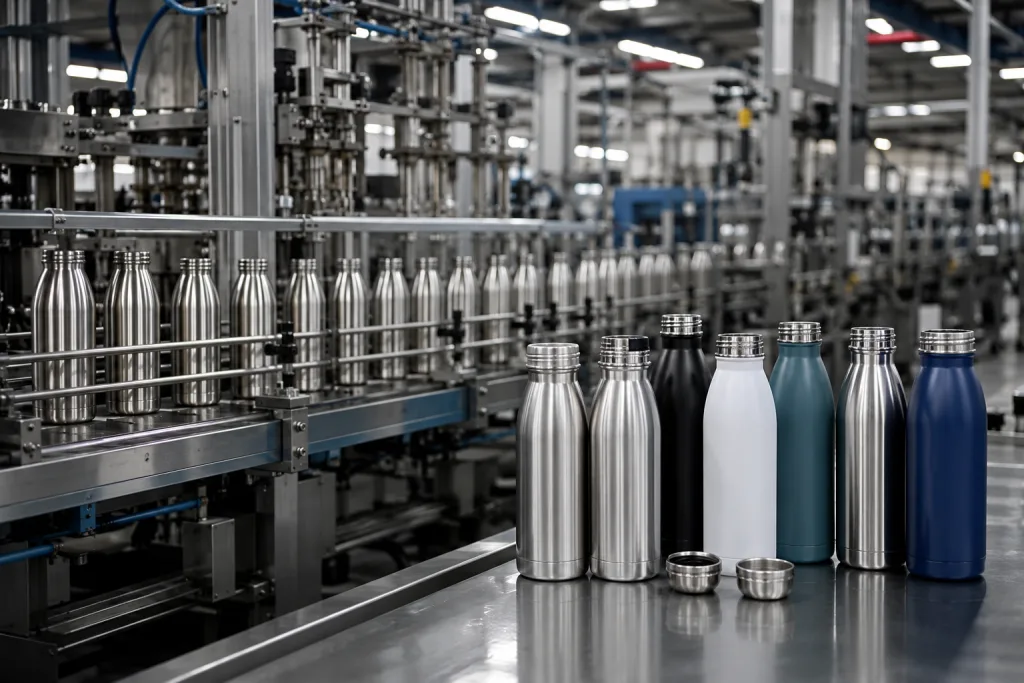
Key Takeaways
- Typical MOQ for factory water bottles is 1,000-3,000 pcs per SKU, with stock-color models sometimes starting at 500 pcs
- FOB China unit prices often land at USD 1.20-2.80 for single-wall bottles and USD 2.90-6.80 for vacuum stainless models
- Custom logo lead time is usually 12-20 days; fully customized canteen projects with molds need 35-60 days
- Decoration, lid design, and packaging can add 8%-35% to unit cost before freight and duty
You can get a quote for factory water bottles in ten minutes. Getting one you can place a PO against is harder. The gap sits in small items buyers miss on the first RFQ: steel grade, lid structure, print method, carton spec, and whether the factory quoted a stock bottle or a true custom canteen. We’ve seen this go sideways over a 0.3 mm wall change or a typo on the PO cap color. If you buy for retail, promo, or distributor channels, this is the part that decides whether the landed cost holds or the margin gets squeezed.
Buyers in Europe and North America usually ask the same two questions first: what will it cost, and when can it ship? Fair questions. At BottleForge Industrial in Zhejiang, we run about 450,000 units per month, and most factory water bottles land in a practical MOQ band of 1,000 to 3,000 pieces per SKU. QC pulled the sample more than once because the buyer flagged “same as approved” while the logo file had changed by 2 mm. The numbers below are the ranges you should expect from a serious canteen manufacturer or canteen supplier in China. Asking for the lowest quote first is the wrong question. Ask what is included.
What Moves the Price Most
If you are comparing quotes from a canteen factory, a canteen vendor, and a canteen distributor, do not start with the final unit price. Start with the cost structure. This is the right question. For factory water bottles, price moves most on material, construction, lid assembly, decoration, and packaging. Everything else sits behind those five. On our line, the first thing we check is the BOM, not the headline FOB.
Material first. For stainless items, 18/8 stainless steel, also called SUS304, costs more than lower grades but is the standard for export custom drinkware in Europe and North America. A basic 500 ml single-wall SUS304 bottle with 0.4 mm body thickness may quote at USD 1.20-1.90 FOB Zhejiang, China at 3,000 pcs. A 500 ml double-wall vacuum bottle in SUS304 inner and outer, often 0.4 mm outer and 0.35-0.4 mm inner, usually lands around USD 2.90-4.80 FOB at the same volume. Add copper plating for better heat retention and you may add USD 0.12-0.25. We measure wall thickness with an ultrasonic gauge, and QC will catch it fast if a supplier tries to slip 0.32 mm inner instead of 0.4 mm. We have seen that before. The quote looked good. The math did not work.
Lid complexity matters more than new buyers expect. A simple PP screw lid with a silicone seal is cheap and stable. A flip straw lid, carry loop, metal cap insert, or two-component assembly can add USD 0.18-0.75 per unit depending on tooling and yield. For a customizable canteen targeted at sports retail, lid failure rates are often a bigger commercial risk than the body itself, so cheaping out here is a false economy. Buyer pushback usually starts after a drop test or leak test, not at PO stage. We run 1.2 m drop tests on sample sets, and weak hinge pins show up fast.
- Decoration: one-color silk screen may add USD 0.05-0.12; laser engraving USD 0.08-0.20; powder coating USD 0.28-0.65; wrap printing more. On powder coat jobs, coating thickness matters. If the line runs thin at 45 μm instead of 60 μm, the buyer flagged scratches after transit.
- Packaging: standard white box can be under USD 0.12; custom gift box can run USD 0.45-1.20. Carton spec gets ignored too often. A 5-ply export carton and a 7-ply carton do not cost the same, and we have seen 3A drop test failures from cartons that looked fine on paper.
- Testing and compliance: REACH, LFGB, FDA-contact declarations, or ASTM-related testing adds cost, but usually less than a failed shipment. QC pulled the sample on one order because the PO typo listed “LFBG” instead of LFGB, and the buyer’s document team still held the file for 2 days.
If one canteen manufacturer is 20% below the market, ask what has been removed. It is usually steel grade, coating thickness, inspection level, or carton strength. Sometimes it is vacuum yield. Sometimes it is no spare lids packed against a 2% defect allowance. We ship enough of these to say it plainly: a low quote is not a win if the claim rate lands after delivery.
Real MOQ Tiers Buyers See
MOQ is not one number. It shifts based on what you buy: a stock item, a semi-custom canteen, or a fully customized canteen design. Buyers hear “1,000 pcs MOQ” and assume it covers any color, any lid, any print, and custom packaging. It doesn’t. We see this on the line all the time: the PO says “matte black + flip lid + gift box,” then sales has to explain that 1,000 pcs only covers the stock bottle with a standard carton.
For stock-shape factory water bottles from a canteen supplier in Zhejiang, China, the practical tiers usually look like this:
- 500 pcs: possible for selected stock colors, one logo, standard carton. Choice is tighter and unit price is usually 8%-15% above the 1,000 pc tier. QC pulled the sample last month on a 500 pc run, and the buyer had only 3 powder colors to pick from because the coating line was already booked.
- 1,000 pcs per SKU: common entry level for custom logo orders. Good fit for canteen promotional projects, pilot retail runs, and smaller canteen distributors. This is where we run most silk-screen logo orders, usually with one print position and no carton change.
- 3,000 pcs per SKU: where pricing becomes more competitive on coating, mixed decorations, and custom inserts. At this level, the math starts to work because setup waste on the spray booth and screen plate gets spread across more units.
- 5,000-10,000 pcs: where a canteen manufacturer may negotiate packaging upgrades, dedicated color matching, or partial tooling support. This is also where buyers start asking for Pantone matching, drop-test targets, or an EVA insert instead of a plain divider.
For a true custom canteen, customizable growler, or customized growler with a new body shape, base, shoulder, or lid geometry, tooling changes the picture. This is the wrong question to ask if you only ask for “MOQ” without asking what part is new. Blow mold or drawing-tool development can require 3,000-10,000 pcs depending on size and complexity. Tooling cost can range from USD 1,500 for a minor lid insert adjustment to USD 8,000-20,000 for more complete stainless body and plastic-part development. We’ve seen this go sideways when a buyer changes the shoulder radius by 2 mm and expects stock-tool pricing.
If you are a canteen distributor or distributor growler buyer serving multiple accounts, ask about mixed-color production under one SKU family. A lot of canteen manufacturers will allow two to four colors inside a 3,000 pc run if the same coating line and decoration setup are used. That gives you a cleaner demand test without paying retail-level pricing. If your supplier says every color needs its own MOQ, ask whether that is a process limit or just a quoting habit. We ship mixed-color runs like this every month, and the real limit is usually label control, carton marking, or whether the buyer flagged separate barcode labels for each color.
Unit Cost Ranges by Bottle Type
Below are working FOB ranges for factory water bottles exported from China. These are not fantasy online prices. They are B2B buying ranges we actually ship with ordinary packaging and standard AQL inspection, usually AQL 2.5 for major defects and 4.0 for minor unless otherwise agreed. On the line, QC pulled the sample against the golden sample before carton sealing.
Single-wall plastic or metal
Entry-level sports bottles in Tritan, PE, or aluminum usually start at USD 0.90-2.20, based on capacity, wall thickness, and lid style. A 500 ml PE bottle with a simple pull-top sits at the low end; a 750 ml Tritan bottle with a flip straw lid moves up fast. We ship these into canteen promotional programs and distributor canteen channels where landed cost matters more than insulation. Buyers ask for “cheap but retail-looking” all the time. Sometimes the math doesn't work.
Single-wall stainless steel
A 500-750 ml single-wall bottle usually runs USD 1.20-2.80 FOB. These fit gyms, events, and lower-price retail where buyers want the stainless look without paying for vacuum construction. One factory detail that shifts cost: body weight. A 500 ml bottle at 180 g is a different quote from one at 230 g, even if the silhouette looks almost the same in the drawing.
Double-wall vacuum stainless steel
This is the main volume item in custom drinkware sourcing. Typical 500 ml bottles run USD 2.90-4.80 at 3,000 pcs. Travel styles with handled lids, textured powder coat, or printed wrap can reach USD 5.20-6.80. Larger customizable growler or custom growler sizes, such as 1.2 L to 1.9 L, usually start around USD 6.50 and can exceed USD 10.50 depending on handle and cap assembly. We run a vacuum test on the line, and a bad seal rate of even 2 in 100 will get attention fast.
Decoration changes margins fast. A bare brushed bottle is one cost; a canteen customized for retail with Pantone powder coat, two-position print, barcode sticker, and color gift box is another. That package can add USD 0.60-1.60 per unit. We have seen buyers flag a 2 mm logo shift on a wrap print, so decoration is not a side issue. For Amazon FBA or big-box compliance, outer carton spec, drop-test tolerance, and FNSKU labeling also affect the final number.
For many buyers, the difference between a workable and unworkable program is not 30 cents on the bottle. It is whether the total pack-out cost was quoted honestly from day one.
If you are comparing a canteen vendor with a canteen factory, ask whether prices are FOB Ningbo or Shanghai, whether the quote includes desiccant, inner polybag, barcode label, and whether any mold or setup charge applies on first order only. This is the right question to ask. We have seen this go sideways over one missing line on a PO, even a typo in “inner box” quantity.
Lead Times Without Sales Spin
Lead time for factory water bottles comes down to one point: what are you changing? Buyers ask for “customized drinkware” all the time, then the PO shows a stock bottle with one logo print. That job usually runs 12-20 days if artwork is clean and the line already has coating capacity booked. A fully customized canteen is a different animal. New mold, new fit check, new risk.
Here is the practical timeline we use in Zhejiang when planning export orders:
- 1-3 days: quote confirmation, artwork review, Pantone check, and sampling plan. We also check logo size against the screen-print jig before we promise a date.
- 5-7 days: pre-production sample for stock bottle with logo. If the buyer flagged a metallic Pantone, QC pulled the sample under a light box first.
- 12-20 days: production for stock factory water bottles with standard logo and export carton, depending on quantity and coating load. For a 10,000 pcs run, this is normal if the bottle body is already on hand.
- 20-30 days: production if you add custom color boxes, multiple print locations, or complex lids. We have seen a 2 mm insert shift in the gift box hold the whole shipment.
- 35-45 days: semi-custom projects involving new lid color parts, insert cards, or small structure changes. This is where buyers often think “small change” means “small delay.” It does not.
- 45-60 days: fully canteen customizable projects with tooling, validation, and pilot run. On these jobs, the pilot run tells the truth, not the CAD drawing.
Transit is separate. Ocean freight from China to North Europe is often 30-40 days port to port; to the US East Coast 30-45 days; to the West Coast often 18-25 days. Then add origin handling, customs clearance, and drayage on both ends. We ship plenty of orders where factory production is 18 days and door delivery still lands past 50. If your launch date is fixed, work backward from shelf date, not ETD.
Ask your canteen supplier one blunt question: what part of this schedule is on the critical path? This is the right question. In a lot of orders, metal forming is not the problem. Powder coating slots fill up first, lid component supply slips, or custom packaging shows up with a typo on the PO and needs rework. A serious canteen manufacturer will tell you where the schedule can slip and how much buffer makes sense. In China, before summer and year-end gifting, the attractive schedule is often the wrong one. We have seen this go sideways too often.
Tooling, Samples, and Hidden Extras
First-time buyers fixate on unit price and miss the one-time charges. Then the math doesn’t work. On factory water bottles, the extras usually sit in four buckets: tooling, samples, compliance testing, and packaging setup. We see this on the line all the time, down to a PO typo that says “1 color logo” while the artwork file shows 2 spot colors.
For a stock model with a logo, sample charges are usually modest. You may see USD 30-80 for a printed sample, often refundable after order. For custom color matching on powder coat or plastic lids, sample costs can rise to USD 100-200 because line setup and material minimums are involved. QC pulled the sample and checked the powder coat chip under D65 light; if the buyer wants a tight match, that extra setup is real. If your project is a customized canteen with a new mold, sample development may include CNC proofing, 3D printing of lid components, or trial forming.
Tooling should be broken down clearly. This is the right question to ask early. A new silicone part may need only a small mold update, sometimes just a cavity revision on a 2-cavity tool. A new PP lid body can require a fresh injection mold in the USD 2,000-6,000 range. A new stainless body profile with base and neck changes can move much higher, especially if the neck diameter shifts by 2-3 mm and we need fresh forming checks. If you are a canteen distributor managing private-label programs, ask whether the tooling is exclusive, whether it can be amortized into unit price, and who owns it if annual volume is met.
Testing is another area where quotes drift. We’ve seen this go sideways when a buyer asks for a broad test package after sample approval instead of before PI signoff. For Europe, REACH and sometimes LFGB-related requirements can apply depending on material and market claim. For North America, FDA-contact compliance declarations and category-specific tests may be requested. If the bottle is for kids, ASTM-related expectations and stricter migration attention may apply. Budget USD 300-1,200 depending on test scope and lab, and check whether the lab is testing the full bottle or only the food-contact parts.
Do not ignore inspection. AQL final inspection before shipment is normal, and many buyers use AQL 2.5/4.0. If the order is for a distributor drinkware rollout with tight retailer penalties, third-party inspection in China is money well spent, often USD 250-400 per man-day. On a 10,000-piece run, that fee is cheap insurance if the buyer flagged carton drop resistance or found 1.5 mm logo shift on a pre-shipment sample.
How to Buy Without Margin Surprises
The safest way to buy factory water bottles is simple: freeze the spec before you squeeze the last 5% on price. An RFQ that says “500 ml vacuum bottle, custom logo” will pull back 6 quotes that look close on paper and miss by 0.15 mm on wall thickness, lid resin, or print method. We have seen this go sideways. Write the spec like your finance team and QC manager will both check it against the PO later.
- Body: define capacity tolerance, steel grade, wall thickness in mm, finish, and weight target in g.
- Lid: state material, color, seal type, leakproof requirement, and carry feature; the buyer flagged one PP lid last month because the handle pin sat 1.8 mm off-center.
- Decoration: give the Pantone reference, print size, print position, and rub-test expectation; QC pulled the sample after 50 wipes because the white ink started fading.
- Packaging: list inner bag, egg crate or divider, box type, carton drop requirement, and barcode labels; do not leave out carton mark details because one PO typo can hold a shipment.
- Quality: set AQL level, vacuum test rate, coating adhesion, salt spray if relevant, and leak test standard; this is where the line either runs clean or gets stuck in rework.
Ask every canteen supplier and canteen manufacturer the same commercial questions, word for word. MOQ per color. Sample lead time. Production lead time. FOB port. Payment terms. Whether BSCI, ISO 9001, or factory audit records are available. We ship cleaner programs when buyers do this. If you buy through canteen vendors or canteen distributors, ask who owns the technical claim if there is a leak or coating defect. This is the wrong question to skip.
At BottleForge Industrial in Zhejiang, China, we usually push buyers toward two-stage approval: first structure and finish, then packaging and labeling. It cuts rework. It keeps the line moving. On one 8,000-piece order, that split saved 12 days versus 18 days because we did not have to scrap printed gift boxes after a lid fit change. For custom growler, customizable growler, or customized growler projects, require seal-life testing and a drop-risk review before mass production. We run hinge-cycle checks and 1.2 m drop reviews for this class of bottle. A growler that looks good in a meeting but leaks in a car trunk is not a product; it is a returns program.
The buyer who gets the best result is usually not the one grinding hardest on unit price. It is the one who locks variables early, understands MOQ breaks like 1,000 vs 3,000 pcs, and gives the canteen factory a clean spec to build against. The math does not work any other way.
Get a costed factory water bottles quote
Send your target capacity, material, lid style, MOQ, and destination port. We will reply with practical FOB pricing, lead time, and sample options.
Frequently asked questions
What is the normal MOQ for factory water bottles with my logo?
For most stock-shape factory water bottles, 1,000 pcs per SKU is the standard starting point. Some canteen suppliers in China can do 500 pcs if you accept stock colors, one-position logo, and standard export cartons. If you want a custom lid color, gift box, or several colorways, 3,000 pcs is a more realistic tier for efficient production. Fully customized canteen projects with new molds usually need 3,000-10,000 pcs depending on whether the change is only a lid part or a new body profile. Always ask whether MOQ is per color, per logo, or per packaging style, because those are often different numbers.
How much do custom stainless factory water bottles usually cost?
A useful FOB China range is USD 1.20-2.80 for single-wall stainless bottles and USD 2.90-6.80 for double-wall vacuum stainless bottles. At 500 ml and 3,000 pcs, a plain vacuum bottle with a simple screw lid is often around USD 3.20-4.30 FOB Zhejiang. Add powder coating, laser engraving, a handled straw lid, and a custom color box, and the same bottle can move above USD 5.00. Larger custom growler sizes, usually 1.2 L to 1.9 L, often start around USD 6.50 and can exceed USD 10.50. Ask for pricing broken into bottle, decoration, packaging, and any one-time tooling or setup charge.
How long does production take for customized drinkware orders?
If you are using a stock model and only adding a logo, production is commonly 12-20 days after sample approval and deposit. Orders with custom cartons, several print locations, or more complex lids often take 20-30 days. Semi-custom projects, such as new plastic lid colors or insert changes, usually take 35-45 days. A fully customized canteen or customized growler with tooling, validation, and pilot runs often needs 45-60 days before shipment. Then add ocean transit: around 18-25 days to the US West Coast, 30-45 days to the US East Coast, and 30-40 days to North Europe. If your launch is fixed, build at least a 10-day buffer.
What hidden costs should I ask about before placing an order?
The usual hidden extras are sample charges, tooling, packaging upgrades, barcode labeling, compliance testing, and inspection. A printed sample may cost USD 30-80; custom color sample work can be USD 100-200. New lid molds often run USD 2,000-6,000, while more extensive body tooling can go much higher. Custom gift boxes may add USD 0.45-1.20 per unit versus a plain white box. REACH, LFGB, FDA-contact, or other lab testing can be USD 300-1,200 depending on scope. Third-party AQL inspection in China commonly costs USD 250-400 per man-day. Get every quote itemized so the landed cost is visible before approval.
Should I buy from a canteen factory directly or through a canteen distributor?
If your order is 1,000-5,000 pcs and the specification is clear, buying direct from a canteen factory in Zhejiang or elsewhere in China usually gives better control over cost, lead time, and technical details. You can discuss steel grade, wall thickness, AQL level, and packaging directly with the people making it. A canteen distributor can still make sense if you need local warehousing, financing terms, mixed-product consolidation, or support across several small programs. The trade-off is usually margin and sometimes slower technical feedback. For custom drinkware with leakproof or compliance risk, direct factory communication is usually safer than passing decisions through several layers.