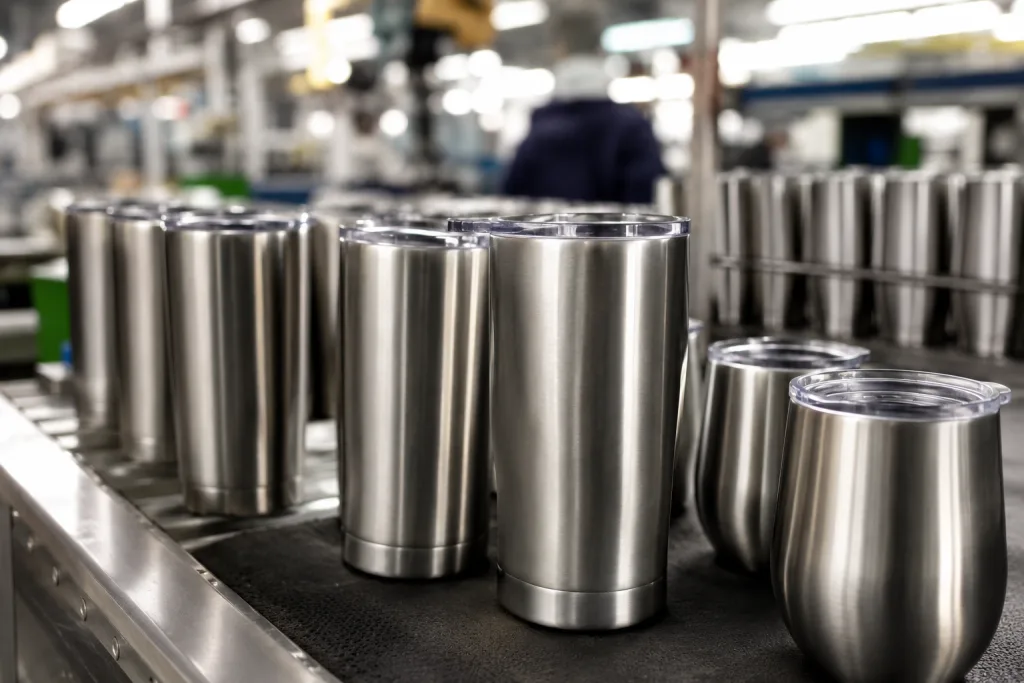
Key Takeaways
- A practical MOQ for decorated tumblers is usually 500-1,000 pcs per color, while new mold lids often start at 3,000-5,000 pcs
- 18/8 stainless steel with a 0.4-0.5 mm inner wall and copper-coated vacuum layer usually gives better cold retention than entry 201 steel
- Typical FOB Ningbo pricing for a 20 oz powder-coated tumbler is about USD 3.20-5.80 depending on lid, finish, and print
- Mass production lead time from Zhejiang, China is commonly 25-35 days after sample approval and deposit
You can buy a stainless tumbler from almost any trading company in China. Easy part. The harder part is knowing whether the factory stainless steel tumbler you approved will still hold temperature, pass a cross-hatch coating test, and land with matching lids across 20,000 units. We’ve seen this go sideways after one inspection found a 1.5 mm lid gap, then the buyer flagged leaks and Amazon returns jumped in the next batch.
If you source for retail, gifting, or distributor drinkware programs, compare on paper first and on the line second. Marketing names are the wrong question to ask. Check the actual specs: steel grade, wall structure, lid style, print method, carton count, MOQ, and lead time — for example 1,000 pcs MOQ and 35 days, not “fast delivery.” This matters when you choose between a standard tumbler, a custom canteen, or a custom growler line from Zhejiang, China for Europe or North America, because we ship all three and QC pulled samples where the PO typo was not the biggest problem.
Start with the comparison grid
Compare a factory stainless steel tumbler the same way you compare any industrial item: spec line against spec line. Two tumblers can look almost identical on a sales sheet, then land 12 days apart in production timing and a full 8-10% apart in packed cost once you add printing, drop-test cartons, and pallet load. We run in Zhejiang, China with output up to 600,000 units/month across tumblers, bottles, and related custom drinkware, and the pattern shows up month after month. QC pulled the sample last week on a 20 oz order where the wall looked the same, but the body measured 0.35/0.45 mm instead of 0.4/0.5 mm, and that changed dent risk in transit. Buyers who build a strict spec table usually avoid the expensive rework.
| Spec Point | Entry Tumbler | Mid-Range Retail Tumbler | Premium Gift Tumbler |
|---|---|---|---|
| Body material | 201 outer / 304 inner | 304 inner + outer | 304 inner + outer |
| Wall structure | Double wall vacuum | Double wall vacuum + copper coat | Double wall vacuum + copper coat |
| Common size | 20 oz | 20 oz / 30 oz | 16 oz / 20 oz |
| Body thickness | 0.35/0.45 mm | 0.4/0.5 mm | 0.5/0.5 mm |
| Lid type | Press lid | Slider lid | Screw lid or magnetic slider |
| Decoration | 1-color silkscreen | Powder coat + laser or screen | Pantone coat + wrap print |
| FOB price | USD 2.60-3.40 | USD 3.20-5.80 | USD 5.20-7.90 |
| MOQ | 1,000 pcs | 500-1,000 pcs | 1,000-3,000 pcs |
This grid also helps when you line up a tumbler program against a canteen customizable range or a customizable growler program. We have seen buyers start with a canteen promo brief, then switch after the buyer flagged that office and commuter use would cover 3 daily scenarios instead of 1. Others start with tumblers and add a customized canteen or customized growler later so the collection feels complete on the shelf. This is the wrong question to ask: “Which photo looks better?” The better question is how the structure fits the use case, lid style, and decoration method. We have seen this go sideways when the PO says “mat black slider” and the catalog image shows a screw lid.
Where tumbler specs really diverge
The cost gap and complaint rate usually come from steel grade and process control, not the photo on the quote sheet. Ask straight: is it full 18/8, meaning 304 stainless, or 201 outer with 304 inner. Mixed construction is not a defect by itself. We run that spec for budget canteen programs all the time, often at MOQ 3,000 pcs, because the math on entry promo projects does not support full 304. For premium retail, full 304 is still the safer call, and buyers who skip that question usually come back after the first salt-spray issue.
Check wall thickness next. A 20 oz tumbler built with 0.4 mm inner and 0.5 mm outer wall feels different in hand from 0.35/0.4 mm, and QC will see the dent risk on the line before the carton is sealed. This is not a small detail. We have seen a drop-test batch where the thinner body picked up shoulder dents after transit while the heavier spec held shape. Vacuum structure matters too. A copper-coated vacuum chamber can hold cold for several more hours than a basic double-wall build, especially on a 30 oz body, and that shows up fast in side-by-side sample checks.
- Budget line: built for canteen promos, event drops, and short-run programs where buyers push hard on target price and accept a simpler finish package.
- Mid-range line: the spec most distributor canteen and drinkware buyers ship, usually with balanced wall thickness, standard powder coat, and fewer claim headaches.
- Premium line: better suited to branded ecommerce, museum stores, corporate gifting, and subscription boxes where the buyer flagged hand feel, coating consistency, and retail presentation.
Lids are where sales claims get sloppy. A clear AS lid with a basic slider is low cost and familiar, but fit tolerance has to stay tight; on our line, a 0.3 mm mismatch at the rim can turn into leak complaints fast. A screw lid reduces those complaints, but unit cost and assembly time go up. We ship both. Do not assume a custom canteen or custom growler lid will share threads with a tumbler from the same factory. Thread tools, gasket hardness like 60 or 70 shore, and neck finish are product-specific, and we have seen this go sideways from one typo on a PO.
For compliance, ask which standard the factory is working to: REACH, LFGB, or FDA, based on your market. For coated items, ask for coating adhesion results and dishwasher guidance in writing, not verbal promises. QC pulled the sample is not the same as a test report. If a supplier cannot explain coating adhesion, contact-safe parts, or what failed in the last inspection, this is the wrong factory to trust with your order.
Use-case fit beats catalog variety
Buyers get shown 80 shapes and still order the wrong 4. We’ve seen this go sideways. Use-case fit should pick the SKU, not catalog length. A factory stainless steel tumbler usually wins when the end user drinks in the car, at a desk, or on a 25-minute commute, where a 90 mm cup-holder base matters more than a fancy silhouette. A custom canteen is better for all-day carry and bag portability. A custom growler or customizable growler fits brewery programs, outdoor use, and refill counters where buyers ask for a thicker handle weld and a tighter cap torque.
Office and corporate gifting
Start with 16 oz or 20 oz tumblers, powder coated, with laser engraving or 1-color print. MOQ can stay around 500 pcs per color if the body is a standard model. This is the cleanest entry point for customized drinkware because the artwork area is easy to control on the line, and packaging can stay simple—often a plain white box with a 3 mm EPE bag. We ship a lot of these for HR campaigns, and the usual buyer pushback is gift budget, not product performance.
Retail and ecommerce
Pick a stronger body, full 304 steel, and a lid with tighter spill control. For Amazon or DTC, insist on drop-resistant master carton design, barcode placement, and if needed FNSKU labeling. The buyer flagged this more than once: one weak insert can wipe out margin through damage and reviews. QC pulled the sample after a carton drop test from 76 cm, and a loose inner tray was the whole problem. This is the wrong question to ask if you only compare unit price.
Promotional and event programs
If the target price is strict, a simpler tumbler often beats a customizable canteen. The reason is decoration cost. A straight wall tumbler is easier to print on a screen-print jig and faster to pack than a complex shoulder bottle. For canteen suppliers and canteen vendors, that usually means 12 days vs 18 days from artwork approval to shipment on a repeat body. The math doesn’t work if the event date is fixed and the bottle shape slows the line.
If you are a canteen distributor, distributor growler buyer, or broader drinkware wholesaler, the stronger program is usually one body family with shared finishes across tumbler, canteen customized bottle, and growler SKUs. That cuts sampling time, keeps color matching tighter at Delta E under 1.0 on repeat orders, and gives the sales team a cleaner collection. We run these as matched sets, and even small PO errors like a lid color typo can snowball if each SKU sits on a different platform.
Factory pricing without guesswork
Price confusion starts when buyers compare quotes that are not built the same way. One factory shows a lower tumbler price, then the buyer flags the missing slider lid, white box, or logo print on page 2 of the PO. Another quote includes those items but drops to thinner steel at the body wall. Ask for a line-by-line cost sheet with the lid type, steel grade, finish, packaging, and print method listed. This is the right question to ask.
For a standard 20 oz factory stainless steel tumbler from a canteen manufacturer in China, a realistic FOB range is:
- USD 2.60-3.40: basic vacuum tumbler, mixed steel construction, clear press lid, plain box.
- USD 3.20-4.50: 304/304 body, powder coat, slider lid, 1-color logo.
- USD 4.80-5.80: copper-coated vacuum, premium finish, laser mark or multi-color print, upgraded gift box.
Tooling cost needs to be split cleanly. If you only need logo decoration, sampling is often USD 50-100, and we sometimes credit it back against the bulk order after sample approval. If you want a new lid, handle, or base mold, expect USD 1,500-6,000 depending on complexity and core count. On the line, a new lid project usually starts with a 3D print check, then mold-flow review, then steel cutting. Buyers mix these two jobs together all the time, and we have seen this go sideways. Separate decoration customization from structural customization. A lot of projects described as canteen customizable or customizable drinkware are only decoration changes. True custom structure needs more time and a larger MOQ.
At factory level, MOQ follows process limits more than sales talk. Standard tumblers can start at 500 pcs for stock colors, but special Pantone powder coating, unique pack-outs, or an uncommon lid usually push MOQ to 1,000 pcs or more because we run coating and packing by batch. For a canteen customized collection or customized growler set, combination MOQs can work if the body, lid, or gift box insert is shared. Ask early. Last month QC pulled the sample on a mixed set because one buyer wanted 4 lid colors at 250 pcs each, and the math did not work. A capable canteen supplier in Zhejiang should tell you exactly which part drives the MOQ.
Quality control before production scales
Once your sample is approved, the real job starts on the line. Smart buyers do not lean on the golden sample by itself; they freeze the production standard with signed artwork, a Pantone or sprayed color target, packaging layout, and a 1-page QC sheet. We have seen POs typed as “same as sample” with no logo offset limit, no carton mark, no lid code—then QC pulled the sample and three people read it three ways.
A workable factory QC flow covers incoming 304 stainless and lid checks, in-line vacuum inspection, coating review, and final AQL inspection. Many B2B buyers use AQL 2.5 for major defects and 4.0 for minor defects, but this is the wrong question to ask if your sales channel is tighter. A big-box retail program usually rejects color drift that a 5,000-piece promo run would pass, and we ship under stricter cosmetic limits when the buyer flagged shelf appearance on the first pre-production sample.
- Vacuum retention spot checks after production, usually 3 pieces per batch with a hold-time record
- Lid fit and leak test by batch using the torque jig and upside-down check for 30 minutes
- Logo position tolerance, usually within 2-3 mm
- Coating adhesion and scratch resistance checks, often with cross-hatch tape and rub testing
- Carton drop test for ecommerce-ready packs from 76 cm if the outer box is part of the retail experience
Ask whether the site has BSCI, ISO 9001, or social compliance records if your customers require them. Not every canteen manufacturer or canteen factory holds the same certifications, and not every audit covers the exact production site that runs your order. We have seen this go sideways when the report showed one factory name, but the shipper on the invoice and the manufacturer on the carton stamp were different.
Most expensive tumbler problems are boring problems: lid mismatch, color drift, weak cartons, and delayed approvals. They are preventable if the spec sheet and QC plan are specific enough.
This applies just as much to a distributor growler program or a customized canteen project as it does to tumblers. The product changes. The factory discipline does not. On a 20 oz tumbler line, the tools may be different from a growler setup, but the math does not change if the coating fails or the lid fit runs loose.
How to choose the right supplier
If you are buying from China for the first time, split the supplier into 3 roles: factory, trading company, and sourcing partner. A direct canteen factory usually gives faster process answers and tighter lead-time control because we run the line ourselves. A trading company fits mixed orders across 5 or 6 categories. Neither is wrong. Trouble starts when a seller claims to be a manufacturer but freezes on basic shop-floor questions like vacuum sealing time, lid sourcing, or whether a 0.15 mm line logo will fill in after powder coat. We’ve seen this go sideways.
Ask direct questions:
- What is your normal MOQ for a 20 oz tumbler with powder coat and 1-color logo?
- What is your current lead time in peak season?
- Can you share AQL standards and recent test reports?
- Do you export under FOB Ningbo or FOB Shanghai?
- Which parts are made in-house and which are outsourced?
A serious canteen vendor or canteen manufacturer answers with numbers, not sales lines. For example: MOQ 500 pcs for stock color, 30 days production after deposit, 7 days pre-production sample, vacuum and leak checks in line, and FOB Ningbo terms. That is the baseline. If QC pulled the sample and the seller still cannot tell you whether they do 100% leak test or spot check, this is the wrong question to skip.
At BottleForge Industrial in Hangzhou, Zhejiang, we see buyers move from a single tumbler PO into broader collections with custom canteen, customizable canteen, and customized growler items. The best supplier is not the one with 800 SKUs on a PDF catalog. It is the team that can point to the risk fast: outsourced lid fit, color delta on powder coat, or a laser logo drifting 2 mm off center — then price the fix in days and dollars. That is how repeat programs stay clean.
If your end market is Europe or North America, check whether the supplier understands labeling language, carton marks, and compliance from day one. The buyer flagged this on us before over a single PO typo: “Made in Chnia” on a master carton. Product was fine. Cartons were not. For repeat distributor drinkware business, that detail matters as much as the tumbler itself.
Get a tumbler quote with real factory numbers
Send your target size, artwork, quantity, and market. We will quote MOQ, FOB pricing, sample timing, and the best-fit construction for your program.
Frequently asked questions
What MOQ should I expect for a factory stainless steel tumbler?
For a standard 20 oz tumbler using an existing mold, MOQ is commonly 500-1,000 pcs per color per design. If you choose a stock body, clear slider lid, and 1-color silkscreen logo, 500 pcs is often workable. If you need Pantone powder coating, custom packaging, or multiple logo positions, expect 1,000 pcs or more. Structural changes are different. A new lid, handle, or base usually pushes MOQ to 3,000-5,000 pcs because tooling and setup costs need to be absorbed. If you are building a broader custom drinkware range with tumbler plus custom canteen or custom growler items, some factories in Zhejiang, China can offer a combined MOQ when finishes and packaging are shared.
How much should a B2B buyer pay for a stainless steel tumbler from China?
A realistic FOB China price for a 20 oz tumbler is usually USD 2.60-5.80, depending on material, lid, finish, and print. Entry models with mixed steel construction and plain packaging are often USD 2.60-3.40. A better 304/304 vacuum tumbler with powder coating and a standard logo tends to land around USD 3.20-4.50. Premium versions with copper coating, upgraded lid systems, and gift box packaging can reach USD 4.80-5.80 or more. Always confirm what is included: logo method, individual box, export carton, testing, and spare parts. Many buyers think they have a cheaper offer until they discover the quote excluded decoration or packaging.
Is a tumbler better than a custom canteen for my market?
It depends on where and how your customers use the product. A factory stainless steel tumbler usually wins for office desks, car cup holders, commuting, and corporate gifts. A custom canteen is better for all-day hydration, gym use, and bag carry because the narrower body is easier to transport. If you sell into outdoor, brewery, or refill channels, a custom growler may make more sense than either. For many distributor drinkware programs, the strongest approach is not choosing one format only. It is launching a small family: 20 oz tumbler, 18 oz or 22 oz canteen customized bottle, and 32 oz customized growler with matching colors. That gives your sales team more channel coverage without multiplying too many components.
What quality checks should I require before shipment?
At minimum, require a documented QC plan covering vacuum performance, leak testing, coating appearance, logo position, and packaging integrity. For final inspection, many buyers use AQL 2.5 major and 4.0 minor, though premium retail can be tighter. Ask for random leak tests by batch, visual checks under consistent lighting, and carton drop testing if the goods are for ecommerce or Amazon FBA. If your market is Europe, request REACH or LFGB alignment where relevant; for North America, confirm food-contact compliance requirements. Also verify that the factory and the inspection report match the same production site. This matters whether you buy tumblers, a customizable canteen line, or a broader customized drinkware order.
How long does production usually take for custom tumblers?
For an existing tumbler model with standard decoration, expect about 5-7 days for a pre-production sample and 25-35 days for mass production after sample approval and deposit. In peak season, especially from August to November, lead time can stretch to 40-50 days if lids or coating lines are tight. Custom packaging may add 3-7 days. A new mold project can add 20-35 days before sampling is even ready. If you are sourcing from Zhejiang, China for Europe or North America, also leave enough time for booking, document preparation, and port congestion. Serious canteen suppliers should give you a week-by-week timeline instead of one vague shipping promise.