Key Takeaways
- A realistic MOQ for a factory protein shaker is often 1,000-3,000 pcs per color, with 35-45 day lead time after sample approval
- Use 18/8 stainless steel or BPA-free PP/Tritan, then confirm REACH or FDA contact compliance before deposit
- Set inspection terms early: AQL 2.5 for major defects and AQL 4.0 for minor defects is a practical starting point
- Leakage, odor, and logo adhesion cause most claims; ask for torque, drop, and dishwasher test data before mass production
You are not buying a shaker bottle. You are buying repeatability from PO to PO: the same thread fit, the same print position within 1 mm, the same seal compression, shipment after shipment. That is where a factory protein shaker order goes sideways, even when the pre-production sample looked clean. One bench sample does not show weld consistency, lid torque drift after 5,000 cycles, powder-coating adhesion, or what happens on the line when mixed-SKU packing has to close before 6 p.m. We have seen QC pull a sample that passed, then find cap torque spread too wide in bulk.
For B2B buyers in Europe and North America, the questions are usually practical and blunt. What material is safe and durable? What MOQ is real, not the sales-team number? How do you control odor, leakage, and logo registration? If you also buy a custom canteen, customizable drinkware, or a customized growler from China, the screening logic is close. Protein shakers are less forgiving. They add moving parts, mixing balls or agitators, and extra leak points, and this is the wrong product to source on sample feel alone. Last quarter, one buyer flagged a PO typo on a 2-color logo callout, and that kind of small miss is enough to slow the whole run.
What are you actually buying?
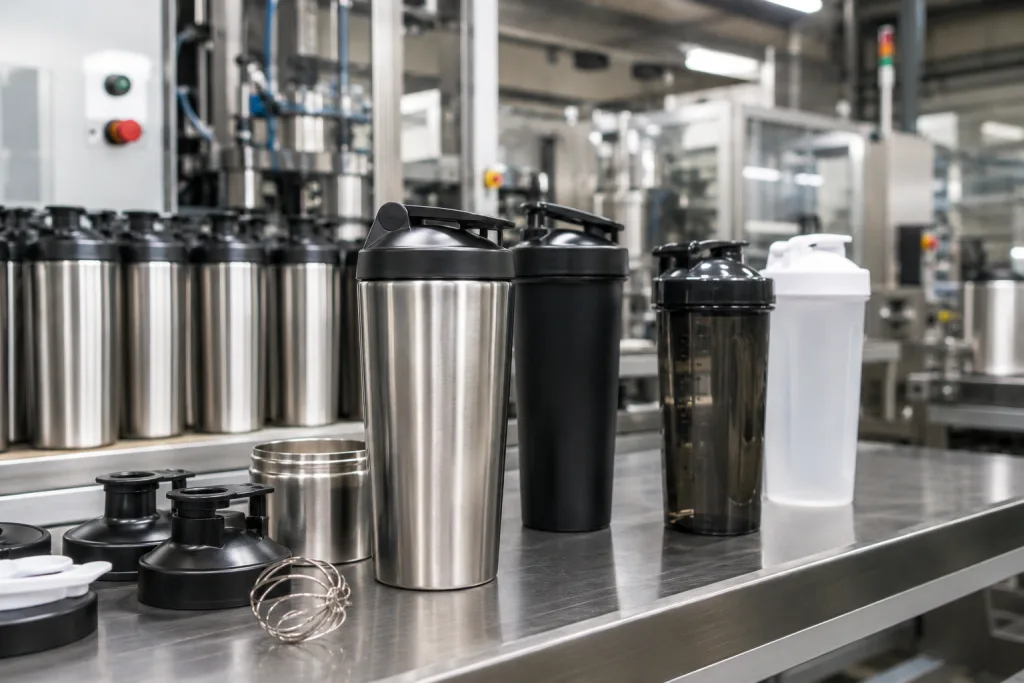
When you source a factory protein shaker, you are buying a small assembly system, not a single bottle. A standard build usually has 7 to 9 parts: body, lid, spout or flip cap, gasket, carry loop, mixer ball or plastic agitator, decoration, and retail packaging. Each added part brings tolerance stack-up. On our line, QC checks thread fit with a go/no-go gauge and measures the silicone ring groove in mm, because one loose thread or one off-size gasket can turn a 20,000-piece order into a returns claim.
Most B2B buyers compare shaker sourcing with broader custom drinkware programs, and that comparison is fine up to a point. If you already buy a custom canteen, customizable canteen, or customizable growler, you know the core items: material, finish, logo method, carton spec, compliance. Shakers need closer review. The lid cycle count is higher, and gym users often open the bottle 3-5 times per day. Protein residue shows odor retention and cleaning problems fast. We have seen buyers focus on bottle wall thickness first; this is the wrong question to ask if the cap hinge fails at 8,000 flips.
Start with the commercial definition
- Body material: PP, Tritan, or 18/8 stainless steel
- Capacity: common sizes are 500 ml, 700 ml, and 750 ml
- Mixing system: wire whisk ball, plastic grid, or fixed internal mixer
- Decoration: silkscreen, heat transfer, laser, UV print, powder coat
- Pack-out: bulk, white box, color box, PDQ, or e-commerce insert
A Zhejiang or wider China supplier that also works as a canteen manufacturer or canteen supplier might list shakers as a catalog add-on. That helps on paper, but catalog overlap does not prove shaker know-how. Ask for monthly shaker output, closure styles in production, and leakage complaints from the last 12 months. Ask for numbers. We ship factories, not slides. One buyer flagged a PO last year with “leakproof” typed as “leak prof,” and that small wording mistake turned into a long approval loop over the cap seal standard. At BottleForge Industrial, the answer should be specific: for example, 60,000 units per month, 3 closure styles running, and 2 confirmed leakage complaints in 12 months. Anything fuzzy usually means the math doesn’t work.
Which material makes sense for your channel?
The right material comes down to channel economics, not just taste. For promo programs under USD 3.00 FOB China, plastic usually wins because the math works at 5,000 pcs and the line runs faster with standard molds. For retail shelves or premium private label, stainless steel earns its cost back through better hand feel, fewer odor complaints, and a higher perceived value when the buyer picks up the sample.
Here is the practical breakdown:
- PP: lowest-cost option, light weight, and still common for shaker lids and some bodies. Typical FOB price can start around USD 1.10-1.80 at 5,000 pcs, depending on mold complexity and print. We run a lot of PP lids on 4-cavity tools, and buyers usually push back on flash around the cap thread before they push back on the cup body.
- Tritan: clearer look and a cleaner premium feel than standard PP. Expect roughly USD 1.80-3.20 FOB for standard sizes. On clear Tritan, QC pulled the sample fast if flow marks showed near the logo panel, because that defect is easy to miss on the line and easy for the buyer to flag later.
- 18/8 stainless steel: stronger durability, better premium positioning, and less odor retention. Single-wall shakers often land around USD 2.80-4.80 FOB; double-wall versions go higher. For this category, the wrong question is “metal or plastic?” The real question is whether your channel can carry the added FOB, freight weight, and lower packing qty per carton.
Do not let a supplier blur the terms. We have seen POs typed as “stainless bottle” with no grade listed, and that is where problems start. Some factories in China call any metal bottle a "stainless bottle" without clearly stating 201 or 304. For sports nutrition or repeated daily use, you should specify 304 stainless steel body, 0.5 mm to 0.6 mm wall thickness for most standard shakers. If the body is insulated, confirm inner and outer wall gauges separately. We have seen this go sideways when the outer wall was fine but the inner liner came in thinner than spec.
For compliance, ask for what your market actually needs: REACH for the EU, California Proposition 65 where applicable, and food-contact declarations backed by lab reports. If your program overlaps with a canteen custom or customized drinkware range, keep one compliance matrix across all SKUs. A factory that also serves as a canteen factory or canteen manufacturer should already understand this workflow, but ask for the document list before deposit, not after shipment. We usually put this into one sheet with SKU code, test item, lab date, and pass/fail so purchasing is not chasing 12 separate PDFs later.
Cheap resin saves cents. One odor complaint on an Amazon review page can cost much more than that.
How do you check if MOQ is honest?
MOQ gets abused in drinkware quotes. We see “500 pcs” on the first sheet, then the real conditions show up later: shared export carton, 1 stock color, 1 logo position, no mold change, no retail pack. For a true branded program on a factory protein shaker, the workable MOQ is usually 1,000-3,000 pcs per item per color. If you want a custom body color, a separate lid color, and a printed retail box, the effective MOQ often moves to 3,000-5,000 pcs. We run into this on the line all the time; the buyer flagged “500 pcs” once, and the PO still had a 3,000-box print requirement because the carton artwork plate was charged by batch.
Ask the factory to break MOQ into four lines. If they will not do that, this is the wrong question to skip.
- Production MOQ: the minimum they can run efficiently on the injection and assembly line, often tied to one full color batch or a mold setup window
- Decoration MOQ: the minimum for silkscreen, laser, or transfer setup; for silkscreen, QC usually checks logo position against a 2 mm tolerance card
- Packaging MOQ: the minimum for color box or insert printing, which is often driven by the printer’s sheet count, not the bottle itself
- Material color MOQ: the minimum resin or powder coat batch; one resin lot can lock you into a larger run than the sales quote first shows
This hits hard if you are a canteen distributor, distributor canteen buyer, or distributor drinkware program manager putting 4 or 6 customer logos onto the same bottle shape. One supplier may accept 1,000 pcs only because they plan to swap leftover colors between orders or live with logo placement drift. We have seen this go sideways. QC pulled the sample on one mixed-logo program and found the print height was off by 3 mm between two batches; the supplier still called it acceptable.
A capable Zhejiang factory should also give you monthly capacity, not just MOQ. For example, 80,000-120,000 shaker units per month is a believable range for a mid-sized line with outsourced decoration support. Ask how many assembly benches they run and whether decoration is in-house or sent out; 6 benches and 2 ultrasonic welding stations tells you more than a smooth sales pitch. Lead time also needs to be split clearly: 7-10 days for pre-production sample, 25-35 days for production, and another 5-10 days if custom packaging is still pending. That means 37 days on a clean run versus 45 days if the box artwork is late. If you also buy customized canteen, customized growler, or from canteen vendors in the same season, book the slot early in China, especially before peak Q3 gifting demand. The math does not work if you wait for final artwork and expect the same ship window.
What quality checks prevent expensive surprises?
If you are new to shaker sourcing, start with failure modes, not brochure language. On the line, the claims that cost buyers money are plain: leakage, odor retention, loose whisk balls, off-center logos, and scuff marks from cartons packed without enough dividers. We have seen a PO say “good packing” and nothing else; 18 days later the buyer flagged scratched bodies in 600 pcs. The fix is simple. Write each check into the PO and the inspection sheet.
Your core checklist
- Leak test: 100% inline air-pressure or inverted water test for assembled lids; we run this station by station before cartons are sealed
- Torque check: define lid closing torque range so cap fit is consistent; for flip lids, QC usually records the range with a torque meter in N·m
- Drop test: 3-5 drops from 1.0 m with water-filled sample units; this is where weak hinge pins show up fast
- Odor check: random sample after 24 hours sealed condition; QC pulled the sample from a closed PE bag, not from an open bench
- Logo adhesion: tape test and rub test after curing; one missed curing hour can turn into a full rework lot
- Dishwasher simulation: if claimed dishwasher-safe, verify 20-50 cycles; this is the wrong claim to print unless the test was actually run
For final inspection, AQL 2.5 major / 4.0 minor is common for drinkware shipments. Major defects include leakage, cracked lids, missing parts, wrong barcode, or an unstable base that rocks more than 1 mm on a flat plate. Minor defects usually mean light print shift, tiny dust points in coating, or slight carton scuffing. If you ship to retail chains, define barcode scan rate and master carton drop performance in advance. If you leave that open, we have seen it go sideways at the warehouse, not at the factory.
This is where experienced canteen suppliers, canteen vendors, and canteen distributors earn their margin. Ask if inspections are done in-house or by a third party, if the factory follows ISO 9001, and if social compliance like BSCI is available when your customer asks for it. In Zhejiang, China, 8 out of 10 factories can send these files in a day, but the paper is not the hard part; shop-floor discipline is. Ask for a real inspection report with photos, defect grading, quantity checked, and one close-up of the failed sample the buyer rejected.
How should you handle logos and packaging?
Logo complaints create more trouble than body defects. The shaker can seal fine, pass a 24-hour leak test, and still get rejected because the print looks off on a matte finish. We hear the same ask on the line: matte body, bold logo, rush ship. That mix does not come free. This is the wrong question to ask if you start with “which print is cheapest?” Start with surface, artwork, and delivery date, then match the decoration method.
For simple promo runs, we run silkscreen first because the math works. On 1-2 solid colors, it is still the cleanest low-cost option, and setup is faster if the artwork is not fussy. On stainless steel, laser marking is the safer pick when buyers want branding that will not scratch off after carton rub tests. Heat transfer and UV printing suit detailed artwork, but QC pulled the sample more than once for curing and adhesion checks, especially on soft-touch coatings. We have seen this go sideways when a buyer approves artwork on screen and skips a physical print sample.
- Silkscreen: lowest cost, best for 1-2 solid colors, usually USD 0.05-0.15 per color
- Laser: durable on powder-coated steel, typically USD 0.08-0.20
- Heat transfer: better for gradients, usually USD 0.12-0.30
- UV print: vivid graphics, but test adhesion carefully
If you sell through e-commerce or distributor channels, packaging sits inside QC, not after it. A white box works for a 5,000-piece event order packed 24 pcs per master carton. For Amazon FBA or DTC orders, ask for FNSKU labeling, suffocation warning if required, scan-tested barcodes, and drop-resistant individual packaging. We usually confirm barcode position with a 100 mm scan window before mass packing. If you are also buying canteen promotional items, customizable drinkware, or a distributor growler line, keep carton dimensions standard where you can. Your warehouse team will thank you.
A supplier that positions itself as a canteen vendor or canteen supplier may push generic stock packaging to hold MOQ at 1,000 pcs. Sometimes that is the right call. Sometimes the buyer flagged it because the shelf look went flat next to retail brands. We ship both ways. Our view is simple: for event use, keep it basic; for retail, spend the extra USD 0.18-0.60 on better packaging, tighter inserts, and fewer damage claims. The cheaper box is not cheaper if 7 out of 200 arrive crushed.
What should you ask before paying deposit?
A seasoned buyer does not need 40 questions. You need about 12 that pin the factory down in the right sequence. Before you pay deposit, get the supplier to confirm operating details in writing. We’ve seen this go sideways: one PO said “black lid,” the buyer meant matte black, and the line ran glossy. If they dodge specifics, you are not buying clarity. You are buying risk.
Use this pre-deposit checklist
- What is the exact material spec for body, lid, gasket, and mixer part?
- What is the real MOQ by color, print method, and packaging type?
- What is the sample lead time and mass production lead time?
- What are the FOB Ningbo or FOB Shanghai prices at 1,000, 3,000, and 5,000 pcs?
- Which tests are standard, and which cost extra?
- What are the carton size, gross weight, and units per carton?
- Can they provide REACH, FDA, LFGB if needed, BSCI, and ISO records?
- What is the defect claim process if leakage exceeds the agreed threshold?
If the factory also makes custom canteen, customized drinkware, customized growler, or works as a canteen manufacturers group supplier, ask whether your shaker shares parts with existing molds. That question saves time. A shared lid or mixer insert can cut sample timing to 7 days instead of 15 and avoid new tooling for a small trial order of 1,000 pcs. QC pulled one sample last month where the stock lid thread was off by 0.6 mm on a new bottle body, so this is the wrong place to assume. If your design needs its own lid geometry, call it early instead of forcing a stock mold to do a job it cannot do.
For payment terms, plenty of China factories still quote 30% deposit, 70% before shipment. That is standard. Bigger accounts often ask for stage gates tied to sample sign-off and final inspection, and the buyer flagged that structure because it keeps arguments out of the shipment week. The wrong question is not “Can I save 1% on deposit?” The real job is locking spec, packaging, test standard, and claim terms before the line starts. Once 5-ply export cartons are printed and sealing tests are done, the math does not work in your favor.
When does a shaker factory fit broader sourcing?
Most buyers do not source protein shakers by themselves. The same PO often includes a stainless bottle, custom growler, customizable growler, kids bottle, or a customized canteen line for the same retail program. So the real question is not “Can this factory make the shaker?” This is the better question: “Can this supplier run the full drinkware program without adding 2 extra approval rounds, split cartons, and booking delays?”
Broad capability matters if the factory can actually run the products well. A solid canteen manufacturer or canteen factory with shaker experience lets you combine sampling, artwork sign-off, carton specs, and shipment booking; we have seen one 40HQ move in 12 days instead of 18 days because the shaker and bottle lines used the same export carton standard. Still, one-stop supply is not always the right answer. If the line runs good PP shakers but weak vacuum steel, the math does not work.
Look for practical overlap:
- Shared compliance files: one supplier covering 6 SKUs usually keeps FDA, LFGB, and test reports in one file set instead of chasing separate versions
- Consistent finishing: matched powder coat or Pantone across drinkware families, checked against the same swatch card at the spraying line
- Container efficiency: combine shaker, canteen, and tumbler SKUs in one booking, with carton size planned to hold loading loss under 3%
- Distributor support: mixed logo programs for canteen distributors or regional resellers, often with MOQ split by lid color or print panel
If you are a distributor canteen account manager or work with canteen distributors in Europe and North America, ask how the factory handles repeat artwork, replacement components, and spare parts. QC pulled the sample on one reorder here because the buyer flagged a lid gasket issue, and the fix should come from the saved BOM and 0.3 mm seal spec, not from a new engineering debate. Good Zhejiang teams keep BOM records, color masters, and packaging references clean enough that the second order moves faster than the first. That sounds basic. We have seen this go sideways when a PO even carried the wrong lid code.
Get factory protein shaker answers before you place
Send your target quantity, material, logo method, and delivery deadline. We will review MOQ, compliance, and production fit from our Zhejiang, China team.
Frequently asked questions
What MOQ should I expect for a custom factory protein shaker?
For a normal branded order, expect 1,000-3,000 pcs per style per color as a workable MOQ. If you only need a stock body color with one-color silkscreen, some China factories may accept 500-1,000 pcs, but pricing usually becomes less efficient. Once you add custom lid color, custom mold parts, or printed color boxes, the practical MOQ often moves to 3,000-5,000 pcs. Always ask the supplier to split MOQ by production, logo printing, and packaging, because those are different cost drivers. A low advertised MOQ is often based on stock components, not a true customized drinkware program.
Which material is best for a protein shaker: PP, Tritan, or stainless steel?
PP is the budget option and works well for promotional use, typically at lower FOB cost and lighter shipping weight. Tritan gives you a clearer, more premium appearance with better impact resistance than standard PP. Stainless steel, usually 304 or 18/8, is stronger for premium retail and better at reducing retained odor. For many B2B buyers, a 700 ml single-wall stainless shaker with 0.5-0.6 mm wall thickness is the safest premium specification. If your target price is under USD 2.00 FOB China, plastic is more realistic. If brand positioning matters more than first cost, stainless usually wins.
How do I reduce leakage complaints on shaker bottle orders?
Start by controlling the closure system, not just the bottle body. Ask for gasket material specs, lid torque range, and a 100% leak test during assembly. A practical factory standard is an inverted water test or air-pressure check on every assembled unit, plus random drop testing from 1.0 meter on filled samples. You should also define AQL terms, with leakage classified as a major defect under AQL 2.5. If the factory cannot show you assembly instructions or inspection records, that is a warning sign. Most leakage claims come from inconsistent thread fit, weak hinge structure, or poor silicone ring seating, not from the steel or plastic body itself.
What compliance documents should a European or North American buyer request?
At minimum, request material declarations and food-contact compliance records matched to your market. For Europe, REACH is common, and some buyers also ask for LFGB depending on category and claim level. For North America, FDA-related food-contact documentation is typical, and California Proposition 65 may matter depending on the sales channel. If your customer has ethical sourcing requirements, ask for BSCI or similar social audit records and confirm whether the factory works under ISO 9001 quality procedures. Do this before deposit. A supplier in Zhejiang or elsewhere in China that says documents are available later may still be legitimate, but you are taking avoidable risk.
Can one supplier handle protein shakers, canteens, and growlers together?
Sometimes yes, and it can save time if the supplier already runs multiple custom drinkware categories. A capable canteen factory or canteen supplier may help you standardize colors, packaging formats, and shipment consolidation across shaker bottles, custom canteen items, and customized growler programs. The commercial benefit is fewer vendors, shared compliance files, and easier container planning. But capability should be checked by category. Ask for separate samples, lead times, and monthly capacity by product type. A supplier that is strong in insulated bottles may not be equally strong in shaker closures. Treat each category on its own technical merits before you consolidate.