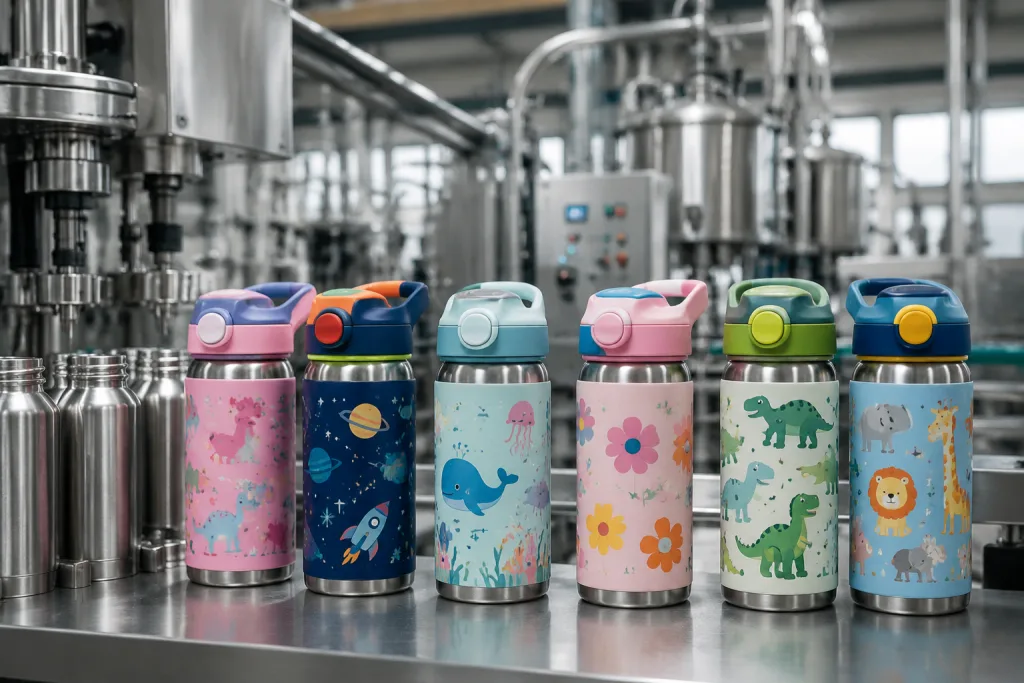
Key Takeaways
- For a 5,000-piece order, a realistic MOQ is 1,000-3,000 pcs per color with lead times around 25-40 days after sample approval.
- Use food-contact materials with REACH and LFGB-ready test support; PP lids, food-grade silicone, and 18/8 stainless bodies reduce complaint risk.
- Set inspection rules before production: AQL 2.5 for major defects and AQL 4.0 for minor defects is common for kids bottle shipments.
- Drop, leak, odor, coating, and print adhesion tests should be written into the PO, not discussed later by email.
You usually do not lose money on a kids bottle order because a drawing looked off. You lose it on production details. The sample passes a desk review, then starts leaking after a 1.2 m drop test, the straw picks up a silicone smell, the print scratches off after 20 dishwasher cycles, or the barcode label does not scan at inbound. We have seen this go sideways over small PO gaps: no straw hardness spec, no lid torque range, no carton barcode placement, no note on abrasion testing. On the line, QC pulled the sample and the problem was there from day one.
For school districts and importers buying from Zhejiang, China, chasing the lowest unit price is the wrong question to ask. The safer move is a spec sheet that blocks the common failures before tooling, sampling, and mass production start. If you are sourcing a bulk children water bottle or a custom school water bottle, ask the practical question: what fails first, at what stage, and what do we write into the PO to stop it? A 0.3 mm seal change or one missed print adhesion note can cost 12 days vs 18 days on a remake, and the math does not work in your favor.
Where kids bottle orders actually fail
Buyers new to a children water bottle factory usually start with shape, color, and logo position. That is normal. It is also the wrong place to spend most of the meeting. The claims we see come back from five repeat issues: leaks, broken lids, odor, decoration failure, and non-compliant materials. If you are buying a bulk kids water bottle for schools or retail, these five points decide whether 10,000 units ship on time or sit on the line for rework after QC pulled the sample.
In Zhejiang, China, plenty of factories can make a showroom sample look clean. Running the same result across 10,000 or 50,000 units is different work. We have seen this go sideways on simple parts, like a silicone ring drifting from 2.0 mm to 1.8 mm and turning a pass sample into a leak complaint. A pre-production sample is not enough. You need a written production standard with numbers, checkpoints, and an AQL the factory will actually run.
- Leak failure: cap thread mismatch, a warped silicone ring, poor straw fit, or a vent valve that seals on one cavity and fails on the next.
- Drop failure: handle cracks after a 1.2 m drop test, hinge pins back out, or the spout cover snaps at the living hinge before carton close.
- Odor and taste failure: low-grade silicone, recycled resin contamination, or poor cleaning before packing; the buyer flagged this once on a PO where 5,000 pcs smelled fine empty but picked up odor after hot-water fill.
- Decoration failure: silk screen scratches in transit, UV print chips, decals shift 2 mm off center, or powder coat gloss changes from batch to batch.
- Compliance failure: missing migration testing, the wrong declaration for food-contact parts, or incomplete traceability back to the resin lot and lid assembly date.
A capable children water bottle manufacturer should show control plans for each risk, not just a lower FOB price. At BottleForge Industrial in Hangzhou, Zhejiang, output can reach 300,000 units per month across bottle categories, but the math does not work if the QC plan is vague. Ask what they check at incoming material inspection, what torque standard they run during assembly, and what defects they reject at final random inspection. If the answer is only “we inspect before shipment,” keep looking.
You are not buying a bottle shape. You are buying a repeatable process.
Material choices that create complaints later
The quickest way to buy after-sales trouble is to choose materials on unit price alone. On a factory kids water bottle, we usually run 3 builds: Tritan body with PP lid, single-wall 18/8 stainless body with PP lid, or vacuum stainless for older kids who carry the bottle all day. Each one solves a different problem, and this is the wrong question to ask if the brief is only “what is cheapest.” On our line, QC pulled samples more than once because a buyer approved the low-price resin option first and asked about odor after molding.
What to lock down in your specification
- Body material: Tritan for clear impact-resistant bottles, or 18/8 stainless steel with 0.4-0.5 mm outer wall for durable metal options.
- Lid resin: food-grade PP is common because it runs clean in injection molding and keeps cost movement under control across 5,000 to 10,000 pcs.
- Seals and straws: platinum-cured or food-grade silicone with odor testing required; we normally ask for a retained sample from each batch if the straw hardness shifts.
- Paint/coating: BPA-free external coating, with cross-hatch adhesion test standard stated; 100-grid tape test results should be written on the spec sheet, not left to the factory memory.
If you are sourcing a children water bottle customized for school programs, watch soft-touch coatings and the lowest-cost clear plastics. Soft-touch feels good in the hand, then the buyer flagged scratch marks after a 48-hour backpack rub test. We have seen cheap clear bottles pass incoming inspection and still cause taste complaints after a hot rinse cycle or 7 days of storage. That goes sideways fast.
For Europe, ask for REACH support documents and, where needed, LFGB-oriented food-contact testing. For North America, importers often ask for CPSIA-related checks on accessible coatings or components, plus ASTM review if the product goes into child-focused channels. A serious children water bottle supplier in China should break this down by part: bottle, lid, straw, and decoration. Not every part has the same exposure risk. We ship programs where the printed body passes clean, but the silicone straw gets extra scrutiny because that is the part kids bite.
If you need a children water bottle custom program below USD 3.00 FOB, say it at the RFQ stage. Under that level, factories usually cut somewhere: wall thickness from 0.5 mm to 0.4 mm, a simpler lid tool, or a lower-cost print method. The math does not work otherwise. That is not automatically a bad decision, but those trade-offs need to be written on the PO before you approve the golden sample. We have even seen a PO typo on color count create a claim later.
Lids, straws, and handles fail first
When buyers complain about a bulk kids bottle, the bottle body is usually fine. The lid assembly is where we see failures. On the line, QC pulled more rejects from push buttons, flip spouts, bite valves, carry loops, hinge covers, and threaded closures than from the stainless body itself.
A school-use bottle gets dropped off desks, over-tightened by parents, scrubbed with hard brushes, and jammed into backpacks with lunch boxes. So spec the lid harder than the body. For a custom kids bottle for ages 4-10, ask the factory to confirm these points:
- Leak test: 100% air-pressure or vacuum leak check during production, plus random upside-down water hold for 30 minutes.
- Drop test: filled bottle dropped from 1.0-1.2 meters on three orientations.
- Handle pull test: 10-15 kg static load for 1 minute if the bottle has a strap or loop.
- Cycle test: 500-1,000 open-close cycles for flip lids or push-button caps.
If a children water bottle manufacturer cannot explain the hinge resin, pin design, and how the gasket is seated, expect problems. This is not a small detail. We have seen leak complaints traced back to manual gasket loading done too fast, with the silicone ring twisted 1-2 mm out of its groove on rush promo orders.
For a bulk school water bottle, plain screw caps often beat one-touch lids on actual durability. Buyers push back on this because the simple lid looks less premium, and the buyer flagged it more than once in sample review, but the math doesn't work if claims start piling up. If your market still wants straw lids, cut risk by skipping complicated lock structures and setting a retention-force standard for the straw and mouthpiece before mass production.
Good factories in Zhejiang, China, usually offer spare gasket stock with shipment or hold replacement parts for 6-12 months. Ask for it if you sell to school districts or institutional buyers. We ship this way for repeat accounts because 2% backup lids cost far less than arguing over a full container after 0.8% leaked in use.
Decoration specs are usually too loose
Decoration is where 7 out of 10 children water bottle promotional orders start drifting. Buyers type “logo in white,” approve a JPG mockup, and the shipment lands with Delta E color shift, prints 2 mm off center, weak adhesion after curing, or logo placement that moves from lot to lot. We have seen QC pull the sample and catch a clean first article, then carton No. 186 shows the mark riding high by 3 mm. That is how complaint emails start.
If you are ordering a custom logo kids bottle, your print spec needs numbers, not general comments. This is the right question to ask. Your spec should include:
- Logo position tolerance: for example, ±1.5 mm left-right and ±2.0 mm vertical.
- Print size tolerance: ±1.0 mm on key logo dimensions.
- Color reference: Pantone code or approved physical standard.
- Adhesion requirement: tape test after curing, plus rub test and dishwasher simulation where applicable.
For stainless bottles, powder coating plus silk screen is common because the math works on 3,000 pcs and the line runs fast. Laser engraving lasts longer, but you lose color pop. UV print can hold detailed artwork, though we have seen it chip on a 0.5 mm shoulder radius when pre-treatment or oven curing was off. A solid children water bottle vendor should push back if the artwork does not match the process instead of saying yes and fixing the problem later.
If you are a children water bottle distributor supplying schools, stay careful with large full-wrap art on heavy-use bottles unless you already passed an abrasion test. Backpack friction is rough. Lunchbox contact is rougher. Repeated washing does the rest. One buyer flagged edge wear after a 48-hour tumbler rub test, and that result was not surprising. For fewer complaints, a lot of buyers stick to a one-color logo on powder-coated stainless or an in-mold logo area on plastic lids.
Confirm packaging before you approve decoration. Individual polybags can scuff matte coatings during transit, especially when 24 pcs are packed tight in one master carton. Divider-packed master cartons cost slightly more but cut friction damage. On a USD 2.80-4.50 FOB bottle, better packing may add only USD 0.05-0.12 per unit, and we ship that upgrade often because replacement claims for scratched graphics cost more every time.
QC plans must start before mass production
We see this a lot: buyers ask for inspection when the order is 90% packed. That is too late. A solid QC plan for a children water bottle wholesale order starts before the line runs, with a pre-production review instead of relying on final random inspection to catch everything.
At minimum, your supplier or children water bottle suppliers should lock four checkpoints before mass production. This is basic control, not extra cost.
- Incoming material inspection: check resin grade, steel thickness, silicone hardness, color masterbatch, and packaging materials. On our side, QC usually checks silicone with a Shore A durometer and steel wall thickness with a micrometer before release.
- Pre-production sample: confirms mold setup, decoration layout, and packing structure. We run this before full output because one logo position off by 2 mm on the first sample is cheaper than 5,000 pcs rework.
- During-production inspection: catches leaks, poor assembly, unstable print, and color deviation before 80% of units are complete. QC pulled the sample at the 300 to 500 pcs stage on one recent line run and found straw fit too loose after cap torque changed.
- Final random inspection: based on AQL, carton checks, barcode review, quantity verification, and function testing. This is the last gate, not the only gate, and the math does not work if you expect final inspection to fix process problems.
A common standard is AQL 2.5 major / 4.0 minor for drinkware, though some school district tenders require stricter defect limits. Major defects normally include leakage, wrong material, sharp edges, missing parts, mold contamination, broken hinges, or incorrect barcodes. Minor defects may include light print offset, small coating marks, or carton scuffs within approved tolerance. On the factory floor, a sharp edge often shows up first at the spout split line, so we check that area by hand and with a simple edge touch test.
If you are buying from a children water bottle factory in China for Amazon FBA or retail distribution, define labeling rules at the PO stage: FNSKU placement, carton marks, inner pack quantity, and suffocation warnings if polybags are used. We have seen this go sideways over one small typo, like a buyer flagged an outer carton mark after 2,400 units were already stacked on pallets. One missing barcode rule can delay inbound 12 days versus 2 days for a small cosmetic claim.
Factories with BSCI, ISO-style documentation, or established social compliance processes are not automatically better at product quality. This is the wrong question to ask. They usually document traceability more clearly, and that matters if you need a lot-level investigation later. Ask for production date coding or batch traceability on the carton and, where practical, inside the master packaging record; even a simple inkjet lot code on carton side panel 2 helps the team trace one shift from the next.
How to write a safer purchase order
The safest buyers are not the ones sending the longest emails. They are the ones writing POs with less room for interpretation. If you buy as a children water bottle distributor, one of several children water bottle distributors, or an importer building a custom children water bottle line, put the technical rules into the PO. That is what stops arguments after QC pulled the sample and the buyer flagged a detail no one wrote down.
For a custom made kids bottle or children water bottle customizable project, include these items:
- Exact materials: list body, lid, straw, seals, and coating type by material grade, not by nickname from a chat screenshot.
- Capacity tolerance: for example, 350 ml nominal, ±3%, measured with a graduated cylinder at room temperature.
- Unit weight tolerance: set it in grams so the line cannot swap wall thickness without getting caught.
- Performance tests: leak, drop, odor, dishwasher, handle pull, cycle test, with pass criteria written on the PO.
- Decoration tolerances: Pantone, location in mm, print method, adhesion standard; we have seen logo shifts of 2 mm turn into a full claim.
- Packing spec: unit box, master carton, drop protection, carton dimensions, labeling, and outer mark layout.
- Compliance package: test reports, declarations, inspection records, and the report issue date.
Commercial terms matter too. For many children water bottle vendors in Zhejiang, MOQ for existing molds is often 1,000 pieces per color, while a new mold for a lid or handle can push total startup cost to USD 2,000-8,000 depending on complexity. Sample lead time is usually 7-12 days for existing designs and 20-30 days for new tooling. Mass production often runs 25-40 days after deposit and sample approval. Buyers push back on these numbers all the time, but this is the wrong question to ask. Ask what is driving the days: mold polishing, color matching, or carton proof approval with a typo on the PO.
If you are balancing budget and risk, ask the supplier to quote two versions: a simplified standard bottle and a fully custom program. Then compare line by line. We ship both types, and the math often does not work on feature-heavy lids for school programs under 5,000 pieces. Many school buyers find that a simpler custom school water bottle with fewer moving parts cuts claim risk by 30-50% versus a complex lid with buttons, springs, and extra silicone parts.
A good PO does not slow the project down. It usually speeds it up because the factory and buyer solve fewer surprises on the line. One clean PO can save 12 days vs 18 days on back-and-forth sample correction, especially when carton marks, straw length, and seal hardness were written clearly from day one.
Get a kids bottle spec checked before ordering
Send your artwork, target price, quantity, and use case. We will review failure risks, MOQ, testing, and lead time for your next China program.
Frequently asked questions
What MOQ should I expect for a factory kids water bottle order?
For an existing bottle body and lid, a normal MOQ is 1,000-3,000 pieces per colorway, depending on decoration and packaging. If you want a fully custom kids water water bottle with a new lid mold, MOQ often starts at 3,000-5,000 pieces because the factory needs to absorb tooling setup and production risk. In Zhejiang, China, simple stock-color programs can sometimes start at 500 pieces for sampling or trial orders, but unit cost rises fast. For school district bids, many buyers target 3,000-10,000 units to get stable FOB pricing, better carton efficiency, and enough quantity to justify stricter inline QC.
Which material is best for school-use children bottles: plastic or stainless steel?
It depends on age group, budget, and abuse level. Tritan with a PP lid is lighter and often lands around USD 1.80-3.20 FOB for common 350-500 ml sizes. Single-wall 18/8 stainless usually runs about USD 2.20-4.20 FOB and handles rough school use better, especially for print durability and body dent resistance. Vacuum stainless adds insulation but also cost and weight, often USD 3.80-6.50 FOB. For younger children, the lid design matters more than the body material. A simple leak-resistant cap with food-grade silicone and a proven 1.0-meter drop test usually beats a complicated premium lid on complaint rate.
What tests should I require before shipment?
At minimum, require leak testing, drop testing, odor testing, print or coating adhesion testing, and final AQL inspection. A practical standard is upside-down leak hold for 30 minutes, drop test at 1.0-1.2 meters with water fill, and 24-hour odor check after cleaning and sealing. For decorated bottles, request tape adhesion and rub testing; for straw lids, add 500-1,000 open-close cycle testing. If you sell into Europe, ask for REACH-related documentation and food-contact support; if you import into North America, confirm applicable CPSIA or other channel-specific requirements. Final inspection should usually follow AQL 2.5 major and 4.0 minor unless your contract states tighter limits.
How long does production usually take for custom kids water bottle orders from China?
For existing molds with custom logo and standard packaging, sampling usually takes 7-12 days and bulk production 25-35 days after deposit and approval. If you need a new lid, new handle, or special packaging insert, sampling can move to 15-30 days and production to 30-45 days. During peak periods, especially before back-to-school and Q4 promotional deadlines, add at least 7 extra days. A factory with 200,000-300,000 units monthly capacity may still need more time if your order includes multiple SKUs, custom Pantone coating, or hand-assembled accessories. Build inspection time into the schedule rather than treating it as an afterthought.
How can I reduce claims when buying children water bottle bulk for schools?
Use simpler specifications and tighter written tolerances. Choose a bottle with fewer moving parts, lock down material grades, and write leak, drop, and print standards directly into the PO. Approve a golden sample and require inline checks, not just final inspection. For school programs, keep at least 1-2% spare lids or full units for service replacements. Ask the children water bottle supplier to pack bottles with dividers or protective sleeves if coatings are matte or printed. Also confirm carton labels, item codes, and barcode placement before mass production. Most claims in bulk school water bottle orders come from avoidable process gaps, not from dramatic factory mistakes.