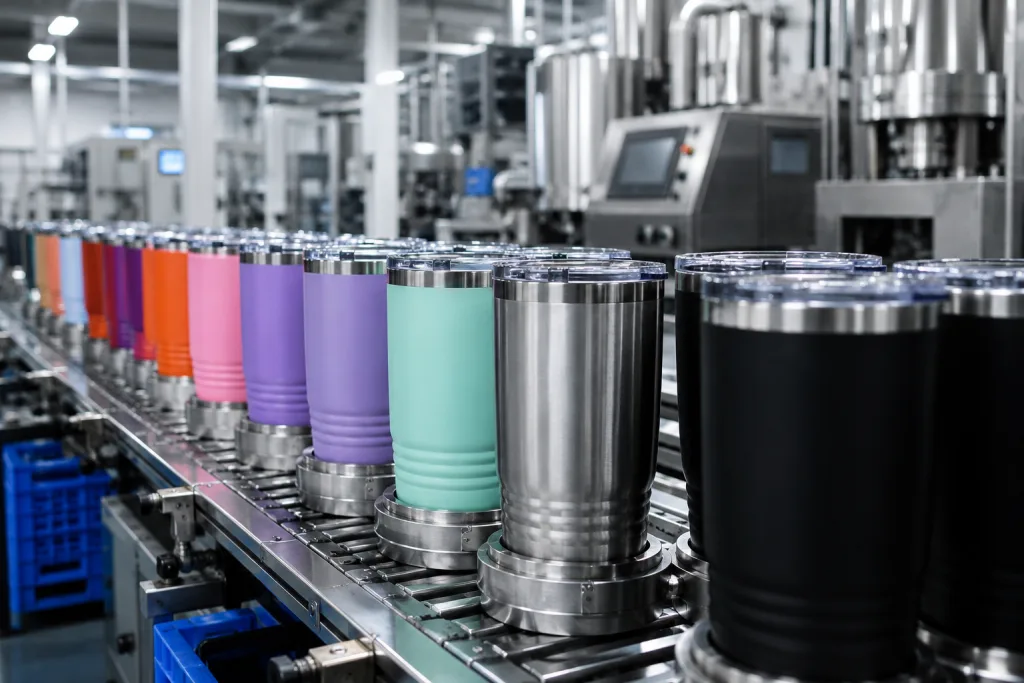
Key Takeaways
- A standard 20 oz double-wall 304 stainless factory insulated tumbler typically lands at USD 2.90-4.80 FOB China at 1,000-5,000 units.
- Most custom drinkware programs start at 500-1,000 pcs per colorway, while fully new molds usually need 3,000-5,000 pcs.
- Production lead time is commonly 25-40 days after sample approval and deposit, plus 3-7 days for export booking from Zhejiang.
- Decoration, lid type, packaging, and testing can add 8%-35% to total tumbler cost even when the cup body stays the same.
You usually do not lose margin on a factory insulated tumbler because the first quote is high. You lose it because the first quote hides the moving parts. A tumbler that lands at USD 3.85 can quietly become USD 5.10 after lid changes, logo methods, drop-test upgrades, packaging, and expedited freight. We have seen a PO marked “same as last order” turn into a new lid mold discussion after QC pulled the sample and found a 1.5 mm fit gap. If you buy custom drinkware for retail, gifting, or distribution, get the cost stack and lead time before you approve artwork.
At BottleForge Industrial in Hangzhou, Zhejiang, China, we see the same pattern with new buyers. They ask for unit price first, then find out MOQ, tooling, sampling, and compliance are the real decision points. On our line, the usual pushback is “why is the sample lead time 7 days if the cup is standard?” Because the logo screen, carton drop spec, and inner tray often are not standard. Whether you are a canteen distributor, a custom canteen brand, or a distributor drinkware importer, price alone is the wrong question to ask. The better question is what is included at that price, and whether production is 12 days or 18 days once approvals start.
What actually moves tumbler pricing
A factory insulated tumbler quote usually breaks into six cost blocks: body material, structure, lid, decoration, packaging, and compliance. Miss one line item and the price comparison is off. We see this every week: one buyer sends two offers from a canteen factory and a canteen supplier, then QC pulls the sample and finds the lid, box spec, or steel grade is different. That is the wrong question to ask. First line up the same build.
Start with the body. A common 20 oz tumbler uses double-wall vacuum stainless steel with inner 304 and outer 201 or 304. If both walls are 304, cost usually rises by USD 0.18-0.35 per unit. Wall thickness matters too. A typical spec is 0.4 mm inner and 0.4 mm outer. Move to 0.5 mm outer for a stiffer hand feel on the line, and you may add another USD 0.12-0.20. We have had buyers push for 0.5 mm outside with 0.4 mm pricing; the math does not work.
Lids are the next swing factor. A simple AS slider lid may cost USD 0.28-0.45. A better Tritan screw lid, magnetic closure, or dual-use straw lid can push that to USD 0.60-1.10. Tooling and fit matter here. Last month the buyer flagged a 0.8 mm gap at the sip opening on a pre-production sample, and the lid had to be adjusted before mass run. Powder coating in one Pantone-matched color is often standard, but special finishes such as gradient spray, ceramic coating, rubber paint, or electroplating can add 10%-25%.
Decoration is where custom drinkware projects drift off budget fast. Basic one-color silkscreen may add USD 0.05-0.12. Laser engraving is usually USD 0.08-0.20. Full-wrap heat transfer or 360-degree digital print can add USD 0.25-0.60 depending on coverage and yield. We run a cross-hatch adhesion check after coating, and this is where scrap starts to move. For canteen promotional programs, decoration choice changes scrap rate and packing speed, not just artwork cost.
- Entry FOB range: USD 2.90-3.40 for a standard 20 oz powder-coated tumbler at 1,000 pcs
- Mid-spec FOB range: USD 3.50-4.20 with upgraded lid and retail box
- Retail-ready FOB range: USD 4.30-5.80 with premium finish, multi-color print, and tested packaging
That is why a canteen manufacturer in China may look cheaper at first glance, then land higher after you add the exact finish, insert card, and transit standard you need. We have seen this go sideways over a typo on a PO where "white box" turned into "window box" and added USD 0.22 per unit before shipment.
MOQ tiers change the whole deal
MOQ is not just a sales condition. It is a cost mechanism. On the factory floor, we split setup labor, powder coating booth time, silk-screen plates, and carton usage by batch size. Small orders are possible, but the math usually does not work in your favor. We have seen buyers push for 200 pcs, then flag the FOB after QC pulled the sample and the costing was rebuilt line by line.
For a factory insulated tumbler built from an existing mold, the practical MOQ is often 500 pcs per size for plain stock colors, and 1,000 pcs per color for custom coating. At BottleForge Industrial, our monthly output is up to 600,000 units across tumblers, bottles, and travel mugs, but capacity alone does not fix pricing. If the order is not grouped cleanly on the line, you still pay for color change, screen setup, and carton waste.
Here is how the tiers usually behave:
- 300-500 pcs: workable on repeat bodies with a simple 1-color logo; expect higher FOB, maybe 2 lid options instead of 6, and stock carton packing only
- 1,000 pcs: the normal starting point for customized drinkware with Pantone coating and standard packaging; this is where we can run coating and printing without forcing the setup cost into each piece
- 3,000 pcs: better carton loading, steadier coating yield, and stronger lid pricing; on a 20 oz body, even a small yield gain matters once the line is running full shift
- 5,000+ pcs: this is where insert options, assorted pack ratios, and freight planning start to open up; at this level, buyers usually ask for mixed color ratios by PO line, and that is a fair ask
If you need a fully customized canteen or customizable growler with new tooling, the MOQ often jumps to 3,000-5,000 pcs, and mold charges can run from USD 2,500 to USD 12,000 depending on body geometry and lid complexity. For a customized growler with a new cap system, the tooling cost can be even higher because leakproof parts and handle components require separate tools. This is the wrong question to ask if you only ask for the mold fee. Ask for the full opening cost, sample loop, and how many cavity changes are included before steel is cut.
If you are a canteen distributor or distributor growler buyer, ask one practical question early: is the MOQ per SKU, per color, or per total order? We have seen this go sideways. A supplier quotes 500 pcs, but later it turns out that number applies only to unprinted mixed stock, not branded units with barcode labels and retail cartons. One buyer even had a PO typo on color split — 700 black and 300 white became the reverse at approval stage — so lock this down before deposit.
A real lead-time map
Most B2B buyers count only workshop days. That is the wrong question to ask. Real lead time starts after the spec is locked and ends when the container is loaded, not when the line starts. For a factory insulated tumbler from Zhejiang, China, we usually map the full cycle as artwork freeze, sample approval, bulk run, inspection, then vessel booking. If the PO still has a lid code typo or the logo size is shifting by 2 mm, the clock has not started yet.
Typical timeline for an existing tumbler model
- Day 1-3: quote confirmation, artwork review, deposit
- Day 4-10: pre-production sample or logo sample
- Day 11-14: buyer approval and final PO lock
- Day 15-40: mass production, vacuum testing, decoration, packing
- Day 41-44: final inspection to AQL 2.5/4.0 or buyer standard
- Day 45-50: booking, customs documents, container loading
So the practical total is 35-50 days for repeat items, not 20 days. We have seen buyers push for 22 days, and the math doesn't work once silk-screen curing, carton print, and booking cut-off are included. If you need a new color chip, custom retail box, or lab test, add another 5-12 days. Before peak gifting season from August to November, powder coating booths and packing lines fill fast; one missed booking window can turn 12 days into 18 days.
For a customizable canteen or custom growler on new tooling, add 20-35 days for mold making and trial samples. A lid core tweak of 0.3 mm is enough to restart sampling, and we've seen this go sideways when buyers treat tooling as a paperwork step. If the lid needs food-contact testing under REACH, LFGB, or California Proposition 65 screening, the schedule stretches again because QC pulled the sample first, then the lab queue did the rest. We tell buyers to separate sample lead time from bulk lead time in every PO because too many projects miss launch when those two numbers get blended into one promise.
Fastest production is not always cheapest production. Rush jobs usually mean overtime, split coating lots, or air shipment of packaging components.
If you are buying for Amazon FBA, retail launch, or a distributor canteen promotion, add a buffer of 7-10 days beyond the factory date. We ship enough export orders to know this part is real. Vessel rollovers, carton remarking, and label rework happen more often than suppliers admit; last month the buyer flagged a carton mark mismatch after loading, and that single fix cost 2 extra days.
Cost adders buyers miss first
The basic cup price is the easy part. On custom drinkware, margin usually gets eaten by late adders outside the body cost. We see this on the line all the time, especially when a PO lists the tumbler spec but skips the pack-out detail.
Packaging is where buyers miss cost first. A plain export egg-crate carton may already be included. If you need an individual white box, add around USD 0.18-0.32. A full-color retail box is more like USD 0.28-0.65 depending on board grade, finish, and print coverage. Then the extras start stacking up: barcode stickers, instruction leaflets, recycled paper claims, or PDQ display trays. On one 10,000-piece order, the buyer flagged a 3 mm insert change after sample approval, and the carton cost moved more than the logo cost. That is the wrong question to ask—buyers often argue over cup price and ignore the pack-out that changes the total.
Testing is another cost line that shows up late. Many Europe and North America importers now request food-contact declarations, coating adhesion checks, dishwasher simulation, salt spray for coated parts, and drop tests. Third-party testing can cost USD 300-900 per SKU depending on protocol. For children’s items or a kids range adjacent to your customizable drinkware line, ASTM or CPSIA-related checks may apply too. QC pulled the sample set for one recent project and found the lid and straw color matched the Pantone chip, but the silicone ring compound still needed separate confirmation before lab booking.
Quality control costs money, and it usually saves a lot more. A final random inspection at AQL 2.5 for major defects and 4.0 for minor defects may run a few hundred dollars, but it is still cheaper than receiving 2,000 leaking lids. Ask your canteen vendor or canteen suppliers how they handle vacuum retention checks, weld inspection, and coating adhesion. The answer should be specific: we expect to hear hold time, test pressure, sample size, and what tool they use, not a sales line. We have seen this go sideways when a factory says “100% checked” but cannot show a vacuum gauge record or cross-cut adhesion result.
- Retail box: +USD 0.28-0.65
- Laser logo: +USD 0.08-0.20
- Special lid upgrade: +USD 0.20-0.70
- Third-party testing: +USD 300-900 per SKU
- Inspection: +USD 250-450 per man-day in China
If you work with canteen distributors or canteen vendors serving promotional channels, ask about overrun and underrun policy early. A standard tolerance of plus or minus 5% can change both invoicing and campaign fulfillment. On a 5,000-piece run, that is 250 units short or extra, and the math does not work if your event count is fixed.
How to quote like a pro
You will get faster, cleaner pricing from a canteen manufacturer if your RFQ reads like a spec sheet from the line, not a mood board. We see quote delays for one reason over and over: the buyer sends “something like this” and skips volume, finish, or packaging. Then by round three, the PO is for a different tumbler. Last month one RFQ said 20 oz in the photo but 30 oz in the Excel file, and QC pulled the sample request because the height was off by 18 mm.
For a usable RFQ on a factory insulated tumbler, give these details up front:
- Capacity in oz and ml, for example 20 oz / 590 ml
- Body diameter and height limits if it must fit cup holders
- Material requirement: 304/304 or 304/201 stainless steel
- Finish: powder coat, spray paint, electroplate, or bare steel
- Logo method and size
- Lid structure: slider, flip, straw, screw, or leakproof travel lid
- Packaging: bulk pack, white box, color box, or e-commerce drop-safe pack
- Target market standards: REACH, LFGB, FDA, Proposition 65
- Order quantity by SKU and color
- Trade term: FOB Ningbo, FOB Shanghai, or EXW
That detail lets canteen suppliers and canteen manufacturers quote actual numbers instead of padded estimates. It also keeps sampling on track. This is the wrong question to ask: “What is your best price?” Ask how the cost moves by spec. If you are developing a custom canteen, customized canteen, or canteen customizable range across several capacities, tell the factory to break pricing by shared parts. Shared lids and shared cartons can reduce your unit cost by 3%-8% over a season. We run this split often, and the math usually shows up fast once MOQ hits 3,000 pcs per size.
One practical point: ask for a costed option table, not one flat quote. A serious canteen factory should show the price delta between one-color print and laser, between a standard lid and an upgraded lid, and between a white box and a retail box. We have seen projects save 12 days vs 18 days in the quote-and-sample cycle just because the buyer approved options early. The buyer flagged one case last quarter where the retail box insert added 0.18 USD but cut transit damage in Amazon packing tests. That is how you control budget without restarting the project every week.
When China sourcing makes sense
Not every buyer should source direct from China. A lot should. If your annual volume is above 10,000 units across tumblers, bottles, and related custom drinkware, buying from the factory gives tighter control on finish consistency, packaging, and spec accuracy. We see this on the line all the time: a color delta of 0.8 vs 1.5 on powder coat starts to matter once the PO hits 3 SKUs and 12,000 pieces. Zhejiang stays strong for stainless drinkware because steel forming, powder coating, lid supply, cartons, and export booking sit within a few hours of each other. The math works better there.
That distance matters on lead time and mistakes. A canteen supplier in Zhejiang can usually coordinate body forming, coating, and cartons in 12 days vs 18 days, while a trader pulling parts from three provinces spends time chasing handoffs and rework. Quality is not automatic. We’ve seen this go sideways. Ask if the factory runs in-house vacuum processing, 100% leak testing, and decoration, or if part of the job moves outside. QC pulled one sample last month with a pinhole at the weld seam because that step had been subcontracted.
Direct sourcing makes more sense when you run a broad line: customized drinkware for retail, canteen promotional items for events, a custom growler series for beverage brands, or a customizable growler program for seasonal launches. Once you manage 8 or 20 SKUs, this is the wrong question to ask: “What is your cheapest unit price?” Better to ask how MOQ breaks by lid, body, and print method. A 3,000-piece MOQ on one lid color is not the same as 500 pieces per artwork, and buyers flag this late if the carton mark on the PO is vague.
Direct does not mean trust first and check later. Ask for BSCI or equivalent social audit status if your channel requires it, request production photos from the polishing area and packing line, define AQL before deposit, and confirm whether spare lids or replacement parts can be supplied at 1%-2% of order quantity. We ship those as service parts all the time, usually packed by 50 pcs per inner carton. Good canteen distributors already ask. New buyers often miss it until one lid style gets a fit complaint.
If a canteen vendor offers a short lead time and low MOQ on a heavily customized canteen, there are usually a few reasons, and none are good. They may be burning leftover stock, cutting process checks, or hiding the real packaging and compliance cost until after the deposit lands. The buyer flagged this on one project where the outer carton spec changed from 5-ply to 3-ply without approval. That is how claims start.
Get a costed tumbler quote with real lead times
Send your capacity, lid style, logo file, packaging spec, and target quantity. We will quote MOQ, FOB pricing, sample timing, and production days clearly.
Frequently asked questions
What is a realistic MOQ for a factory insulated tumbler order?
For an existing tumbler shape, 500 pcs can work for a simple repeat order, but 1,000 pcs per color is the more realistic MOQ for custom drinkware with Pantone coating and printed logo. If you want a new lid, new body mold, or a customized canteen design, MOQ usually moves to 3,000-5,000 pcs. Buyers should also check whether MOQ is counted per SKU, per size, or per colorway. A supplier may advertise 500 pcs, but that often applies only to plain stock cups with one basic decoration method. For a retail program with color box packaging, barcode labeling, and compliance paperwork, assume 1,000 pcs minimum to keep the price reasonable.
How much does a custom insulated tumbler cost from China?
A standard 20 oz double-wall stainless factory insulated tumbler typically costs around USD 2.90-3.40 FOB China at 1,000 pcs if you use an existing mold, standard powder coating, and a basic slider lid. Add a premium lid, laser engraving, and individual retail box, and the same item can move to USD 3.80-4.80. More complex finishes such as gradient paint or full-wrap print can push it above USD 5.00. If both inner and outer walls are 304 stainless, add roughly USD 0.18-0.35. Tooling for a completely new customized growler or custom canteen body is separate and can run from USD 2,500 to USD 12,000 depending on complexity.
How long does production usually take after sample approval?
For a repeat model, bulk production normally takes 25-40 days after final sample approval and deposit. Then allow another 3-7 days for final inspection, export document preparation, and loading arrangements from Zhejiang, China. If your project includes a new color box, special lid sourcing, or third-party lab testing, add about 5-12 days. New tooling adds more time, often 20-35 days for mold development and trial samples before bulk production even begins. Buyers planning seasonal launches should build a safety buffer of at least 7-10 days because packaging delays, vessel booking issues, and carton remarking are common during peak season.
What quality checks should I require before shipment?
At minimum, ask for vacuum retention checks, leak testing, appearance inspection, logo position verification, carton drop review, and a final random inspection using an agreed AQL standard such as 2.5 for major defects and 4.0 for minor defects. If you are buying factory insulated tumbler products for Europe or North America, also confirm food-contact compliance documents and coating adhesion performance. For travel tumblers with handles or screw lids, thread fit and torque consistency matter. A good factory in China should be able to define defect categories clearly, share pass rates, and explain whether testing is done in-line or only at the end. If they cannot explain the process, that is a warning sign.
Should I buy from a trading company or directly from a canteen factory?
If your annual volume is below 5,000-10,000 units across mixed SKUs, a trading company can sometimes simplify communication and consolidate small runs. But once your volume grows, buying directly from a canteen factory or canteen manufacturer usually gives you better visibility on MOQ, process control, and lead time. You can ask direct questions about wall thickness, steel grade, lid sourcing, coating line schedule, and spare parts support. In Zhejiang and other strong drinkware regions in China, direct factories can also coordinate cartons, decoration, and booking faster because the supply chain is local. The key is not the label of trader or factory. The key is whether the partner can give transparent specifications, stable lead times, and accountable QC records.