Key Takeaways
- A practical MOQ for a factory hydration flask is usually 1,000-3,000 units per SKU, with tooling-free stock models starting around 500 units.
- FOB China pricing often lands around USD 3.20-6.80 for 18/8 stainless vacuum flasks, depending on size, coating, lid, and print method.
- Pre-production sampling typically takes 7-12 days, while bulk lead time is commonly 25-45 days after deposit and artwork approval.
- Use AQL 2.5/4.0, leak testing, coating adhesion checks, and carton drop tests before the goods leave Zhejiang, China.
You are not buying a hydration flask. You are buying 40 or 50 small decisions that decide whether the shipment leaves on Friday or sits for 12 days waiting on rework. Most failures start at the RFQ stage. We see the same ones on the line: buyer asked for 304 stainless but the PO left out inner-wall spec, the logo passed tape test but failed after 200 dishwasher cycles, the gift box was 8 mm too tall and broke pallet count, or the MOQ looked fine at 1,000 pcs until it split into 4 colors and 2 logo methods. This is the wrong question to ask: “What is your best price?” Ask what will fail first.
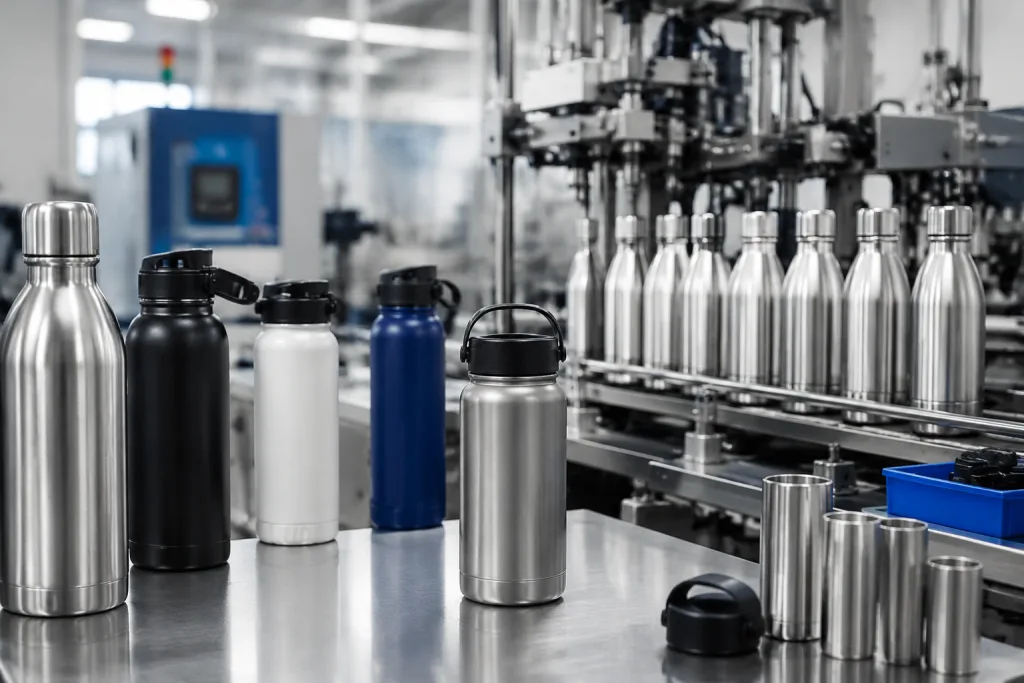
Take a real buyer case. You need a factory hydration flask for a European or North American program, with custom branding, retail-ready packaging, and repeatable quality. We will walk that order from first RFQ to final inspection the way a canteen factory in Zhejiang actually runs it—quoting, sampling, production, and risk control. QC pulled the sample, the buyer flagged a Pantone mismatch, and the carton drop test told us more than the sales sheet did. That is the job.
Start with the buying brief
Here is a typical brief we see on the line: 5,000 units for a spring launch, 650 ml insulated factory hydration flask, matte black, one-color logo, BPA-free lid, individual kraft box, EU food-contact compliance. Your sales team may call it a custom canteen. A distributor may file it under customizable drinkware. On the factory side, we start with a simpler question: what are we building, down to the spec sheet?
A good brief is short. It is also tight. Put in capacity, bottle diameter and height, material grade, insulation type, logo process, packaging, target market, test standard, and order split by SKU or by ship-to. If you send one reference photo and ask for price, you will get a spread, not a quote. We have seen FOB offers drift 18% to 25% on the same-looking bottle because the lid insert and carton spec were never defined. This is the wrong question to ask.
- Body material: 18/8 stainless steel inside and outside, or 18/8 outside with 304/201 mix if you are chasing low cost.
- Construction: single wall or double wall vacuum.
- Wall thickness: common ranges are 0.4 mm inner and 0.5 mm outer for a vacuum flask.
- Lid style: screw lid, flip straw, carry loop, or spout lid.
- Decoration: silkscreen, heat transfer, laser engraving, or powder coat plus logo.
- Packaging: bulk pack, white box, kraft box, or PDQ display.
For a serious RFQ, state your target landed price, or at least tell us the channel. A canteen promotional order for giveaways is built differently from a specialty retail flask, and the math does not work if you want retail finish on promo cost. We run about 300,000 units per month across drinkware lines at BottleForge Industrial in Hangzhou, Zhejiang, but quote speed still comes down to clean inputs. If QC pulled the sample and your PO says “matt black” in one place and “rubber paint black” in another, the quote stops until we clear it up.
If you are working with canteen distributors or a private-label retailer, ask them now about barcode labels, FNSKU, suffocation warnings, bilingual packaging, and country-specific claims. Buyers flag this late all the time. Last month one client added a 50 mm × 30 mm FNSKU label after artwork approval, and the outer carton mark had to be redone. These details look small at RFQ stage and expensive at rework stage.
Choose the flask that fits channel
Now cut the SKU list down. In this buyer case, the retail target is a commuter bottle: practical, clean-looking, easy to carry on the train or in the car. Not a premium alpine flask. Not a cheap gym bottle. The safe fit is a standard double-wall vacuum bottle from a stock mold. Stock mold matters because a canteen manufacturer in China can quote the same day and skip the 20-35 days needed to cut a new body tool. On our side, that also means we can pull an existing neck gauge and lid fit sample from the rack instead of waiting for first-tool correction.
For a 650 ml stock model, typical FOB China pricing might look like this:
- 1,000 units: USD 4.90-5.80 each
- 3,000 units: USD 4.10-4.90 each
- 5,000 units: USD 3.80-4.60 each
That price usually covers 18/8 stainless steel, powder coating, one-color silkscreen, and an individual box. Add USD 0.18-0.45 for laser engraving, USD 0.25-0.60 for a more complex lid, and USD 0.12-0.35 for upgraded gift box packaging. If you switch to a customized growler or customizable growler, the math changes fast. Body weight goes up, the mouth tooling is wider, and the handle or cap assembly needs extra parts and checks. We have seen buyers push back on a 40 g weight increase, then accept it after QC pulled the sample and compared drop performance side by side.
You also need to decide where you want flexibility. Buyers often ask for a canteen customizable program with several lid colors and body colors, then get stuck on the MOQ split. The factory might accept 3,000 units on one PO, but still require 500-1,000 units per color and per print design to keep coating loss and screen setup under control. This is the wrong question to ask: not “Can I mix colors?” but “What is the MOQ per colorway on the line?” We run powder by batch, and small mixed runs usually go sideways on cost.
Single-wall vs vacuum is a direct budget lever. A single-wall custom drinkware bottle may cost 35-50% less than a vacuum flask, but it sweats, does not hold temperature, and usually lands in a different retail tier. If your buyer brief says factory hydration flask, most North American and European buyers expect vacuum insulation unless you state single-wall clearly on the spec sheet. We have had POs delayed over one missed word in the description.
This is where experienced canteen suppliers earn their keep. They do not quote the cheapest body and hope for the best. They ask if the program needs 6-hour, 12-hour, or 24-hour thermal hold, whether the base diameter must stay under 75 mm for a car cup holder, and whether the coating has to survive 500-1,000 rub cycles in transit. Those are factory-floor questions. On our line, the abrasion check is simple but brutal: 3M tape, rub cloth, and a reject tag if the print breaks too early. That is not upselling. It is cost control.
Sampling before you approve anything
After the quote is aligned, move to sampling. We usually run it in two steps: one blank sample first, then one pre-production sample with your logo and packaging. That is faster and cheaper than trying to fix bottle structure, surface finish, and print position in one shot. On the line, the first blank sample tells you most of what matters—weight, threading, mouth feel, and whether the base sits flat.
A blank stock sample from a canteen supplier in Zhejiang, China often ships in 2-4 days. A pre-production sample with powder coat, logo, and custom box usually needs 7-12 days after artwork confirmation. Sample charges vary, but USD 50-150 for a decorated flask and USD 80-200 for a custom box mockup is normal. On bulk orders, most canteen vendors credit part or all of that back. One common delay is simple: the buyer signs off the logo, then changes a 3 mm print height on the PO the next day.
Do not approve by photo only if brand color matters. Ask for a physical sample. Matte black is easy. Mid-tone Pantone matching on powder coating is where buyers get surprised, and we have seen this go sideways. If you need a customized canteen to sit beside existing branded merchandise, ask for the nearest Pantone reference and write the acceptable tolerance before sampling starts. QC pulled one sample last month that looked fine on WeChat photos but read too warm under a D65 light box.
What to check on the sample
- Weight: compare it to the quote; a 20-30 g gap on one flask often means the steel thickness changed.
- Mouth finish: check for a smooth rolled edge, no burrs, and no visible welding marks inside the neck; we use a fingertip check first, then visual.
- Thread fit: the lid should start cleanly and close without cross-threading; if you need force on the first half-turn, the line should recheck the thread gauge.
- Logo position: measure print height and seam alignment; do not accept “looks centered” when a ruler gives you the answer in mm.
- Base stability: set it on a flat table; no rocking. This sounds basic. It is not.
- Packaging fit: allow only light movement inside the unit box; if the flask knocks the wall on a drop test sample, the math does not work.
If you are a canteen distributor or distributor drinkware buyer serving multiple resellers, document approval with a signed sample sheet. Put in dimensions, net weight, finish code, logo size, carton pack, and barcode placement. This is not paperwork for its own sake. It saves arguments later. We ship against that sheet, and if the buyer flagged a barcode position at 12 mm from the box edge, the factory has a clear target.
Approval rule: if it is not written on the approved sample sheet, treat it as open to interpretation.
Lock specs before bulk production
After the sample is signed off, the PO needs to turn that sample into the production standard. New buyers miss this all the time. They send 5,000 units and a ship date, but no spec table, no approved carton mark, no pass/fail checklist. Then the canteen factory runs to its house standard. That is the wrong question to ask after mass production starts. We have seen this go sideways over a lid vent hole that was 0.8 mm off the sample.
For the 5,000-unit order in this scenario, the PO pack should carry the artwork file, approved sample photos, carton marking, barcode list, packaging dieline approval, and a written quality checklist. Put the commercial terms in the same file set: usually 30% deposit and 70% before shipment, or against copy BL for established accounts. Standard lead time for a stock-model factory hydration flask is around 25-35 days in moderate season and 35-45 days in peak season after deposit and final approval. On our side, we also want the color code and print position locked, because QC pulled the sample once and found the logo centered 3 mm higher than the signed reference.
Specify the technical points that affect function and claims:
- Steel grade: 304 interior and 304 exterior for food contact consistency.
- Vacuum performance: for example, 12 hours hot above 50°C and 24 hours cold below 10°C, depending on test method.
- Seal requirement: zero leakage in inverted test for 30 minutes.
- Coating: powder coat with cross-hatch adhesion pass and no bare metal exposure.
- Logo durability: print must withstand agreed tape test or rub test.
If this is a multi-market program, ask the factory which compliance items it can support and which ones need outside lab work. Typical checks are REACH screening, LFGB or EU food-contact migration testing, and North America items such as California Proposition 65 risk review where relevant. Serious canteen manufacturers and canteen vendors in China should be able to discuss BSCI, ISO-style process control, and third-party lab flow without dancing around the topic. We ship plenty of orders that do not need every certificate, but the line still needs a clear file trail.
This is also the point to lock the overpack. A unit box that adds 8 mm on each side sounds small. It is not. Across 5,000 units, it changes master carton count, pallet utilization, and freight cost, and the math does not work if you check this after booking space. Experienced distributor canteen buyers normally cap carton gross weight at 15-18 kg for easier warehouse handling, and we usually confirm that with a drop test carton before bulk packing starts.
QC points that catch expensive mistakes
Production is running. You need controls the line can execute every day, and standards tight enough to stop chargebacks before they ship. For most B2B orders, we run one inline check during production and one pre-shipment inspection using AQL 2.5 for major defects and 4.0 for minor defects. If the flask is for EU retail or a sports chain with strict returns targets, tighten the plan. Do not ship without a defect definition sheet signed against the PO—last month a buyer typed the lid color code wrong, and that single typo nearly pushed 3,600 units into rework.
For this hydration flask order, focus on the defects that turn into claims, not small cosmetic noise nobody notices after unloading. This is the wrong question to ask: “Can you make every piece perfect?” Ask instead which defects trigger rejection and who checks them at the station. A few examples:
- Critical: sharp edge on mouth, wrong material, leakage, mold contamination, failed food-contact test.
- Major: vacuum loss, obvious coating peel, wrong logo, dented body, unstable base, incorrect carton quantity.
- Minor: small specks in coating, slight print position variance within tolerance, light carton scuffing.
The most useful in-factory tests are basic, repeatable, and easy for QC to record on a batch sheet clipped at the line:
- Leak test: 100% check or statistically significant sample, inverted and side-laid for 30 minutes.
- Vacuum check: heat retention spot test and vacuum-dot or instrument check by batch; QC pulled the sample every 500 pcs on one recent run.
- Coating adhesion: cross-hatch and tape pull on production pieces using a 3M tape pull, not a random tape from the packing table.
- Drop test: packaged unit dropped from agreed height, commonly 76 cm to 1 m depending on box spec.
- Salt spray: when requested for hardware or coated accessory parts, usually where the buyer flagged rust risk on spouts or clips.
Ask your canteen custom supplier to send inline photos from neck forming, welding, coating, print, and packing. Photos do not replace inspection. They do catch drift early. If the logo is already 5 mm off-center on day three, or the weld seam polish looks uneven under the bench light, you want that call before 2,000 units are packed. We have seen this go sideways fast.
A capable canteen manufacturer in Zhejiang already works this way. They know a rejected shipment burns both sides on freight, rework, and trust. The better factories ask for the tolerance sheet before mass production, and they will show you the go/no-go sample from the first carton seal test. That is what you want when buying customized drinkware at scale.
Shipment, claims, and repeat orders
Your inspection passes. Good. The last mistakes usually happen in the shipping paperwork, not on the line. For 5,000 vacuum flasks, we usually ship by sea under FOB Ningbo or FOB Shanghai. On a 5-layer export carton, even a 12 mm change in box height can shift loading from a cleaner stack plan to messy partial container load space, and the freight math per unit jumps fast. We have seen buyers focus on flask cost and ignore carton cube; this is the wrong question to ask.
Before balance payment, confirm the final packing list, carton dimensions, gross and net weight, HS code usage, and label application. Check the PO line by line. We have caught simple issues like a wrong color name on the carton mark and one digit off in the HS code before shipment. If the order is for Amazon FBA or a structured distributor program, outer cartons may need FNSKU, suffocation warning, carton sequence labels, or pallet label rules. A buyer flagged this on one run after QC pulled the sample carton and found the FNSKU was on the inner box, not the master carton. Many canteen distributors and canteen suppliers lose margin here because relabeling at destination is slow and expensive.
Set the claim window before shipment. Do not leave it vague. A fair B2B setup is often 30 days from arrival for visible defects, with a separate window for function issues like leakage or insulation failure after a 2-hour hot water check. Keep reserve samples from the approved pre-production sample and from mass production, sealed and dated. We usually mark them by PO number and production date on the carton with a 10 mm label sticker. If there is a dispute about a customizable canteen coating or a leaking lid, those retained samples decide the argument faster than email does.
For repeat orders, do not assume the second PO can run on memory. It should not. Ask the canteen factory to keep the approved sample, SOP notes, and packaging specification under one item code. We run this by code, not by chat history. If you switch from one logo method to another, or from one lid source to another, issue a formal engineering change. We have seen this go sideways when a buyer changed from screen printing to laser marking and forgot to update the packing insert file. Many quality problems in China are not caused by poor factories. They come from uncontrolled changes between orders.
If you are building a long-term line of custom drinkware, customized growler, or distributor growler items, the right supplier is not just the cheapest canteen vendor. It is the one that quotes with clear specs, matches the approved sample, produces within 25-45 days, and shows how variation is controlled at AQL 2.5 or your agreed standard. Ask what the line checks at sealing, coating, and pack-out. If the answer is fuzzy, the risk is real. That is what turns a one-off PO into a stable sourcing program from Zhejiang, China.
Need a factory hydration flask quote with real numbers?
Send your target quantity, size, logo method, and market. We will review MOQ, FOB pricing, lead time, and QC checkpoints for your project.
Frequently asked questions
What is a realistic MOQ for a factory hydration flask order?
For a stock-model factory hydration flask, a realistic MOQ is usually 1,000 units per SKU, with some factories in China offering 500 units for simple runs using existing colors and packaging. If you need a custom body mold, MOQ often moves to 3,000-5,000 units because tooling and setup have to be amortized. Also watch the hidden MOQ inside the MOQ: powder-coat color may require 300-500 units per color, and logo setup may require 500 units per artwork. If you split 1,000 units into four colors and two logo versions, the factory may surcharge or refuse the combination. Ask for MOQ by SKU, by color, by lid, and by packaging style before you approve the project.
How much should I budget for custom drinkware sampling and tooling?
If you use a stock flask from a canteen manufacturer, sampling is affordable. Blank samples are commonly free or charged at courier cost only. Decorated pre-production samples usually cost USD 50-150 each, and custom box mockups often add USD 80-200 depending on print complexity. New tooling is different. A new lid tool can run roughly USD 2,000-6,000, while a fully new bottle body mold may cost USD 3,000-10,000 or more depending on structure. Lead time for stock sample approval is often 7-12 days; custom tooling development may add 20-35 days before you even reach the pre-production sample stage. For most B2B buyers, a stock mold with customized decoration is the lower-risk first order.
Which tests matter most for a stainless steel hydration flask?
For most B2B orders, focus on tests tied to complaints and compliance. Start with food-contact material control, then leakage, vacuum performance, coating adhesion, and carton drop resistance. A basic quality plan should include 100% or near-100% leak checking, batch vacuum verification, logo rub or tape adhesion testing, and an AQL final inspection at 2.5 major and 4.0 minor. For EU programs, many buyers also request REACH screening and food-contact migration testing through a third-party lab. If the flask is sold into North America, discuss Proposition 65 risk and any retailer-specific protocol early. Ask the canteen supplier to define pass/fail standards in writing, not just say the goods are 'export standard.'
Should I buy from a canteen factory directly or through canteen distributors?
It depends on your order size and internal bandwidth. Buying direct from a canteen factory in Zhejiang or elsewhere in China usually gives you better FOB pricing, more control over specs, and easier access to sample revisions. That matters once you are ordering 1,000 units or more per SKU. But direct buying also means you manage artwork approval, compliance, QC, shipping terms, and claim handling yourself. Canteen distributors can be useful if you need low volume, mixed SKUs, local invoicing, or short replenishment from domestic stock. In simple terms: direct factory is usually better for private label and margin; distributors are better for convenience and small runs. Many brands start with a distributor, then move direct once the item proves demand.
What causes the biggest delays on customized canteen orders?
Artwork changes and packaging errors cause more delays than steel production. A stock hydration flask body can often be produced in 25-35 days, but if your logo file is revised three times, your barcode list changes, or the gift box dimensions are wrong, the whole shipment can slip. Color approval is another common delay, especially for powder coating matched to Pantone references. During peak season, lid components and packaging materials can add 7-10 extra days if they are not reserved after deposit. The best prevention is simple: approve one signed sample sheet, lock the carton specification, freeze the barcode file, and confirm all claims and label wording before mass production starts. That discipline saves more time than pushing the factory every two days.