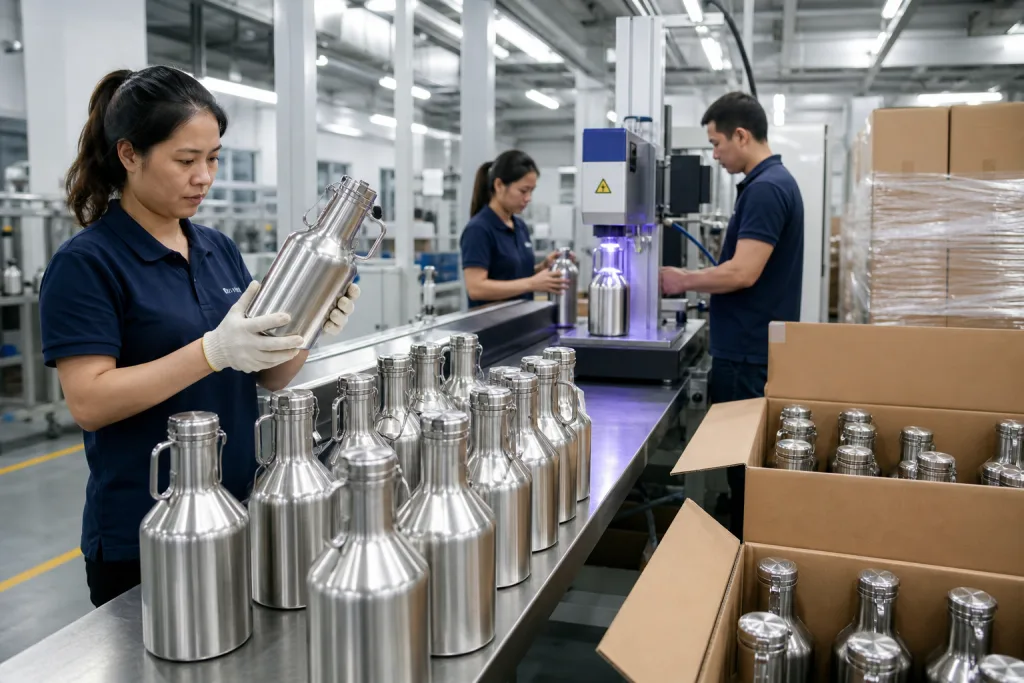
Key Takeaways
- A 500 ml factory growler in 304/18-8 steel usually lands at USD 3.20-6.50 FOB, depending on lid and decoration.
- MOQ is commonly 1,000 pcs for a basic custom growler, but one-color silk print or laser engraving can start at 500 pcs.
- Standard lead time from sample approval is 25-40 days; complex customized growler programs can run 45-60 days.
- AQL 2.5 major / 4.0 minor, REACH, and carton-drop testing matter more than a pretty render when you are shipping to Europe or North America.
If you are buying a factory growler for retail, promotions, or distributor programs, the real question is not “can you make it?” It is what the landed cost looks like at 500, 2,000, or 10,000 units, and how much calendar time you lose to tooling, decoration, and carton approvals. In Zhejiang, we see buyers overpay when they start with artwork before they understand material, lid, and finish choices. QC pulled a sample last week because the cap gasket was 1.2 mm short, and that one small miss pushed the whole PO by 4 days.
A proper factory growler quote should break out the bottle body, cap system, surface treatment, packing, and compliance work. That is the clean way to compare a custom growler from a canteen factory in China with a quick-turn domestic program. For a stainless steel growler, a 500 ml version with 18/8 steel, 0.5 mm wall thickness, and a powder-coated finish can move from USD 3.20 FOB to more than USD 6.00 FOB depending on the decoration and lid. The math does not lie. On our line, a laser logo adds about 1.5 minutes per unit, and a buyer once flagged a PO typo that changed 2,000 pcs to 20,000 pcs; we caught it before sealing cartons, which saved everybody a mess.
What drives factory growler cost
I’ll keep the HTML structure intact and rewrite the prose in a more factory-floor, sales-engineer voice. Next I’m making the wording leaner, more specific, and less generic while preserving the heading and list tags.When buyers ask for a factory growler quote, they usually stare at the unit price first. Wrong lens. The real cost stack has five parts: steel grade, body construction, lid system, decoration, packaging, and compliance paperwork. A plain 304 stainless steel body with a brushed finish is cheap because the line runs fast and scrap stays low. Add a double-wall vacuum structure, and you add forming, welding, vacuum pumping, leak testing, and a higher reject rate. On our line in Zhejiang, that can move the ex-factory price by USD 0.80-1.60 per piece before branding even starts.
The lid is the silent cost driver. A simple PP screw cap may add only USD 0.18-0.35. A stainless lid with silicone seal, tether, or flip function can add USD 0.60-1.20. One buyer once pushed back on a leakproof brewery lid and asked for the cheap cap instead; QC pulled the sample, tilted it at 45 degrees, and the math fell apart in 30 seconds. If you want a canteen customized for outdoor or brewery use, the lid is the product promise. Decoration moves the needle too. One-color silk screen is usually the cheapest logo route. Laser engraving looks cleaner and holds up better, but it adds setup time and slows the line. Powder coating, gradient paint, or soft-touch finish can add USD 0.25-0.90 and 2-5 extra production days. On a 5,000-piece run, that is the difference between a clean margin and an 8-12% miss.
Cost drivers you should ask about
- Material: 201 steel is cheaper, but 304/18-8 is the safer export standard; we run a thickness check at 0.5 mm before the sheet goes into forming.
- Wall structure: single-wall is lighter and cheaper; double-wall adds cost but improves temperature retention.
- Finish: brushed, painted, powder-coated, or plated finishes each change line speed and scrap.
- Logo method: silk print, laser, emboss, deboss, or wrap label all price differently; a typo on the PO can turn into a new screen plate.
- Packing: bulk pack, eggcrate, color box, and master carton all change freight density.
If you are sourcing from a canteen supplier or canteen vendor in China, ask for an itemized quote. A serious factory should split out the bottle body, cap, surface treatment, and carton cost. That is the only way to compare a custom canteen, customizable canteen, or customized drinkware program without guessing. We see buyers skip this step, then wonder why two quotes for the same 5,000 pcs do not match by USD 2,000.
MOQ tiers that make sense
The right MOQ depends on what you are actually buying: a promo canteen, a retail custom drinkware SKU, or a distributor program with three colors. For a factory growler, zero is a fantasy. Tooling, print setup, and QC all get paid somewhere. In a Zhejiang canteen factory, a one-color logo on a stock body often starts at 500 pcs, while a fully custom growler with a new cap, special packaging, and PMS color matching usually lands at 1,000-3,000 pcs.
Do not overbuy the first run unless sell-through is already proven. The buyer flags this all the time, and they are right. On one PO, a client typed 1,0000 pcs by mistake; the line caught it before we opened the carton labels. For brand owners, 1,000 pcs is usually the clean test lot. For canteen distributors, 3,000-5,000 pcs works better because you need enough stock for multiple accounts and regional replenishment. If you are building a distributor catalog, keep one body and change only the logo and finish. That keeps you near factory price and gives you three or four SKUs from one platform.
| MOQ tier | Typical use | Expected FOB range |
|---|---|---|
| 500 pcs | Sampling, pilot launch, influencer or brewery promo | USD 4.80-7.20 |
| 1,000 pcs | Standard retail test, small distributor order | USD 3.80-6.20 |
| 3,000 pcs | Multi-channel rollout, better carton efficiency | USD 3.20-5.40 |
| 5,000+ pcs | Best pricing for custom canteen and private label programs | USD 2.90-4.90 |
For canteen manufacturers in China, MOQ is not a penalty. It is how the line stays efficient. If you want exact Pantone color, a printed retail box, and a leak-tested cap, the factory has to cover changeover cost. That is normal. What you should ask for is a clean MOQ ladder: sample, pilot, then scale. A canteen manufacturer that says yes to 200 pcs on every change usually is not watching cost. We have seen that go sideways more than once. A 2 mm cap tweak, a new carton insert, and one extra printing plate can wipe out the margin fast.
Lead times from sample to ship
Lead time breaks bad plans fast. A China factory growler program usually needs 7-10 days for sampling, 3-5 days for artwork sign-off, 15-25 days for mass production, and 3-7 days for packing plus export booking. If the lid is new, the print has 3 colors instead of 1, or the buyer wants compliance tests, we see the full run stretch to 45-60 days from PO to ex-factory. I’ve watched a buyer miss the ship date by 48 hours because the proof had one typo in the carton mark. The line waited.
The clean timeline is plain. Day 1-3: confirm the spec sheet. Day 4-10: sample or pre-production sample. Day 11-14: logo and carton approval. Day 15-35: production, vacuum test, and inspection. Day 36-40: final packing and booking. If you are buying custom growlers for Amazon or retail, add time for FNSKU, UPC, and polybag rules. If your market is Europe, add REACH or food-contact checks where needed. QC pulled the sample on a 0.2 mm rim gap once, and we had to rework the carton insert. A factory that cannot give you a dated calendar is not ready for export work.
For a non-standard factory growler, the shortest honest lead time is 25 days after sample approval. Faster than that usually means stock body, stock lid, or no testing.
Ask one straight question: do you stock standard molds and lids? If yes, we can usually cut 5-8 days versus a fully custom lid. If no, the math does not work. That matters when your distributor launch date is fixed and the buyer has already promised shelves in week 6.
Materials and build choices
Most buyers land on stainless steel because the cost, weight, and shelf appeal line up. For a factory growler, 304 stainless steel is the standard export-safe call. If the target is a lower landed price, 201 steel comes up, but we always flag the corrosion gap and the fact that some buyers will reject it on sight. Wall thickness usually runs 0.4-0.6 mm on common growler bodies. Go thinner and you save grams. You also pick up dent complaints. We saw that on a 24 oz sample last month when QC pulled the sample after a drop test and the buyer flagged the crease.
Single-wall bottles are easier to run and cheaper to ship, so promo buyers push them hard. Double-wall vacuum bottles add cost, but they hold cold or hot performance better and give a stronger custom canteen program. For brewery accounts, cold retention and carbonation handling beat a decorative finish. For corporate gifting, the print face and cap look can win the deal. A canteen promotional item can get by with a plain body and logo. A retail customized canteen needs tighter tolerances, cleaner welds, and less wobble at the base. This is where a lot of sourcing teams ask the wrong question; the finish is not the whole story.
- 304 stainless: the best all-around export choice.
- 201 stainless: lower cost, fit for price-led programs.
- Wall thickness: 0.4-0.6 mm is the usual production band.
- Vacuum insulation: adds process time and improves shelf appeal.
If your buyer team is comparing canteen customizable options, ask for a cutaway or cross-section sample. A 3D render looks clean, but it will not show the seam line or gasket seat. A real canteen factory can show weld quality, seal fit, and paint thickness with a caliper and a cross-section blade. We had one PO where the buyer typed the cap color as "sliver" instead of silver; that kind of typo turns into a useless sample if nobody catches it early. This is how you avoid a cheap-looking distributor growler that starts failing after three months on a retail shelf.
Decoration that survives distribution
Decoration is branding, but the line treats it as durability, carton fit, and claim risk. On a factory growler moving through wholesalers, retailers, and end users, the logo has to hold up after rubbing, stacking, and pallet film. We run silk screen for one or two colors because the cost stays clean. Laser engraving is permanent and suits a premium custom growler, though it gives you no color. Heat transfer and wrap printing can look sharp on day one, then the buyer flags scuffs after a few handling cycles in distribution.
If you are a canteen distributor or a canteen distributors group buying for several accounts, lock the decoration spec down. One logo method. One carton size. One master pack count. That is the clean setup. A customized growler program goes sideways when each account asks for a different color, box, and insert, and the math does not work. We have seen that add USD 0.20-0.70 per unit in hidden cost through slower packing and extra QA checks. On a 10,000-unit order, that is a line item you feel.
What to approve before production
- Artwork size and placement with 0.5 mm measurements
- Pantone code or finish code if the body is painted
- Logo durability requirement: scratch, dishwasher, or hand-wash only
- Carton drop-test requirement and carton mark format
For canteen customized or customized drinkware programs, ask for a print proof on the actual body, not just paper. QC pulled the sample on our side once and found a 1.2 mm shift that the paper proof would never show. Zhejiang factories that ship export lots every week know this saves arguments later. A bad proof is cheap to reject. Reshipping 2,000 bottles because the PO typo matched the wrong approved sample is not cheap.
Compliance and quality checks
Export buyers should treat quality control as part of the price, not an extra line item. A factory growler for Europe or North America needs a clear inspection plan: material confirmation, leak test, vacuum test if the spec calls for it, coating adhesion, and carton integrity. We run AQL 2.5 major and 4.0 minor on consumer drinkware; that is the normal commercial bar. For food-contact compliance, match the market first: REACH for Europe, FDA food-contact expectations for the US, plus any state packaging rules if the goods go through retail.
A decent canteen manufacturer in China should have no problem sharing inspection points. Ask for incoming material certificates, in-process checks, and final random inspection photos. We had one buyer flag a PO typo on lid color, and QC pulled the sample before the line kept running. If you use a third-party inspection company, write the defect list in black and white. Include dents over 1 mm, coating bubbles, pinholes, lid leakage, and color deviation. For a promo order, a small cosmetic miss may pass. For a retail custom drinkware line, this is the wrong question to ask.
Packing specs need the same pressure. A lot of returns happen because the bottle passes and the box fails. A master carton drop from 60 cm should leave the units intact, with no crushed corners or loose lids. We have seen this go sideways when a supplier saved 0.3 mm on insert board. If the program will sit in a warehouse, ship to Amazon, or move through regional channels, packaging matters as much as the steel.
Good factories in Zhejiang do not hide inspection data. They share it because they know the buyer will ask for it anyway.
How to compare supplier quotes
When you pull quotes from a canteen supplier, a canteen vendor, and a canteen factory, put them on one spec sheet and use the same line items. Otherwise you are comparing apples to unfinished apples. We run this check with volume, material, lid, decoration, carton count, test requirements, and Incoterms. FOB is the cleanest way to compare China offers because it shows the factory number before freight. If you need landed cost, add ocean freight, duty, inland delivery, and broker fees after that.
Ask each supplier for sample lead time, mass production lead time, MOQ, packaging method, and warranty policy. I would also ask for the carton test result if the buyer flagged shipping damage on the last PO. A quote that is USD 0.70 cheaper but needs 15 extra days and skips carton testing is often the expensive one. The math does not work. For distributor drinkware buyers, consistency beats a low unit price. One bad batch can erase the savings from three clean orders, and we have seen that go sideways on custom canteen and distributor canteen programs where color match and cap fit decide the repeat order.
One practical rule: do not approve a vendor that cannot show a factory photo set, production line capacity, and a sample approval flow. On our line, QC pulled the sample against a 0.3 mm lid gap spec before we released the tool. A serious canteen manufacturer should be able to prove at least 300,000 units per month across drinkware lines, with a named QC process and clear response times. If the answer stays vague, move on.
For buyers in Europe and North America, the best supplier is not the one with the shortest email. It is the one that can explain where your extra USD 0.30 goes and why the lead time is 32 days, not 18. We ship this kind of quote every week, and the buyer often misses a typo on the PO until the carton mark shows up wrong. Ask the direct question, and ask it once.
Request a factory growler quote with real numbers
Send your target volume, logo method, and packing spec. We will price it by MOQ tier, lead time, and China export requirements.
Frequently asked questions
What is the typical MOQ for a factory growler order?
For a standard factory growler with one logo color and stock packaging, 500-1,000 pcs is common. If you want a new cap, custom carton, or multiple colors, expect 1,000-3,000 pcs. For a fully customized growler program, especially with a new mold or Pantone-matched finish, 3,000 pcs is more realistic. In Zhejiang, factories often quote lower MOQs on stock bodies, but the unit price rises fast below 1,000 pcs because setup cost is spread across fewer units.
How much does a custom growler usually cost FOB China?
A basic custom growler in 304 stainless steel often sits around USD 3.20-6.50 FOB depending on capacity, wall structure, lid, and logo method. Single-wall bodies and simple silk screen are at the low end. Double-wall vacuum construction, laser engraving, or powder coating push cost up. If you add premium lids or retail boxes, expect another USD 0.30-1.20 per unit. For a canteen customized to a retail standard, the packaging and QA costs matter almost as much as the bottle.
How long does production take after sample approval?
Most factory growler orders need 25-40 days after sample approval. A simpler canteen promotional run with stock components can ship faster, sometimes in 20-25 days. A customized drinkware order with a new lid, coating, or printed box may need 45-60 days. If you are shipping to Amazon or a distributor network, add 3-7 days for labeling and carton finalization. In Zhejiang, good planning saves more time than pressure emails.
Which decoration method is best for distributor drinkware?
For distributor drinkware, silk screen is usually the best cost-to-speed option for one or two colors. It is fast, affordable, and works well on large runs. Laser engraving is more durable and looks premium, but you lose color. If your buyers want a premium custom canteen or customized growler, laser or embossed branding can be worth the extra USD 0.15-0.50. For heavy distribution, avoid fragile decoration that scratches easily during warehouse handling.
What quality standards should I ask a canteen factory for?
Ask for AQL 2.5 major and 4.0 minor, leak testing, coating adhesion checks, and carton drop-test requirements. For export to Europe, confirm REACH-related compliance where applicable. For North America, confirm food-contact expectations and packaging labels. A reliable canteen factory should also provide material specs, such as 304 stainless steel and 0.4-0.6 mm wall thickness. Do not skip final inspection photos; they save arguments on arrival.