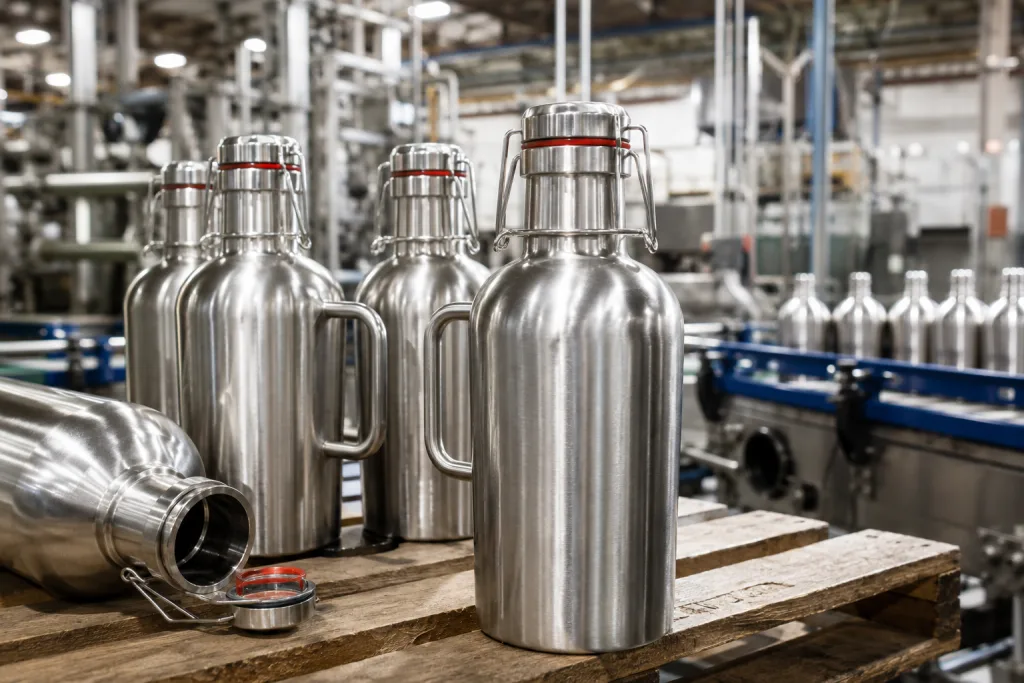
Key Takeaways
- Most factory growler bottle projects start at MOQ 500-1,000 units per SKU, with 25-35 day production after sample approval
- A 64 oz double-wall 18/8 stainless growler typically costs USD 5.20-8.90 FOB Zhejiang, China depending on lid, finish, and print
- For B2B orders, ask for AQL 2.5 inspection, leak test at 100%, and REACH or LFGB material declarations before deposit
- Logo method matters: silk screen is lower cost from about USD 0.08-0.18 per color, while laser engraving is more durable at roughly USD 0.20-0.45
You are not buying a retail growler. You are buying a repeatable supply chain: steel, lids, weld quality, print adhesion, cartons, compliance files, and a factory that can match the approved sample on the next PO. We’ve seen this go sideways when buyers ask design questions first and procurement questions after sampling. The wrong sequence costs money. Buyers in Europe and North America usually push on the same points: leakage at the cap, insulation hold time, logo finish, landed cost, and whether the Zhejiang factory ships on the promised date. On our line, QC pulled one sample last month for a 0.3 mm lid-thread mismatch, and that single detail would have turned into a leak claim in the market.
At BottleForge Industrial in Hangzhou, Zhejiang, we see 20 to 30 first-time B2B buyers a quarter arrive with a sketch and a target price, but no checklist. That is expensive. A decent custom growler program can start at 500 to 1,000 units per SKU, ship in 25 to 45 days, and land between USD 3.80 and 8.90 FOB China depending on size, steel grade, coating, and decoration. The buyer flagged one PO last season with the logo color only listed as “mat blk,” and the line stopped until we confirmed whether that meant matte black powder coat or a black screen print. This is the wrong question to ask late.
Start with the purchase brief
Ask a canteen manufacturer or canteen supplier for a quote with a purchase brief that reads like a spec sheet. That gets you a usable price fast. A mood board does not. A screenshot from social media does not. On our side, sales usually drops your brief straight into the BOM and checks it against the caliper readings from similar runs.
For a factory growler bottle, list capacity (32 oz, 40 oz, 64 oz), wall construction (single wall or double wall vacuum), steel grade (usually 18/8 or SUS304 for body, sometimes SUS201 for non-contact outer parts), mouth diameter, lid type (screw cap, swing top, carry handle), finish (powder coat, spray paint, brushed, electroplated), logo method, and target carton pack. If you need Amazon FBA, state barcode placement, FNSKU label requirements, and drop-test expectations from day one. We have seen this go sideways over one missing line on a PO, like “black lid” typed without matte or gloss.
A serious canteen factory in China will also ask where you sell. Europe may need REACH declarations and sometimes LFGB support. North America often needs FDA-contact statements and ASTM-related packaging or product safety checks depending on the item format. If you are a canteen distributor, distributor growler buyer, or distributor drinkware program manager, tell the factory whether this is private label, promotional resale, or a branded retail line. That changes the packaging spec and the inspection plan. QC pulled a sample last month because the retail buyer wanted shelf-ready boxes, while the PO still showed a plain 24-piece export carton.
- Target MOQ per color: 500-1,000 pcs
- Typical factory sample time: 5-10 days for existing molds
- Normal production lead time: 25-35 days; 40-50 days in peak season
- Useful body thickness range: 0.4-0.5 mm inner, 0.45-0.6 mm outer for stainless vacuum builds
If your RFQ is vague, the quote will be vague. Simple as that. Then you end up comparing 3 prices for 3 different bottles, and the math does not work.
What specs actually affect performance
Buyers usually start with shape and logo. That is normal. On the line, performance comes from the parts you do not see: wall thickness, vacuum level, thread fit, and gasket compression. A custom growler meant for cold retention and repeated use should usually be double-wall vacuum stainless steel. For beer, coffee, or mixed-use retail, 18/8 stainless is the safe default. We have seen low quotes save USD 0.20-0.35 per unit by dropping steel thickness by 0.1-0.2 mm, then the body dents in carton drop tests and feels too light in hand. Buyers flag that fast.
Ask the canteen manufacturer these direct questions:
- Is the inner wall SUS304 and what is the thickness in mm?
- What vacuum retention result do you guarantee, such as less than 8-10°C loss over 6 hours for chilled water?
- What is the leak test standard: 100% inversion test for 30 minutes or spot check only?
- What gasket material is used in the lid: food-grade silicone, hardness range, odor test?
- Is the powder coat thickness controlled, typically 60-80 microns?
A customizable growler with a wide mouth is easier to clean and fill, but it puts more pressure on lid design. This is where projects go sideways. Thread tolerance and gasket compression matter more than the mouth opening itself; we check thread fit with a go/no-go gauge, and a 0.3 mm mismatch is enough to start trouble. Poorly matched threads are a common leak cause, especially when canteen customized orders use color-matched custom lids from a second supplier. We have had POs where the lid code was typed wrong by one digit, and QC pulled the sample only after cross-threading showed up. If your product is really a custom canteen format rather than a classic beer growler, tell the factory whether users will add ice cubes, fruit, or carbonated drinks. Carbonation changes the closure requirement. Frankly, if the factory does not ask this, they are skipping the hard part.
A cheap body can still look good in a pre-production sample. We have seen it pass the first look, then fail later in 1.2 m drop tests, transport abrasion, or after 50 dishwasher cycles on the cap components.
Good China factories will tell you what they verify in-house and what must go to third-party testing. We run internal leak checks, coating adhesion checks, and vacuum hold checks, but not every claim belongs on an in-house report. A pretty sample proves almost nothing; an honest test boundary is worth more.
MOQ, tooling, and real FOB pricing
Every procurement manager asks this first: what should a factory growler bottle cost? The wrong question is the bare unit price. Cost starts with structure. If you use an existing mold, a Zhejiang stainless line can run 32 oz or 64 oz bodies with finish, lid color, and logo changes and skip tooling. If you ask for a new silhouette, that changes fast. On our side, QC usually checks the neck diameter first with a digital caliper, and a 0.3 mm shift is enough to change lid fit.
Typical FOB China pricing for standard-volume orders looks like this:
- 32 oz single-wall stainless growler: USD 2.30-3.80 at 1,000 pcs
- 64 oz double-wall vacuum growler: USD 5.20-8.90 at 1,000 pcs
- Bamboo or PP handle lid upgrade: add USD 0.25-0.70
- Individual color box: add USD 0.18-0.45
- Master carton drop-tested export pack: add USD 0.05-0.12
If you need a canteen customizable body shape, new lid, or bottom geometry, tooling may run from USD 1,500 to 8,000 depending on complexity. A custom lid with silicone and metal parts can take 20-30 days for tooling and first-off validation. That part is normal. What usually goes sideways is a supplier promising zero tooling on a new structure with fresh threads, hinge parts, or a different base radius. We have seen first-off samples fail on leak test just because the silicone shore hardness was off by one grade.
MOQ is more layered than buyers expect. A canteen vendor may quote 500 pcs MOQ for the bottle, but powder coat color might require 300 pcs per color and a printed box might require 1,000 pcs per artwork. We ship plenty of mixed orders where the buyer flagged the bottle MOQ, then missed the carton or insert MOQ on the PO. Confirm MOQ at SKU, color, decoration, and packaging level. That is where budget leakage starts, and the math does not work if you only check the bottle shell.
BottleForge Industrial runs capacity in the range of 300,000 units/month across drinkware categories in Zhejiang, China, but even large factories push MOQ up during peak gifting season because line changeovers cost money. On the line, one color swap can burn 2-3 hours between powder prep, hanging reset, and first-piece approval. Plan POs 60-75 days ahead if delivery matters. We have seen 12 days vs 18 days just on vessel production depending on whether the order hits before or after holiday rush.
Logo methods and packaging decisions
In custom drinkware, buyers often spend in the wrong place. We’ve seen a PO for 5,000 pcs carry a premium print spec that added USD 0.32 per unit, then the product went into a low-price canteen channel where nobody paid for that upgrade. Your logo method needs to match the sales channel. That is the first filter.
For promotional and distributor orders
If the order is for canteen promotion, event giveaways, or a distributor canteen program with tight price targets, single-color silk screen is usually enough. Cost is commonly USD 0.08-0.18 per color per position at volume. On our line, this is the fast setup option, and it looks clean on matte powder coat after a quick fixture check. The trade-off is simple: abrasion resistance is lower than laser or baked transfer. Buyers push back on this after the first scratch test, but for short-cycle promotions, the math often works.
For retail and long-life brand programs
Laser engraving fits better if you need durability and a premium look. Budget roughly USD 0.20-0.45 per position. QC pulled the sample more than once where UV print looked sharp on day one but failed because the surface prep was rushed, so do not treat print method as the only question. UV print gives stronger color detail but adds cost and needs clean surface prep. Heat transfer works for wrap graphics, though registration control is tighter—if the seam shifts by 1.5 mm, the buyer flags it fast.
Packaging gets missed all the time. A canteen customized project often fails not because of the bottle, but because the gift box scuffs, collapses, or prints the brand red as the wrong shade. Ask for carton spec in plain numbers: paperboard weight, E-flute or B-flute, inner tray material, and export carton drop test level. This is the right question to ask. For retail-ready customized canteen packs, require barcode scan test and shipping mark approval before mass production. We ship smoother when those files are signed off before the first carton mockup.
- Standard opp bag + egg crate carton is the low-cost default
- Mailer-safe color box usually needs stronger corner support
- For Amazon, ask for suffocation warning, FNSKU position, and carton weight under your warehouse limit
A reliable canteen vendor will tell you if the packaging design is unrealistic for the budget. We’ve seen this go sideways with a 250 gsm box spec on a 1.2 kg packed set. That is useful advice, not resistance.
How to qualify a China factory
You do not need a perfect supplier. You need a canteen manufacturer that is open with data, steady on delivery, and built for your market. We’ve audited plants in Zhejiang that looked polished in a meeting room and still had 0.3 mm wall variation on the line. Qualification should stay practical.
Start with documents. Then verify what happens on the floor. Ask for the business license, ISO 9001 if available, BSCI or Sedex status if social compliance matters to your customers, and recent test reports for material contact safety. For stainless growlers, ask what they control in-house and who owns the equipment: vacuum testing, leak testing, coating adhesion, salt spray, and incoming raw material checks. If they say they do vacuum testing, ask what pressure standard they run and how QC records it. This is the wrong question to ask if you only want a cheap quote, but it tells you fast whether you are talking to the factory or a sales middle layer.
Then ask operational questions a real factory can answer in 2 minutes, not after 3 follow-up emails and a vague spreadsheet:
- How many units per month do you produce in drinkware?
- What percentage of orders are export versus domestic?
- What is your normal lead time in peak season?
- Can you support AQL 2.5 final inspection and 100% leak test?
- What is your deposit term: 30/70, LC, or another structure?
If a canteen supplier avoids specifics, assume the order may be trading through multiple layers. That is not always bad. We ship through coordinators on some projects. The risk is different, and the math changes. A trading setup should be priced and managed that way. Trouble starts when they call themselves a canteen factory but cannot answer body thickness, gasket material, or welding method. We’ve seen this go sideways after a buyer flagged a lid leak and the seller still could not confirm whether the seal was silicone or TPR.
For buyers new to custom canteen or customizable drinkware sourcing, use one simple test: ask for a cut-open reject sample or a factory QC photo set. Real producers usually have both, and QC pulled the sample before. Traders often do not. Ask for one cross-section shot near the shoulder weld and one leak-test station photo with the date card in frame. It sounds small. It saves time. You will see fast whether the partner understands the product technically or just forwards emails.
Quality checklist before you pay deposit
Use this checklist before you pay deposit. Not after the goods are packed and the line has moved on.
- Approved golden sample: signed off for color, finish, logo size, and lid fit; we usually mark the sample carton with PO date and buyer name so QC does not pull the wrong version
- Specification sheet: capacity tolerance, net weight, dimensions, steel grade, coating code; if the body drawing shows 0.5 mm wall difference, ask now, not after tooling is set
- Testing plan: leak test 100%, vacuum retention sample size, coating adhesion, odor test; on growlers, we run a full water-fill leak check because one bad silicone gasket can sink the batch
- Inspection plan: AQL 2.5 major / 4.0 minor is common for export drinkware; QC pulled the sample from top, middle, and bottom cartons on our last run
- Packaging approval: barcode, carton marks, pack count, carton dimensions, gross weight; one wrong digit in the barcode or a PO typo on the carton mark will block shipment faster than a scratch on the body
- Compliance file: REACH declaration, FDA/LFGB support if applicable, BPA-free statement for plastic parts; ask which lid and gasket material is on file, because PP and silicone documents are not the same thing
- Commercial terms: FOB Ningbo or Shanghai, deposit %, balance timing, delay clause if agreed; this is where buyers push for flexible balance terms, and sometimes the math doesn't work
For a customized growler or customizable canteen with several accessories, ask for a pre-production meeting summary in writing. One page is enough. Put in the approved color chips, print placement in mm, gasket color, and carton layout. We have seen this go sideways over a 3 mm logo drop. The buyer flagged it as too low, and the factory pointed back to the art proof.
If you work with canteen distributors, canteen manufacturers, or distributor drinkware importers across several markets, keep one master checklist and lock the non-negotiables. Change only artwork, language, barcode, and carton mark. That is the right control point. Last quarter, one buyer kept the same checklist across 4 markets and cut approval time to 12 days vs 18 days. Chasing another USD 0.07 off unit price sounds smart, but consistency usually saves more.
Send your growler spec and get a workable quote
Share capacity, target price, logo file, and delivery window. We will review MOQ, FOB cost, lead time, and technical risks before you place a PO.
Frequently asked questions
What is a realistic MOQ for a custom growler order?
For a standard factory growler bottle using an existing mold, 500 to 1,000 units per SKU is realistic in China. If you want a new body shape, lid tooling, or custom retail box, effective MOQ often rises to 1,000 to 3,000 units because decoration, coating, and packaging all have their own minimums. For example, the bottle may be 500 pcs MOQ, but a special powder coat color can require 300 pcs per color and a printed box may need 1,000 pcs per artwork. If you are a canteen distributor combining several clients, ask for MOQ by bottle, color, logo method, and packaging separately. That gives you a real picture of the order, not just a headline number.
How long does production take after sample approval?
For existing models from a Zhejiang or other China drinkware factory, normal sample time is 5 to 10 days and mass production is usually 25 to 35 days after deposit and sample approval. Peak season can push this to 40 to 50 days, especially from September to November. If you need a customized growler with new tooling, add 20 to 30 days for mold work and first sample corrections. Also allow 3 to 7 days for final inspection, booking, and export paperwork. If your program includes custom packaging, barcode labels, or Amazon prep, lock artwork before production starts. Late artwork approval is one of the most common reasons a “30-day lead time” becomes 45 days.
Which material and lid style are best for a growler bottle?
For most B2B custom drinkware programs, double-wall 18/8 stainless steel with a food-grade silicone gasket is the safest default. Inner wall thickness around 0.4 mm and outer wall around 0.5 mm gives a good balance of durability and cost. For hot and cold retention, vacuum construction is far better than single wall. Lid choice depends on use. A screw cap with molded handle is the most reliable for export and repeated opening. Swing tops look traditional but need tighter control on sealing parts and can add failure points in transit. If users may store carbonated beverages, state that clearly to your canteen manufacturer because closure pressure performance matters more than appearance.
What quality checks should I require before shipment?
At minimum, require 100% leak testing, visual inspection against an approved golden sample, and an AQL final inspection, commonly AQL 2.5 for major defects and 4.0 for minor defects. For insulated bottles, ask for vacuum retention testing on a defined sample size, coating adhesion checks, and odor testing for silicone and plastic parts. If the bottle has custom packaging, include barcode scan verification and carton drop testing. For Europe, ask for REACH support and material declarations; for North America, request food-contact statements relevant to the product materials. A good canteen supplier should provide inspection photos, carton marks, and final packing list before balance payment, not after the container is sealed.
How should I compare quotes from different canteen suppliers?
Compare like for like, or the cheapest quote is meaningless. Put all suppliers on the same specification sheet: capacity, steel grade, wall thickness, finish, lid type, logo method, packaging, MOQ, FOB port, and lead time. Ask each canteen vendor to confirm whether the quote includes mold cost, sample cost, barcode labels, and export cartons. A price difference of USD 0.40 to 0.80 can come from thinner steel, a cheaper gasket, weaker packaging, or excluding logo setup. Also compare commercial terms. One canteen factory may offer FOB Ningbo with 30/70 payment, while another quotes EXW with no inspection support. Landed risk matters as much as unit cost when you source customized drinkware from China.