Key Takeaways
- Typical MOQ starts at 1,000 units for printed factory drinkware and 3,000 units for custom mold work
- Standard lead time is 25-35 days after sample approval, plus 20-35 days for ocean freight
- Decoration can change unit cost by $0.12-$0.80 depending on print area, colors, and finishing
- REACH, FDA-related material checks, and AQL 2.5 inspection should be written into the PO
If you are buying factory drinkware, finding a supplier is the easy part. Reading the quote is the real job. Two bottles can look the same on paper and still differ by $0.40, 18 days, and one failed test report. We see it on the line all the time. The gap usually comes from mold choice, decoration method, carton pack-out, and how tight the factory is on production planning.
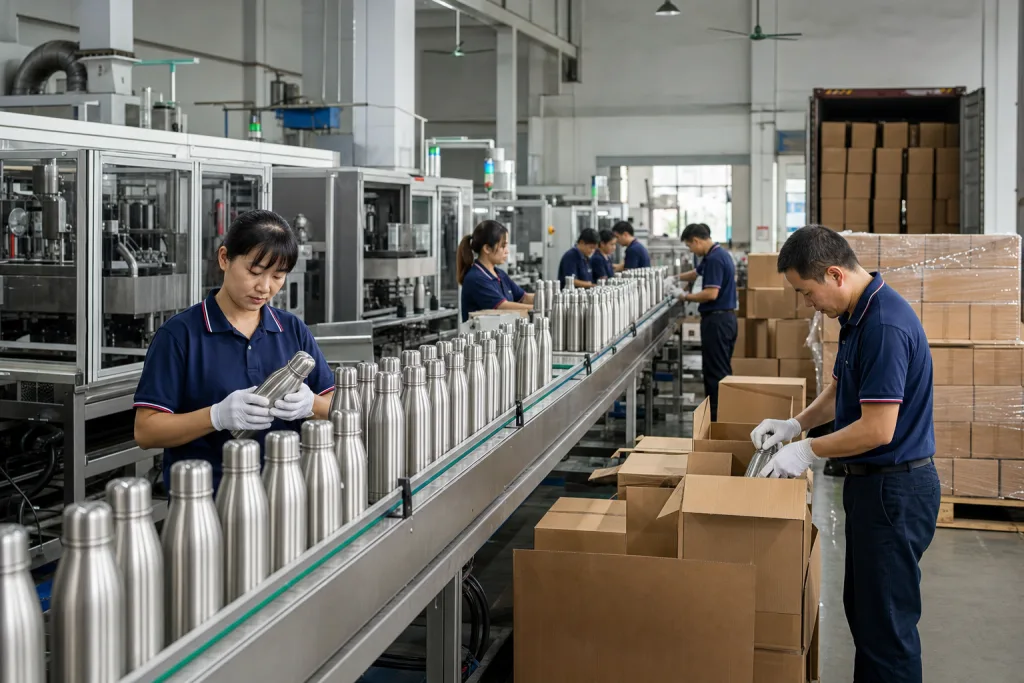
At our Zhejiang factory, we ship over 800,000 units a month. Buyers who ask about MOQ, lead time, and compliance at the start get cleaner pricing and fewer surprises. Buyers who skip those questions usually pay for artwork changes, lid upgrades, or a rush order later. QC pulled the sample, and the buyer flagged a lid typo on the PO before mass production. That saved a week. If you want custom drinkware for Europe or North America, price the full job, not just the bottle.
What drives the unit price
Buyers usually ask for one price. The factory side does not work that way. We price a canteen by material, forming method, lid structure, decoration, packing, and MOQ. On a 500 ml stainless steel bottle, 201 vs 304 steel is often only $0.18 to $0.35 apart, while a basic PP lid versus a leakproof 2-piece lid can swing $0.22 to $0.60. Add a silicone loop, powder coating, and a retail box, and the quote moves fast. QC pulled the sample on the line last week because the buyer flagged a lid leak at 1.2 mm tolerance.
Tooling drives the jump. A stock mold with logo printing can keep landed cost around $1.20-$2.10 FOB China for simple promotional canteen orders. A fully custom canteen with a new shape, new cap, and molded handle can land at $2.80-$5.50 FOB, depending on volume. We separate unit cost from new tooling; the math does not work any other way. A buyer once mixed those two lines on the PO, and the first sample approval went sideways before we even ran production.
- Material: 304 stainless, Tritan, glass, or aluminum all price differently
- Decoration: screen print, laser, UV print, or wrap labels
- Packaging: bulk pack, color box, mailer, or retail-ready carton
- Compliance: REACH, LFGB, FDA migration tests, and audit costs
If you are sourcing a custom canteen or custom growler, ask the canteen manufacturer to split the quote into product, mold, printing, and packaging. That is how you compare canteen vendors and canteen suppliers on equal terms. We ship quotes this way every day in Hangzhou. One typo on a PO, like 5000 pcs changed to 500 pcs, can make the whole order look cheap or expensive for the wrong reason.
MOQ tiers that actually matter
MOQ is where distributor drinkware orders start to slip. A factory drinkware supplier may quote 500 pieces, but that usually means one stock body, one-color print, and standard packing. Change the lid, add a matte coat, or ask for a custom canteen in a specific Pantone color, and the MOQ moves up. We’ve seen the buyer flag a PO typo on the lid code and the line still had to stop. A practical China tier setup looks like this:
- 300-500 units: stock item, simple logo, existing packaging
- 1,000 units: most custom drinkware print jobs, including canteen promotional runs
- 3,000 units: custom color, special finish, or custom logo packaging
- 5,000+ units: canteen customizable projects with new molds or deep customization
For a distributor canteen program, the right MOQ depends on sell-through, not hope. This is the wrong question to ask if the calendar is your only plan. If the first run is 1,000 customized drinkware units and your replenishment cycle is 60 days, you can test demand without parking too much cash. For a canteen distributor serving schools, sports clubs, or outdoor chains, 3,000 units can make more sense because it cuts unit cost by 8% to 15% versus a smaller run. QC pulled the sample on a 304 stainless bottle last week and found the print was off by 1.2 mm. That kind of miss gets expensive fast.
Mixed SKU orders need a hard look. Three colors at 1,000 pieces each usually cost more than one color at 3,000 pieces. We run that math every week, and it never gets prettier with small splits. A canteen factory in Zhejiang will usually give cleaner pricing on one repeated spec than on a scattered order with too many variants. The buyer asked for four lids, two body colors, and separate cartons once. The quote jumped 14%. No surprise.
Lead time from sample to ship
Lead time is not just production days. For factory drinkware, we count sample approval, carton artwork, production, AQL 2.5 inspection, and the booking window for sea freight. On one 500 ml bottle job, QC pulled the sample on day 8, the buyer flagged a lid typo on the PO, and we still needed 28 days for mass production after final sign-off. A normal timeline is 7-12 days for samples, 3-5 days for revisions, and 25-35 days for mass production after final approval. If the item needs a new mold, add 12-20 days before sampling even starts.
For a standard canteen with existing tooling, the line moves faster:
- Artwork confirmation: 1-2 days
- Pre-production sample: 7-10 days
- Mass production: 20-30 days
- AQL inspection and packing: 2-4 days
- Ocean freight to Europe or North America: 18-35 days, depending on port and season
A buyer hears “30 days” and expects the carton to load next week. The math does not work. We’ve seen this go sideways when the order also needed custom kraft boxes and a drop test report, then the shipper missed the cut-off by 4 days. If you need stock for a launch date, place the order at least 75 days ahead. That is safer than paying express freight later. A canteen vendor that claims 12 days for a fully customized growler should raise a flag unless they are only changing print on a stock item.
Practical rule: if your project needs new tooling, custom packaging, and compliance testing, plan for 45-60 factory days before the cargo leaves China.
How decoration changes the quote
Decoration is where a canteen factory makes or loses margin, and buyers often read the quote wrong. A one-color silk screen on a stainless bottle usually adds $0.08-$0.15 per unit. Two colors or three colors can lift that to $0.18-$0.35. Laser engraving looks simple on paper, but on heavy-wall steel the head runs slower and the finish needs tighter control. We saw that on a 750ml bottle last month: the buyer wanted the same art on both sides, QC pulled the sample, and the line had to slow down. UV printing on curved custom drinkware can add $0.25-$0.80, depending on coverage.
If you are buying canteen promotional stock for events, the cheapest route is usually one-color print on an existing bottle shape. If you want a premium distributor growler for retail, matte powder coat plus laser mark usually gives a cleaner face and avoids artwork mismatch. For a customizable growler, you may also need a special lid gasket or carry handle, and those small parts change the price and the lead time. One PO came in with the gasket line missing the word silicone. The buyer flagged it, and we had to stop the job until we got a corrected file.
- Silk screen: low cost, good for simple logos, best at 1-2 colors
- Laser engraving: durable, premium look, slower on large areas
- UV print: good for detailed artwork, higher cost, more setup
- Heat transfer/wrap: useful for full-color designs, but not always dishwasher-safe
Ask the canteen supplier whether the decoration is tested for abrasion, dishwasher exposure, and condensation. This is the wrong question to leave vague. A good factory drinkware supplier in Zhejiang should tell you the failure points, not just show you a glossy sample. On our side, we run an abrasion rub test at 500 cycles and check edge lift under condensation, because a pretty print that fails after 12 washes does nobody any favors.
Compliance and quality checks
If you sell into Europe or North America, compliance is not optional. For custom drinkware, check the base material and every food-contact part: stainless steel grades, silicone, PP, Tritan, coatings, inks, and adhesives. A serious canteen factory should send REACH papers for Europe, food-contact declarations, and migration test reports where they apply. For the US market, buyers often ask for FDA-related material statements, but the PO still needs the exact test scope. We had a buyer flag a missing coating code on a PO once, and that small typo held the file for 3 days.
Quality control needs numbers, not slogans. We normally set AQL 2.5 for major defects and 4.0 for minor defects on finished factory drinkware. For retail programs, ask for:
- Drop test from 1 meter, 3 times
- Leak test at 100% fill for 5-10 minutes
- Coating adhesion test
- Carton drop test for export packing
If you are ordering customized canteen products for a distributor network, do not assume one spec fits every market. A canteen distributor in Germany may ask for a thicker test file than one in Texas. The line can make both, but the paperwork load is different. China has plenty of capable factories, and some are not set up for export documents. Ask for ISO 9001, BSCI, and shipment references from the last 12 months if you want fewer headaches.
If the supplier cannot explain the difference between material compliance and finished-goods testing, keep looking. That is the wrong question to dodge. We have seen this go sideways: QC pulled the sample, the lid passed, the cup failed after a 24-hour hot-water soak, and the buyer had to rework the order.
Choosing the right factory partner
The best factory drinkware partner is not the cheapest quote. It is the one that repeats the same spec on the line, shift after shift. A real canteen manufacturer should tell you monthly capacity, line count, sample turnaround, and where the bottleneck sits. In our Hangzhou plant, we run 800,000 units per month across stainless, plastic, and glass drinkware, and standard custom orders ship in 25-35 days from approval to finish. The buyer who chases a “fast delivery” promise without asking how the press line is balanced is asking the wrong question.
When comparing canteen suppliers or canteen vendors, ask these direct questions:
- What is the MOQ for the exact spec, not the brochure model?
- What is the unit price at 1,000, 3,000, and 5,000 pieces?
- What tooling cost is separate from the piece price?
- What is the acceptable defect rate and what is the AQL level?
- Which packaging format is included in the quote?
A distributor canteen program needs consistency more than novelty. If the supplier keeps changing the cap, the coating gloss, or the carton thickness, your warehouse team will pay for it later. QC pulled the sample last week and caught a 1.2 mm lid gap on one run; that kind of miss becomes a claim if nobody checks it early. Good canteen manufacturers in Zhejiang know this and will usually suggest a simpler spec that holds the margin. That is not less professional; it is export-ready.
Buyer math for landed cost
FOB is just the starting line. To see what factory drinkware really costs, you add ocean freight, duty, inland delivery, and compliance overhead. We shipped a 1,000-unit order of 500 ml custom drinkware at $2.10 FOB, and the landed number in Europe and North America landed at $3.15-$4.05 after customs charges and domestic transport. Air freight changes the picture fast. The same order can climb by $1.20-$2.80 per unit, and that kills margin on low-price promotional canteen programs.
This is the math buyers actually run:
- FOB China: product price from the canteen factory
- Ocean freight: a 3,000-unit lot moves cheaper than a 500-unit lot
- Duty and VAT/sales tax: market dependent, and the bill does not shrink on its own
- Packaging and labeling: FNSKU, barcode, carton marks, retail inserts
If you sell through Amazon or retail distribution, labeling mistakes cost more than most decoration upgrades. We had a buyer flag a PO because the carton marks said 24 pcs, but the inner pack list showed 20 pcs. The line had already packed 300 cartons. A distributor growler or customized growler may need individual polybags, warning labels, and carton marks that match your warehouse system. That is why smart buyers ask for a landed-cost quote before approving art. A canteen custom project that looks 12% cheaper on paper can end up more expensive after freight and labeling if you do not lock the full spec.
China, especially Zhejiang, still works well for this kind of sourcing because production, decoration, and packing sit in one plant. We run the line, QC pulled the sample, and the job moves faster by days if the PO is clean. If one line says 500 ml and another says 17 oz, the math does not work.
Get a real quote, not a guess
Send your target volume, material, logo method, and delivery country. We will return a clear factory drinkware quote with MOQ, lead time, and packing details.
Frequently asked questions
What is a realistic MOQ for factory drinkware?
For stock factory drinkware with logo print, 300-500 units is possible. For most custom drinkware, expect 1,000 units. If you want custom color, special packaging, or new tooling, 3,000-5,000 units is more realistic. A canteen factory in China will usually quote lower MOQs only when you accept higher unit pricing or limited decoration options.
How much does a custom canteen cost FOB China?
A simple custom canteen with existing tooling and one-color print often lands around $1.20-$2.10 FOB China. A more customized canteen with special coating, upgraded lid, or retail box can run $2.80-$5.50 FOB. New mold charges are separate and can add $800-$6,000 depending on complexity. Zhejiang factories usually split tooling from unit price.
How long does production take after sample approval?
For most customized drinkware, plan on 25-35 days after sample approval. If you need new tooling, add 12-20 days before samples. Then allow 18-35 days for ocean freight to Europe or North America. A practical end-to-end timeline is 45-65 days for a standard order, and 75+ days if you need design changes or peak-season shipping.
What quality checks should I ask for?
Ask for AQL 2.5 on major defects and 4.0 on minor defects, plus leak testing, drop testing from 1 meter, and carton drop tests. For Europe, request REACH-related documentation and food-contact declarations. For North America, many buyers also request material statements and internal migration testing. A serious canteen supplier should be able to show these before shipment.
Can I order a custom growler for distribution without high risk?
Yes, if you keep the spec controlled. A customizable growler with existing mold tooling, one lid style, and one decoration method is manageable at 1,000-3,000 units. Avoid too many variants in color or packaging on the first run. Distributor growler programs work best when you standardize the body and only change the logo or finish.