Key Takeaways
- A usable RFQ for a factory direct growler should lock 12 core specs before sampling, including capacity, steel grade, insulation, finish, logo method, and carton pack
- Typical MOQ is 500-1,000 pcs per size/color, with sample time around 7-10 days and bulk production 30-45 days after deposit and artwork approval
- For vacuum stainless growlers, 18/8 steel, 0.4-0.5 mm wall thickness, and AQL 2.5 final inspection are practical baseline requirements
- Put PO line items on every step: sample approval, lab tests, packaging marks, spare ratio, and defect limits, or you will pay for ambiguity later
You can buy a growler from a trader, a canteen vendor, or direct from a canteen factory in China. The price gap is real. So is the risk. On the quote sheet, a factory-direct order looks clean: volume, color, logo, carton. Then sampling starts. QC pulled the sample and the lid seeped at a 45° tilt test, the Pantone chip did not match the sprayed body, or the master carton failed the first drop on the corner for a distributor program.
If you buy for retail, promo, or wholesale in Europe or North America, you need a process that cuts assumptions before the PO is issued. This is the wrong question to ask: “What is your best price?” In Zhejiang, we see the same mistake every week. The buyer who locks the line items early usually saves 2 to 4 weeks later—12 days vs 18 days is common just on sample correction and carton approval. That matters when MOQ starts at 500 pieces and standard bulk lead time is 30 to 45 days. We’ve seen this go sideways over a 2 mm logo shift or one PO typo on carton marks.
Start with the commercial brief
Before you ask a canteen manufacturer for pricing, pin down the commercial job first. A factory direct growler for brewery merchandise is a different build from a customized drinkware program for a big-box private label, and it is also different from canteen promotional stock for an event distributor. We quote faster and with fewer mistakes when the buyer sends a one-page brief, not a two-line message asking for a custom canteen or customizable growler. One page is enough.
Your brief should answer five practical questions:
- Channel: retail, ecommerce, distributor growler, on-premise brewery, or corporate gifting
- Target price: for example FOB Ningbo under USD 6.80, or landed under USD 9.50
- Volume plan: launch quantity, repeat forecast, and whether you can consolidate colors
- Compliance market: EU REACH, LFGB where needed, or North America with FDA and California-focused chemical controls
- Packaging goal: PDQ tray, mailer-safe individual box, or simple export carton
Buyers new to China often ask 6 to 12 suppliers for "best price" first. This is the wrong question to ask. It usually creates two problems: one factory quotes 0.4 mm body material with a plain export carton, another quotes heavier gauge with a gift box and upgraded lid. The numbers look close on paper. They are not comparable. In Zhejiang, China, a serious canteen customized project starts with the selling scenario because structure cost can swing by USD 0.60 to 1.80 per unit based on steel weight, lid design, and packaging. We have seen buyers flag a quote gap, then realize one PO had no inner box spec at all.
Put these first line items into your RFQ file:
- Capacity: 32 oz, 64 oz, or 128 oz equivalent
- Body material: SS304 inner and outer, or SS304 inner with SS201 outer if your market allows it
- Insulation: single wall or double wall vacuum
- Finish: powder coat, spray paint, brushed, polished, or full-wrap print
- Estimated order quantity and reorder plan
If you send that file cleanly, a canteen factory can quote apples to apples within 24 to 72 hours instead of burning three rounds on clarification. QC pulled one sample last month because the finish code on the PO said matte black, while the artwork note said gloss black. Small miss, big delay. We run quotes off the brief, and the math works better when the first spec sheet is tight.
Build the RFQ around exact specs
Get specific here. We lose the most time when a custom growler quote is approved from one reference photo and nothing else. A photo will not show a 0.1 mm wall change, a loose gasket fit, or a shoulder weld line that QC pulled under a 500 lux light box. If you buy factory direct growler models, write the build standard in plain numbers.
For most B2B orders, the baseline RFQ should include:
- Capacity tolerance: for example 64 oz nominal, +/-3%
- Steel grade: 18/8 stainless steel, commonly called SS304, for food contact parts
- Wall thickness: 0.4 mm inner and 0.5 mm outer is common for a durable vacuum body
- Mouth diameter: such as 45 mm or 55 mm, affecting filling speed and cleaning
- Lid construction: screw lid, swing top, carry loop, silicone gasket hardness
- Thermal target: keep cold 24 hours, hot 12 hours, tested at defined fill temperature
- Surface standard: powder coat 60-80 microns, or brushed finish with no visible weld marks at 50 cm
- Logo method: silkscreen, laser engraving, heat transfer, digital print, or embossed patch
Secondary product language matters too. If your wider range includes canteen custom, customizable canteen, or customized canteen styles, state whether you need the same visual standard across growlers, tumblers, and sports bottles. A canteen distributor usually wants one Pantone target, one logo position, and one finish standard across 6 to 12 SKUs. We have seen this go sideways when the buyer flagged two dark navy samples that were both "correct" on paper but came from different coating suppliers.
Add explicit PO line items even at quotation stage:
- Unit price basis: FOB Ningbo or FOB Shanghai
- Tooling or setup charge, if any
- Sample fee and refund rule after bulk order
- Carton dimensions, gross weight, and units per carton
- Spare parts ratio for lids or straws if applicable
Zhejiang canteen suppliers who run export orders every week usually handle this format well. It tells the sales team and the line you are buying with controls, not guessing from photos. That improves quote quality. It also cuts negotiation time; we often see 12 days vs 18 days once carton spec, spare lid ratio, and FOB port are fixed on the first RFQ.
Ask for samples that answer risks
Sampling is not a beauty contest. It is how we cut expensive mistakes before bulk starts. Most custom drinkware buyers should ask for at least two sample stages, and this is one place where the extra 7 to 10 days usually saves money:
- Stock sample: existing mold, similar finish, sent in 2 to 5 days so you can judge size, lid feel, and overall quality
- Pre-production sample: your exact customized growler with logo, color, and packaging, usually 7 to 10 days after artwork approval
Do not approve a sample just by checking body color under office light. Check the failure points. On a factory direct growler, we look at leak test, vacuum test, thread smoothness, base stability, coating adhesion, and carton fit. QC pulled samples before where the body looked good but the lid thread felt rough on cycle 6, and the buyer flagged it right away. A growler for beer or cold brew also needs a lid that stays sealed after repeated opening, not one pass in a static water test. This is the wrong question to ask: “Does it look nice?” Ask whether it still works after 10 open-close cycles.
Sample checklist worth putting on the PO
- Leak test: no leakage after 30 minutes inverted and 10 cycles of opening and closing
- Vacuum performance: no heat transfer line or failed vacuum spot check
- Coating adhesion: cross-hatch or tape check according to agreed internal standard
- Logo position tolerance: for example +/-1.5 mm
- Carton fit: no body movement causing abrasion in transit
If you are a canteen distributor or distributor canteen buyer serving multiple customers, request one sealed golden sample kept by both sides. That sample becomes the visual and structural reference for bulk inspection. We usually label it with PO number, date, and signature, then seal it in a PE bag before it goes into the sample room. It avoids the usual argument later about what "matte black" or "soft touch" was supposed to mean. We have seen this go sideways over a small PO typo and a color callout that was too loose.
You do not need a perfect sample. You need a sample that shows what must be fixed before money goes into production.
A capable canteen manufacturer in China will usually charge USD 50 to 150 for a custom sample depending on print method and packaging, then credit part or all of it against bulk. That is standard. The expensive mistake is skipping the sample and finding the issue after 5,000 pieces are packed. At that stage, the math doesn't work. One rubbed logo or one loose carton divider turns into a full rework problem on the line.
Write the purchase order like a control plan
Once the sample is approved, your PO should read like a control plan, not a loose quantity sheet. This is where buyers lose ground fast. If the PO only says "64 oz customized growler, black, 3,000 pcs," the line still has to guess finish code, lid build, carton pack, and label position. We have seen this go sideways over one missing note on a 2 mm logo offset.
Use line items that tie the commercial deal to what production will actually run. A solid PO for custom canteen or customized drinkware programs should include:
- SKU code and description: exact size, lid type, and finish, down to matte vs powder coat and the approved lid drawing revision
- Quantity split: by color, logo variant, and packaging language version, so the line does not mix 1,200 black units with 1,800 white units under one loose remark
- Unit price and trade term: FOB Ningbo, EXW Zhejiang, or other agreed basis, with the same wording shown on the PI and PO
- Payment term: common structure is 30% deposit, 70% against inspection or copy B/L, and this should match finance release terms exactly
- Delivery window: for example 35 days after deposit and final artwork approval, not "ASAP" or "late June"
- Inspection standard: AQL 2.5 major, 4.0 minor, or your own protocol, with the sampling level stated so QC pulled the sample the same way you expect
- Packaging details: inner box material, barcode label placement, carton marks, pallet rules, and even tape direction if your warehouse flagged crush damage before
- Compliance file: declaration for REACH, food-contact test report scope, factory social audit status such as BSCI if required, plus the report issue date if your retailer checks validity
For Amazon or omnichannel buyers, add FNSKU, suffocation warning language, carton label format, and overbox instructions if required. We ship plenty of orders where the buyer flagged a carton font size after production, and that is the wrong question to ask that late. For canteen promotional orders, include the exact event date and a late-delivery penalty only if you can actually administer it.
State acceptable substitutions in plain words. Example: lid gasket must remain food-grade silicone of agreed hardness; no material or finish substitution without written approval. On our side, incoming material is checked against the approved sample and Shore hardness if needed. Across busy seasons in China, raw material supply does change. If your PO says nothing, you are betting on goodwill instead of process.
At BottleForge-scale production, a monthly capacity of 300,000 units across drinkware lines is manageable because each PO is built clearly. The supplier may use a different template. That part does not matter. What matters is that every department, from purchasing to packing, reads the same control points from the same document.
Control bulk production before it ships
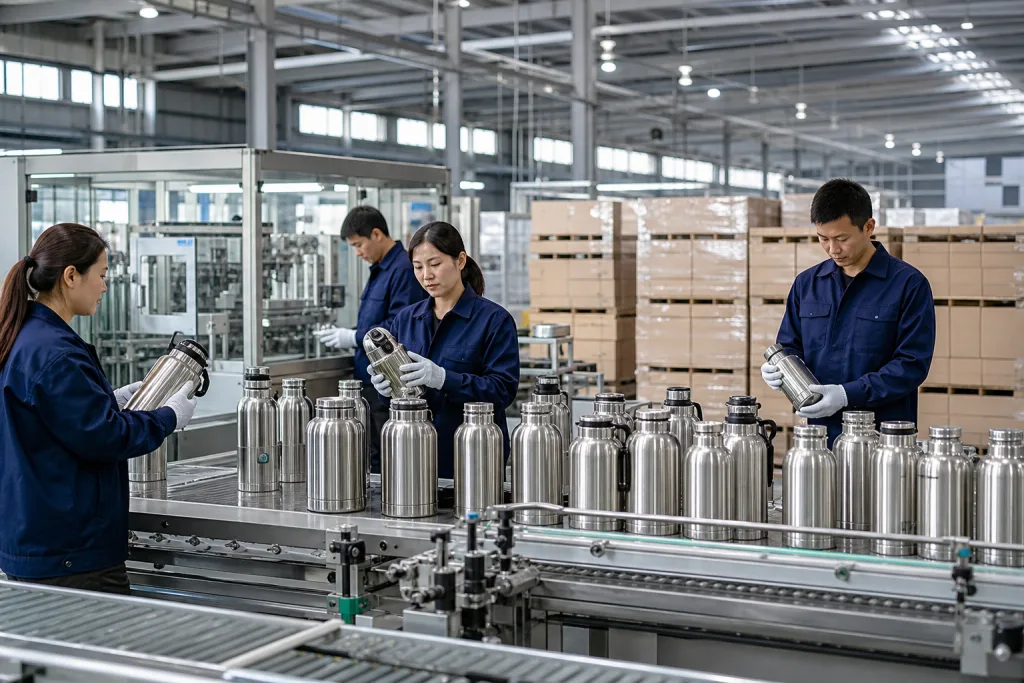
After deposit, the job is not done. Bulk production needs checkpoints tied to release points, not a nice-looking schedule on WhatsApp. On a 3,000 to 10,000 piece factory direct growler order, we run material prep, body forming, welding, vacuuming, polishing, coating, logo application, assembly, packing, and final inspection in sequence, and each stage should have one sign-off before the next lot moves. We have seen 0.8 mm logo shift pass down the line because nobody stopped at first article. That is the wrong question to miss.
You should ask for three updates at minimum:
- Pre-production confirmation: raw materials, Pantone, artwork, and carton layout signed off
- In-line update at 20-30% completion: photos or video of coating and logo consistency
- Pre-shipment inspection readiness: packed quantity, carton count, and test records
For vacuum stainless growlers, the defect patterns are predictable. QC pulled the sample and found pinholes in weld zones, denting at the shoulder, weak powder coat on curved edges, and misaligned logos from fixture drift more times than we like to admit. If your canteen customizable range runs two or three body heights on one line, fixture mix-ups happen fast; last season a buyer flagged 64 pcs packed under the wrong SKU because the nest plate was changed mid-shift. This goes sideways when nobody checks the first packed carton.
Testing should match risk, not marketing language. Useful checks include:
- Vacuum retention sample test
- Leak test on finished units
- Coating adhesion and abrasion spot checks
- Salt spray testing if you claim exterior durability, with clear hour target
- Drop test on export carton, especially for ecommerce
If you use a third-party inspector, brief them properly. "Check quality" is not a brief; it gets you a generic report and missed claims. Give them the golden sample, PO, packaging artwork, barcode list, and AQL plan. In Zhejiang, 8 out of 10 factories already know how to work with SGS, Intertek, or local Asia-focused inspection teams, so the inspector brand is not the main issue. What matters is whether the checklist matches your channel, carton standard, and claim set. We once saw a PO typo on barcode suffixes hold a shipment for 2 days at final packing.
AQL is not a magic shield. It is a sampling method, nothing more. If the product has one non-negotiable point, such as leak-free performance, write it clearly to the factory and inspector: any confirmed leakage is a critical defect and must be sorted 100%. The math does not work if 1 leaking growler reaches a gifting program or retail shelf.
Plan logistics, repeats, and supplier fit
The last stage is not about one container. It is about whether this supplier can support repeat POs without drama. A factory direct growler source needs to ship on time on the first order and make the second and third orders smoother. That is the real test. We have seen buyers focus on sample approval, then get stuck later because the cap mold changed by 0.3 mm and the reorder no longer matched the first lot.
Start with freight math, not headline FOB. A lower FOB from an inland canteen factory does not mean much if trucking to port, terminal fees, or a missed vessel cut-off wipes out the saving. Zhejiang is strong here because we ship through Ningbo and Shanghai every week, and the transit planning is simpler for most programs. Ask your canteen supplier for carton size, CBM, gross weight, and load quantity at the quoting stage. A 64 oz vacuum growler packed in an individual color box takes more room than most buyers expect; on one project, changing the insert structure cut loading from 1,680 pcs to 1,440 pcs in a 40HQ, and the math did not work.
Then review supplier fit beyond price:
- MOQ flexibility: can they run 500 pcs per color, or does the line stop below 1,000 pcs because coating setup loss is too high
- Repeat consistency: do they keep the same coating vendor and lid source on reorders, or does QC pull a sample and find gloss and thread fit changed
- Range support: can they also supply custom canteen, customizable drinkware, or customized canteen items under one quality system and one inspection standard
- Documentation: do they provide test reports, material declarations, and clean barcode control; we once saw a PO where the inner carton mark carried the wrong EAN by one digit
- Communication speed: are engineering questions answered in 24 hours, or does the buyer flag a leakage point and wait 4 days for a reply
This matters most for canteen distributors, distributor drinkware importers, and private-label buyers building a line, not a one-off SKU. If your canteen manufacturer can handle growlers, sports bottles, and tumblers with one QA method, your admin cost drops fast. If they cannot, the landed cost on the quote sheet is misleading. This is the wrong question to ask if you only compare unit price.
One point from years on export orders in China: the cheapest quote often becomes the most expensive repeat order. Saving USD 0.35 on the first PO looks good until you get 3% rework, a 12-day delay instead of 5 days, or carton burst in your warehouse drop test at 76 cm. At that point, the margin is gone. A stable canteen factory with a realistic MOQ, clear lead time, and disciplined pre-shipment control is usually the better margin call.
Get your growler RFQ reviewed by our factory team
Send your target price, artwork, and packaging idea. We will review specs, flag risk points, and quote a practical factory direct growler program.
Frequently asked questions
What is a realistic MOQ for a factory direct growler order?
For a standard stainless steel factory direct growler, 500 pcs per size or color is a practical starting point at some factories, but 1,000 pcs is still common if you want a custom powder coat and printed box. If you need several logo versions, ask whether the total MOQ can be split across variants. For example, 1,000 pcs total with 250 pcs each across 4 logos may work if the body color and packaging stay the same. Truly custom molds usually require much more. If a canteen manufacturer offers 100 pcs for a fully customized growler, check whether they are using stock components and charging a much higher unit price.
How long do samples and bulk production usually take?
A stock sample normally takes 2 to 5 days. A pre-production sample with your logo, color, and packaging usually takes 7 to 10 days after artwork approval. Bulk production for 1,000 to 5,000 pcs often runs 30 to 45 days after deposit, confirmed sample, and final packaging files. Peak season can push that longer, especially before major holidays. If your order includes custom cartons, allow extra time for printing and approval. The fastest orders are not always the safest. It is better to spend 3 more days approving a real golden sample than to lose 3 weeks correcting a coating or leak issue after production.
What specifications matter most for a custom growler?
The key points are steel grade, wall thickness, lid seal design, insulation type, finish, and packaging. For most premium custom growler projects, ask for SS304 on all food-contact surfaces, double-wall vacuum construction, and around 0.4-0.5 mm body thickness depending on the model. Confirm mouth diameter, gasket material, and carrying handle design because those directly affect user experience and returns. Then lock the finish details: powder coat type, color standard, logo method, and location tolerance. Finally, define carton pack and drop-test expectation. A beautiful bottle with weak packaging will still fail in transit, especially in North America ecommerce channels.
Should I buy from a trading company or a canteen factory directly?
It depends on your internal bandwidth. A direct canteen factory in China often gives better pricing, faster engineering feedback, and clearer control over sample revisions. That is why many B2B buyers prefer factory direct growler sourcing. But direct also means you must manage specifications, approvals, and inspection more carefully. A good trader can add value if they consolidate mixed items from several canteen suppliers or handle communication well. The practical test is simple: ask who owns production, who controls QA, and who answers technical questions about welding, coating, and packaging. If those answers stay vague, your supply chain will probably stay vague too.
What quality checks should be non-negotiable before shipment?
At minimum, require leak testing, appearance inspection, barcode and packaging verification, and a final AQL inspection plan such as AQL 2.5 major and 4.0 minor. For vacuum growlers, add vacuum retention spot checks and base stability checks. If you sell into retail or promo channels with high handling, include coating adhesion testing and export-carton drop testing. Any confirmed leakage should be treated as a critical defect and sorted 100%. Also verify that the final shipment matches the approved golden sample for finish and logo placement. These checks do not need to be complicated, but they do need to be written into the PO and repeated by the inspector.