Key Takeaways
- A workable MOQ for a custom 20 oz tumbler is usually 1,000-3,000 pcs per color, with sampling in 7-10 days and production in 25-35 days from Zhejiang, China.
- 304 stainless inner with 0.4-0.5 mm wall thickness is the common safe baseline; 201 steel can cut cost by USD 0.20-0.45 but raises corrosion risk.
- Leak-resistant lids need dimensional control within about +/-0.15 mm on critical sealing parts, or claim rates can climb above 2%.
- Factory QA should use AQL 2.5 for major defects, 4.0 for minor, plus REACH, LFGB or FDA contact testing depending on your market.
You are not buying a tumbler. You are buying tolerance control, leak-test limits, decoration failure rates, carton math, and a lead time the factory can actually hit. On our line, a lid gap out by 0.3 mm is enough for QC to pull the sample and stop packing. A factory direct coffee mug program needs more than a clean render and a low FOB quote. This is the wrong question to ask if price is the only filter, because claims show up later in retail and gifting.
For coffee brands and corporate-gift buyers, the real questions sit in the spec sheet. A 20 oz travel tumbler can look the same from 10 suppliers in China, including a lot of factories in Zhejiang, yet one unit passes 500 dishwasher cycles and a 1.2 m drop test while another starts leaking in week one. We have seen buyers flag the lid fit after mass production because the PO had a typo on silicone hardness. If you are buying from a coffee mug factory direct, read each spec line for buyer impact, not surface appearance.
Read the steel line first
The first line on a lot of quotes is capacity. The first line you should check is steel. For a factory direct coffee mug or travel tumbler, the standard export build is SS304 inner + SS201 or SS304 outer. In Europe and North America, 304 on the inner wall is the baseline. If a supplier writes only “stainless steel” on the PI, this is the wrong question to skip. We see this on the line all the time, and the buyer flagged it once because the sample said 304 while the carton mark did not.
Here is what it means in buying terms. A simple 20 oz model with 304 inner and 201 outer often runs at USD 1.85-2.60 FOB Ningbo at 5,000 pcs. Full 304 inside and outside may push that to USD 2.15-2.95. That gap looks small on paper. It is not small after complaints start. We have seen 201-outer programs pass incoming check, then pick up rust spots around the bottom seam after salt-spray exposure, and QC pulled the sample for review. If you sell premium beans or a subscription coffee line, saving USD 0.30 on steel while risking reviews and warranty claims is poor math.
- 304 inner: the safe baseline for coffee, tea, and lemon water because acid resistance is better.
- 201 outer: workable for cost-driven bulk coffee tumbler orders if the exterior coating adhesion is stable and the use case is clear.
- 316 inner: usually over-spec. We ship it for niche requests, not standard drinkware, unless the buyer asks for high-salt or specialty-use conditions.
Ask for wall thickness. For travel tumblers, 0.4 mm inner / 0.4 mm outer is common. At 0.35 mm, dents show up faster in courier drops; we have measured lip deformation after a 76 cm carton drop test. At 0.5 mm, the hand feel is better, but weight and cost go up, and freight math changes. A serious coffee mug manufacturer in Zhejiang should print both grade and thickness on the PI, not hide behind “stainless steel.”
If you are comparing a coffee mug supplier list, cut any supplier that cannot show a mill certificate or at least match the material declaration across quote, sample, and carton. We have seen this go sideways over one PO typo: “304/304” on the quote, “SS” on the box, no backup paper from the mill. That is where factory-direct savings disappear.
Vacuum, heat hold, and real use
Double-wall vacuum is not a marketing phrase; it lives or dies on process control. Two tumblers with the same silhouette can test miles apart once you look at vacuum rate, copper coating coverage, bottom weld consistency, and whether the lid vents too much. On our line, a 20 oz bulk coffee travel mug that performs honestly will hold 6-8 hours hot above 55°C and 10-12 hours cold in normal indoor use. We’ve seen buyers ask for 12 hours hot as a blanket claim, and this is the wrong question to ask unless the test setup is written down on the spec sheet.
A factory test that means something is simple: fill at 95°C, seal, rest at 20-25°C, then record the liquid temperature after 6 hours. We usually log the 4-hour point too with a probe thermometer, because commuter use is closer to 4-6 hours than “all day” copy on a carton. If your coffee brand is building a commuter-focused SKU, ask for the 4-hour and 6-hour data side by side. That tells you more than an overnight claim that no one on the train actually uses.
Vacuum quality also shows up fast in condensation. A weak vacuum lets the outer wall sweat or heat up within minutes, and QC pulled samples before where the shell felt warm after a short bench test even though the powder coat looked clean. Buyers notice that right away. For coffee mug promotional products and corporate gifting, the recipient judges quality in the first minute, not after reading your print file.
What to ask your coffee mug factory
- Is the vacuum pass rate recorded by batch, with date and model number?
- Do you run 100% vacuum inspection or only random sampling at AQL level?
- Is there a heat-retention report for each model, or just one generic catalog statement reused across 3 lid styles?
At BottleForge-type production scale in Zhejiang, a factory making 300,000-500,000 units/month should already run a standard vacuum inspection routine and keep a reject log. On our side, that usually means batch sheets, vacuum check records, and rework notes from the line. If a coffee mug factory direct source cannot show any of that, you are buying on appearance only. The math doesn’t work. For coffee mug private label programs, we’ve seen this go sideways because your logo gets blamed first, not the factory that missed the vacuum loss.
A low leak rate and stable heat retention matter more than an extra 2 oz of advertised capacity.
Lids, threads, and complaint rates
Most complaints on a bulk travel tumbler start at the lid, not the body. We see this on the line. Flip lids, slider lids, screw lids, and press-fit lids do not fail for the same reason, so this is the wrong question to ask if a buyer only says, “Which lid is best?” A slider lid works for desk use and short moves between rooms, but we would not sell it as leakproof after QC pulled the sample and found seepage at the slide gate during a 15-degree tilt check. A screw lid with a silicone gasket is the safer commuter option, but only if the thread fit, gasket hardness, and lid-seat match are held tight batch to batch.
Get the sealing structure in writing: food-grade PP or Tritan lid, silicone ring hardness, vent hole design, and leak-test method. We ship this on spec sheets for POs over 3,000 pcs because buyers have flagged vague wording before. A decent factory should run an inverted leak test and a side-lay test. For example, filled with room-temperature water, inverted for 30 minutes, side-laid for 30 minutes, no visible leakage. Not fancy. It cuts returns.
Tolerance is where lid programs go sideways. The critical dimensions on the lid-seat and gasket channel often need to stay around +/-0.15 mm, and our molding tech checks this with a digital caliper every 2 hours on the cap tool. Once molding drift starts, you get one batch that feels loose and the next that needs too much torque to close. The math does not work if the body looks good but 4 out of 100 customers complain about drips. That is how a clean-looking coffee mug custom made program turns into a service issue.
- Slider lid: lower cost, usually USD 0.08-0.15 less; good for office use, not fully leakproof, and buyers often push back after the first spill claim.
- Flip top: easier to drink from one-handed; hinge life depends on resin grade, and we have seen crack marks near the pin after 5,000-cycle opening tests on cheap material.
- Screw lid: best sealing for bulk travel mug use; slower to drink from, but complaint rates usually run lower if the thread start is clean and the silicone ring sits flat.
If you sell through a coffee mug distributor network, match the lid style to the channel. Corporate-gift buyers usually ask first about logo area and finish, sometimes down to a 45 mm print height. Coffee brands and ecommerce sellers look harder at leak resistance because review damage shows up fast. A disciplined coffee mug supplier in China will say clearly which lid is splash resistant and which is leak-resistant after testing. If every lid is called leakproof, treat that as a warning sign; we have seen that wording create claim fights over something as small as a vent hole.
Decoration specs decide brand consistency
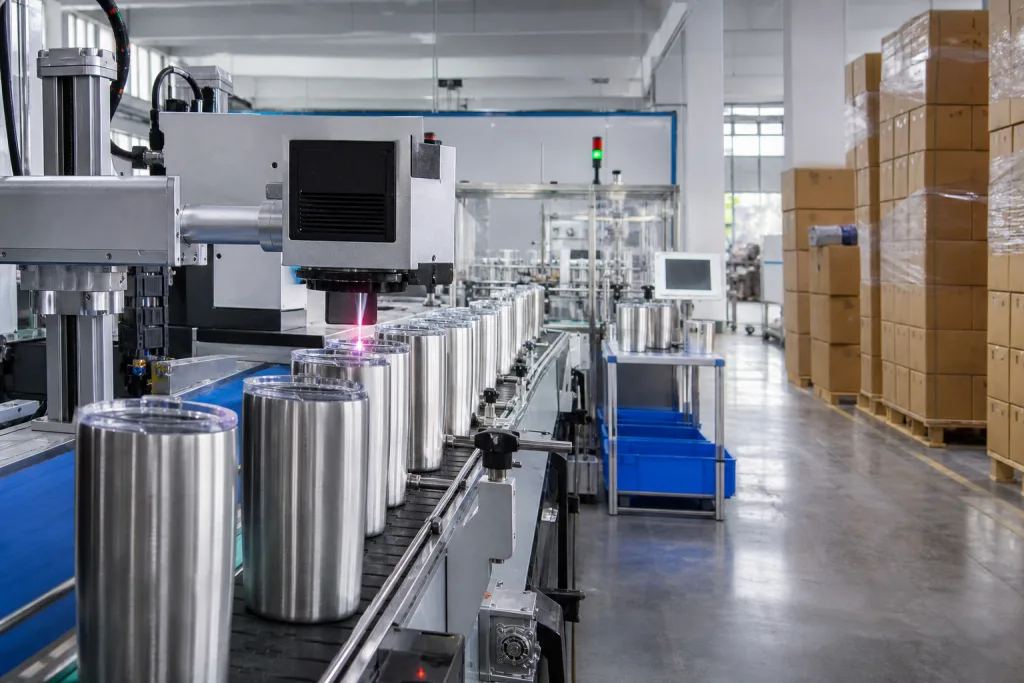
For coffee mug customized orders, decoration is where brand artwork meets the line, and this is where buyers usually get pushback. On travel tumblers, we run powder coating, spray painting, silk screen, heat transfer, water transfer, laser engraving, and 360-degree digital print on selected shapes. The wrong question is not “which logo method looks best.” Ask which process holds alignment on your body shape, at your MOQ, with your target defect rate.
For a clean corporate-gift run of 1,000 pcs, a powder-coated body with 1-color silk screen may add around USD 0.10-0.18. Laser engraving can be USD 0.12-0.25 depending on position and quantity. Full-wrap transfer decoration gives stronger shelf impact for coffee mug promotional campaigns, but we have seen this go sideways on curved walls: QC pulled the sample, and the seam drift was 2 mm after curing. Durability also changes by process, so the math does not work if you save 4 cents on print and lose 3% in rejects.
The spec lines that matter are not just “logo included.” You should confirm:
- Print area: for example 50 x 70 mm or wrap width with seam gap.
- Color standard: Pantone reference and acceptable delta.
- Adhesion test: cross-hatch or tape test after curing.
- Dishwasher statement: whether the decoration is hand-wash only.
If you need a coffee mug customizable item for different clients, choose a body shape with stable flat print zones. This saves trouble. Fancy curves look good on a rendering, but on the jig they make registration harder and increase rework. We have had buyers flag a logo that looked centered on screen but shifted near the radius break on the actual cup. For coffee mug private labeling, powder coating plus laser is often the safer premium combination because it looks clean and cuts some of the peeling risk that comes with surface print.
Good coffee mug manufacturers in Zhejiang, China will build a pre-production sample against approved artwork and note logo position tolerance, often within +/-1.5 mm to 2.0 mm. We usually mark that on the sample sheet before mass production. Skip that approval to save 2 days, and the buyer may open the cartons and find logos rotated 1.8 mm across the run. We ship plenty of repeat orders, and this single step prevents most arguments.
Carton math, MOQ, and landed cost
New buyers often stare at FOB piece price and miss carton math. That is the wrong question to ask. On one 20 oz tumbler, a gift box might add only USD 0.20 versus a plain white box, but if the master carton drops from 25 pcs to 20 pcs, freight per unit jumps fast. We see this on the line all the time. Your spec sheet should spell out unit packing, pcs/ctn, carton size, gross weight, and pallet pattern, down to the mm and kg.
Typical MOQs from a coffee mug oem manufacturer in Zhejiang are:
- Existing model, standard color: 500-1,000 pcs
- Custom color + logo: 1,000-3,000 pcs
- New mold or major lid change: 5,000 pcs and up
For a plain-box coffee mug in bulk order, a 20 oz tumbler may pack at 25 pcs/ctn. Add individual gift boxes and it often drops to 20 pcs/ctn with a bigger outer carton, so the CBM math changes before you notice the extra USD 0.20. QC pulled a sample last month where the insert was 3 mm too tall, and the carton bulged at the top flap. If you ship to Amazon FBA, outer carton weight usually has to stay under channel limits, and each unit may need FNSKU, suffocation warning, barcode placement, and drop-test-ready inner packaging.
This is where “factory direct” earns its keep. A listing in a coffee mug supplier directory does not tell you whether the factory can change an EPE insert, fix carton marks after the buyer flagged a PO typo, or reprint pallet labels in one shift. We run these changes in-house because sending them through a trader burns time. For importers and coffee mug distributors, those packing changes often save more money than squeezing the first unit quote.
Lead times should be written by stage: 7-10 days sample, 25-35 days bulk production, and another 2-5 days if third-party inspection is booked. If a factory promises 15-day mass production during peak Q4 gifting season in China, ask how they locked coating slots and assembly capacity on the schedule board. We have seen this go sideways. Sometimes sales says yes, then the lid line is already full.
Compliance paperwork is part of the product
If you sell into the EU, UK, US, or Canada, compliance paperwork sits in the same spec sheet as 304 stainless, lid fit, and carton drop test. We ask buyers to lock the test scope and audit requirement before deposit, not after the PI is stamped. This is the right question to ask early; we have seen a PO move 9 days because the buyer added a social-audit clause after tooling approval.
For drinkware, the usual asks are REACH, LFGB, or FDA food-contact, based on destination market. Children’s items can pull in CPSIA or ASTM, but for a standard 20 oz commuter tumbler, that is usually not the core file. On enterprise gift programs, buyers often push harder on BSCI, Sedex, or ISO 9001 than on the mug report itself. Last quarter, one buyer flagged a missing factory address on an audit file before they even checked the lid drawing.
You also need an inspection standard in writing. A solid baseline for a coffee mug bulk order is AQL 2.5 major / 4.0 minor. Major defects are clear: leakage, vacuum failure, wrong logo, sharp edge over about 0.3 mm burr, or an obvious dent. Minor defects are the small stuff, like paint dust points or print offset inside the approved limit sample. If the PO stays vague, QC pulled the sample, the buyer rejects 600 pcs, and then the math does not work.
Ask the factory which lab they run in China and whether testing covers raw material, finished product, or both. A steady coffee mug supplier will not throw 12 certificates at you just to win the order. We ship better when the scope is plain: which report already exists for this body, and what needs fresh testing for your color, lid resin, silicone ring, or laser logo. We have seen this go sideways over one lid resin change from PP to AS.
That clarity matters for coffee mug promotional products tied to public campaigns. If one shipment gets held because the declaration pack is missing one page, the delay can mean 12 days vs 18 days at destination after rework and resubmission. The cheapest quote from a generic coffee mug supplier list looks good on day one; it looks bad when customs asks for the exact report tied to the shipped model code.
How to qualify the factory behind the quote
If you source a coffee mug factory direct program, the last check is not another 3% discount request. The real check is whether the factory can run your approved sample on the line and hold the same result across 10,000 units. In Zhejiang, we see this every week: 8 suppliers can send a clean prototype, maybe 2 can keep Pantone color close, hold lid torque, pass vacuum testing, and ship master cartons without a PO mix-up. This is the wrong question to ask if you only focus on price.
Ask practical questions:
- What percentage of production is in-house versus outsourced?
- Which parts are molded internally and which are bought in?
- What is the monthly capacity for travel tumblers?
- How are incoming lids and silicone seals checked?
- Can they support private label carton marks and mixed-SKU packing?
A credible coffee mug manufacturer should answer with numbers, not sales lines. For example: MOQ 1,000 pcs per color, 400,000 units/month capacity, 30-day lead time, 100% vacuum test, and final random inspection to AQL standard. Ask how they check incoming lids—our QC pulled the sample with a go/no-go gauge and found a 0.4 mm fit issue on an outsourced lid batch. That tells you more than any showroom wall.
If you are a coffee brand, push on repeatability and decoration control. Ask how they track print position tolerance and what happens when the buyer flagged logo shift on the first mass sample. If you are a corporate-gift buyer, push on gift-box quality, booking date control, and courier-drop packing; a 1.2 m carton drop test is a basic check, not a premium one. If you are building a reseller line with a coffee mug private label approach, confirm that artwork files, carton specs, and test reports are filed by SKU and PO, because we have seen this go sideways when one carton mark typo gets copied across 2,000 sets.
The best factory relationships in China are not built on the lowest opening quote. They are built on a spec sheet both sides read the same way, line by line, with details like 304 stainless, carton mark layout, and seal color signed off before production starts. Once you can read that sheet properly, you can buy bulk coffee mug and travel tumbler programs with fewer surprises, cleaner shipments, and margin math that actually works.
Get a factory direct coffee mug quote that is usable
Send your target capacity, lid type, logo method, and quantity. We will reply with a spec-based quote, MOQ, lead time, and compliance options.
Frequently asked questions
What is a realistic MOQ for a factory direct coffee mug travel tumbler order?
For an existing 20 oz model, a realistic MOQ is usually 500-1,000 pcs for stock color and 1,000-3,000 pcs for custom color plus logo. If you want a new lid, unique body mold, or special gift box, expect 3,000-5,000 pcs or more. In Zhejiang, China, many factories quote low sample MOQs to start the conversation, but the real production MOQ depends on coating color, print setup, and carton efficiency. If you are buying for a corporate-gift event, 1,000 pcs is often the workable threshold for decent unit pricing without overcommitting inventory.
How much should I expect to pay for a bulk coffee travel mug from China?
For a standard stainless 20 oz tumbler, FOB pricing from China often lands around USD 1.85-2.60 at 5,000 pcs for 304 inner, 201 outer, powder coat, and simple lid. Full 304 construction, better lid systems, or premium finishes can move the price to USD 2.40-3.20. Add roughly USD 0.10-0.25 for basic logo decoration and more for gift boxes or wrap print. If one quote is USD 0.40 below the pack, check wall thickness, steel grade, lid resin, and whether testing and inspection are excluded. That is where hidden cost usually sits.
Which lid style is best for coffee brands selling online?
For ecommerce, a screw lid with silicone seal is usually the safest option because it reduces leak complaints during normal commuting use. Slider lids look clean and cost a bit less, but they are better described as splash resistant, not leakproof. Flip-top lids are convenient but need stronger hinge material and tighter QC. Ask the factory for a defined leak test such as 30 minutes inverted and 30 minutes side-laid with no visible leakage. If your return rate rises above 1.5-2.0%, the savings from a cheaper lid disappear very quickly through refunds, replacement freight, and negative reviews.
What compliance documents should I request before placing a PO?
At minimum, ask for food-contact test scope relevant to your market: FDA for the US, LFGB or REACH-related declarations for Europe depending on buyer requirements. Also ask for factory audit status such as BSCI, Sedex, or ISO 9001 if your procurement policy requires it. On the quality side, define AQL in the PO, for example 2.5 major and 4.0 minor. For private label orders, confirm that the test report covers the actual lid material and decoration process, not just a similar older model. If the factory in China cannot map documents clearly to your SKU, expect delays later.
How long does custom travel tumbler production usually take?
A normal schedule is 7-10 days for pre-production sample approval, then 25-35 days for mass production after deposit and artwork confirmation. During peak gifting season or before major holidays in China, 35-45 days is more realistic, especially for custom colors and gift boxes. Add 2-5 days if you book third-party inspection and another few days if cartons need FNSKU, pallet labels, or retailer-specific marks. If a factory offers 15-20 days for a fully customized order, ask whether coating, printing, and lid assembly are all in-house. Fast promises often break at exactly those subcontracted steps.