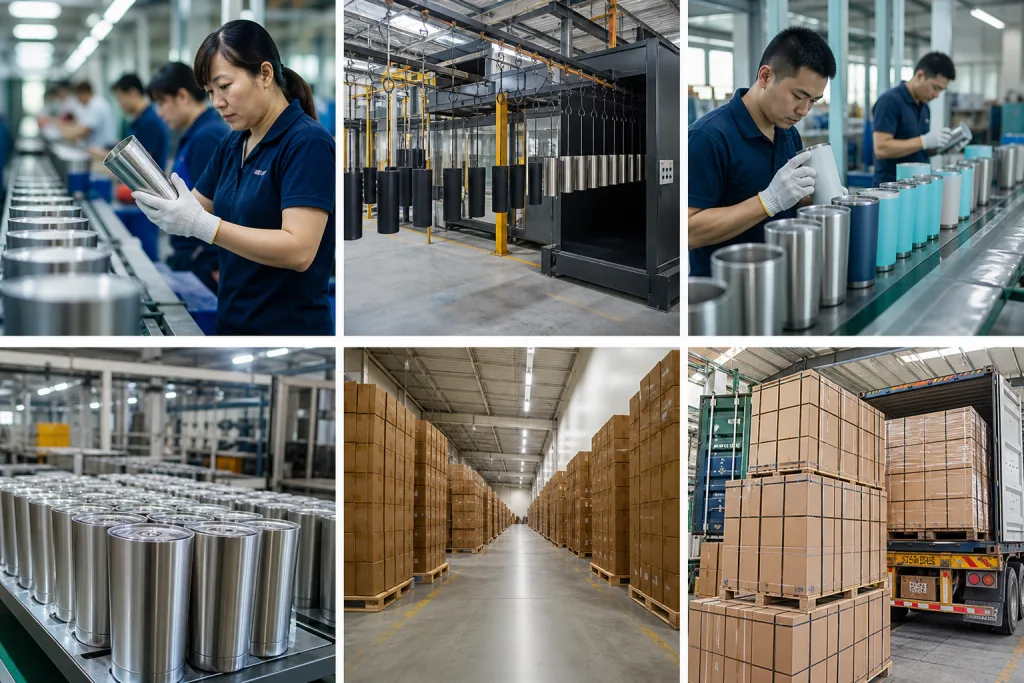
Key Takeaways
- A 0.5 mm inner wall and 0.4 mm outer wall in 18/8 stainless is a common stable spec for a 20 oz beer tumbler
- Factory-direct MOQ is typically 1,000-3,000 pcs per color, with repeat orders often cut to 500 pcs if tooling and packaging stay unchanged
- Standard production lead time from Zhejiang, China is 25-35 days after sample approval and 30% deposit
- Use AQL 2.5/4.0 with drop, leakage, coating adhesion, and dishwasher-cycle testing before shipment
You can buy a beer tumbler from almost any trading company in China. Getting a quote is easy. The hard part is knowing what sits inside that number, what the supplier left soft, and which spec line turns into returns 6 months later. We’ve seen this go sideways over a 0.3 mm wall change, a lid gasket swapped without notice, or a PO typo on carton count. If you source for retail, hospitality, or canteen promotional programs, small misses turn into rework fast and the math doesn’t work.
Buying a factory direct beer tumbler from Zhejiang means buying a pile of technical choices: steel grade, single wall or double wall, lid fit tolerance, print method, test standard, carton drop result, and refill lead time like 12 days vs 18 days. At BottleForge Industrial in Hangzhou, Zhejiang, we run into the same pattern on the line. New buyers chase unit price first. Experienced buyers start with the spec sheet, where margin, compliance, and claim risk are set. QC pulled one sample last month because the lid torque was out by 2 mm—this is the wrong question to skip just to save $0.08.
Start with body material
The first line on a factory direct beer tumbler spec sheet should be the body material, not the logo. For most B2B orders, the safe call is 18/8 stainless steel, also called SUS304, for the inner and usually the outer body. That is the grade buyers expect for beer, sparkling water, cold brew, and acidic drinks. If a quote only says “stainless steel,” ask for the exact grade and ask to see the mill cert. We see this on the line all the time: one RFQ says 304, the PO comes back with “SS body” only, and the buyer flagged rust risk later. SUS201 can lower cost by roughly USD 0.20 to 0.45 per piece on some sizes, but this is the wrong place to save money for long-term beverage contact in Europe or North America.
Wall thickness sits right behind steel grade. A practical commercial spec for a 20 oz beer tumbler is 0.5 mm inner wall + 0.4 mm outer wall. Go thinner and you might save USD 0.03 to 0.08 per piece, but dent claims go up after 18 days on water instead of 12, and retail handling gets rough. QC pulled the sample on one 0.35 mm outer wall run last year and found panel dents right after carton drop testing. Go heavier and the math does not work: you add cost, carton weight, and often no user benefit. If you are sourcing custom drinkware for chain accounts or a canteen distributor network, consistent gauge is what keeps batch-to-batch quality steady.
Ask your canteen supplier or canteen factory for these points in writing:
- Material certificate for SUS304 contact surface
- Whether the body is food-contact polished or electrolytically treated
- Actual wall thickness tolerance, usually ±0.03 mm to ±0.05 mm
- Whether silicone parts are LFGB-grade or FDA-grade on request
China has thousands of canteen manufacturers and canteen vendors offering “same look” cups. They are not built the same, even if the silhouette matches within 1 to 2 mm. We ship plenty of programs where the buyer wants a customized canteen line, custom growler range, or customizable drinkware assortment, and the cleanest move is to lock one steel grade across the full collection. Compliance files stay simpler. Complaint handling gets faster. We have seen this go sideways when one lid SKU used FDA silicone and the next PO asked for LFGB without updating the BOM.
Insulation, seam, and sweat control
If the tumbler is double-wall vacuum, check three things first: the vacuum build, whether the inner wall gets a copper coat, and how the cup behaves in condensation tests. A factory-direct beer tumbler in this class should hold cold beer for 6 to 12 hours in normal use, but that number means nothing without the same test setup. We’ve seen buyers compare 4°C ice water against room-temperature beer with ice in the same email thread; the math doesn’t work. On our line, QC logs the start liquid temperature and ambient room temperature before the hold test starts.
Most export buyers from Europe and North America still split into two structures: double-wall vacuum for retail and gifting, or single-wall stainless for event orders and canteen promotions. For vacuum models, ask a direct question: does the inner wall have a copper-plated heat barrier, and what retention gain did the factory record in its last run? In stable production, copper coating can improve retention by around 10% to 20%. If the vacuum process drifts, that gain disappears fast. We run random cut checks on the line, and the copper tone is visible once the sample is opened.
Check the seam and the base. That is where weak vacuum units start talking. A bad vacuum seal might pass first inspection, then show sweating after transport or after 3 dishwasher cycles. We’ve seen this go sideways after a drop test, where the bottom bead looked fine but the seal ring had already shifted by 0.3 mm. That is why we recommend incoming or pre-shipment tests such as:
- Vacuum retention spot check on 3 to 5 pcs per lot
- Boiling water or hot-box test to identify vacuum loss
- 24-hour condensation check at 25°C ambient
- Base impact test after packing simulation
If you are a distributor drinkware buyer or a distributor growler program manager, ask for the reject criteria. “No sweat” is the wrong phrase to approve on a PO unless it has a test method behind it. It needs a measurable limit, a sample size, and a pass/fail record. In Zhejiang, China, our production planning for vacuum tumblers is built around leak and vacuum-loss screening because these defects cost far more after arrival than they do on the line. Last month, one buyer flagged 18 sweaty cups from a 2,000-piece lot, and QC pulled the sample history in under 20 minutes because the checks were already tied to the batch card.
Capacity, mouth, and drink experience
Capacity on paper trips up new buyers all the time. A “20 oz” tumbler may be 20 oz to brimful and only 18 oz to practical fill line. For beer service, that gap shows up fast on the counter. If your customer is a brewery, event operator, or canteen customizable merchandise buyer, confirm whether the stated volume is brimful, usable, or market nominal. We usually ask QC to fill-check 3 samples with a graduated cylinder and put all three figures into the internal spec. This saves arguments later.
Mouth diameter changes cleaning, filling speed, and how the drink lands. A typical beer tumbler mouth is 80 to 90 mm. Wider mouths make garnish, ice, and hand cleaning easier, but if lid tolerance drifts by even 0.3 mm, the buyer will flag wobble on the first sample set. Narrower mouths can suit a customized growler family line, though daily use feels less convenient at events and staff canteens. We have seen this go sideways on rush orders.
Shape is not only about looks
A straight-wall body is easier to print and pack; the screen fixture sits more stable on the line. A tapered body fits more vehicle cup holders and often cuts carton cube by 8% to 12% on the same nominal volume. A stemless profile feels more giftable, but dent risk around the shoulder goes up if the steel is too thin—we have seen 0.4 mm bodies fail drop checks that 0.5 mm bodies passed. If you source for canteen distributors or a canteen vendor serving institutions, standard shapes usually beat fashionable ones because repeats, spare lids, and replacement runs stay simpler. Frankly, this is the wrong place to chase novelty.
When you compare quotes, ask for three dimensions: top diameter, bottom diameter, and total height. Two tumblers can both be sold as 20 oz and still behave very differently in use and in packaging.
For custom canteen, customizable canteen, or canteen customized projects that extend into bottles and growlers, keep the family look, but do not force one mouth and lid setup across every SKU. We ship mixed programs like this all the time, and the PO typo usually starts when one lid code gets copied across 4 items. A beer tumbler should prioritize drink comfort and stackable packing, not visual consistency with a custom growler or sports bottle. The math does not work if the line has to re-pack unstable master cartons.
Surface finish and decoration limits
The finish call on the spec sheet is where brand owners burn margin. Powder coating is still the standard commercial choice for a factory direct beer tumbler because the cost-to-wear ratio makes sense on the line. We usually run 60 to 90 microns, checked with a dry film gauge after curing. Go too thin and the rim shows wear early. Go too thick and logo edges blur, and some lids start dragging on fit.
Decoration is not one bucket. Silk screen, laser engraving, heat transfer, and 360-degree digital wrap each have limits tied to body shape and artwork. For a curved tumbler, silk screen is still the price leader at volume; typical one-color printing adds about USD 0.08 to 0.18 per piece depending on size and quantity. Laser engraving looks premium and lasts, but on powder-coated steel the contrast depends on the actual coating formula, not the catalog photo. QC pulled samples before where the black coat engraved out gray, and the buyer flagged it. Do not sign off from a phone photo. Ask for a physical pre-production sample.
Buyers in Europe and North America should ask coating and ink compliance questions early, not after artwork approval. REACH and California Proposition 65 checks are routine now, and this is the wrong question to ask at the shipping stage. If your canteen manufacturer, canteen supplier, or canteen factory cannot send declarations within 24 hours, expect the file to stall later when your customer or lab asks for backup.
- Matte powder coat: the safest all-round option for retail and hospitality; it hides light scuffs better, and we see fewer carton-rub complaints
- Spray paint metallic: looks good on the first sample, but abrasion resistance is lower and cosmetic claim risk is higher after tape test and transit
- Laser engraving: low fade risk and a cleaner premium look, especially on dark coatings with stable contrast after trial runs
- Silk screen: efficient for canteen promotional volume runs; best value on simple 1-color logos with controlled print area
A canteen customized order with multiple colorways looks smart on a mood board, but the math does not work on every factory floor. A realistic starting MOQ is 1,000 pcs per color per size for standard bodies, because each extra color means another powder change, another oven setup, and another first-piece check. Split one order into four colors at 250 pcs each and your canteen vendors will often raise the unit price hard or walk away from the order. We have seen this go sideways over a PO typo that listed one lid color across four body colors.
Lid fit, packaging, and transit risk
A big share of tumbler claims do not come from the 304 stainless body. They come from the lid, the gasket, or the box. For beer tumbler projects, set the lid claim early. Most slider lids are spill-resistant, not leakproof. If your customer wants bag-safe use, say it on the PO and switch the lid structure before sampling. We have seen this go sideways after mass production because one buyer wrote “no leak” in email, while the signed spec only showed a standard slider lid with a 2.5 mm silicone ring.
Get the lid material list from the supplier, not just “plastic lid” on a quote sheet. AS, SAN, Tritan, PP, and silicone do not perform the same on clarity, smell retention, dishwasher cycles, or unit cost. For alcohol retail, buyers often push for a crystal-clear lid, then flag cracking after a drop on tile. QC pulled the sample on one order and the body passed, but the clear lid broke at the slide track on the second drop. Check impact on the lid itself. This is the right question to ask.
Packaging is next. Standard export packing is often 1 polybag, 1 white box, and a master carton of 24 pcs or 36 pcs. That works for plenty of distributor and canteen orders. It is often not enough for e-commerce. If you ship by Amazon FBA or direct parcel, ask for:
- ISTA-style drop test on gift box and master carton
- Barcode placement including FNSKU if required
- Carton gross weight under 15 kg where practical
- Partition design to protect powder-coated rims
At our Zhejiang facility, monthly output across drinkware categories reaches 300,000 units, but shipment quality is capped by packing discipline, not line speed. We run carton compression checks before loading, and the weak point is usually the corner drop or divider crush, not the tumbler wall. A low FOB Ningbo offer with thin carton board and loose partitions can cost more after claims. The math does not work.
Compliance, inspection, and reorder math
The last block on the spec sheet is not glamorous, but it decides whether the PO runs clean or turns into claims later. For factory direct beer tumbler programs, we ask buyers to write the compliance path into the order: food-contact declaration, REACH where applicable, and destination-market testing. QC usually checks the print file against the PO before the line starts, and we still catch small misses—a missing “Made in China” line, or a PO typo in the barcode suffix. For children’s products, ASTM or CPSIA checks may apply. For adult beer tumblers, the focus is usually food-contact safety, labeling, and chemical compliance. This is the wrong question to ask if a buyer only wants to know “Is it FDA?” One line on a test report does not cover the full shipment.
Set inspection rules before production starts. Do not leave this for the pre-shipment call. A practical default is AQL 2.5 for major defects and 4.0 for minor defects. Write major defects in plain language: vacuum failure, sharp edge, unstable base, wrong logo, coating peel, leakage beyond agreed standard, wrong barcode, or failed carton marks. On our side, QC pulled the sample and the go/no-go ring gauge once because the rim burr was 0.3 mm over limit; that kind of detail saves arguments later. If the defect list stays vague, every claim becomes subjective, and we have seen this go sideways.
Reorder math is where factory-direct sourcing starts paying off, but only if the base setup is stable. A first order may sit at 1,000 to 3,000 pcs depending on body style, coating, and packaging. Once artwork, screens, and cartons are locked, repeat orders can sometimes drop to 500 pcs per color on selected items. Standard lead time is usually 25 to 35 days after sample approval and deposit. Tooling for a new lid or new body can add 20 to 35 days more. On the floor, one new silk-screen plate or one new carton die-line can be enough to push a repeat job from 25 days to 32 days. Buyers often ask for low MOQ on 6 colors at once. The math does not work unless the parts are shared.
If you are working with canteen suppliers, canteen distributors, or a distributor growler program across multiple SKUs, ask your canteen manufacturer how they manage component carryover. Ask for the hard numbers: one lid for 3 body sizes, one master carton for 2 pack-outs, or one Pantone coating used across 4 SKUs. Shared lids, shared cartons, and shared coating colors cut dead stock and speed replenishment. We ship these programs faster when the line can run common parts instead of stopping for one-off changes. That is the practical advantage of buying customized drinkware from a real canteen factory in Zhejiang, China instead of assembling one-off items from unrelated sources. You get a repeatable supply chain, not just a sample that looked good once.
Send your beer tumbler spec for a factory review
Share target size, steel grade, decoration, MOQ, and destination market. We will flag risk points and quote a workable FOB China plan.
Frequently asked questions
What is a realistic MOQ for a factory direct beer tumbler order?
For a standard 20 oz vacuum stainless beer tumbler with one powder-coat color and one logo, a realistic factory MOQ is 1,000 pcs. Some canteen manufacturers in China will quote 500 pcs, but usually with fewer color choices, existing cartons, or a higher unit price. If you need custom retail packaging, multiple print locations, or special lids, expect 2,000 to 3,000 pcs. Repeat orders are easier. Once artwork screens, packaging files, and approved samples are already in the system, some factories in Zhejiang can support 500 pcs per color on repeat business. Always ask whether MOQ is per color, per size, or total order. That one detail changes your landed cost more than buyers expect.
How much should I expect to pay factory direct from China?
A typical FOB China price for a 20 oz double-wall vacuum beer tumbler in SUS304 with powder coating is often around USD 2.80 to 4.80, depending on steel weight, lid type, decoration, and quantity. Single-wall versions can drop below USD 2.00. A premium finish, copper insulation layer, laser engraving, or gift box can add USD 0.20 to 0.80 per piece. If a quote looks unusually low, check whether it excludes the lid, white box, or export carton upgrades. Also check steel grade. A cheap offer using SUS201 or thin wall stock can create dent, rust, or complaint costs later. Ask for FOB Ningbo or FOB Shanghai terms so you can compare offers cleanly.
What tests should I require before shipment?
At minimum, ask for a pre-shipment inspection under AQL 2.5/4.0, vacuum or insulation spot checks, leakage checks based on the agreed lid standard, coating adhesion testing, and carton drop testing. For coated tumblers, a cross-hatch adhesion test and a simple abrasion rub test are useful. For logos, confirm print position tolerance, usually within ±1.5 mm to ±2.0 mm depending on artwork size. If your market is Europe, request REACH-related declarations for coatings and food-contact materials. If you sell to large retail accounts, you may also need dishwasher-cycle testing, often 20 to 50 cycles for logo durability benchmarks. The goal is not more paperwork. The goal is catching defects before they leave China.
How long does production usually take after sample approval?
For a standard factory direct beer tumbler using existing molds, normal lead time is 25 to 35 days after final sample approval and deposit. In peak season, especially before holiday retail shipments, lead time can stretch to 40 days. A plain sample is often ready in 5 to 7 days, while a fully branded pre-production sample usually takes 7 to 12 days. If you are developing a new body shape, custom lid, or new customizable growler family with matching tumblers, add 20 to 35 days for tooling and validation. Ask your factory whether lead time starts from deposit date, artwork confirmation date, or packaging approval date. Different factories define the clock differently.
Is it better to buy from a factory or a trading company?
If your project is straightforward and volume is stable, buying direct from a canteen factory or canteen manufacturer usually gives you better control over specs, repeat consistency, and engineering answers. It also helps when you need quick decisions on wall thickness, coating, packaging, or AQL criteria. A trading company can still be useful if you are combining many categories from different sources or need heavy consolidation support. The key is transparency. Ask who owns production, who manages QC, and who issues compliance documents. A real factory in Zhejiang should be able to explain capacity, such as 300,000 units per month across drinkware lines, plus realistic MOQ and lead time. If the answers stay vague, you are not getting factory-level visibility.