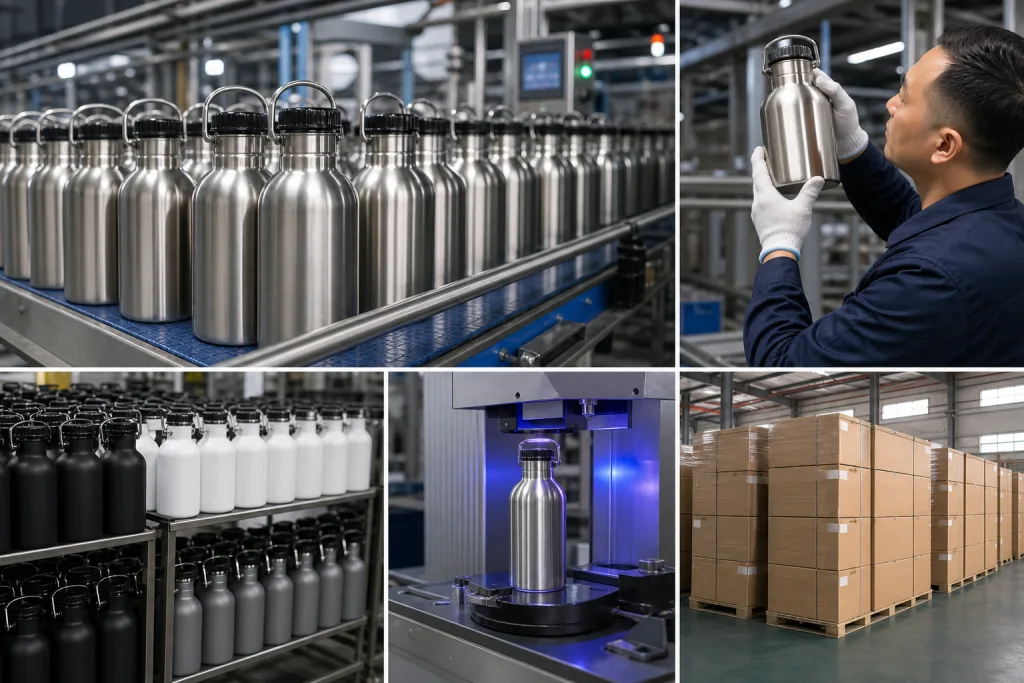
Key Takeaways
- Start with 64 oz or 2L, 18/8 stainless steel, and a leak-tested lid; changing capacity late can add 12-18 days
- Typical MOQ for a factory direct beer growler is 1,000-3,000 units per SKU, with FOB prices often around USD 4.80-9.50 depending on structure
- Vacuum insulation adds roughly USD 1.20-2.80 per unit but can improve temperature retention from 6-8 hours to 18-24 hours
- Use AQL 2.5/4.0, REACH and LFGB or FDA checks, and a 1.0% pressure or leak defect cap before shipment
You usually do not lose money on a beer growler because the drawing looked wrong. You lose it on one early call: capacity, steel grade, lid system, decoration method, carton pack, or MOQ. We see this on the line all the time. By the time the first sample comes off the spin welder, one change can add 8% to 20% to cost, push shipment back 10 to 18 days, or leave you with a growler that sells fine at retail and then gets rejected in a brewery refill program.
If you are buying a factory direct beer growler from China for Europe or North America, low FOB is the wrong question to ask. You need clear decisions on unit cost, compliance, branding fit, and replenishment speed before sampling starts. At BottleForge Industrial in Zhejiang, China, we run into the same pattern across custom growler, custom drinkware, and custom canteen programs: buyers who lock the core specs early get fewer surprises, and QC pulled far fewer carton and lid issues before ship on those orders.
Decide the commercial use first
The first question is not color or logo size. It is where the growler will be sold and how it will be used. A brewery taproom refill program, an outdoor retail line, a private-label e-commerce listing, and a canteen promotional campaign do not need the same product. We see buyers miss this on the first RFQ, then the spec shifts after sampling and 18 days turns into 28. Start with the sales channel. Then lock the build.
For taproom refill, most buyers want three things: a lid that seals, a lead time the line can hold, and a price that still works on the second and third order. The usual starting point is a 64 oz stainless model with single wall or entry vacuum construction. On our line, QC pulled a sample last month where the silicone ring sat 0.8 mm proud, and that small miss was enough to trigger seepage after transport. Retail shelves in Europe and North America ask for more than the bottle itself: powder coat finish, gift-ready packaging, barcode labeling, and tighter color matching from batch to batch. For Amazon FBA or distributor drinkware channels, carton dimensions, FNSKU labels, and inner packs that pass drop test matter almost as much as the growler.
A buyer coming from general custom drinkware sometimes treats growlers like oversized bottles. That is the wrong question to ask. Beer fill is different. The filling method, carbonation sensitivity, handle comfort, and neck opening all change user satisfaction. We have seen this go sideways when a buyer chose a narrow mouth to save on cap tooling, then the brewery flagged slow refill at the counter. If the growler is intended for beer, ask how long carbonation needs to hold, whether the lid will be opened 2 or 3 times in a day, and whether the vessel is for transport or for storage after fill.
- Brewery refill program: prioritize leak rate, easy cleaning, replacement lid continuity, and MOQ flexibility. A 1,000 pcs MOQ is common, but some lines will run 500 pcs on standard colors.
- Retail private label: prioritize finish consistency, packaging, compliance file, and photo-ready decoration. The buyer usually flags color delta first, not the steel grade.
- Promotional campaign: prioritize landed cost, decoration speed, and broad-appeal colors. Screen print placement tolerance of 2 mm should be agreed on the PO.
- Distributor growler program: prioritize replenishment lead time and SKU standardization. We ship these best when lid, carton, and barcode format stay fixed across repeat orders.
If you also source custom canteen, customizable canteen, or canteen custom items from the same canteen supplier, check whether the factory can combine production planning. A capable canteen factory or canteen manufacturer can often consolidate lids, coatings, and packaging materials across projects, which helps with MOQ and freight efficiency. We run mixed schedules like this often, and the math works better when 2 SKUs share one coating batch and one outer carton size.
Choose structure, steel, and insulation
Once the use case is clear, fix the structure early. Most factory-direct beer growler projects come down to three calls on day one: single wall or vacuum, steel grade, and lid style. Those choices move unit cost fast, and they also decide where claims and returns show up later. On our line, QC usually flags lid fit and weld consistency before anything else.
Material: For stainless growlers, 18/8 stainless steel, also called SUS304, is the normal export standard. That is the baseline most buyers in Europe and North America expect, and this is not the place to shave pennies. If a quotation uses 201 stainless to save USD 0.30 to 0.60, the buyer should slow down and ask why. We have seen 201 pass an early sample, then show tea-stain rust after salt-spray exposure and warehouse humidity. For beverage contact and long-term brand use, 304 is the better choice. Typical body thickness is 0.5 mm to 0.6 mm for single wall, and 0.4 mm inner plus 0.5 mm outer for vacuum bodies.
Insulation: Single wall works if the growler is just a transport container and price is the first filter. Vacuum insulation typically adds USD 1.20 to 2.80 per unit, depending on size, shape, and finish. The upside is easy to measure: a vacuum growler may keep cold for 18 to 24 hours, against 6 to 8 hours for a non-insulated design in normal ambient conditions. We run both types, and the wrong question to ask is only “what is the cheapest body?” If the product sits in a taproom, car trunk, or retail shelf program, the math often fails once complaint rates start.
Lid system: Screw cap, swing top, and sealed cap with handle are the common options. Each one has different failure points. Swing tops look traditional, but they bring more parts, hinge alignment checks, and gasket risk; we have had buyers flag uneven wire tension on pre-production samples. Screw lids are simpler for a canteen manufacturer to scale, and replacement stock is easier to ship in cartons of 200 pcs. If carbonation retention is part of the sales claim, ask for leak and pressure testing protocol, not a broad promise. QC should pull the sample, run pressure hold, and record where the seal starts to drop.
Baseline spec that works for many buyers
- 64 oz / 1.9 L or 2 L capacity
- SUS304 interior and exterior
- Vacuum insulated body
- Powder-coated exterior
- PP lid with food-grade silicone seal
- Electropolished interior for easier cleaning
A growler that looks premium but has a weak lid is not premium. Buyers remember returns, not just first cost.
This is also where secondary programs start to matter. If you already buy customized drinkware, customized canteen, or customizable drinkware from canteen manufacturers in Zhejiang, China, keep the steel grade and finish standard aligned across the PO. We have seen this go sideways because one PO said “304 inside” and another said “same as last order,” then samples came in with different gloss and brushing. Shared material standards make audits cleaner and cut sample confusion across product categories.
Price against MOQ and tooling reality
Factory-direct buying sounds simple: cut out the trader and save money. Sometimes that happens. Sometimes the risk just shifts to your side of the PO. The wrong question is “factory or trader?” The better one is whether the factory can run your volume, decoration, and ship date without backfilling margin through MOQ splits, tooling charges, or packing add-ons the buyer flagged too late.
For a standard factory direct beer growler on an existing mold, MOQ is commonly 1,000 to 3,000 units per SKU. For a new body shape or proprietary lid, MOQ may move to 3,000 to 5,000 units, and tooling can range from USD 2,000 for a small component adjustment to USD 12,000 or more for a fully new stainless body set. At BottleForge Industrial in Zhejiang, our typical lead time is 25 to 35 days for repeat orders and 35 to 50 days for new customized growler programs, with capacity around 300,000 units per month across drinkware categories. On the shop floor, that usually means sample confirmation on one line, tooling check with a caliper at 0.2 mm tolerance, then mass production booking after deposit clears.
Unit cost is driven by seven factors more than buyers expect:
- Capacity: 32 oz, 64 oz, and 128 oz are not linear in cost; 128 oz usually needs heavier stainless and a larger carton drop-test setup.
- Vacuum vs single wall construction; the vacuum model adds welding steps and yield loss if the pull rate is off.
- Powder coat, paint, or bare stainless finish; a powder coat line can reject parts for uneven film build under 60 μm.
- Number of logo colors and decoration positions; two-position screen printing costs more because the line resets jigs between runs.
- Lid complexity and handle assembly; a custom cap with a handle pin or silicone seal adds parts, labor, and failure points.
- Gift box vs brown box packing; gift boxes raise carton volume fast, so the container math changes.
- Order quantity per color and per SKU; 5 colors at 300 pcs each is where we’ve seen the math stop working.
A realistic FOB China range for many standard custom growler projects is USD 4.80 to 9.50. Promotional single-wall versions can land below that. Premium vacuum models with custom lid assemblies and retail packaging can exceed USD 10.50. If one canteen vendor quotes 18% lower than everyone else, inspect the details: steel grade, vacuum yield, coating thickness, packaging quality, and spare parts support. QC pulled samples on one low-price job last year and found thin wall stock, weak weld cleanup, and carton bursting under spec — that order looked cheap only on page one.
If you are a canteen distributor, canteen distributors network, or a distributor canteen buyer adding growlers to a broader line, ask whether the canteen supplier can mix container loading with custom canteen, customizable growler, and canteen promotional SKUs. We ship mixed loads every month, and this point matters more than most buyers expect. A 40HQ filled with 3 SKUs and shared brown-box packing often protects margin better than pushing for another USD 0.08 off the bottle. We’ve also seen POs slowed by a simple color-code typo, so confirm SKU split, carton marks, and MOQ per color before the line starts.
Branding choices that affect complaints
Decoration is where custom programs burn money fast. We’ve seen this go sideways. The logo method needs to match the sales channel, order volume, and how hard the bottle gets handled on the line and in the field. A brewery merch SKU touched every day by wet hands and bar-rag friction is not the same job as a 500-piece event giveaway tossed into tote bags.
Silkscreen is usually the lowest-cost route for a one-color logo on a smooth body. We run it often for canteen promotional and basic custom drinkware orders, usually from MOQ 1,000 pcs. The weak point is wear: if curing time or coating thickness is off, QC pulled the sample and you can already see edge scratch after tape test. Laser engraving costs more than silkscreen in many cases, but on powder-coated stainless it gives a durable, premium look that buyers complain about less. Heat transfer and 3D digital printing give you more artwork freedom, but line speed drops and the math doesn't work on every project.
Do not approve artwork by itself. This is the wrong question to ask. Ask for the decoration tied to the exact finish, because matte black powder coat and glossy navy paint do not print the same way under the same mesh count. Also check logo placement against the growler handle or body seam; one buyer flagged a centered logo that looked off by 3 mm once the handle was welded. A good canteen factory will provide a visual proof with measurable logo size, such as 45 mm wide by 28 mm high, and note the tolerance.
Packaging decisions affect brand perception and damage rate too. Common options are:
- Egg-crate carton pack for wholesale or brewery refill programs
- White box with barcode label for distributor growler orders
- Color gift box with insert for retail and e-commerce
A color box can add USD 0.35 to 0.90 per unit. That cost is fine if shelf presentation drives sell-through. If not, skip it. We ship plenty of bulk orders in plain export cartons with a 5-layer outer box, and breakage claims stay lower than buyers expect. For canteen vendor or canteen vendors group orders going into broad distribution, plain export cartons are usually the smarter call.
For canteen customized, customized canteen, and customizable canteen projects sold alongside growlers, keep the decoration method consistent across the range. Buyers notice fast when one SKU feels crisp and durable while another starts peeling after 12 days on shelf or after two weekend events. We’ve had a PO with one typo in the finish code create mixed gloss levels across 2,400 pcs. A line should behave like one line.
Compliance and QC are not optional
If you sell into Europe or North America, product safety and batch consistency are already in the price, even if the quote sheet leaves them out. A factory direct beer growler should come with a compliance file and a QC plan that names the checks, the sample size, and who signs off on the line. If a factory or canteen manufacturer stays vague, or sends a 1-page “test passed” summary with no lab name, that is a red flag. We see buyers ask only for the lowest unit price, then get stuck later over a missing lid seal report at the 11th hour.
For food-contact drinkware, the normal checks are FDA or LFGB material compliance based on your market, plus REACH screening for Europe where it applies. For adult growlers, the core issue is food-contact safety and coating chemistry, not toy testing. Ask what parts were tested, not just whether the item “meets standard”: 304 stainless contact surfaces, PP or Tritan lid parts, silicone seals, paint or powder coat, and packaging ink if the print sits where users touch it. QC pulled one sample last month where the PO said “silicon ring” instead of “silicone ring,” and the buyer flagged the wording because the lab report had to match the BOM exactly.
For quality control, set measurable standards. AQL 2.5 for major defects and 4.0 for minor defects is a common shipment standard. Critical defects should be zero tolerance. On growlers, that usually means sharp rim edges over 0.2 mm burr, heavy leakage, wrong material, and visible contamination inside the body. You also need performance checks. This is the wrong question to skip.
- 100% vacuum retention check during production sampling plan
- 100% lid fit verification
- Leak test with inverted hold for 30 minutes
- Coating adhesion cross-hatch test per batch
- Salt spray target if corrosion resistance is being claimed
If social compliance matters to your customer, ask for BSCI audit status or an equivalent program, with the audit month, not just “passed.” If process control matters, ask whether the plant runs under ISO-style quality procedures and whether that applies to the actual workshop making your order, not only the parent group office. We run into this pushback a lot: the certificate exists, but the stamping line and powder booth for your SKU sit in another building.
China has strong drinkware factories and weak ones, and Zhejiang has both. The safe way to buy is against documents, golden samples, and checkpoints at 3 stages—pre-production, inline, and pre-shipment—not against promises on WeChat. The better canteen suppliers and canteen factory teams usually welcome a detailed QC appendix because it cuts arguments later; the weak ones complain once you add a rim gauge, a 30-minute leak hold, and carton drop notes.
Plan supply continuity, not just launch
The first PO is half the job. The hard part starts on the repeat order, when the buyer flags a black lid that shifted to dark charcoal, a carton mark printed 8 mm off spec, or a cap that feels different on the thread. We’ve seen this go sideways. Treating a growler as a one-time buy usually costs more on PO2 and PO3.
Lock the reference sample first. Keep one golden sample with signed finish, logo position, carton mark, and accessory list, then tie it back to the bill of materials. Include gasket hardness if possible, coating code, and master carton dimensions; on our line, QC pulled a sample once because the silicone seal was 2 points softer and the lid torque changed enough to cause seepage in transit. If your custom growler takes off, the wrong replacement lid batch will show up fast.
SKU strategy needs discipline. This is the wrong question to ask: “How many colors can we launch?” We regularly see first-time buyers open with six colors and three sizes, then learn each variant misses efficient MOQ and the math doesn’t work. A tighter plan is two core colors, one capacity, and one packaging format. Then expand after sell-through data is clean. For a lot of B2B buyers, one 64 oz vacuum model in black and stainless is a better opening move than a wide catalog.
Ask your canteen supplier or canteen manufacturer practical continuity questions:
- Can they hold powder inventory codes for repeat production?
- Can they reserve replacement lids or seals for 12 months?
- Can they support mixed-SKU reorders at 500 to 1,000 units each after the first run?
- Can they pre-apply FNSKU, carton labels, or retailer-specific marks?
This gets more critical if you are a canteen distributor, distributor drinkware buyer, or running 3 canteen vendors at the same time. A stable program helps you forecast freight, cut emergency air shipments, and protect margin; we ship smoother when the outer carton size and label position stay fixed from run to run. The China factories worth keeping are not just cheaper vendors. They run repeatable production. That is the standard to buy against, whether the item is a factory direct beer growler, custom canteen, or a broader customizable drinkware range.
Get a growler quote built around your real specs
Send your target capacity, insulation type, packaging needs, and forecast volume. We will quote MOQ, FOB price, lead time, and test options clearly.
Frequently asked questions
What is a realistic MOQ for a factory direct beer growler order?
For an existing model, 1,000 units per SKU is a realistic starting point, though some factories in China will ask for 2,000 to 3,000 units if you want multiple colors or retail packaging. If you need a new lid, handle, or body shape, MOQ often rises to 3,000 to 5,000 units because setup loss and tooling must be absorbed. You should also ask whether MOQ is per color, per logo, or per total order. A buyer who assumes 1,000 mixed colors can be surprised later. If you are combining custom drinkware or custom canteen items with one canteen supplier in Zhejiang, sometimes the factory can be more flexible on secondary SKUs after the first production run.
How much should I expect to pay for a custom growler from China?
A practical FOB China range for a standard custom growler is about USD 4.80 to 9.50 per unit. Single-wall stainless models with simple one-color print can sit near the lower end. Vacuum-insulated 64 oz or 2L growlers with powder coating, laser logo, and better packaging usually land in the middle to upper end. If you add a fully custom lid, gift box, or special finish, cost can move above USD 10.50. Freight, duty, and local testing are separate. Ask every canteen manufacturer or growler supplier to quote the same spec sheet: steel grade, wall thickness, finish, logo method, seal material, and carton pack. That is the only fair cost comparison.
Is vacuum insulation necessary for beer growlers?
Not always. If the growler is mainly used for short trips from brewery to home, a single-wall model may be enough and can save roughly USD 1.20 to 2.80 per unit. But for outdoor retail, gifting, or premium private label, vacuum insulation is usually worth it. It improves cold retention from roughly 6 to 8 hours up to 18 to 24 hours in normal use, and it gives a heavier, higher-value feel. The trade-off is higher cost, slightly longer production time, and more QC attention on vacuum performance. If your target customer expects a premium customizable growler, vacuum is often the safer choice for reviews and repeat sales.
What compliance documents should I request before shipping to Europe or North America?
At minimum, ask for food-contact compliance relevant to your market and product materials. For North America, buyers commonly request FDA-related material declarations or test reports for beverage-contact parts. For Europe, LFGB expectations are common, and REACH screening may be required depending on your program. If the growler includes painted or powder-coated surfaces, make sure the coating system is addressed too, not just the stainless interior. Also request a QC report tied to your PO, carton spec, and material list. For shipment inspection, many B2B buyers use AQL 2.5 for major defects and 4.0 for minor. If your canteen factory hesitates to define defect standards, tighten the process before deposit.
How long does production usually take for a customized growler order?
For an existing model with confirmed artwork and standard packaging, 25 to 35 days after deposit and sample approval is common. A new customized growler with a new mold, custom accessory, or retail box development can take 35 to 50 days, sometimes longer in peak season. Sampling usually takes 7 to 12 days for a standard logo sample and 15 to 25 days if tooling or new packaging is involved. If you source from Zhejiang, China before major holiday periods, add buffer time. Good factories can move fast, but waiting on artwork approval, barcode files, or carton marks often causes the real delay rather than metal production.