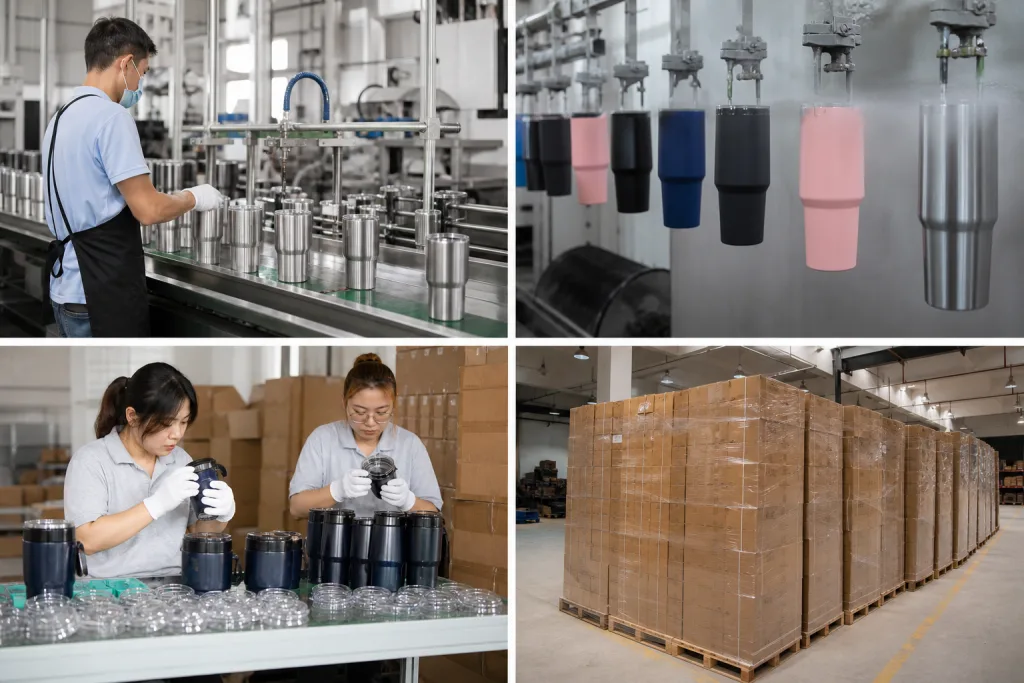
Key Takeaways
- A 20 oz double-wall 304 stainless tumbler typically starts around USD 3.20-5.80 FOB China at 1,000-3,000 pcs, depending on lid, coating, and print
- Most custom travel tumbler projects fail at 4 points: material grade, lid sealing, decoration adhesion, and packaging drop performance
- Set AQL 2.5 for major defects, leak test 100% at assembly, and require 24-hour thermal and condensation checks before shipment
- In Zhejiang, practical MOQ for a coffee mug custom made program is usually 500 pcs per color for stock molds and 3,000+ pcs for new tooling
You usually do not lose margin on a factory coffee tumbler because 304 stainless costs more this month. You lose it after the approval sample looks clean, then mass production lands with lids that seep at 60°C, logos that fail a 3M tape test, cartons that crush in a drop test, or a powder-coat color that drifts enough for the buyer to flag it. We have seen QC pull a sample from the line with a 0.8 mm lid gap, and that small miss turned into a full rework call. For coffee brands and corporate-gift buyers, the problem is rarely the idea. It is the production spec.
If you are sourcing in Zhejiang or elsewhere in China for a bulk coffee tumbler, think like a quality engineer. This is the right question to ask. A decent coffee mug manufacturer should guide the build, but you still need to spell out failure points and the control for each one—seal leak standard, logo abrasion limit, carton spec, color tolerance, even the PO typo that can flip matte black to navy if nobody stops the line. That is how we ship a bulk travel tumbler on time, pass inspection, and avoid 18-day return headaches after delivery.
Where factory tumbler projects break
A travel tumbler looks simple. That is exactly why projects get underspecified. We see the same pattern on the line: one pre-production sample gets signed off, then mass production drifts on details the PO never pinned down. If you are sourcing a bulk coffee mug or bulk coffee travel mug for resale, subscription coffee gifts, or coffee mug promotional products, the failure points are plain and repeatable—and the chargebacks are not small.
The common breakdown points are:
- Material substitution: body grade changes from 304 to lower-grade stainless on hidden parts, or wall thickness drops from 0.5 mm to 0.4 mm to save cost. We check this with an XRF gun and micrometer, because the buyer usually cannot see the change after assembly.
- Lid inconsistency: silicone hardness, vent geometry, thread tolerance, and slider fit vary by cavity, causing drips and customer complaints. QC pulled the sample on one run last month because cavity 3 was leaking at a 45° tilt test while the other cavities passed.
- Decoration mismatch: powder coat gloss, Pantone drift, laser depth, or silkscreen adhesion change between sample and batch. The buyer flagged it on a recent order because the approved blue looked clean under D65 light, but batch color shifted enough to show across 2 pallets.
- Packaging weakness: inner tray or carton board is too light for parcel shipping, so e-commerce units arrive dented. This part gets ignored too often; the math does not work if a 12 kg master carton is built for shelf delivery and then thrown into courier handling.
If you are working with a coffee mug supplier or coffee mug factory direct in China, do not ask for a generic "good quality" standard. That is the wrong question to ask. Give measurable values. A proper spec sheet for a factory coffee tumbler should list body material, wall thickness, vacuum requirement, lid resin, gasket material, logo method, packaging structure, carton burst strength, and inspection plan. BottleForge Industrial in Zhejiang runs around 450,000 units per month across drinkware categories, and the first thing we push buyers to do is lock those numbers before deposit, not after first sample comments. Even one typo on a PO—0.4 mm entered instead of 0.5 mm—can send costing and production in the wrong direction fast.
That matters whether you are a coffee mug distributor, a coffee mug supplier directory buyer comparing factories, or a brand developing a coffee mug private label line. Production does not fail because the factory is in China. It fails because tolerance, test method, and acceptance criteria were left open to interpretation. We have seen this go sideways over a lid thread tolerance of 0.2 mm, then everyone argues at final inspection about whether the sample or the written spec controls.
Material specs that stop hidden downgrades
The first costly mistake is treating all stainless tumblers as the same. They are not. For a factory coffee tumbler built for hot drinks, the safe baseline is usually SUS304 on both inner and outer walls, especially for Europe and North America. We’ve seen buyers approve a pre-production sample, then QC pulled the sample from bulk and found the inner wall had switched grades. That changes corrosion resistance and, after a few months, some users say the coffee picks up a metallic note. If a supplier gives you a quote that is far below the pack, ask where each steel grade sits on the drawing. This is the right question.
A practical body spec for a 20 oz bulk travel mug is:
- Inner wall: SUS304, 0.4-0.5 mm
- Outer wall: SUS304 or SUS201 depending on positioning, 0.4-0.5 mm
- Vacuum gap: 1.5-3.0 mm typical
- Copper coating: optional for improved heat retention
- Lid contact parts: food-grade PP or Tritan where applicable
- Seal ring: food-grade silicone, typically 50-60 Shore A
If you need a coffee mug customizable line for premium café merch, ask for a material declaration and compliance support for REACH, LFGB where relevant, and U.S. food-contact testing references. On our side, that usually means the stamp on the tube, resin grade for the lid, and the silicone hardness report all match the file before we run mass production. For children’s use or mixed gift packs, also check ASTM points linked to small parts or packaging claims. We’ve seen this go sideways over a lid straw packed into the wrong gift set carton.
How buyers get trapped by low pricing
A quote that is USD 0.40 lower can be valid if the lid is simpler, the wall is thinner, or the print area is smaller. The problem starts when none of that is written down. Ask your coffee mug oem manufacturer for a signed BOM summary. You do not need every vendor name, but you do need the fixed inputs: steel grade, wall thickness, lid resin, seal hardness, finish code. On the line, a 0.05 mm change in wall thickness is enough to shift weight and heat retention, and the buyer flagged exactly that on a 3,000-piece PO last season. If you are sourcing from Zhejiang or elsewhere in China, this one document cuts out half the disputes after production starts.
For coffee mug custom and coffee mug customized projects, the sample approval should state steel grade, wall thickness, finish code, and lid version number. A photo is not a specification.
Lids fail more than steel bodies
Most bulk coffee tumbler complaints come from the lid, not the steel body. We see this on the line all the time: the body passes drop and weld checks, then QC pulled the sample and the lid weeps at the vent hole. Buyers ask if a tumbler is "leakproof," but that word is too loose. This is the wrong question to ask. In practice, you are usually asking for one of three test targets: splash-resistant during commuting, inverted leak-resistant for a short period, or fully leakproof for bag carry. Those are different standards, and they need different lid structures.
For a factory coffee tumbler, write the lid requirement in test language. Put it on the PO, not in a chat message with a thumbs-up:
- Splash resistance: no visible liquid escape after 10 tilts at 45 degrees with 90°C water filled to nominal line.
- Inversion test: no continuous leakage after 60 seconds inverted.
- Bag-carry leakproof: no leakage after 30 minutes horizontal rolling test. Only realistic for certain screw-cap designs.
Slider lids sell well in coffee mug promotional and corporate gift programs because the cost works and people like the easy sip opening. We ship a lot of them at 3,000 pcs MOQ. The weak point is leak performance, especially if the slider track picks up a 0.2 mm flash. Flip lids usually perform better if the hinge pin and vent layout stay stable through production. Screw lids with gasket compression are strongest. Some users still push back on convenience, and that tradeoff is real.
When you approve a bulk coffee travel mug sample, ask for 100% leak testing during assembly. Not random checks. A lot of factories run a quick vacuum or pressure fixture at the end of the lid line, but the setup has to stay consistent by shift, fixture, and pass/fail limit. We have seen this go sideways when one operator tightened the fixture more than the next. Also ask how many lid cavities are running. A clean golden sample from one cavity tells you little if the production mold has eight cavities and cavity 6 is flashing around the vent.
For coffee mug private labeling programs, we usually tell buyers to lock the body first, then choose from two mature lid platforms instead of forcing a new lid geometry. The math doesn't work on small runs like 2,000 or 5,000 pcs. New lids add tooling cost, qualification time, and risk, and we have even seen PO typos mix old and new lid codes in the same order. Typical lead time in Zhejiang for a stock body with an existing lid is 25-35 days after sample approval. Add 20-30 days if you develop a new lid mold and want proper pilot testing.
Decoration defects buyers can actually prevent
A tumbler can hold temperature perfectly and still get rejected by the market if the finish looks worn after two weeks. We have seen good vacuum performance buried by decoration complaints on day 12, while the same item body was still fine at day 18 in use tests. The usual failures are adhesion loss, color drift between lots, scratches from packing, and stretched logos on tapered bodies. This is where projects go sideways. On the line, QC pulled samples with edge chipping around a 0.3 mm fine logo more than once, and the buyer flagged it before shipment.
The common decoration options for a coffee mug factory program are powder coating, spray painting, silkscreen, heat transfer, UV print, and laser engraving. Each one fails in its own way:
- Powder coat: strong for retail shelves, but batch color can shift if cure temperature moves 8-10°C or the powder lot changes. We run cross-checks with a gloss meter because matte black from lot A and lot B can look like two different SKUs.
- Silkscreen: good cost for 1-2 spot colors, but adhesion lives or dies on ink system and cure window. We still get buyer pushback on white ink over dark powder if the mesh count is wrong.
- Laser engraving: durable and clean for corporate logos, but line thickness and exposure need control on coated surfaces. A 20W laser set too hot will burn the edge and make small text look fuzzy.
- UV or transfer print: works for complex artwork, but abrasion resistance needs a real test, not a promise. We have seen full-wrap art pass visual check and then fail after carton vibration testing at 6 hours.
If you are ordering coffee mug custom, coffee mug customizable, or coffee mug promotional products for events, write a rub test into the approval standard. A practical internal method is 50 dry rubs and 20 wet rubs with no major logo loss. Put it on the PO. We once saw a PO typo that said "wet pubs" instead of "wet rubs," and nobody laughed after the dispute started. For premium retail, ask for dishwasher disclaimer wording that matches actual performance. Many tumblers are sold as hand-wash only for a reason.
Color control matters for coffee brands. If your core brand tone is dark matte green or cream, specify a Pantone reference and acceptable visual tolerance under D65 light. Do not accept "similar." This is the wrong question to ask: "Can you match it by eye?" Ask for the delta and the retained sample. For large coffee mug in bulk orders, request one sealed production color swatch kept by both buyer and factory. It saves arguments later. We usually seal and label the swatch with date, line number, and powder lot code.
A capable coffee mug supplier should also protect decorated units in packing. Individual poly bags can cause scuffing on soft-touch finishes. Tissue wrap, EPE sleeve, or molded pulp often works better, even if unit packaging cost rises by USD 0.03-0.08. The math works. A soft-touch black tumbler scratched at carton drop test is harder to sell than a plain unit with 5 cents more packing cost. We ship a lot of matte finishes, and this is one place buyers should push harder.
Thermal claims that survive inspection
Hot-hold claims are where the sales sheet gets bold and QC starts asking for the test record. A factory coffee tumbler sold as "keeps hot for 12 hours" needs one defined setup on the PO. If one side tests at 95°C fill and the other at 85°C, the result is noise. We have seen buyers flag this after mass production because the report logged center-liquid temperature and their lab checked drinking temperature at the rim.
A reasonable internal standard for a 20 oz double-wall vacuum bulk travel tumbler is to fill with 95°C water, close lid, hold at 20-25°C ambient, and measure at 6 and 12 hours. On our line, QC usually checks with a calibrated digital probe after lid closure and records the reading in °C. Depending on shape and lid style, you may still see 55-70°C at 6 hours and 40-55°C at 12 hours. A wider-mouth tumbler with a slider lid will lose heat faster than a narrow-mouth bottle. That is physics. This is the wrong question to ask if the buyer only wants one headline number without the test method beside it.
Cold retention and condensation are also buyer concerns, especially for summer promotions. Ask the coffee mug manufacturer to verify no exterior sweating under a defined ice-water test, not just "cold for long hours." We ship plenty of summer programs where the buyer wants a 4-hour sweat check at 25°C ambient, and that request is fair. If the vacuum seal fails on even 1% of units, customers notice fast because the outer wall temperature shifts and condensation shows up.
How do you prevent vacuum failures? Start with a vacuum inspection method, usually spot testing plus thermal validation. Then make sure the body design is mature; deep draw depth, base weld consistency, and vacuum sealing control all show up later in claims. We run transit simulation after packing because this is where weak units get exposed, not just at the line. A tumbler that passes production and fails after carton drop testing from 76 cm is still a failed tumbler. The math does not work any other way.
If you are buying through a coffee mug supplier list or comparing coffee mug manufacturers, ask for actual test records from recent production, not only a generic statement. ISO-managed process documents help, but practical evidence is the data on the sheet: sample size, fill temperature, ambient temperature, and pass rate. We have had one case where the buyer PO said "12 hrs hot" but the factory record was taken at 10 hours — QC pulled the sample log and caught the mismatch before shipment.
Packaging, cartons, and shipping damage
Most coffee brands stare at the tumbler spec and skip the shipper carton until the first container arrives. Then 3% of units show dents, QC pulled the sample, and everyone starts arguing about where it happened: our factory, the port, or final-mile delivery. We’ve seen this go sideways. For bulk coffee mug and coffee mug private label orders, packaging sits inside product quality, not outside it.
Start with the sales channel, not the box style. A pallet shipment to a coffee mug distributor does not pack like Amazon FBA or direct-to-consumer parcel orders, and this is the wrong question to ask after artwork is approved. If you are doing retail or parcel shipping, specify:
- Individual box construction and flute type, such as E-flute or B-flute based on wall thickness and fit tolerance
- Drop test level, such as 1A style principles for parcel handling, with actual packed samples from the line
- Master carton board grade, burst or edge crush requirement, confirmed on the supplier COA
- Carton gross weight cap, usually under 15 kg for easier handling and fewer warehouse complaints
- Barcode placement, FNSKU or customer item label if needed, with a taped sample on the outer before print run
For a 20 oz coffee mug in bulk program, common pack-out is 24 pcs per carton, but 20 pcs can reduce dent risk if the tumbler is tall and heavily decorated. We run both layouts on the carton table and check the void space in mm before approval. Ask your coffee mug factory for carton dimensions before you approve packing, because one inefficient carton can add hundreds of dollars in freight per cubic meter. The math doesn’t work if the carton ships air.
Gift buyers often ask for premium individual boxes. Fine. A rigid gift box with poor fit is worse than a plain corrugated insert if the tumbler shifts 8 mm inside transit. The buyer flagged this on one PO last year after hearing lid rattle in the sample box. If you are sourcing from Zhejiang, run a simple packed drop test on three heights: one corner, one edge, one face. It costs little and catches obvious packaging weakness before mass production finishes.
Good factories in China also photograph pallet loading and container stuffing. Ask for those photos in the shipment file, along with the loading count and pallet wrap detail. We ship this as standard because warehouse claims get noisy fast, and pictures of corner boards, stretch film, and carton stack pattern help settle the argument.
The QC plan you should demand
If you are new to travel tumbler sourcing, this is the wrong question to ask: “Who is the best coffee mug supplier?” Ask for the control plan first. We run into this on the line all the time. A reliable coffee mug oem manufacturer can still ship mixed quality if the approval file is loose, the golden sample is unsigned, or the PO says “matte black logo” when the artwork file shows Pantone white. Your job is simple: make pass/fail clear before the container leaves China.
A practical QC structure for a factory coffee tumbler order looks like this:
- Pre-production approval: signed sample, BOM summary, artwork file, packaging spec, barcode layout.
- Inline inspection: first 200 pcs checked for finish, lid fit, logo position, and leak performance.
- Final random inspection: AQL 2.5 major, 4.0 minor is common for general drinkware.
- 100% checks: leak test, basic visual scan for dents, barcode readability where applicable.
- Lab or internal tests: coating adhesion, thermal retention, carton drop, dimensional check.
For stock molds, MOQ is often 500-1,000 pcs per color, with sample lead time of 5-10 days and production lead time of 25-35 days. For coffee mug custom made projects with new tooling, expect MOQ from 3,000 pcs and development of 45-60 days before mass production. The math does not work if a factory promises new tooling, approved sample, and stable mass production in 20 days. We have seen this go sideways. On custom projects, our team usually checks thread fit and rim diameter with a digital caliper before pilot run signoff.
Ask whether the factory has BSCI, ISO-style process control, and experience with retailer compliance files. Those certifications do not guarantee quality, but they do show the supplier has baseline systems and records. QC pulled the sample on one order last year because the compliance file was fine, but the carton mark still missed the PO suffix by one letter. Also ask who owns the artwork and custom tooling, and put it into the PI. Coffee mug distributors and brand owners skip that point, then fight about ownership when they want to move production later.
If you are selecting from a coffee mug supplier directory or coffee mug supplier list, treat responsiveness as a quality signal. We ship enough tumbler orders to say this plainly: if a supplier cannot answer wall thickness in mm, test method, or defect criteria at quotation stage, discipline will not appear after the deposit lands. One buyer flagged a factory for taking 3 days to answer whether the body was 0.4 mm or 0.5 mm stainless, and that pushback was fair.
Spec your travel tumbler before production starts
Send your target price, capacity, lid style, and packaging needs. We will review failure risks, MOQ, and lead time for your next China program.
Frequently asked questions
What is a realistic MOQ for a custom factory coffee tumbler?
For a stock body with custom color and logo, a realistic MOQ is usually 500-1,000 pcs per color per design. If you want a special lid color, gift box, or multi-SKU assortment, factories in Zhejiang may push the MOQ closer to 1,000-3,000 pcs because packaging and color setup create extra waste. For a completely new mold, expect 3,000-5,000 pcs minimum plus tooling charges. A very low MOQ can be possible on leftover stock colors, but then your options for powder coat, lid match, and carton customization are limited. If you need coffee mug private labeling with retailer packaging, ask for MOQ by component: body, lid, print, and box. That gives you a clearer cost picture than one blended number.
How much should I budget for a bulk coffee tumbler order?
For a 20 oz double-wall vacuum stainless factory coffee tumbler, typical FOB China pricing is about USD 3.20-4.10 at 3,000 pcs for a standard powder-coated body with one-color logo and slider lid. A more premium version with better lid tooling, copper lining, gift box, or laser engraving can land around USD 4.50-5.80. Small 500-1,000 pc runs usually cost 8-18% more because setup is spread over fewer units. If your quote is below USD 3.00, check steel grade, wall thickness, finish quality, and whether the lid is truly leak resistant. For corporate gift programs, remember packaging can add USD 0.20-0.80 per unit depending on box style and insert.
What tests should I require before shipment?
At minimum, require 100% leak testing during assembly, a final random inspection to AQL 2.5 major and 4.0 minor, and spot tests for thermal performance, decoration adhesion, and carton integrity. A useful thermal test is 95°C hot water at 20-25°C ambient with measurements at 6 and 12 hours. For finish quality, ask for dry and wet rub tests and a cross-hatch or tape adhesion method if relevant to the coating system. If the order is for e-commerce, add packed drop testing on corner, edge, and face. Also verify barcode scan rate, carton markings, and unit count. Those tests cost far less than a single rejected pallet in North America or Europe.
Are slider lids good enough for commuter coffee tumblers?
They are good enough for many use cases, but you should not market them as fully leakproof unless the design has been validated for that claim. A slider lid is usually best described as splash resistant or drink-through convenience style. It works well for desk use, commuting in a car cup holder, and coffee mug promotional campaigns where price and ease of use matter. For bag carry, choose a screw lid or a sealed flip lid with a clear gasket compression design. Price difference is often only USD 0.15-0.40 per unit, but complaint rates can be much lower. If you expect users to toss the tumbler into backpacks, do not let marketing write a stronger claim than the lid can support.
How long does custom travel tumbler production usually take?
For an existing mold in China, sample approval usually takes 5-10 days if artwork and color references are clear. Mass production then takes about 25-35 days for 1,000-5,000 pcs, assuming standard lids and packaging. During peak season, especially Q3 to Q4, add 7-15 days for coating and packaging queues. A new mold or heavily customized coffee mug custom made project can take 45-60 days for development before normal production starts. If you need compliance testing, Amazon FBA prep, or retailer barcode management, build those into the schedule from day one. The fastest orders are the ones with the fewest unanswered details, not the ones with the most pressure emails.