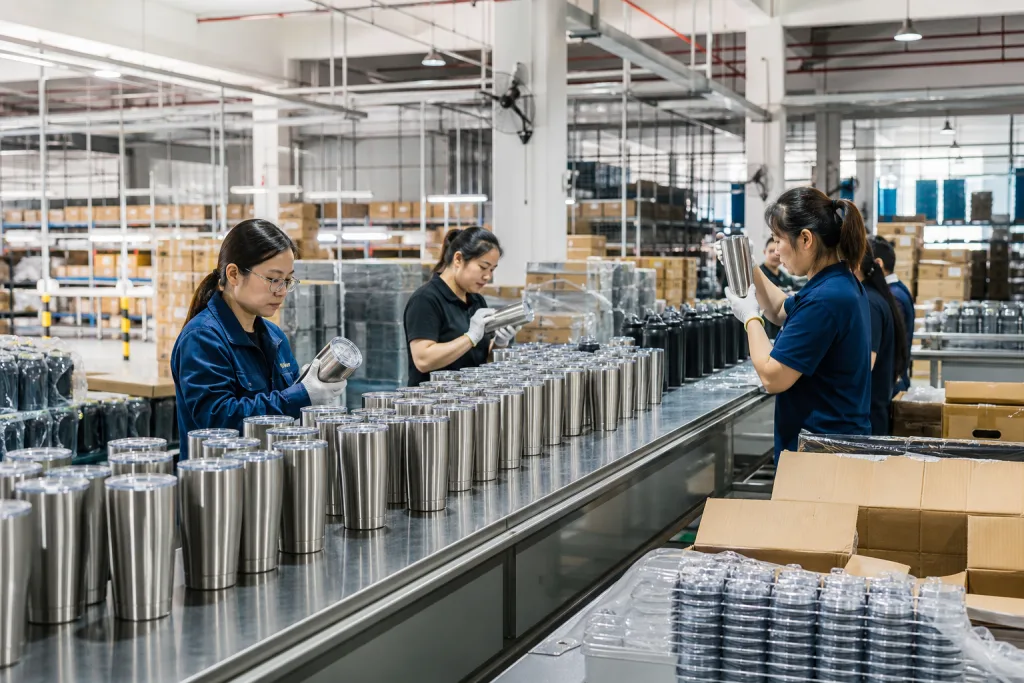
Key Takeaways
- A practical MOQ for custom travel tumblers is usually 1,000 to 3,000 pcs per color, while some stock models from China start at 500 pcs.
- FOB pricing for a 20 oz 304 stainless steel tumbler is often USD 2.80 to 4.90, depending on coating, lid, and print method.
- Lead time is typically 7 to 12 days for samples and 25 to 40 days for mass production; our Zhejiang factory output is 300,000 units/month.
- AQL 2.5/4.0 inspection, REACH testing, and leak testing at 100% matter more than adding one more accessory.
You are not buying a mug. You are buying a defect rate, a heat-loss curve over 2 hours, a print method that either survives 300 dishwasher cycles or gets buyer complaints, and a landed cost that still leaves margin after freight. We’ve seen this go sideways: the PP pre-production sample looked clean, then QC pulled the sample on the line and found lid seepage at a 15° tilt test.
For coffee brands and corporate-gift buyers, “what looks good?” is the wrong question to ask. Better ask which spec set fits your channel, target cost, and reorder timing. From our factory in Zhejiang, we see buyers cut total cost by 8% to 15% when they lock 4 points early: body structure, lid system, decoration method, and compliance level. One PO even came in with “dishwahser safe” typed on it, which tells you how early details get missed. Get those 4 right first. The rest is usually simple.
Start with the four buying decisions
If you are sourcing a factory coffee travel mug, make the call in this order: body construction, lid style, decoration method, then order model. A lot of first-time buyers start with Pantone color or a 45 mm logo width, and we end up revising the spec sheet after the first sample. Start with the structure first. Color comes later.
Decision 1: body construction. Pick the use case before you look at finish options. A single-wall piece fits low-cost promotions. A double-wall vacuum piece fits daily commuting. A heavier retail tumbler needs more shelf presence, and the weight often lands around 320 g to 380 g for a 20 oz size. A 20 oz double-wall 18/8 stainless tumbler with 0.4 mm inner and 0.45 mm outer wall is still the common middle ground. We run this spec every week because it works for a bulk coffee tumbler program, gift sets, and coffee-brand merchandise without pushing the math too hard.
Decision 2: lid style. Lid choice changes complaint rate fast. Slide lid, flip lid, screw lid, and straw-compatible lid do not perform the same, and this is where buyers sometimes ask the wrong question. “Does it leak?” is too broad. Ask how it performs after a 30-minute inverted hold test and whether QC pulled the sample from production or from a hand-built prototype. For office gifting, splash resistance is often enough. For commuter use, ask for a genuine leak-resistant design, then test it with hot water, not just room-temperature water.
Decision 3: decoration method. Silkscreen works for simple spot colors and keeps cost under control. Laser engraving stays clean and holds up better on daily-use cups. Wrap printing looks strong on shelf, but the line rejects more pieces for scratch marks, registration drift, and coating dust. We have seen a PO typo switch matte black to gloss black, and the buyer flagged the whole approval set even though the logo was correct. Decoration affects unit price, carton yield, and rework risk at the same time.
Decision 4: order model. Decide whether you want a coffee mug private label item from a stock mold or a fully coffee mug custom made body. Stock molds from China shorten development by 20 to 35 days and usually keep MOQ near 1,000 pcs. In our shop, a stock shape can move from drawing check to pre-production sample in about 12 days vs 18 days for a modified lid set. A new mold only makes sense when your retail position depends on a distinct silhouette or a patented closure. If the sales target is a standard promo program, custom tooling usually goes sideways.
- For promotional use: put cost first, then print speed. Color consistency still matters, especially on repeat orders above 3,000 pcs.
- For coffee brands: focus on drink feel, finish quality, and stable reorders. Buyers come back fast if the powder coat batch shifts.
- For corporate gifts: focus on packaging, leak control, and logo durability. A drop-test fail on the insert tray is an avoidable headache.
This filter works better than browsing a long coffee mug supplier directory or asking every coffee mug distributor to ship random samples. We have seen buyers collect 12 samples and still miss the lid test, which is where the real risk sits.
Match the tumbler to your sales channel
A tumbler that works in a cafe loyalty program often fails online. We see this all the time. North America may want a larger 20 oz body, while a corporate-gift project in Europe gets pushed back at EUR 4.20 landed. Your sales channel should set the spec first. If you pick the bottle before the channel, we've seen this go sideways on the line.
Retail and coffee brand merchandise
For a coffee brand, end users care about heat retention, hand feel, and whether the finish still looks clean after 6 weeks in a car cup holder. A 16 oz to 20 oz vacuum tumbler is the safe starting point, usually with a body diameter around 88 mm so it fits standard holders. Powder coating gives better grip and looks more premium on shelf. A transparent AS or Tritan lid lets the buyer see the drink level, and yes, that small detail helps conversion. This is where a coffee mug customizable or coffee mug customized program from a stable coffee mug manufacturer matters, because repeat orders need to match the first batch on color, gloss, and logo position. QC pulled one sample last month with a logo shifted 1.5 mm, and the buyer flagged it fast.
Corporate gifting and promotional campaigns
For a coffee mug promotional order, budget is the first filter. Buyers often target FOB USD 2.50 to 3.50 for 12 oz to 16 oz items at 3,000 pcs, and the math doesn't work if you start with custom lids and full-color wrap printing. Stock colors, one-position silkscreen, and standard white mailer boxes are the usual cost-control setup. If the product is meant for executive gifts, step up to matte powder coating, laser logo, and a custom color box. That can raise FOB by USD 0.60 to 1.20 per unit, but it usually lifts sell-through or gift perception enough to carry the extra cost. We run these projects with a basic tape test on the logo and a box compression check before shipment.
Distributor and wholesale programs
If you are a coffee mug distributor or one of several coffee mug distributors covering 20 or 30 accounts, standardization beats novelty. Pick 2 proven bodies, not a dozen experimental shapes, then build decoration options around them. That cuts inventory risk and helps a coffee mug factory direct supplier in Zhejiang, China keep tooling, lid fit, and packing specs stable for reorders. One buyer even sent a PO with the lid code typed wrong by one digit, and because the body platform was standardized, we caught it before mass production.
If your end customer cannot explain why they need a special lid or unique shape, use a standard mold and spend the money on finish and packaging instead.
For Amazon FBA or DTC programs, check FNSKU placement, gift-box drop performance, and scratch risk in transit before you approve the order. This is the wrong question to ask: “Does the pre-production sample look nice?” Ask what happens after a 76 cm drop test and 18 days in a container. A pretty sample from a coffee mug supplier list means little if the first container lands with 4% cosmetic damage. We ship with inner dividers or PE bag changes when needed, because one scratched sidewall is enough to kill a review.
Choose materials without paying for fiction
Material claims are where buyers lose money fast. The wrong question is “what sounds premium?” The right one is “what are you building, in what thickness, with what test report behind it?” On our line, QC pulled a cup last month because the PO said “304 body” but the lid spec was missing.
For a dependable bulk coffee travel mug, 18/8 stainless steel, also called SUS304, is still the standard for Europe and North America. It gives you stable corrosion resistance, food-contact safety, and a price most retail programs can carry. A 201 stainless outer does cut cost on aggressive targets, and we do ship that spec for promo projects over 5,000 pcs. For retail and long-term brand use, most buyers stay with full 304 construction because the complaint math works better. If you want a premium spec, copper-plated vacuum insulation does improve heat retention, but we have seen buyers pay for it and then fail to show the difference in a normal 6-hour user test. Side-by-side, yes. On its own, not much.
Ask the coffee mug factory for hard specs, not broad promises. We run a micrometer check at incoming inspection, and 0.05 mm off on the inner wall changes the feel in hand and the dent rate in transit.
- Inner wall thickness: 0.4 mm or 0.45 mm
- Outer wall thickness: 0.4 mm to 0.5 mm
- Steel grade: SUS304 inside, ideally outside too
- Lid resin: AS, Tritan, PP, or combination structure
- Sealing ring material: food-grade silicone
For compliance, Europe may require REACH focus, and some buyers ask for LFGB pathway testing depending on product structure and market. North American buyers often ask for FDA-contact declarations plus ASTM-related packaging or drop-test standards for retail programs. If children may use the product, the spec sheet changes again. A serious coffee mug oem manufacturer in China should map this clearly by part and market, not send one generic PDF with six unrelated SKUs on it. We have seen this go sideways when a buyer flagged a report that covered silicone only, not the full lid assembly.
Do not ignore finish choice. Powder coating hides minor handling marks better than spray paint and usually gives stronger field performance. Electroplating looks sharp on the approval sample, but it scratches easier and pushes defect risk up on the line. For a bulk travel tumbler order, that can be the difference between 0.8% and 3% cosmetic claims. One carton drop during in-house handling will tell you plenty.
At BottleForge in Zhejiang, we normally tell buyers to spend first on steel consistency and lid fit, not on exotic coatings. A loose lid at 1.2 mm silicone compression gets complaints faster than a plain finish ever will. Those two areas drive more returns than the marketing copy printed on the carton.
Price the project beyond FOB
Buyers comparing quotes from a coffee mug supplier often line up the wrong numbers first. FOB is one line only. We price sampling, packaging, inspection, freight efficiency, and defect risk because that is where the project margin usually moves. On our side, QC pulled a sample last month over a lid leak at 85°C, and that single issue mattered more than a USD 0.08 unit gap.
For reference, a standard 20 oz vacuum travel tumbler from a coffee mug manufacturer in Zhejiang, China may look like this:
- FOB Ningbo: USD 2.80 to 3.40 for stock color + one-color silkscreen at 3,000 pcs
- FOB Ningbo: USD 3.60 to 4.40 for powder coat + laser logo + better lid at 3,000 pcs
- Custom color box: add USD 0.28 to 0.75
- Master carton upgrade or dividers: add USD 0.05 to 0.18
- Third-party inspection: roughly USD 300 to 450 per day depending on provider and location
If you are buying coffee mug in bulk for gifting, ask for packed-carton size and loading quantity at quote stage, not after artwork approval. A tumbler that saves USD 0.10 on unit price but cuts container loading by 12% is not cheaper; the math doesn't work. We have seen 58 x 39 x 27 cm cartons beat a cheaper offer simply because the line packed more units per 40HQ. The buyer flagged freight later, but by then the PO was already issued.
MOQ changes cost fast. A 500-piece trial order works for validation, but silkscreen setup, barcode labels, and carton print spread badly at that level. Most efficient runs for a bulk coffee mug or bulk travel mug sit around 1,000 to 3,000 pcs per design. If you split one order into four colors, ask whether MOQ is per color, per lid match, or per SKU. We ship plenty of repeat orders where the first dispute started from one small PO typo on color breakdown.
Coffee mug private labeling usually does not require a new mold. In factory language, it means logo print, Pantone color, packaging, barcode, care card, and carton marks. That keeps tooling at zero and saves time on launch. A full custom body is a different project and this is the wrong question to skip: new tooling can add USD 2,000 to 8,000 and 30 to 45 days in development. On the floor, that also means sample checks with calipers and fit tests before we run mass production.
Audit the supplier, not just the sample
A good pre-production sample shows the shape, finish, and logo can be made. It does not show line control. If you are screening coffee mug manufacturers or cutting down a coffee mug supplier list, this is the right place to look. We have seen polished samples pass, then mass goods fail on rim paint and lid torque.
Start with capacity, then check what sits on the factory floor. A plant claiming 1 million units per month can still miss your shipment if welding or packing is sent outside. Ask which steps are done in-house: tube forming, laser welding, vacuuming, powder coating, printing, assembly, packing. Ask which ones run on their own line, and which ones go to a subcontractor 12 km away. Our own travel tumbler line in Zhejiang runs around 300,000 units per month, with normal lead time of 25 to 35 days after deposit and artwork approval. We usually get buyer pushback on this point, but the math does not work if a supplier promises both custom color and 15-day delivery at scale.
Then ask about quality system basics:
- AQL standard used for final inspection, commonly 2.5 major / 4.0 minor
- 100% vacuum check and 100% leak test or sample-based leak test
- Incoming inspection for lids, silicone rings, and coatings
- Traceability by production date, line, and carton mark
- Social compliance such as BSCI or equivalent if required by your customer
A real coffee mug factory direct partner should name the failure points without being pushed. On tumblers, QC pulled the sample for the same issues again and again: lid fit, color difference over ΔE 1.0, powder-coat chips around the rim, logo position drifting 2 mm, base wobble on a flat steel plate. If a supplier stays vague here, we would worry. This is where orders go sideways.
Ask for a defect photo library from previous inspections. Serious factories in China usually have one saved by date and PO number, sometimes with a buyer typo carried through on the carton mark so you know it is real. It tells you more than a brochure. Also confirm whether the replacement policy is credit on next order, spare quantity packed in the shipment, or cash settlement within an agreed claim window. Put it in the PI. Not in chat.
Build a brief that gets accurate quotes
Buyers often ask for a coffee mug custom project and send only a logo plus a rough size. Then every coffee mug supplier fills in the blanks, and that is where quotes drift fast. We have seen one RFQ price at 16 oz with 0.4 mm inner wall, while another factory quietly quoted 14 oz with a lighter body. Same photo. Different mug. A good RFQ is brief, specific, and built for costing.
Your brief should include:
- Target market: EU, US, Canada, or mixed
- Capacity: 12 oz, 16 oz, 20 oz, or metric equivalent
- Use case: cafe resale, employee gifts, promo event, subscription box
- Body spec: single wall or double-wall vacuum; 304 steel requested or not
- Lid requirement: splash-resistant or leak-resistant
- Decoration: silkscreen, heat transfer, UV print, laser engraving
- Packaging: polybag, white box, color box, PDQ, e-commerce mailer
- Order quantity by color and by SKU
- Needed certifications and test reports
- Deadline, ship term, and destination port
If you are sourcing a coffee mug promotional products program, put the target price in line 1. If you are a brand buyer, give your expected retail price and margin target. That is the number set that matters. Otherwise the math does not work, and the coffee mug factory is pricing blind. We ship both promo and retail orders, and the cost split is different right away: logo method, lid style, box, even whether a 500 pcs MOQ is workable.
For artwork, send vector files and Pantone references. For coffee mug custom made packaging, include barcode rules, country-of-origin statement, and any retailer marks. If you sell online, call out FNSKU, suffocation warning language, and carton drop requirements at the start, not after sampling. QC pulled a sample last month where the buyer flagged a 2 mm barcode quiet-zone issue only after mass box layout. That kind of change burns days.
The best quotes are not the shortest emails. They state material, wall thickness, lid material, logo process, MOQ, sample charge, lead time, and validity period in plain terms. Ask for those points side by side. This is the right question to ask. Then you can compare one coffee mug bulk offer against another without guessing what was cut out to make a lower price look good.
Get a workable tumbler quote, not a vague one
Send your target quantity, size, logo method, and deadline. We will recommend the right factory coffee travel mug spec from Zhejiang, China within 1 business day.
Frequently asked questions
What MOQ should I expect for a custom factory coffee travel mug?
For a stock mold with custom logo, the normal MOQ is 1,000 pcs per design, often with 500 pcs per color if the finish is standard. Some China factories accept 500 pcs for trial orders, but your unit cost can rise by USD 0.30 to 0.80 because setup, carton, and print costs are spread over fewer pieces. If you want a fully new body shape, practical MOQ usually moves to 3,000 to 5,000 pcs and tooling can add USD 2,000 to 8,000. For coffee brands and corporate-gift buyers, the best cost-to-risk point is usually 1,000 to 3,000 pcs on an existing tumbler mold with custom logo and packaging.
How much does a bulk coffee travel mug usually cost from China?
A realistic FOB range for a double-wall 16 oz to 20 oz stainless steel tumbler from China is USD 2.80 to 4.90, depending on steel grade, coating, lid structure, and decoration. Entry-level promotional models sit near USD 2.50 to 3.20 at 3,000 pcs. Better powder-coated retail models with laser logo and upgraded lids often land around USD 3.60 to 4.40 FOB. Add USD 0.28 to 0.75 for a custom color box, plus inspection and freight. If a quote is much lower, check whether the factory downgraded the lid, reduced wall thickness, used mixed materials, or excluded packaging that you assumed was included.
What is the safest decoration method for coffee mugs with custom logos?
If durability matters more than bright graphics, laser engraving is usually the safest choice. It survives handling and typically gives the lowest complaint rate on powder-coated stainless tumblers. For simple logos, silkscreen is the most cost-effective and works well on promotional orders, but it is more vulnerable to abrasion and dishwasher abuse. Heat transfer or full-wrap print gives stronger retail appeal but also raises risk of print misalignment and cosmetic rejects. On bulk orders, we usually see laser add around USD 0.08 to 0.20 versus basic print, which is often worth paying for corporate gifts or coffee-brand merchandise that needs a cleaner, longer-lasting result.
Which tests and documents should I request before placing the order?
Start with product specification confirmation, then ask for material declarations and market-relevant compliance documents. For Europe, REACH-related confirmation is common, and some buyers request LFGB-oriented food-contact testing depending on product type. For North America, FDA-contact declarations are common. Operationally, ask the factory to confirm 100% vacuum check, leak testing standard, and final inspection to AQL 2.5/4.0. If your customer requires social compliance, ask for BSCI or equivalent audit status. For retail programs, request drop-test review for the packed box and barcode placement approval. These documents will not replace inspection, but they sharply reduce the chance of buying a nice sample and a weak production run.
How long does a custom coffee mug private label project take?
For a stock tumbler with custom logo and standard packaging, sample time is usually 7 to 12 days after artwork confirmation. Mass production is commonly 25 to 35 days after deposit and approved pre-production sample. If you add a custom color box, allow a few extra days for packaging proofing. If you need a new mold, development can add 30 to 45 days before mass production even starts. During peak season, especially from late August through November in China, lead times can extend by 7 to 15 days. If your event date is fixed, lock artwork, packaging, and carton marks early because revisions on those items often cause more delay than the tumbler itself.