Key Takeaways
- A standard 20 oz double-wall 304 stainless factory coffee mug usually lands at $3.20-$5.80 FOB China at 1,000-5,000 units, depending on finish, lid, and print.
- Common MOQ starts at 500-1,000 units per colorway, while custom color, private label packaging, or new lid parts often push practical MOQ to 2,000-3,000 units.
- Sample to shipment timeline is typically 25-45 days after approval; truly custom tooling can extend lead time by 15-30 days.
- Decoration, packaging, and testing often add 12%-28% to base cup cost, more than many first-time buyers expect.
You are not buying a mug. You are buying landed cost, a production slot on the line, and a risk level your team can live with. That matters fast if your factory coffee mug project is a stainless travel tumbler for a coffee brand launch, a seasonal corporate-gift program, or a distributor restock. The wrong quote looks cheap on page 1 and expensive after that: mold changes after the 2D drawing sign-off, packaging upgrades from white box to color box, failed print adhesion in the tape test, or a vessel out of China that misses the booking window.
From Zhejiang, we run into the same mess every month. A buyer asks for a bulk coffee tumbler or bulk travel tumbler quote, gets 5 prices, and still cannot compare them because one factory priced a 0.5 mm outer wall and another slipped in a different lid set. This is the wrong question to ask. The practical way to buy is to split the project into cost drivers, MOQ tiers, and a real calendar the factory will stand behind. If you know what moves price by $0.40 and what adds 18 days, you can push back like a buyer who ships volume, not like someone placing a first PO with a typo in the logo code.
What you are actually pricing
When you request a quote for a factory coffee mug, first decide what you are buying. This is the wrong question to skip. A plain 20 oz stainless steel body with a standard push lid is one price. A coffee mug custom made with powder coat, laser logo, color gift box, barcode labels, leak-test standard, and retail carton drop-test requirement is a different job on the line. We see this every month: a factory quotes the bare body first, then the PO grows after the buyer adds a 5-layer gift box, EAN label, and a 1.2 m drop test. That is where deals go sideways.
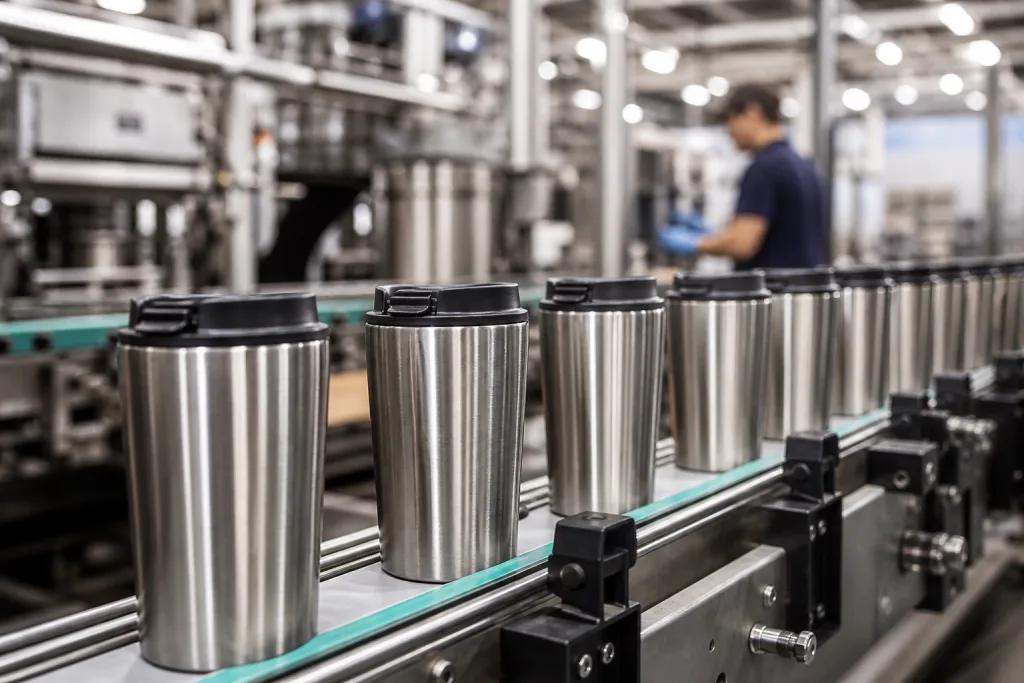
For Europe and North America, the usual base specification for a travel tumbler is 18/8 stainless steel, which means SUS304 inside and outside, double-wall vacuum insulation, wall thickness around 0.4 mm inner and 0.5 mm outer, with a PP or Tritan lid and food-grade silicone seal. On our floor, QC checks wall thickness with an ultrasonic gauge before vacuuming. For a bulk coffee travel mug at 20 oz, this is the range we usually ship:
- $2.60-$3.40 FOB Zhejiang, China for a standard uncoated body with one-color silk screen and standard lid at 3,000 units
- $3.40-$4.40 with powder coating, tighter lid fit, and retail-ready packaging
- $4.50-$5.80 with premium finish, engraving, special color match, and upgraded pack-out
If a coffee mug supplier gives you one number only, you still do not have a working quote. Ask for the split: cup body, lid, decoration, packaging, carton spec, and test charges. We run quotes this way because buyers push back later on small items that are not small, like a lid change from PP to Tritan or a master carton count change from 24 pcs to 20 pcs. The math does not work if you compare factory A's bare cup price against factory B's full retail pack-out.
Useful rule: if two quotes differ by more than 15%, ask for the exact steel grade, wall thickness, lid resin, coating type, and carton count before you assume one factory is simply cheaper.
The cost drivers buyers miss first
The first cost trap is staring at capacity and missing the rest. We see this on the line all the time. Capacity matters, but finish, lid build, and packaging usually move the quote faster. For a coffee mug factory direct order, the cup body itself is often only 55%-70% of unit cost. The rest comes after the first quote, once the buyer adds details that were not on the original PO.
Material and insulation
SUS304 is still the standard for a quality coffee mug manufacturer shipping to export markets. Some suppliers offer 201 on the exterior to hit a target price. That saves about $0.08-$0.18 per unit, and yes, buyers ask for it. Then the buyer flagged rust risk after a 48-hour salt spray check. For humid climates or long-term brand programs, most Europe and North America accounts stay with full 304. Copper lining improves heat retention and usually adds $0.12-$0.25. We have seen this go sideways when the question is only “what is the cheapest wall material?” That is the wrong question to ask.
Finish and color
Spray paint is cheaper than powder coat. Powder coat usually holds up better in scratch tests, especially around the base where QC pulled the sample after carton drop checks. Expect powder coat to add $0.20-$0.45 depending on color and texture. Pantone matching for a coffee mug customized program can slow the line and create setup waste, especially on matte or rubberized effects. A 1 shade mismatch at first article can burn half a day, and on a 3,000-piece run that cost lands back in the unit price.
Decoration
For coffee mug custom branding, the usual options are silk screen, heat transfer, laser engraving, or 360-degree digital print. Typical adders at 1,000-3,000 units:
- 1-color silk screen: $0.05-$0.12
- Laser engraving: $0.10-$0.22
- Heat transfer wrap: $0.18-$0.40
- Full digital print: $0.35-$0.80
Packaging gets missed all the time, especially on corporate-gift projects. A plain white box may cost $0.12-$0.20. A custom printed gift box with EVA or pulp insert can run $0.45-$0.95. Add FNSKU or warehouse labels for Amazon projects and you may add another $0.03-$0.08. We ship plenty of simple tumbler orders out of Zhejiang, and packaging complexity is still one of the fastest ways to turn a clean bulk coffee mug order into a slow, expensive one. Last month one buyer’s PO even had the FNSKU size typed wrong by 2 mm, and the relabel work wiped out the price they fought for at the start.
MOQ tiers that change your math
MOQ is not one number. On our side, we break it into factory MOQ, decoration MOQ, packaging MOQ, and sometimes component MOQ. A bulk coffee mug program looks easy on the quote sheet, then the buyer asks for 3 body colors, 2 lid colors, and 4 logo versions. That is when the real minimums show up on the line.
For a standard travel tumbler from a coffee mug oem manufacturer, practical tiers usually look like this:
- 500 units: workable for an existing shape, existing lid, stock color, and one simple logo. Unit price stays highest, and stock color choices are tight. We usually run this tier only if the silk screen fixture is already on hand.
- 1,000 units: the normal starting point for a serious coffee mug private label order. Pricing drops, carton planning is cleaner, and decoration choices open up. This is also where the math starts to work for a 24 pcs master carton.
- 3,000 units: where FOB pricing usually turns competitive for distributors and promotional buyers. At this level, coating loss is easier to absorb, and QC pulled the sample faster because the run is stable.
- 5,000+ units: where custom lid color, exclusive packaging, and annual blanket ordering start to make sense. If you want a Pantone-matched slider and an insert card with a separate barcode, this is the tier we quote first.
Here is the part buyers miss: MOQ can be per SKU, not per order. If you need 1,000 pieces total split across 4 colors, most coffee mug manufacturers will read that as 4 runs of 250 pieces. That is rough for powder coating, logo setup, and pack-out. We have seen this go sideways. The buyer flagged the total quantity as "enough," but the coating gun still has to be cleaned and reset for each color, so the result is a surcharge or a soft refusal.
At BottleForge Industrial in Hangzhou, Zhejiang, our monthly capacity on travel tumblers is up to 300,000 units, but efficient MOQ for a coffee mug customizable project is still driven by setup time. That is the wrong question to ask if you only focus on plant capacity. A custom color lid injection order may require 2,000-3,000 pieces per color before the mold change and color dosing make cost sense. Custom gift boxes often need 1,000 pieces per design, and we have had buyers change one word on the box after approving the PO. If you are a coffee mug distributor testing a new line, start with the lowest-risk version first: stock body, one decoration method, standard carton, and one logo position.
Lead time from sketch to sailing
Lead time is where coffee brands lose schedule fast. We hear buyers say “30 days” all the time, then find out they counted artwork edits, sample sign-off, carton mark checks, and vessel booking in the same bucket. That is the wrong question to ask. On our line, one missed PO detail — even a barcode typo — can push booking by 3 days. A factory coffee mug timeline needs clear stages.
- Quotation and technical confirmation: 2-5 days
- Pre-production sample: 5-10 days for existing models
- Custom color or packaging sample: 7-12 days
- Mass production: 20-35 days after deposit and sample approval
- Final inspection and booking: 3-7 days
- Ocean transit: roughly 25-40 days to Europe, 20-35 days to North America, route dependent
If you need new tooling for a handle, lid slider, or bottom base, add 15-30 days for tool making and first article revision. We usually cut the first tool trial, check fit with a caliper, and then revise. A lid slider off by 0.3 mm is enough for the buyer to flag it. A coffee mug custom made project with a completely new silhouette can take 45-70 days before shipment, even from a fast coffee mug factory in China.
Seasonality changes the math. Orders placed before peak gifting periods or before Chinese New Year need earlier planning than most buyers expect. In Zhejiang, the production line may be ready, but coating lines, packaging suppliers, and trucking slots get tight. We have seen a nominal 25-day run stretch to 38 days because the outer carton supplier missed 1 print slot and the truck booking rolled 2 days.
The cleanest way to control lead time is to lock these points early: artwork format, Pantone code, barcode list, carton mark, drop-test requirement, and inspection standard. QC pulled the sample on Monday, everything looked fine, then the buyer changed the retail box on Friday. The clock restarted. If the gift box size shifts by even 8 mm, master carton count changes, pallet count changes, and booking often changes with it.
How to compare factory-direct quotes
A serious buyer does not look at unit price alone. Compare the full quote: cost structure, production assumptions, and where the order can fail. This is the wrong question to ask if the only target is “best price.” Whether you buy from coffee mug distributors, a coffee mug supplier list, or factory-direct contacts in China, send every vendor the same quotation template. We run into this every month: one buyer compares 3 quotes, then finds one factory included a 0.05 mm thicker outer wall and another did not.
Your checklist should include:
- Incoterm: FOB Ningbo or Shanghai, not just “China price”
- Material: SUS304 inner and outer, or mixed grade
- Weight: net weight and gross weight per carton
- Wall thickness: actual mm, not “standard”
- Decoration: exact process and logo size
- Packaging: white box, color box, PDQ, or master carton only
- Testing: REACH, LFGB, FDA, Proposition 65, ASTM if relevant
- Quality standard: AQL 2.5/4.0 or your own limit sample
For corporate gift projects, ask about spare rate. One supplier quoting 1,000 units may pack exactly 1,000. Another may build 2% spare, so 20 extra pieces cover logo defects or dented lids. That detail changes whether your event gets full inventory or comes up short. We have seen buyers flag missing pieces after carton count because the PO said “1,000 pcs” but never mentioned spare policy. For coffee mug promotional products, also ask if each unit is individually polybagged, tissue wrapped, or assembled with inserts. Those steps add labor on the line, but the complaint math usually works better.
If two factories are within $0.12 per unit, pick the one that shows process discipline. ISO-based documentation, BSCI or Sedex social audit, incoming material checks, vacuum retention testing, and leak testing by lot tell you more than a headline saving. QC pulled the sample last week on a similar job and found 3 lids with weak seal fit at 0.6 m drop test height; that shipment would have gone sideways without lot inspection. For a coffee mug private labeling program, one failed shipment can wipe out the margin from 4 or 5 clean orders.
Risk control before you send deposit
Most bulk coffee mug failures are easy to see coming. Buyers just lock the spec too late. Before you send a deposit, put the quality and compliance terms in writing. We’ve seen this go sideways over a 0.8 mm dent limit that never made it onto the PO.
Start with the inspection standard. A common export practice is AQL 2.5 for major defects and 4.0 for minor defects. Write down what counts: print alignment tolerance, coating fish-eyes, dents, sharp edges, odor, and leak performance. Then fix the test method, not just the target. For example, leak test at inverted position for 30 minutes, vacuum retention target such as less than 10°C drop over 6 hours for hot water under stated ambient conditions, and dishwasher warning if the decoration cannot tolerate it. QC pulled samples before with a lid that passed upright but failed upside down at minute 18. That detail matters.
Settle packaging performance before the line starts packing. If your coffee mug promotional order will move through parcel networks, ask for a carton drop test or at least a stronger outer carton. Upgrading from a 5-layer to a heavier board grade may add $0.06-$0.14 per unit depending on pack count, but the math usually works if it prevents one damaged shipment claim. We ship a lot of 24-pack master cartons, and buyers often push back on board weight until the first crushed corner photo lands.
Agree payment and documentation terms in plain words. Standard export terms are often 30% deposit, 70% before shipment, but larger buyers may negotiate against inspection pass or bill-of-lading copy. Also list the paperwork set: invoice, packing list, test report, carton marks, and shipping label format. This is the wrong question to ask at the end. Last month a buyer flagged a one-letter typo on a PO number, and the bank docs had to be redone.
Be realistic about communication. A good coffee mug supplier in Zhejiang or wider China should answer technical questions clearly: steel certificate, lid resin, logo durability, carton dimensions, production photos. If a seller cannot explain why one bulk travel mug quote is $0.50 below the others, assume there is a downgrade in steel weight, paint thickness, or packaging. We run into this all the time. Smart sourcing is not the lowest number; it is the lowest controllable total cost with fewer surprises.
Get a tumbler quote with real cost breakdowns
Send your target size, quantity, logo method, and packaging plan. We will quote MOQ, FOB price, and lead time clearly from our Zhejiang production team.
Frequently asked questions
What is a realistic price for a custom factory coffee mug order?
For a standard 20 oz double-wall stainless travel tumbler, a realistic FOB China price is usually $3.20 to $5.80 at 1,000 to 5,000 units. At the low end, you are looking at an existing shape, standard lid, simple one-color print, and plain box. Add powder coating, laser engraving, custom color box, or premium lid and the price moves up quickly. Very small runs around 500 units can be 10% to 20% higher per piece. If you need full private labeling, special inserts, or compliance testing, budget another $0.40 to $1.20 per unit depending on requirements.
How long does a bulk coffee travel mug order usually take?
For an existing model, plan on 25 to 45 days from sample approval to shipment. A pre-production sample usually takes 5 to 10 days, then mass production takes 20 to 35 days depending on line loading, finish, and packaging. If you change the lid color, retail box, or artwork after sample sign-off, expect delays of 3 to 10 days. New tooling for a lid, handle, or body profile usually adds 15 to 30 days. Ocean transit from China is separate, often 20 to 40 days depending on destination port, season, and booking conditions.
What MOQ should I expect from a coffee mug factory direct supplier?
For a standard stock tumbler, many factories can start at 500 units, but that is usually for one stock color and basic branding. A more practical MOQ for a custom project is 1,000 units per SKU. If you need a custom lid color, premium finish, or custom printed gift box, efficient MOQ often becomes 2,000 to 3,000 pieces per design. Packaging suppliers also have their own minimums, commonly 1,000 boxes per artwork. If you split one order into too many colors or logos, your effective MOQ rises because each setup creates waste and labor.
Which specifications affect cost the most on a bulk coffee tumbler?
The biggest cost drivers are steel grade, wall thickness, lid construction, surface finish, decoration, and packaging. Moving from spray paint to powder coating can add $0.20 to $0.45. Laser engraving adds roughly $0.10 to $0.22, while full-wrap print can add $0.35 to $0.80. A custom gift box can cost $0.45 to $0.95 compared with $0.12 to $0.20 for a white box. Copper lining, custom lid tooling, and stricter parcel-safe cartons also increase cost. Capacity matters, but the difference between a basic tumbler and a retail-ready branded mug usually comes from finishing and pack-out.
How do I reduce risk when sourcing from coffee mug manufacturers in China?
Use a written specification sheet and do not rely on chat messages. Confirm SUS304 grade, wall thickness, lid material, decoration method, packaging, carton count, and inspection standard before deposit. Ask for AQL levels such as 2.5 major and 4.0 minor, plus functional tests like 30-minute leak test and heat retention benchmark. For Europe, ask about REACH or LFGB if needed; for North America, FDA and Proposition 65 may be relevant depending on materials and claims. A pre-shipment inspection typically costs far less than a bad container. Good factories in Zhejiang, China will accept structured QC terms because it avoids disputes later.