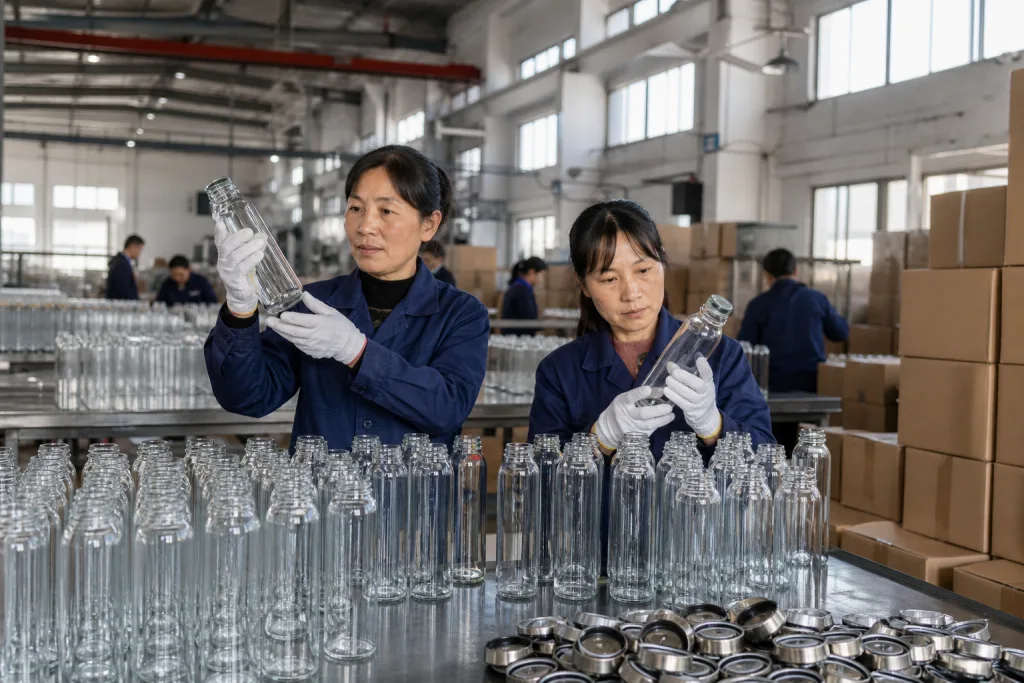
Key Takeaways
- For most borosilicate glass bottle bulk orders, MOQ starts at 1,000 to 3,000 units per SKU, with custom color parts often needing 3,000+ units
- Lead time is usually 7 to 12 days for samples and 30 to 45 days for mass production after deposit and artwork approval
- A practical QC plan is AQL 2.5 for major defects and AQL 4.0 for minor defects, plus 1.0 meter drop checks on packed master cartons
- Single-wall high borosilicate bottles commonly use 1.8 to 2.5 mm wall thickness, which affects weight, breakage rate, and FOB cost
Glass bottle trouble usually does not start with the obvious stuff. Capacity looks right. The sample feels solid in hand. Price lands in range. Then bulk production shows up and the problems start: carton drop failures at 76 cm, a bamboo lid that picked up moisture and swelled 1.5 mm in transit, a silk-screen logo scuffed after rub testing, or a silicone sleeve that came back off your approved Pantone by enough that the buyer flagged it. That is the real sourcing problem with a factory borosilicate glass bottle.
If you buy for a wellness brand or a sustainable retail line, a catalog is not enough. You need to lock the key specs before we run the line. In Zhejiang, plenty of suppliers can show polished photos, FDA paperwork, and a clean sample set on the conference table. The wrong question is “Who has the lowest quote?” What matters is how you choose the glass grade, decoration method, closure build, and pack-out standard before mass production starts. QC pulled this exact issue on one PO where the insert card was 2 mm too short and bottles knocked together in transit. Get those decisions right early, and scaling a custom glass water bottle program gets a lot less painful.
Start with the four decisions
With a factory borosilicate glass bottle, four decisions set the quote fast: glass spec, lid system, decoration method, and pack-out standard. Miss one, and the sample round drags. We’ve seen projects slip 12 days vs 18 days just because the wall thickness changed after the first mold drawing. On the line, QC checks body diameter with a digital caliper before packing approval, so these details are not paperwork only.
Start with actual use, not the catalog photo. A wellness brand selling tea infusions might need a 550 ml bottle with a stainless tea strainer, carry loop, and a rigid tube box that survives shelf display. A sustainable retailer might want a cleaner 500 ml item with a bamboo lid and a lower landed cost target. Same category, different build. This is the wrong question to ask: “What is your best price for a custom borosilicate glass bottle?” We need the use case first. Last month, a buyer flagged a lid fit issue that came from mixing a sport-use brief with a gift-box budget.
- Glass body: confirm capacity, mouth diameter, wall thickness like 1.8 mm or 2.2 mm, straight or tapered shape, and whether the bottle runs with a silicone sleeve.
- Closure: choose PP lid, bamboo cap, or stainless cap, then lock the silicone gasket, tea filter, or straw lid setup so the leak test standard stays clear.
- Branding: define silk screen, heat transfer, decal, laser logo on lid, or a hangtag with color carton, because each route changes MOQ and reject risk on the print line.
- Pack-out: state egg-crate divider, individual polybag, white box, gift box, and any mailer drop test requirement; if not, one supplier ships 24 pcs/ctn and another builds 12 pcs/ctn with inner protection.
If you are comparing a borosilicate glass bottle manufacturer, a borosilicate glass bottle supplier, and a trading company in China, make all three quote the same four points in writing. Otherwise one price is based on a 2.2 mm bottle, another on 1.8 mm, and the low quote may exclude the inner box or use a lighter carton. We ship against plenty of POs where one typo in “with box” vs “without box” turns into a claim later.
At BottleForge Industrial in Zhejiang, China, we see this mistake every month: the buyer asks for a bulk glass water bottle quote and skips transit protection. Then freight damage shows up. The math doesn’t work. In one recent order, upgrading from a plain divider to a stronger egg-crate pack added less than USD 0.18 per piece, but breakage in trial transit dropped from 6% to under 1%. So lock the decisions first, then compare price. That’s how the quote stays honest.
Choose glass specification before style
The body material is not a marketing line. In a borosilicate glass bottle factory, we check borosilicate content, thermal shock performance, wall thickness, dimensional tolerance, and annealing stability before we talk about shape. Skip that work and the sample still looks clean on the meeting table, then the first drop test in transit goes sideways. On the line, QC usually checks wall thickness with a digital caliper at 3 points on the body, and a 0.2 mm drift is enough to change breakage results.
Most buyers in Europe and North America ask for high borosilicate because it handles hot-to-cold change better than soda-lime glass. That matters when the end user pours hot tea in the morning and chilled water later the same day. A typical single-wall bottle in this category runs 1.8 to 2.5 mm thickness. At 500 to 550 ml, moving from 1.8 mm to 2.3 mm may add 40 to 80 grams, reduce breakage in transit, and increase FOB cost by roughly USD 0.12 to 0.28 per unit depending on shape and order size. Buyers sometimes push back on that 0.5 mm increase. The math does not work if you save USD 0.18 and then lose 3% more cartons in distribution.
What you should confirm on the spec sheet
- Capacity tolerance, for example 500 ml plus or minus 5%
- Body weight tolerance, often plus or minus 3% to 5%
- Mouth diameter and thread or plug-fit design
- Heat resistance claim and test method
- Dishwasher suitability for decorated vs undecorated bottles
If you are buying a borosilicate glass bottle wholesale program for retail shelves, shape affects cost and trouble rate more than most buyers expect. Straight-wall cylinders are easier to decorate, pack, and repeat across 6 or 8 SKUs because the screen position stays stable and carton fit is simpler. Curved shapes look different on shelf, but we have seen fragile shoulder zones crack first, carton void space go up by 10% to 15%, and decoration alignment get flagged by the buyer. This is the wrong question to ask: “Which shape looks best?” Ask which shape still runs clean after mass production and container loading.
You are not buying "glass" in general. You are buying a very specific failure rate, pack density, and customer-use experience.
A good borosilicate glass bottle manufacturer in Zhejiang should show dimensional drawings, sample weights, and annealing records, not just lifestyle photos. We usually ship pre-production samples with actual bottle weight and mouth ID in mm marked on the report, and QC pulled the sample more than once after finding a PO typo on cap fit. If a supplier cannot explain tolerances clearly, be careful with any borosilicate glass bottle bulk order above 5,000 units.
Match the lid to the channel
Most complaints on a customized glass water bottle are not about the glass body. They start at the cap: leaking silicone rings, bamboo lids with rough sanding marks, loose straps after a 5 kg pull test, cross-threading on the line, or plastic odor the buyer flagged when the carton was opened. If this item is going to yoga studios, health stores, museum shops, or DTC fulfillment, match the lid to the channel first. We’ve seen this go sideways when brands pick the lid for looks and ask about sealing later. That is the wrong question to ask.
Bamboo lids sell the eco story fast, but the material has limits. Grain and color shift from lot to lot, and in humid storage we have measured slight swelling on incoming pieces before assembly. On branded retail projects, a lot of buyers choose bamboo outside with a PP or stainless inner core so torque and sealing stay consistent at the neck. If your brand promise is leakproof commuting, this hybrid build is the safer call over a full natural cap. QC pulled samples before where the bamboo top looked good, but the flatness at the gasket seat was off by 0.3 mm and the lid failed tilt testing.
- PP lid: the lowest-cost option, easy to control for color, and a practical fit for promotional orders starting at 1,000 units. We run this lid most often on repeat bulk programs.
- Bamboo lid: gives a stronger eco shelf look, but expect more shade variation and a higher defect rate at incoming inspection.
- Stainless lid: gives a cleaner premium feel and works better where you need a tea filter assembly or a boxed gift set.
- Strainer insert: fits wellness and tea brands, but it adds one more assembly step, one more cleaning point, and more chances for missing parts at packing.
For a borosilicate glass bottle promotional project, simple usually wins. A 500 ml bottle with PP lid, one-color silk screen, and white box can stay inside a workable FOB range of about USD 1.55 to 2.40 at 3,000 units, depending on thickness and sleeve. Add bamboo, a tea infuser, a color sleeve, and a custom gift tube, and the number moves to USD 2.80 to 4.80 fast. The math doesn’t work on some “budget premium” requests, especially when the PO also asks for tighter packing and lower breakage.
If you work with borosilicate glass bottle distributors or a distributor glass water bottle channel, ask the factory to hold one neck finish across several sizes, such as 350 ml, 500 ml, and 750 ml. That makes replacement caps, accessory planning, and after-sales service much cleaner. We ship spare gaskets with bulk orders all the time, and a serious borosilicate glass bottle vendor should talk through the spare ratio up front, usually 1% to 2% of order volume. One small spec choice here saves a lot of trouble later, especially when a buyer sends a repeat PO with the old cap code typed wrong.
Branding methods change your risk
Decoration is where a lot of borosilicate glass bottle custom projects give back margin. Buyers stare at logo appearance, then miss abrasion resistance, color tolerance, and line yield. We’ve seen this go sideways. On one 12,000-piece run, QC pulled the sample after packed transit and found the white print scuffed at the bottle shoulder. Choose branding by how the bottle will be handled, not by shelf appeal alone.
For most customizable glass water bottle orders, buyers pick from silk screen on the bottle, heat transfer, water decal, laser marking on bamboo or stainless parts, plus printed packaging. Silk screen is still the default on our line: low setup cost, clean graphics, and stable repeat runs once the mesh and jig are locked. A one-color print might add only USD 0.08 to 0.18 per unit. If the artwork has 3 colors, gradients, or full wrap coverage, you move into transfer or decal. Then the math changes fast: lead time might stretch from 12 days to 18 days, and defect rate usually climbs because alignment and handling get tighter.
Practical trade-offs
- Silk screen: works best for bold logos, simple lines, and 1 to 2 Pantone colors; we normally hold cleaner results when line width stays above 0.3 mm.
- Heat transfer: fits detailed artwork, but registration is touchy; the buyer flagged a 1.5 mm logo shift on a recent trial, and that was enough to reject the sample set.
- Water decal: gives a premium look, but the process is slower and handling breakage goes up; one extra transfer step sounds small until the line starts re-packing trays.
- Laser on lid: lasts well on bamboo or metal, though tone range and marking area are limited; on a 55 mm bamboo lid, usable logo space gets tight fast.
If your product is an Amazon item or a high-turn retail SKU, test decoration after packed transport, not just after curing at the factory. This is the right question to ask. For a customizable borosilicate glass bottle, ask for a pre-production sample with full final packaging, then run carton drop tests and rub tests. We usually check print adhesion after 24 hours cure and again after 72 hours. On one order, the bottle passed at 24 hours and failed after 72 because the ink at the edge lifted under tape pull.
A reliable borosilicate glass bottle supplier in China should spell out artwork limits early. Fine text below about 1.2 mm line height on curved glass usually looks worse in mass production than on a digital mockup. That is not a factory excuse; it is physics. We check this with the artwork film and a wrapped sample before mass production starts. The safer move is to simplify the branding before you scale your customized borosilicate glass bottle order.
Ask for compliance and QC details
If you sell into Europe or North America, compliance paperwork is mandatory. Paper alone does not protect the order. You need the report tied back to incoming material records, line checks, and final inspection results. That is how we separate a serious borosilicate glass bottle manufacturer from a casual borosilicate glass bottle vendor. On our floor, QC pulled one silicone ring lot last month because the color matched the approved chip, but the supplier code on the bag did not.
For glass drinkware, the usual checks are REACH relevance for accessories, LFGB or food-contact migration expectations for some EU programs, and California Proposition 65 awareness for US retail. Ask the factory which exact part is tested—silicone sleeve, paint, bamboo coating, glue, or printed packaging with direct-contact risk—and how often they rerun it. This is the right question to ask. A report from two years ago on a different lid is not enough, and we have seen buyers miss that point until the retailer asked for a fresh file 3 days before booking. If the cap changed from PP to Tritan or the gasket changed from translucent to black, QC should flag a new review.
- AQL plan: 2.5 for major, 4.0 for minor is common for final random inspection.
- Leak test: 100% cap sealing check during assembly for leakproof SKUs.
- Drop test: packed carton drop from 1.0 meter on edges, corners, and faces.
- Thermal shock check: defined internal test if you claim hot-and-cold use.
At our Zhejiang operation, monthly output across drinkware categories can reach 300,000 units, but that number by itself tells you little. The useful question is whether the factory holds the same QC result on 1,200 pieces and on 20,000 pieces. Those are two different jobs on the line. A 1,200-piece boutique run with gift boxes needs tighter carton matching, slower packing, and print-position checks every 30 minutes; a 20,000-piece borosilicate glass bottle wholesale order for chain retail usually lives or dies on consistency, pallet count, and rework control. We ship both, but the math does not work if a factory treats them the same way.
If you are working with borosilicate glass bottle suppliers or borosilicate glass bottle manufacturers in China, ask them to state the exact inspection point where they verify bottle weight, bottle height, mouth diameter, print position, lid torque or seal, and carton mark accuracy. Ask for the tool too: digital scale, vernier caliper, torque tester, seal vacuum check, or master carton sign-off sheet. One buyer flagged a 2 mm logo shift only after goods reached the warehouse, and another caught a PO typo where “clear” was typed as “clean” on the carton mark. If the answer is vague, surprises usually come later.
Costing the program realistically
Do not judge a bulk borosilicate glass bottle offer by unit price alone. Look at the full program cost: sampling, tooling if any, decoration setup, spare parts, packaging upgrades, inspection, and freight cube. We have seen quotes differ by USD 0.18 per bottle just because one supplier included a 5 mm EPE insert and the other did not. The cheapest quote is often the one with the most lines missing. That is the wrong question to ask.
For a standard 500 ml custom glass water bottle with high borosilicate body, PP lid, one-color logo, and white box, a reasonable FOB China range at 3,000 units might be USD 1.55 to 2.40. Add a silicone sleeve, bamboo cap, tea infuser, and custom color gift box, and the same bottle can reach USD 3.20 to 5.20. If a quote lands far below that band, check the glass spec first. We have seen wall thickness cut from 2.8 mm to 2.3 mm, and QC pulled the sample right away because the weight was light in hand. Also confirm the bottle is not soda-lime and the drop protection is not stripped out of the packout.
Typical commercial terms from a borosilicate glass bottle factory are 30% deposit and 70% balance before shipment. Sample cost is often refunded against a bulk order, but custom mold or tooling charges may not be. For many borosilicate glass bottle customized projects, MOQ is 1,000 units for an existing shape, 3,000 units for custom color accessories, and 5,000 units or more if you want exclusive components or complex packaging. On our side, once a project moves past 5,000 units, we usually lock the lid color against a signed Pantone chip because the buyer flagged shade drift on a repeat PO last year.
If you sell through a borosilicate glass bottle distributor network, think about carton efficiency early. The math changes fast. A bottle shortened by 12 mm can let the line pack 24 units per master carton instead of 20, and that can shift units per 40HQ enough to matter on the freight side. Ask for carton dimensions, gross weight, and units per 40HQ in the quote. A professional borosilicate glass bottle supplier should send that data without being chased, usually with carton size like 48 x 32 x 28 cm and a gross weight check under 18 kg.
The better negotiation line is not “lower your price.” Ask the factory to break out the cost effect of changing sleeve thickness, inner box structure, or cap material. That is how experienced buyers work this in China. We run these comparisons every week, and this is where the real savings are without blowing up breakage rate or reorder consistency.
What a good supplier conversation sounds like
If you are still choosing between a borosilicate glass bottle supplier, a factory, or several borosilicate glass bottle vendors, pay attention to how they answer technical questions. A good supplier does not just say yes. We run into this every week: the buyer asks for a lighter bottle wall and lower breakage at the same target cost, and the math does not work. The right supplier will pin down neck finish tolerance, glass weight in grams, and carton drop standard before quoting.
A productive first call for a custom borosilicate glass bottle should get specific fast: target retail channel, annual forecast, first PO quantity, destination market, packaging standard, decoration requirement, testing needs, and your acceptable breakage rate in transit. This is not a box-ticking exercise. QC pulled a sample last month where the PO said “silk print” but the artwork file was set up for decal, and that one typo cost 6 days. If the supplier never asks where the product will be sold, they are probably quoting too loosely.
- Sample lead time: usually 7 to 12 days for existing models with custom print.
- Mass production: often 30 to 45 days after sample approval and deposit.
- MOQ: 1,000 to 3,000 pieces for common bottle programs.
- Replacement parts: ask for extra lids or gaskets packed separately; we usually suggest 2% spare lids per order.
Wellness brands and sustainable retailers often care about story as much as specification, but story without process is weak. Ask for BSCI or social audit status, QA flow, packaging test photos, and lead times they can defend on the line. We ship plenty from Zhejiang, and a real answer looks like this: 5-ply export carton, 8-corner drop test, 3 mm divider gap, and photos from final inspection. Broad “eco-friendly” claims do not help much once the buyer flagged transit damage.
The simplest test is this: send the same RFQ to three borosilicate glass bottle suppliers. The strongest one will not always be the cheapest. It will be the one that spots missing details, asks why you want a certain glass weight or closure, and warns you before your own SKU goes sideways. This is the wrong question to ask if you only compare unit price.
Get a practical quote for your glass bottle program
Send your target capacity, lid style, artwork, quantity, and packaging requirement. We will quote the right factory borosilicate glass bottle structure, not a vague placeholder price.
Frequently asked questions
What is a normal MOQ for a factory borosilicate glass bottle order?
For an existing bottle shape, normal MOQ is usually 1,000 to 3,000 units per SKU. If you want a custom accessory color, bamboo lid engraving, or a printed gift box, MOQ often moves closer to 3,000 units. Fully customized components, such as a new lid structure or exclusive sleeve mold, can require 5,000 units or more. Some China suppliers will quote 500 units, but that often means using stock parts, limited decoration options, or a higher unit cost. If you are testing a new wellness SKU, a practical starting point is 1,000 to 2,000 units with standard bottle tooling and custom branding only.
How do I compare borosilicate glass bottle manufacturers fairly?
Ask every supplier to quote the same structure: capacity, wall thickness, bottle weight, lid material, gasket type, decoration method, individual packaging, master carton spec, and Incoterm such as FOB. Without that, one borosilicate glass bottle manufacturer may quote a 1.8 mm body and another a 2.3 mm body, which can change both cost and breakage rate. Also compare sample lead time, mass production lead time, AQL standard, leak testing method, and carton drop test procedure. For Europe and North America, request material compliance documents for silicone, coatings, and printed parts, not just for the glass body.
Is bamboo lid better than PP lid for a custom glass water bottle?
Better for branding, not always better for performance. Bamboo gives a natural look that suits sustainable retail and wellness positioning, but it has natural grain and color variation. It can also be more sensitive to humidity. PP lids are usually more consistent in sealing, color matching, and long-term replacement supply. On cost, a PP lid can be USD 0.20 to 0.60 cheaper per unit than a bamboo-based assembly, depending on size and insert structure. If you need a leakproof commuter bottle, a bamboo-look outer lid with an internal PP or stainless sealing system is often the safer compromise.
What tests should I require before approving a borosilicate glass bottle bulk order?
At minimum, ask for leak testing, dimension and weight checks, decoration adhesion verification, and packed carton drop tests from 1.0 meter. If your product is marketed for hot tea or temperature change, require a defined thermal-use check as well. For final inspection, many buyers use AQL 2.5 for major defects and 4.0 for minor defects. If the bottle includes silicone sleeves, bamboo, paint, or printed packaging with food-contact relevance, request supporting compliance reports tied to the current materials. Also approve a full pre-production sample with final box and inserts, not just a naked bottle sample.
What lead time should I expect from a borosilicate glass bottle supplier in China?
For standard shapes with custom logo, sample lead time is commonly 7 to 12 days. Mass production is usually 30 to 45 days after deposit, artwork confirmation, and sample approval. If your order includes custom Pantone accessories, gift tubes, or exclusive molds, add 7 to 15 more days. Peak season in China can extend timing, especially before major holidays. A good supplier should break the lead time into sample making, raw material preparation, production, decoration, packaging, and inspection. If someone promises 15 to 20 days for a fully customized glass bottle program, check carefully what is actually included.