Key Takeaways
- Vacuum failure usually starts with weld, sealing, or drop-test weakness; ask for 100% vacuum inspection and a 1.0 m drop test standard
- For Tritan parts, specify Eastman-grade resin, dishwasher resistance targets, and migration compliance to REACH, LFGB, or FDA before tooling release
- Most custom thermos issues come from vague specs; lock wall thickness, thread tolerance, coating adhesion, and AQL 2.5/4.0 in writing
- A practical MOQ for a custom stainless thermos program is often 1,000 to 3,000 units, with tooling taking 20 to 30 days and production 30 to 45 days in China
A lot of buyers start with the same brief: clear lid, stainless body, outdoor look, custom logo, ship before peak season. First samples look fine on the table. The trouble shows up later on the line and in the market: lids turn cloudy after 20 dishwasher cycles, thread fit shifts 0.3 mm between mold cavities, vacuum loss shows up after a 1.2 m drop test, or the logo starts scuffing after carton rub. That is where an eastman tritan thermos supplier should be judged as a production partner. Not a quoting desk. We have seen this go sideways after a PO typo changed lid resin spec and QC pulled the sample too late.
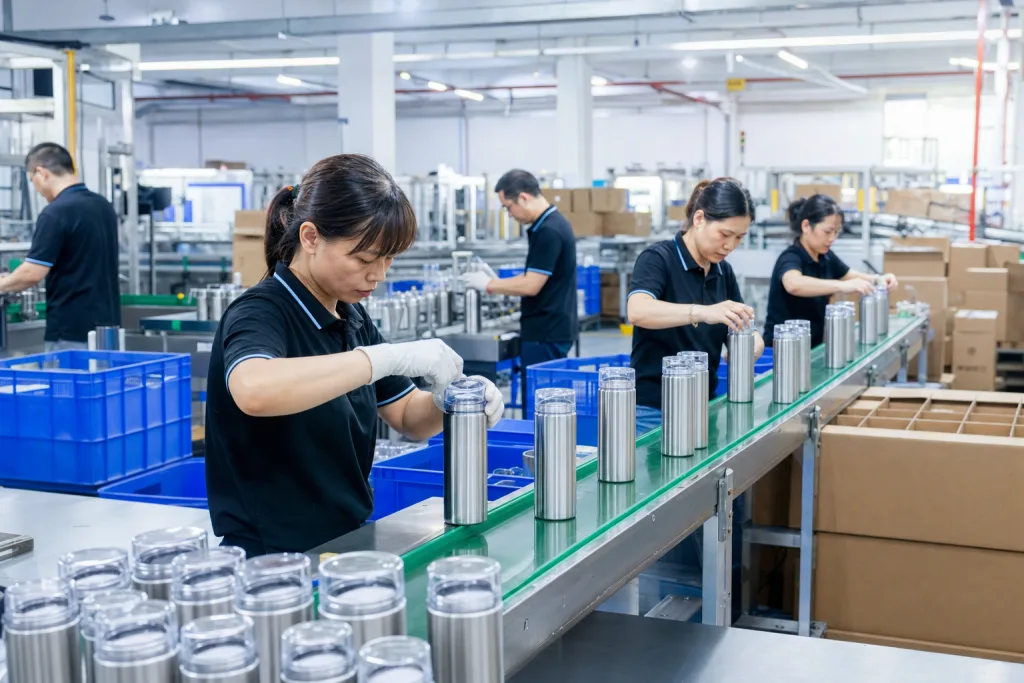
For outdoor retailers and promotional brands buying from Zhejiang, China, this is the wrong first question to ask: can the factory make a bottle? Most can. The better question is which failure points they already control, and what the data says. In our Hangzhou, Zhejiang operation, stainless drinkware output can reach 300,000 units per month, typical MOQ starts at 1,000 pieces, and repeat-order lead time is usually 25 to 35 days. We run vacuum inspection with a helium leak tester, and the buyer usually flags coating wear before they ask about weld consistency. If you buy bulk thermos or customized thermos programs, those controls need to be written down before PO approval.
Where production usually breaks
Buyers often ask for an eastman tritan thermos supplier when the real build is a hybrid cup: stainless inner and outer walls for heat retention, with Tritan parts on the lid, straw, infuser, or clear cap. We run this combination every week. It sells well, but it gives the line more places to fail than a plain stainless bottle. The wrong question to ask is “Can you make it?” Most factories can. The real question is whether the factory controls both material systems like one product, not two separate parts on the PO.
Across Zhejiang, we still see quotations for the same item written in loose terms: 500 ml vacuum bottle, 18/8 stainless steel, Tritan lid, custom logo. That is sales language, not a production spec. On the floor, missing details show up fast: resin source, lid structure, thread tolerance within 0.15 mm, silicone hardness such as 50 or 60 Shore A, powder coat thickness, weld inspection method, and carton drop requirement. QC pulled the sample on one order last month because the PO said “clear lid” but never defined whether the Tritan came from Eastman stock or a substitute resin.
For promotional thermos or distributor thermos programs, the risk goes up because the date usually drives the job. We have seen this go sideways. The sample seals fine, then mass production moves off because one mold cavity runs tighter, the paint oven dwell time gets cut to catch ex-factory date, or the lid vendor swaps color masterbatch without telling anyone. One buyer flagged a gray lid shift at Delta E above 1.5 after 3,000 pcs were packed. A reliable thermos supplier should point out those weak spots before the claim hits, not after.
- First weak point: transparent Tritan parts that look clean on approval samples, then stress-whiten or crack at the thread root after repeated closing torque. We usually check this area first with a go/no-go gauge and assembly test.
- Second weak point: vacuum insulation failures after transport vibration or retail handling. If the weld ring or bottom seal is marginal, heat retention drops and the complaint shows up after shipping, not in the office sample.
- Third weak point: decoration that passes factory inspection but breaks down after 50 to 100 dishwasher or abrasion cycles. The line can make it look good on day one; that does not mean the coating thickness or cure is right.
- Fourth weak point: inconsistent assembly torque causing leaks in a thermos bulk shipment. We have seen caps at 8 kgf·cm and others at 14 kgf·cm in the same lot, and the math does not work if you want stable sealing.
If a supplier thermos quote is cheaper by USD 0.40 to 0.80 per unit, the savings usually come from one of those points. It is not always fraud. Sometimes it is a thinner wall, a 2-hour insulation soak instead of an overnight check, a lower-grade resin, or fewer inspections at packing. We ship plenty of price-sensitive orders, but the buyer needs to know exactly which cost was cut.
Tritan parts fail in predictable ways
Tritan sells because buyers can see through it, drop it, and still get a cleaner hand feel than basic AS or cheap copolyester. The failures are usually predictable. We’ve seen buyer complaints blamed on an eastman tritan thermos supplier when the real issue was a bad spec: substitute resin instead of Eastman, thread wall reduced from 2.2 mm to 1.6 mm, or gate stress left in the cap and showing up as cracks 3 weeks later.
For a customizable thermos with a clear screw lid or cap window, ask for the resin declaration by grade, not a sales phrase. If you want Eastman Tritan, write it on the approved BOM and PO. We once saw a PO typo switch “TX1001” into a generic note, and QC pulled the sample too late. Do not accept “Tritan-like.” This is the wrong question to soften. Then lock the geometry. Thin ribs, sharp thread roots, and uneven wall sections are where whitening starts. A lid can pass hand check at the factory and still fail after 200 open-close cycles from retail customers.
What to lock down
- Resin: Eastman Tritan specified on BOM and purchasing sheet
- Dishwasher expectation: for example, top-rack residential dishwasher, 20 to 50 cycles
- Thread design: no sharp transitions at stress points
- Transparency standard: no black specks, flow marks, or obvious gate blush on A-surface
- Compliance: REACH, LFGB, FDA as required by your market
For outdoor retail, clarity is a shelf issue. Under 4000K store lighting, a small flow mark near the gate shows fast, and the buyer flagged it on a 3,000-piece cap order even though function was fine. For thermos promotional programs, the failure point shifts. Logoed lids get over-packed in master cartons, scuffed in transit, and then rejected by brand teams for appearance, not leakage. We’ve seen this go sideways on drop-test-safe packs that still looked rough on arrival.
A transparent part is less forgiving than stainless. If the mold, resin, or assembly torque is slightly wrong, you will see it faster.
Good thermos manufacturers in Zhejiang, China usually run incoming resin verification, first-article cavity checks, and assembly leak tests at the line. Ask if the lid supplier is in-house or outsourced, and ask who controls torque with a digital torque meter. A lot of thermos exporters run steel well but buy plastic parts outside. That can work. The math doesn't work if the lid arrives pre-packed, skips incoming inspection, and goes straight to assembly without a real quality gate.
Vacuum loss is rarely random
When a buyer says the custom thermos is not holding temperature, vacuum loss is usually tied to four shop-floor causes: weak vacuum extraction, seal instability after evacuation, a bad bottom weld, or transport impact. We see this on the line. It is not random. A decent factory should check each point as routine, not wait for QC to pull the sample after packing.
On stainless bodies, specify 18/8 or SUS304 for food-contact surfaces unless your target price leaves no room. Then ask for wall thickness in mm, not just “standard.” For most vacuum bottles, 0.4 mm to 0.5 mm on both inner and outer walls is the normal range. If the body runs too thin, the math does not work: you save some weight and a little steel cost, then dent resistance drops fast. For outdoor use, buyers notice that. A 0.5 mm outer wall usually feels more solid in thermos custom projects, and we have had buyers flag 0.4 mm shells after a simple caliper check.
For vacuum QC, do not accept a sales line like “keeps hot and cold.” Ask how the factory proves vacuum on each run. Common checks are vacuum point inspection, heat-retention testing, and bottom dot or vacuum-indicator review, depending on the structure. This is the right question to ask. On a manufacturer thermos order, practical checks should include:
- 100% leak or vacuum presence inspection on line
- Heat retention spot test, such as hot water fill with a target temperature drop after 6 hours
- 1.0 m drop test with no functional leak
- Thread and gasket inspection after impact
If you buy distributor thermos or distributors thermos inventory across 6 or 8 SKUs, ask for packaging drop data too. A lot of “vacuum failure” claims are transit damage from loose inner carton fit or a bad pulp tray. We have seen bottles ship out fine from China, then come back with micro-leaks after container vibration and last-mile handling. One common finding is 3 mm of free play inside the gift box. That is enough to cause trouble.
A reliable thermos manufacturer should also show you the reject pattern. If bottom weld failures stack up on one line, that points to process drift at the welding station. If leaks show up after assembly, check gasket compression and cap torque values first; we run into this after cap changes more than buyers expect. Those are workable findings. “Random defect” usually means the team did not dig deep enough.
Leaks start at threads and gaskets
Leaks kill launches fast. In our factory, failed units almost never come from the steel body itself. They fail at the closure set: thread mismatch, a warped Tritan lid after cooling, weak silicone gasket compression, a straw plug off by 0.2 mm, or capping torque that drifts shift to shift. Buy only on unit price and this is where the claim cost comes back.
For a custom thermos with a Tritan screw lid, treat the closure stack as one controlled system. Ask for the neck finish drawing, lid thread tolerance, gasket section dimensions, silicone shore hardness, and target torque range. We run checks on this with a go/no-go gauge and torque tester, because one mold cavity can run a slightly high thread while another runs low. Both samples may look fine on the table. On the line, they leak when the user stops a quarter turn short. We have seen buyers ask only for "leak-proof lid." This is the wrong question to ask.
AQL matters here. For bulk thermos orders, many buyers use AQL 2.5 for major defects and 4.0 for minor defects. Leakage should sit under major defects, and in some commuter or bag-use programs, it should be critical. If your thermos distributor channel sells through outdoor stores, even a 1% leak rate is too high. One retailer complaint can block the next PO. The buyer flagged this on a 20,000-piece order last season after QC pulled the sample and found 3 leaking caps in one carton.
What a useful leak spec includes
- Static upside-down leak test duration, for example 30 minutes
- Hot water leak test if thermal expansion changes fit
- Torque window for assembly and final inspection
- Silicone odor standard and food-contact declaration
- Cap opening and closing cycle test, such as 2,000 to 5,000 cycles for moving parts
For thermos customizable designs with handles, flip spouts, or integrated straws, each added feature opens one more leak path. New features are fine. The math does not work if nobody prices in the risk. A flip spout spring, a handle pin, or a straw seat that misses by 0.3 mm can turn into returns after shipping. A thermos vendor that agrees to every sketch without talking about leak points is selling hope. We have seen this go sideways.
Decoration fails after shipping and use
Brand owners usually check heat retention first and treat decoration as a later item. On claim files, that order flips fast. We’ve seen a thermos pass the 12-hour insulation check, then fail the market because the logo scratched after 18 days in transit testing, the laser mark looked gray on arrival, the powder coat chipped within 3 mm of the base ring, or the repeat PO came back half a shade off. This is the wrong question to ask: not “does it keep hot,” but “what will the branding look like after cartons, shelves, and daily use?”
For stainless exteriors, the common choices are powder coating, spray painting, silkscreen printing, heat transfer, and laser engraving. They do not fail the same way. Powder coat usually breaks first on edges and bottom corners if pretreatment is weak or the oven cure drifts; on our line, the hanging points and base radius need extra attention. Silkscreen wears off under bag abrasion if the ink system is wrong or the bake time is short. Laser lasts better, but QC pulled samples before where contrast changed because coating thickness moved from 60 μm to 85 μm and the steel finish under it was inconsistent. We’ve seen this go sideways on repeat orders.
If you need a customized thermos for outdoor retail, ask for coating adhesion and abrasion data, not nice photos. Cross-hatch adhesion testing is standard, and a simple rub test with a dry cotton cloth for 50 cycles already tells you a lot. For repeat programs, keep an approved color panel or Pantone reference and set tolerance under D65 lighting; we check this at the light box, not by walking the bottle to the window. Basic stuff, yes. Still, the buyer flagged more than one shipment because the supplier judged color by eye only.
- Budget decoration: one-color silkscreen, low setup cost, higher wear risk on high-contact areas
- Stable retail option: powder coat plus laser logo, better scratch performance in daily handling
- Premium tactile finish: matte powder with tight cure control, usually checked by oven temperature log and first-piece approval
MOQ changes the math on decoration. A 500-piece promotional thermos order usually fits standard colors and one logo process; once you reach 3,000 to 5,000 pieces, custom color matching, two-position branding, and custom gift box artwork start to make sense. In Zhejiang, China, some factories quote low setup charges, then recover margin through slower approvals and extra sampling rounds. We ship against that risk by fixing sample count up front. Ask how many pre-production samples are included, whether the logo jig is used on line, and who pays if the PO typo puts the mark 5 mm off-center.
Documents matter more than nice samples
A good sample proves the look and basic function. It does not prove production control. Experienced buyers ask an eastman tritan thermos supplier for the documents behind the sample, because a clean prototype from a 3D-printed lid or a hand-polished body tells you little about what the line will ship at 10,000 pcs. If you source manufacturer thermos or thermos manufacturer programs for North America and Europe, the paperwork has to move with the cargo, not sit in a sales inbox.
Start with the specification sheet. This is the first file QC checks against. It should state capacity tolerance, net weight tolerance, material grade, Tritan declaration, gasket material, insulation structure, finish, logo method, unit packaging, carton standard, and pallet requirement if applicable. We also expect core dimensions in mm, not just a product photo with arrows. If the order is for Amazon or other direct fulfillment, include FNSKU placement, suffocation warning, and drop-test requirements at carton level. We have seen a PO typo put the FNSKU on the side wall instead of the gift box, and that mistake cost 12 days.
Then check compliance and audit fit. Match the file set to the sales channel and the SKU. Relevant items may include REACH, LFGB, FDA food-contact declarations, BSCI social audit, ISO-based process controls, and ASTM or CPSIA references for kids-related accessories if the design crosses into that category. Not every standard applies to every SKU. Vague claims are still a red flag. If a supplier says “test pass no problem” but cannot show the report number, lab name, or resin trace for the Tritan part, the math doesn't work.
For QC, ask what happens before shipment:
- Pre-production sample approval against final BOM
- In-line inspection on forming, coating, and assembly
- Final random inspection using agreed AQL
- Vacuum, leak, and appearance reports tied to PO or lot number
This is where thermos suppliers split apart. A capable supplier thermos team in China can send a tidy quote in one day. That part is easy. The better test is whether they send a dimensional drawing, test plan, and realistic lead time before you ask three times. QC pulled the sample last month on a lid-seat gap of 0.6 mm, and the buyer flagged it right away. For reference, custom tooling changes often take 20 to 30 days, normal mass production 30 to 45 days, and peak-season congestion in Zhejiang can add another 7 to 15 days. Ask for the plan, not promises.
How to spec a safer first order
If this is your first order with a new thermos supplier, keep it commercial and simple. We’ve seen first POs go sideways when a buyer stacks a new mold, a new finish, laser logo on one SKU, and a 35-day ship target on the same file. The wrong question to ask is how much change you can squeeze in. Ask how many unknowns you can remove and still have a product you can sell.
For outdoor retail, a safer first program is usually a standard stainless vacuum body in 500 ml or 750 ml, SUS304 interior, powder-coated exterior at 60–80 μm, and a proven Eastman Tritan lid structure already running on the line. Add your logo, carton, and maybe one accessory like a silicone boot. Skip major new closure engineering unless the margin covers the trial cost, extra leak testing, and likely rework. For thermos bulk supply, standardization cuts defect risk faster than any speech about QC.
When you ask for quotation, include the points that stop later arguments. QC pulled a sample last month where the PO said “grey” and the artwork said “gray,” and that small typo turned into a packing delay.
- Target market: EU, US, or both
- Order quantity and reorder forecast
- Retail or promotional channel
- Required tests and compliance documents
- Logo method and expected durability
- Packaging drop expectations and labeling details
- Incoterm such as FOB Ningbo or FOB Shanghai
If a thermos factory answers those points clearly, you are already cutting risk. If they dodge specifics and send only price tables, you are probably buying a sample service, not a production system. We ship both kinds of projects, and the difference shows up fast once carton marks, barcode placement, and lid torque spec need sign-off.
The target is not zero defects. No serious buyer asks for that. The target is controlled defects, visible process data, and fast corrective action at the 1st article, inline, and final inspection stages. AQL 2.5 still needs real numbers behind it. That is what makes a thermos distributor, thermos distributors, or thermos vendor program workable over repeat seasons. In Zhejiang and broader China sourcing, the suppliers worth keeping are usually not the ones with the lowest opening quote. They are the ones whose figures stay stable when the order moves from prototype to a 1 x 40HQ container.
Send your thermos spec for a factory review
Share your target market, quantity, logo file, and lid concept. We will flag likely failure points, MOQ, lead time, and test requirements before sampling.
Frequently asked questions
What should I ask an eastman tritan thermos supplier before placing a first order?
Ask for five things first: the BOM naming Eastman Tritan specifically, stainless grade for food-contact parts, leak and vacuum test method, decoration durability standard, and compliance documents for your market. Then ask for commercial basics: MOQ, tooling time, production lead time, and AQL standard. A practical starting point is MOQ 1,000 pieces for a custom thermos color or logo, 20 to 30 days for tooling adjustment if needed, and 30 to 45 days for mass production. If the supplier cannot provide thread drawings, gasket specs, or a defined leak test such as 30 minutes upside-down, you are buying blind. Nice samples are not enough.
Is Tritan suitable for a thermos body, or only for lids and accessories?
For a true insulated thermos, stainless steel should handle the vacuum body. Tritan is typically used for lids, cap windows, straws, tea infusers, or outer components where clarity helps. If you need heat retention for 6 to 12 hours, stainless double-wall vacuum construction does the work, not Tritan. In most factory thermos programs, Tritan adds visual value and impact resistance, but it also adds molding and sealing risk. That is why you should specify Eastman-grade resin, gasket fit, and dishwasher expectation. For outdoor retail, a common structure is SUS304 inner and outer body with a Tritan screw lid and silicone seal.
What MOQ and pricing are realistic for bulk thermos orders from China?
For standard stainless vacuum bottles with custom logo, MOQ is often 1,000 pieces per size or color. For more customized thermos work, such as new lids, custom mold changes, or special packaging, MOQ can move to 3,000 pieces or more. Pricing depends heavily on size, finish, and lid complexity, but many mid-range stainless thermos projects land around USD 3.20 to USD 6.80 FOB China for common 500 to 750 ml formats. A Tritan-heavy lid, premium powder coat, or gift box will increase that. If a quote is far below market, check whether steel thickness dropped from 0.5 mm to 0.4 mm or whether testing and inspection were reduced.
How do I reduce leak and return risk for promotional thermos campaigns?
Keep the first campaign simple. Use a proven closure system rather than a new flip-top or straw mechanism unless you have time for validation. Specify a static leak test of at least 30 minutes upside down, plus a hot-water leak test if the product is used for hot beverages. Ask for cap torque limits, silicone hardness, and AQL 2.5 for major defects. For promotional thermos orders, packaging matters too, because rough handling between event logistics and end users can expose weak lids fast. If the project is under 2,000 pieces and timing is tight, standard lid tooling with custom logo and carton labeling usually gives the safest outcome.
Which certifications or reports matter most for thermos suppliers selling to Europe and North America?
The answer depends on your channel, but for most stainless thermos programs you should at least review food-contact declarations and chemical compliance tied to your market. For Europe, REACH and often LFGB-related testing matter. For the US, buyers commonly ask for FDA-related food-contact statements. If you sell through major retail or brand channels, BSCI or similar social audit records may also be requested. On the quality side, ask for lot-based inspection reports, vacuum and leak test records, and final random inspection using your agreed AQL. If accessories target children, ASTM or CPSIA-related requirements may enter the discussion. Get the paperwork before shipment, not after claims appear.