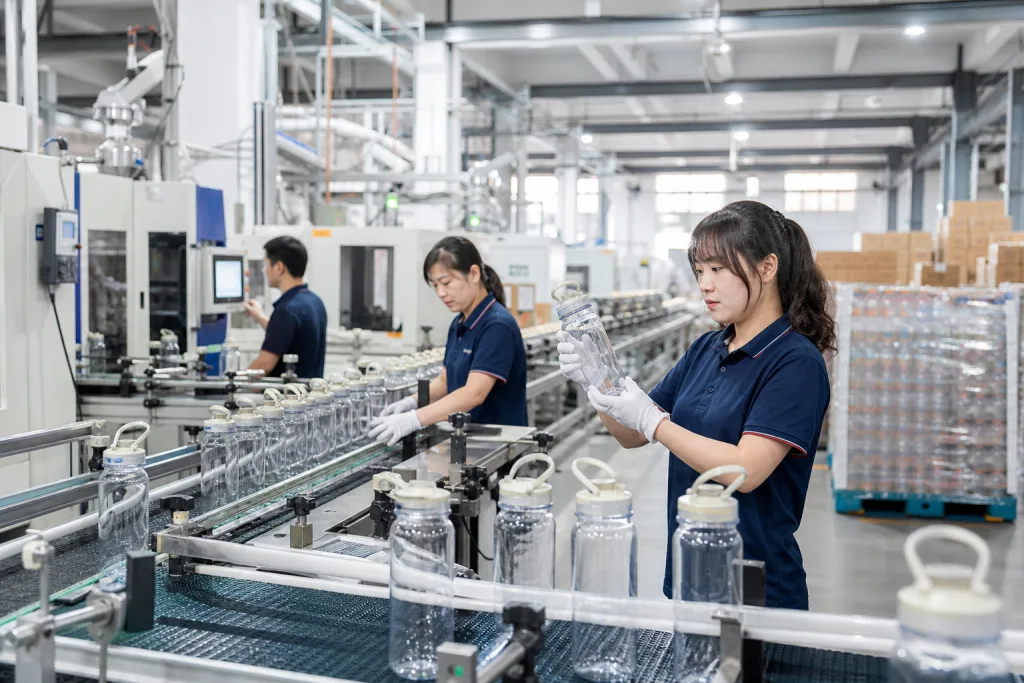
Key Takeaways
- For Eastman Tritan drinkware wholesale, practical MOQ usually starts at 1,000-3,000 units per color, with custom mold lead time of 35-55 days.
- A 0.6-0.8 mm wall may work for low-cost retail, but 0.8-1.2 mm is safer for e-commerce drop resistance and dishwasher durability.
- Silkscreen on Tritan is cheaper by about USD 0.05-0.12 per unit than laser-marked metal parts, but it usually has lower long-cycle abrasion resistance.
- For Europe and North America, ask for REACH, LFGB or FDA contact compliance, and use AQL 2.5/4.0 final inspection before shipment.
You can approve a Tritan bottle from a sample box and still lose money on the production run. We see it on the line. A 0.6 mm wall that looked fine in hand cracks in e-commerce drop tests, a lid starts weeping after 2,000 open-close cycles, silk print fails dishwasher checks, or the freight quote lands and the margin is gone. If you are sourcing eastman tritan drinkware wholesale, resin choice is just the first line on the spec sheet. The real job is matching bottle geometry, lid construction, compliance paperwork, and MOQ to the sales channel.
At BottleForge Industrial in Hangzhou, Zhejiang, China, we run into this most with brand owners shifting from stainless to clear reusable bottles, and with distributors trying to roll bulk drinkware, canteen wholesale, and growler wholesale into one supplier base. Last month a buyer flagged a PO typo on lid color and QC pulled the sample before mass packing, which tells you how small misses turn into chargebacks. A clean spec comparison saves days. It also cuts features your customers will not pay for, and this is the wrong place to buy on looks alone.
What Tritan solves, and what it does not
Buyers ask for Eastman Tritan for three plain reasons: clear appearance, better impact resistance, and a BPA-free claim retail teams already know how to sell. Fair enough. We run Tritan often for clear bottles, shaker bodies, infuser bottles, and light daily-use SKUs for gyms and offices. On the line, color matching is usually steadier than low-cost copolyester; with a standard Pantone check under the light box, rejects drop fast. It also brings fewer odor claims than cheap plastic. Last month QC pulled the sample after a 24-hour lemon-water hold, and the low-grade option failed first.
Material alone does not make a bottle premium. This is the wrong question to ask. If you buy wholesale drinkware for Europe or North America, the trouble usually starts in the assembly details, not the resin pellet.
- Lid design: PP cap threads, silicone gasket compression, hinge pin wear, and spout sealing decide whether the bottle leaks after 500 open-close cycles. We have seen buyers push hard on Tritan body grade, then ignore a 1.8 mm gasket that should have been 2.2 mm.
- Wall thickness: A bottle body at 0.65 mm can look fine on shelf, then deform in top-load test or crack after a cold-drop check. We have seen 0.8 mm pass where 0.65 mm failed, and the math does not work if returns eat the margin.
- Decoration method: Silkscreen, heat transfer, IML, or wrap print do not age the same way after dishwasher cycles. QC usually checks adhesion with a 3M tape test first, because nice artwork on day 1 means nothing if it starts lifting after 20 washes.
- Channel fit: The best wholesale drink bottle for a gym membership gift is often the wrong choice for Amazon FBA or corporate gifting. One buyer flagged this after their PO mixed retail-ready color boxes with bulk-pack requirements on the same SKU.
From our Zhejiang, China production floor, the best results come when Tritan is treated as one item in a full spec sheet, not the whole story. We ship smoother when the file locks capacity tolerance, net weight tolerance, leak standard, odor test, drop test, carton drop requirement, and barcode placement. A missing barcode position sounds small. Then the outer carton lands with the code blocked by tape, and the warehouse rejects it. If you also source canteen bulk, alcohol flask wholesale bulk, or beer tumbler wholesale bulk from the same region in China, use the same rule: control the full assembly with a spec sheet, not only the headline material.
Head-to-head spec table for common formats
If you are comparing eastman tritan drinkware wholesale across 2 or 3 projects, start with the use case, not the catalog photo. That is the right first filter. The table below shows the B2B ranges we run most often in Zhejiang, based on custom production specs buyers actually send over.
| Format | Typical Capacity | Body Wall | MOQ | FOB China Price | Best Fit |
|---|---|---|---|---|---|
| Single-wall Tritan bottle | 500-750 ml | 0.8-1.0 mm | 3,000 pcs | USD 1.65-2.60 | Retail, gym, school, promo |
| Tritan sport bottle with flip lid | 600-1000 ml | 0.9-1.2 mm | 2,000 pcs | USD 2.10-3.40 | E-commerce, active use |
| Tritan canteen shape | 700-1200 ml | 1.0-1.2 mm | 2,000 pcs | USD 2.40-3.80 | Outdoor, souvenir, canteen wholesale |
| Tritan growler style | 1.5-2.0 L | 1.2-1.5 mm | 1,000 pcs | USD 4.20-6.80 | Events, non-carbonated refill |
| Tritan beer tumbler | 16-24 oz | 0.8-1.0 mm | 3,000 pcs | USD 1.20-2.10 | Festival, stadium, promo |
| Tritan alcohol flask look | 6-10 oz | 1.8-2.5 mm | 3,000 pcs | USD 1.50-2.80 | Gift sets, novelty retail |
Use the table carefully. A Tritan growler is not a direct replacement for stainless if your customers expect cold retention for 12 hours or pressure handling on carbonated fill. We have seen this go sideways. For growler bulk and beer growler wholesale, state on the inquiry if the container is for still beverages only; QC pulled samples before where the buyer expected beer storage, but the PO only said "drink bottle 1.8L." Most Tritan versions fit water, cold brew, juice, or short-hold draft transfer better than long-term carbonated storage.
A canteen bulk program usually needs stronger strap pull performance, wider mouth access for brush cleaning, and more sidewall stiffness than a desk bottle. On the line, that usually means more resin weight and a tougher mold structure, sometimes with body wall moving from 1.0 mm to 1.2 mm. Buyers ask for drinkware bulk pricing with no use-case detail all the time, and this is the wrong question to ask. Quotes can swing 20-35% because one factory priced a basic bottle, while another priced a canteen body that passed a strap pull check at 15 kg.
Use-case fit by channel and product type
Not every Tritan format fits every channel. If you want fewer returns and cleaner replenishment, match the product to the sales channel before you start cutting 3 or 5 cents. We have seen this go sideways after sampling—same bottle, wrong channel, then the buyer flagged slow sell-through in the first 45 days.
Corporate gifting and promotional orders
For wholesale drinkware in the USD 2.00-3.20 FOB range, a 650-750 ml straight-wall bottle with silkscreen logo and color lid is still the safest SKU. The line runs faster on this shape, packing is cleaner in a standard 24 pcs carton, and mold risk stays lower because there are fewer deep curves to polish. MOQ often starts at 3,000 units, though stock-color combinations may reduce that to 1,000. If you ask me, this is the right place to stay boring. Buyers sometimes push for a custom cap too early, then the math does not work on repeat orders.
Retail and specialty stores
Retail is more visual. On shelf, shape and hand feel do more work than a plain spec sheet, so matte texture bands, carry loops, measurement marks, or an integrated infuser usually earn their cost. Here, canteen wholesale and wholesale canteen projects often do better with 700-1000 ml bodies and a wider shoulder because the bottle feels fuller in hand at first pickup. Expect FOB prices around USD 2.60-4.00 depending on lid complexity. We have had buyers reject a sample over a 1.5 mm mismatch on the texture band position, so details matter fast in this channel.
E-commerce and Amazon FBA
Parcel shipping needs tighter packaging control. Ask for carton drop validation, inner bag, tissue or molded insert, and FNSKU placement rules before mass production; QC pulled the sample more than once because the barcode sat across the carton seam. A low-cost thin-wall bottle gets expensive after damage claims, and that is the wrong question to ask if the target is only factory price. For drinkware wholesale into parcel channels, we usually recommend 0.9 mm minimum wall thickness and a leak test rate of 100% on the line.
Event and beverage programs
Beer tumbler bulk, beer tumbler in bulk, and beer tumbler wholesale bulk orders usually care more about stackability and print area than heavy-duty durability. A 16 oz or 20 oz clear tumbler works for festivals and stadium hospitality, but if the venue runs industrial dishwashers, decoration choice needs checking on the first pre-production sample, not after the PO typo gets fixed. For growler wholesale, bulk growler, or beer growler in bulk needs, clarify whether the buyer wants reusable merchandising, souvenir use, or refill use. Same shape, different closure target. We ship some with a simple screw lid and some with a tighter seal because the closure torque spec changes with the use case.
You do not win by ordering the lowest unit price. You win when sell-through stays high and the return rate stays under 1.5%.
Lids, decoration, and details that change cost
Most quote gaps on Eastman Tritan drinkware wholesale projects come from the secondary parts, not the bottle body. A buyer looks at two 750 ml bottles and sees a USD 0.42 gap, then asks about resin price. That is usually the wrong question. In most cases, the cost moved inside the cap assembly, the straw set, or one extra silicone seal that QC pulled on the line.
- Simple screw cap: Lowest cost, fewer leak points, and faster assembly on the capping station. Good for drinkware bulk promotions, especially at MOQ 3,000-5,000 pcs where buyers want clean pricing and fewer complaint points.
- Flip straw lid: Higher tooling and assembly cost, usually +USD 0.25-0.60. Better fit for sports retail, but we have seen buyers flag bite-valve fit, spring force, and leak issues during a 1.2 m drop test.
- Carry handle or loop: Adds utility, but it also increases carton volume and failure risk if the joint is weak. We have seen handle parts crack at the hinge pin after 500-800 carry cycles.
- Wide-mouth canteen cap: Easier cleaning and stronger shelf impact. Common in canteen bulk programs, and the larger top diameter often needs a different torque setting on the line.
Decoration is the next cost driver. Standard one-color silkscreen may add USD 0.05-0.10 per unit. Two-color print can add USD 0.08-0.18. Heat transfer wrap prints cost more and look better at retail, but the setup is less forgiving; if the artwork drifts 1.5 mm on a tapered bottle, the buyer will spot it fast. Add metal badges, painted collars, or overmolded grips, and reject rate can climb by 2-5% unless the supplier runs a stable process. We have seen this go sideways on badge glue strength alone.
Alcohol flask bulk and alcohol flask in bulk projects look simple because the volume is small. They are often harder to run. The small format makes molding lines, gate marks, and logo position more obvious, especially on glossy clear parts under 200 ml. A cavity mark that passes on a large bottle can fail on a flask gift item. If the flask is sold as a gift item, buyers usually ask for tighter cosmetic control, often AQL 1.5 for major visual defects rather than a standard 2.5, and QC will check logo centering with a simple positioning jig.
At BottleForge Industrial, our advice is simple: freeze the cap drawing before approving body color, and approve print location with a 1:1 artwork wrap. We run 400,000 units/month across multiple drinkware lines, but schedule stability depends on locking assembly details early. Last-minute lid changes can push lead time from 30 days to 45 days even when the bottle mold is ready. We have even had a PO typo on a lid insert code hold sampling for 2 days.
Compliance, testing, and factory control points
If you sell into Europe or North America, paperwork is part of the order, not an extra. For Eastman Tritan drinkware wholesale, ask for the compliance file that matches the market and the actual SKU build, because a plain bottle and a bottle with printed ink, silicone sleeve, and metal loop do not carry the same risk. The usual base set is FDA food-contact support for the US and REACH for Europe. Some channels also ask for LFGB migration testing, California Proposition 65 review for inks or accessories, and CPSIA review if the item is meant for children. We have seen buyers send one PO for 3 SKUs and miss the straw material on line 2; that is where claims start.
Do not stop at a resin declaration. Ask how the finished bottle is controlled on the line. A solid China supplier should answer these points fast, with records, not sales talk. This is the right question to ask, because we have seen clean paperwork paired with weak floor control.
- Incoming inspection: resin lot confirmation, color masterbatch control, silicone hardness check, and metal accessory verification. QC usually checks silicone at 50±5 Shore A with a durometer, and the buyer flagged one batch last year because the ring color was half a shade off the approved chip.
- In-process checks: thread gauge fit, net weight tolerance, visual haze, leak test, and drop test. On our side, QC pulled the sample every 2 hours, ran a go/no-go thread gauge, and watched bottle weight within about 3 g so the wall thickness did not drift.
- Final inspection: AQL 2.5 major / 4.0 minor is common for general wholesale drinkware. We ship against that level often, but only after final random inspection confirms sealing, scratch control, and logo position.
- Packaging audit: carton mark, barcode scan, quantity count, and carton drop performance. Carton mark errors sound small, but one typo in a PO number or one wrong EAN label can hold 1,200 cartons in the warehouse.
For beer growler wholesale bulk or wholesale growler projects, also define closure cycling. A cap that seals on day one but loosens after 500 open-close cycles will trigger complaints from refill users, and that math does not work for repeat retail. For flip lids, ask for hinge life testing; 2,000 to 5,000 cycles is a practical benchmark. We run cycle checks with a simple fixture on the bench, and failed parts usually show hinge whitening before breakage. For printed sports bottles, buyers often ask for a dishwasher test or abrasion rub test, though hand-wash recommendation labels are still common.
If your importer or retailer asks for social and quality system evidence, check whether the factory has BSCI audit history and ISO-based process control. Zhejiang suppliers vary a lot. Some run molding well but lose traceability in final assembly, especially on mixed parts like lids, straws, and seals packed under one work order. Others do the reverse. We have seen this go sideways when a 304 stainless part was approved in the sample stage but swapped by a subcontractor without a clear incoming log. You want both.
MOQ, lead time, and landed cost reality
The first number buyers ask for is MOQ. We usually push back. MOQ for which setup—color, lid, logo method, and box? For stock shapes we run in Zhejiang with existing molds and standard lids, 1,000 units per colorway is the normal starting point. If you want a fully custom body or a proprietary cap, 3,000-5,000 units is the range we quote most often. On the factory side, this comes down to mold allocation and line changeover time; one 0.3 mm logo offset on the print jig is enough for QC to pull the sample. New tooling for a Tritan body can range from USD 3,000 to 8,000, while a more complex cap mold can add another USD 2,000 to 6,000.
Lead time moves with the spec, not with the product name. We have seen buyers write “same as last order” on the PO, then change the insert card and lid color after approval; that is how 15 days turns into 22. The line is usually straightforward:
- Stock item with logo: 15-25 days
- Existing mold, custom color, custom packaging: 25-35 days
- New mold development: 35-55 days for tooling and sample approval, then 25-35 days mass production
Landed cost mistakes usually start with carton math and defect assumptions. This is the wrong question to ask if you only compare FOB. A 1000 ml canteen wholesale order may show a nice unit price, then lose on carton efficiency once we pack it and the outer box jumps 18 mm in height. Freight per piece can rise by 8-15% versus a straight-wall 750 ml bottle. Growler bulk and bulk growler shipments are even touchier because the big body creates dead space in the carton. We have also had a buyer flag a “cheap” option after drop-test damage at 6 faces, 1 corner. If you compare bottle A at USD 2.45 FOB and bottle B at USD 2.68 FOB, bottle B can still be the better buy if it packs 24 per carton instead of 20 and cuts claim risk.
For procurement managers, compare total landed cost by sellable unit. Nothing else is clean. Put FOB price, duty, freight, packaging adders, inspection, expected defect allowance, and warranty reserve into one sheet, then check what survives after write-offs. We usually build this from the master carton spec, not the quote sheet, because the math goes sideways fast if one supplier types 12 pcs/ctn on the PI and ships 10. That is the fair way to compare drinkware wholesale, wholesale growler, or alcohol flask wholesale across suppliers in China.
How to shortlist the right Zhejiang supplier
Once you are ready to buy, don’t blast 10 factories with the same fuzzy RFQ. Shortlist 3 suppliers in Zhejiang or nearby clusters, then press them on technical details. Strong factories answer with numbers—like ±0.3 mm wall tolerance, 45-day mold timing, or Tritan TX1001 vs TX2001 resin grade. Weak ones send nice renders and dodge the line details. We’ve seen this go sideways fast.
Use a simple buying checklist:
- Can they quote by exact capacity, wall thickness, and resin grade, or are they rounding a 650 ml bottle into “about 22 oz”?
- Can they confirm MOQ by colorway and decoration method, such as 1,000 pcs per Pantone lid color or 500 pcs per silk-screen layout?
- Can they provide REACH, FDA, or LFGB support for the complete finished item, not just a raw-material sheet from the resin supplier?
- Can they explain leak testing, AQL level, and drop-test method, like 1.2 m drop height and how QC pulled the sample?
- Can they support mixed programs such as wholesale drinkware, wholesale canteen, and beer tumbler wholesale from one account team without mixing up PO specs?
If you buy across categories, ask if the same supplier can also handle alcohol flask wholesale, alcohol flask wholesale bulk, beer growler bulk, and beer tumbler in bulk. Consolidation only helps if the quality system is the same across the line. This is the wrong question to ask if you start with “How many categories do you make?” Ask who runs incoming material checks, how decoration approvals are signed off, and whether the buyer flagged color migration on the last mixed order. We usually suggest 1 hero SKU and 1 secondary SKU first, not 6 custom items dumped into sampling at the same time.
The target is plain. It works. You need 1 bottle that lands on price, 1 that clears compliance, and 1 that holds up in real use after a 1.5 m drop and 500 dishwasher cycles. If a supplier shows stable output, lead times they can defend—say 12 days for stock color parts vs 18 days for custom pigment—and clear replies from the account team, that’s a supplier worth scaling.
Send your target spec and get a practical quote
Share capacity, lid type, MOQ, market, and packaging needs. We will recommend the right Tritan, canteen, growler, or tumbler path with clear FOB numbers.
Frequently asked questions
What is a normal MOQ for Eastman Tritan drinkware wholesale?
For existing bottle molds, a normal MOQ is 1,000 to 3,000 units per color and size, depending on the lid and decoration. A plain stock bottle with one-color logo can sometimes start at 1,000 units. If you want a custom body, custom cap, or gift box, expect 3,000 to 5,000 units. For larger pieces such as bulk growler or canteen bulk programs, some factories accept 1,000 units because the resin weight is higher and margins can support smaller runs. Always ask MOQ by SKU, colorway, and print method. A supplier saying only “MOQ 1,000” without that detail is not giving you a usable quote.
Is Tritan suitable for growler wholesale and beer growler bulk orders?
It can be suitable, but only for the right use. Tritan growler style bottles work well for still beverages, event merchandise, short-term transport, and lightweight outdoor use. They are usually not the best choice for long-term carbonation retention or vacuum insulation. Typical Tritan growlers are 1.5 to 2.0 liters with 1.2 to 1.5 mm walls and FOB prices around USD 4.20 to 6.80 at 1,000 units. If your buyer expects beer growler wholesale bulk for refill programs, specify closure type, leak test standard, and beverage condition clearly. For carbonated use, many buyers still prefer stainless or glass depending on the market and channel.
What compliance documents should I request for Europe and North America?
At minimum, ask for food-contact support tied to the finished product, not only the raw resin. For the US, buyers commonly request FDA-related food-contact documentation and a review of inks or accessories. For Europe, REACH is standard, and many importers also request LFGB migration testing. If the product is for children, add CPSIA review where relevant. For printed bottles, check whether decoration materials trigger extra testing. A serious China factory should also support AQL inspection standards, often 2.5 for major defects and 4.0 for minor, plus leak and drop test records. If you sell to large retailers, ask early whether BSCI or similar social compliance evidence is needed.
How do I compare Tritan bottles against canteen wholesale or beer tumbler wholesale options?
Start with use case, not shape. A Tritan bottle is strongest when you need clarity, low weight, and a BPA-free retail story. A canteen-style Tritan bottle works for outdoor and souvenir channels, usually at 700 to 1200 ml. A beer tumbler bulk program is different: stackability, print area, and event handling matter more than threaded leakproof closure. Compare six things side by side: capacity, wall thickness, lid complexity, print method, carton efficiency, and return risk. Unit price alone is misleading. A USD 1.95 tumbler with poor print durability can cost more than a USD 2.20 version if your venue washes it repeatedly or your distributor rejects cosmetic inconsistency.
What lead time should I plan for a first custom order from Zhejiang, China?
For an existing mold with custom color and logo, plan 25 to 35 days after sample approval and deposit. If you are using a stock item with simple print, some factories can ship in 15 to 25 days. A new mold usually needs 35 to 55 days for tooling, first samples, and revisions, then another 25 to 35 days for production. Build in extra time if you need retail packaging, third-party lab testing, or inspection booking. For Amazon or club store programs, allow at least 7 more days for barcode checks, carton testing, and final document review. First orders from Zhejiang often move slower than repeats, so do not promise your sales team an unrealistic date.