Key Takeaways
- For eastman tritan drinkware custom, a practical MOQ is usually 3,000-5,000 pcs per color, with sample lead time around 7-10 days and bulk production 25-40 days
- Bottle wall thickness around 0.6-0.8 mm affects clarity, drop resistance, and unit cost more than many first-time buyers expect
- AQL 2.5/4.0 final inspection and leak testing at 100% for assembled lids are standard risk controls for B2B custom drinkware orders
- Single-color silk screen may add about USD 0.05-0.12 per unit, while mold changes for a custom canteen body can start around USD 2,500-8,000
You can buy a Tritan bottle from 200 canteen suppliers in China. Buying the right one is the job. Channel fit, margin, and complaint rate decide whether the program works or turns into claim emails 45 days after arrival. We have seen a sample pass on a buyer’s desk, then fail after 300 dishwasher cycles, a 0.2 MPa leak test, or simple barcode receiving because the label panel was 3 mm too curved for the scanner. That is why the spec sheet matters more than the rendering.
When you source eastman tritan drinkware custom from Zhejiang, you are buying a stack of production decisions: resin grade, 1.8 mm vs 2.2 mm wall thickness, lid structure, decoration method, packaging format, and inspection limits. This is the wrong question to ask if you only ask for the lowest FOB price. On our line, QC pulled the sample and found a PO typo on logo position once—8 mm off-center on the approval file, and the buyer flagged it only after mass production started. If you are new to a canteen factory in China, reading those spec lines properly can save 12 days vs 18 days on revisions, plus tooling changes and claims after delivery.
Start with the resin line
On a buyer spec sheet, the material line looks short: Tritan body, PP lid, silicone seal. It drives the whole eastman tritan drinkware custom program. We see it on the line and after shipment. A clear Tritan body gives the glass-look most retail buyers want, better drop performance than glass, and BPA-free positioning that shows up fast in Amazon listings and club-store reviews. On one 650 ml tumbler project, QC pulled the sample after a 1.2 m drop test because the visual standard mattered as much as the impact result.
Ask exactly which parts are Tritan. This is the right question. Buyers often assume the full bottle uses one resin, then the buyer flagged odor or dishwasher whitening after first production. Usually the body is Tritan, the lid is PP or ABS, and the straw is PE or silicone. For a customizable drinkware program sold by a canteen distributor or distributor drinkware team into schools, gyms, or outdoor chains, those mixed materials change smell retention, top-rack dishwasher performance, and what paperwork your customer asks for. We have even seen a PO list “tritan lid” by typo, and that went sideways in sampling.
- Body resin: ask for Eastman Tritan grade confirmation and lot traceability.
- Lid resin: PP is common for durability and food contact cost control.
- Seal material: food-grade silicone should be specified by shore hardness if leak performance matters.
- Compliance: request REACH and LFGB or FDA contact declarations based on your market.
For Europe, REACH checks are routine. For North America, California Proposition 65 questions also come up, often tied to decoration ink or a colored silicone part rather than the bottle body itself. A solid canteen manufacturer in Zhejiang should send the BOM, material declarations, and test reports in 24 to 48 hours. If you need to push three times, the math doesn't work. We run into this during pre-production review: if the factory cannot name each component material down to the straw tip or seal ring, expect trouble later when your customer asks for paperwork and the file set is still incomplete.
Capacity, weight, and wall thickness
The next lines on the spec sheet are capacity, unit weight, diameter, height, and wall thickness. This is where custom drinkware quotes go sideways. Two bottles can look almost the same on screen—700 ml and 750 ml—but the gram weight, carton pack-out, and drop result are different. We have seen buyers flag a quote after the first sample because the PO showed 700 ml, while the approved drawing was closer to 750 ml. That changes FOB price and freight efficiency from China.
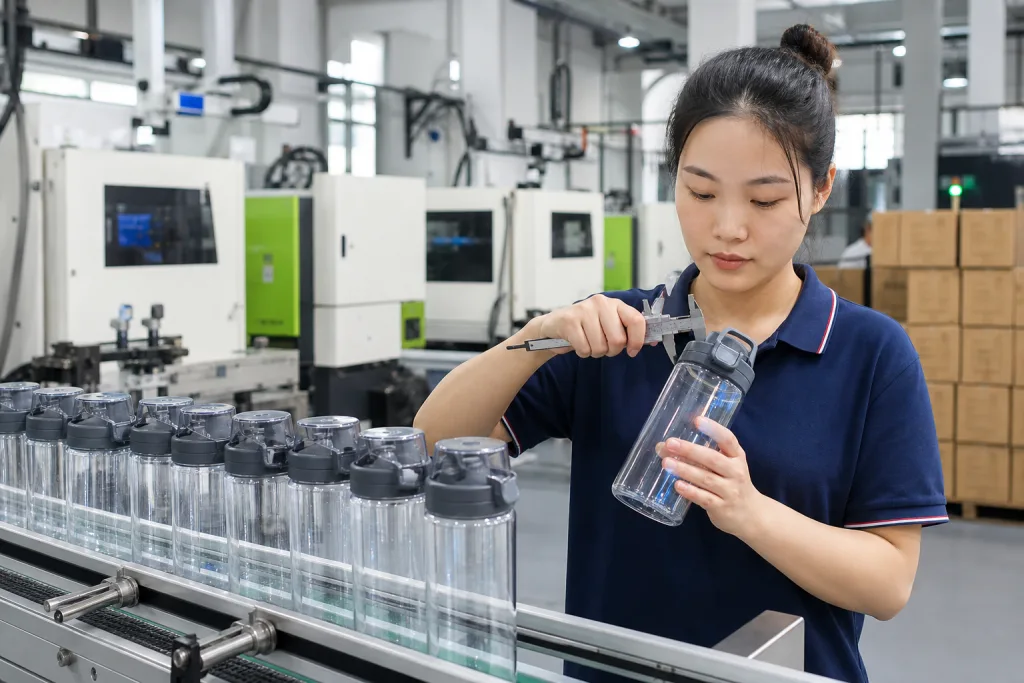
Wall thickness is usually the hidden cost driver. On Tritan bottles, we often run around 0.6-0.8 mm based on shape, shoulder design, and whether the bottle is vacuum-free. At 0.6 mm, the piece is lighter and cheaper, which fits canteen promotional programs and large-volume price targets. At 0.8 mm, you get more rigidity and a stronger hand feel, but resin use goes up and so does shipping weight. On the line, QC will check wall section with an ultrasonic thickness gauge, because 0.1 mm off is enough to change the math.
Why buyers should care
- Too thin: easier denting, stress whitening near threads, and more deformation if the end user misuses it for hot fill. We have pulled samples with whitening right under the neck ring after torque test.
- Too thick: heavier freight, higher resin cost, and slower cooling time in molding. The cycle can move from 18 seconds to 21 seconds, and that hits output fast.
- Wrong diameter: the bottle may miss standard car cup holders, gym machine holders, or shelf spacing at retail. A 78 mm body that should have been 72 mm is a common buyer complaint.
If you buy as a canteen vendor, canteen suppliers, or canteen manufacturers sourcing partner for private label, compare actual net weight with quoted weight. This is not a small detail. A gap of 8-12 grams across 50,000 units means 400-600 kg of resin, and the buyer usually catches it only after sample weighing on a bench scale. In Zhejiang plants shipping 600,000-800,000 units a month across several drinkware lines, that is margin, not rounding error.
A sample that feels premium in hand usually has a cost reason. Ask if that feel comes from better structure, or if it is just extra material. This is the right question.
The same rule applies to a custom growler or customizable growler in Tritan instead of stainless. Once you move into larger volumes, wall-thickness mistakes get expensive fast. We have seen this go sideways on 1,000 ml programs where the buyer approved the feel first and asked for the weight later.
Lid construction decides complaint rate
Buyers usually pick the bottle silhouette first and leave the lid for later. That is the wrong question to ask. On the line, most post-shipment claims come from the lid, not the body: leaking, hinge cracks after 3,000 to 5,000 cycles, carry loops failing a 15 kg pull test, thread mismatch, straw odor, or one-hand opening that sticks after assembly. For any eastman tritan drinkware custom order, check the lid drawing line by line, including thread pitch, gasket groove depth, and vent hole diameter in mm.
Look hard at thread design, gasket compression, venting, opening torque, and assembly method. A screw lid with one silicone ring is usually cheaper and safer than a flip-top with 6 parts. If your channel is sports retail or back-to-school, the buyer may still push for a push-button or straw lid because shelf appeal matters. We have seen this go sideways: more functions mean extra molds, more assembly stations, and more QC points for the line to hold.
- Leak standard: define whether testing is upside-down static for 30 minutes, shake test for 200 cycles, or both.
- Torque range: too tight hurts user use; too loose leaks in transit. We normally set a cap window in N·m and confirm with a torque meter.
- Handle load: specify pull test requirements if the lid has a loop or strap. One common target is 10 kg for 1 minute with no crack at the gate.
- Assembly: ultrasonic welding and snapped components need fatigue validation. QC pulled the sample more than once where the snap ear whitened after repeat opening.
For B2B buyers, I recommend 100% leak testing on assembled lids for the first production order, then keeping AQL 2.5 for major defects and 4.0 for minor defects at final random inspection. We run this way because one leaking lid in an FBA carton of 24 pieces can turn into 6 returns and a bad review string fast. If you are buying from a canteen factory in China for Amazon FBA, wholesale, or a distributor canteen program, the math does not work if the lid complaint rate gets away from you.
A practical note: if the lid has more than 5 separate plastic and silicone parts, expect assembly cost to climb and defect chances to multiply. Last month a buyer flagged a 7-part straw lid after pilot run because one small valve was installed backward on 3 samples. A simpler canteen customizable design usually holds up better over time than an over-engineered lid picked only because the rendering looked modern.
Decoration specs affect branding results
The decoration line is where branding meets the line, and this is where projects get approved or get stuck. Buyers often ask only for logo position. That is the wrong question to ask. The spec sheet should lock the print method, max print area in mm, artwork tolerance, adhesion standard, and dishwasher claim before sampling starts. For customized drinkware and customized canteen programs, we usually run silk screen, heat transfer, digital print, or insert graphics for double-wall items. Laser marking shows up more on stainless caps or bases; on a clear Tritan body, most buyers skip it because the look is weaker.
Single-color silk screen on a Tritan bottle may add around USD 0.05-0.12 per unit depending on size and order volume. Two-color work often adds another USD 0.03-0.08. Full-wrap graphics cost more, and QC pulled the sample more than once on wrap jobs with a 1.5 mm seam shift. If you need exact Pantone matching, say it on the first PO, not after the pre-production sample. We have seen buyers flag a logo as “too light” even when the ink matched the approved chip, because transparent bottles throw light through the print and do not read like coated steel.
What to lock before approval
- Artwork file: vector only, with Pantone references and fonts outlined before the file hits our RIP software.
- Position tolerance: for example ±2 mm on centered front logo, measured from the bottle centerline at sampling.
- Adhesion test: tape test standard and curing conditions, such as oven curing time logged by the line supervisor.
- Scratch expectations: especially for promotional or school channels, where cartons rub hard in transit and the buyer flagged scuffing on a 24-drop carton test.
If you are a canteen distributors buyer serving multiple regional customers, ask whether the same bottle can support low-MOQ decoration changes across colorways. We ship this setup often. A standard bottle and lid with logo-only screen changes is normal in Zhejiang, and 1,000-2,000 pcs per artwork usually works under one larger production plan if the base item stays unchanged. The catch is screen management. One typo on a PO number or Pantone suffix can split the wrong logos onto the wrong colorway.
Do not ignore barcode and label specs. A bottle can look sharp and still fail at receiving because the outer carton mark, inner label, or FNSKU position is off by 10 mm. We have seen this go sideways on Amazon and distributor orders. For promotional and distributor business, the math does not work if you spend on one extra print color but miss the carton spec.
Packaging, MOQ, and freight math
Packaging looks like office work on the PO, but this is where margin gets won or lost. Our standard export pack for Tritan drinkware is usually 1 polybag, 1 egg-crate or divider set, then a 5-layer master carton, and QC will still run a carton drop from about 76 cm if the buyer flagged transit risk. If you need a color box, belly band, hang tag, or PDQ display, lock that before final costing. Late packaging changes hit carton size, packing labor, and drop-test failure rate. We have seen a clean-looking gift box add 0.012 CBM per carton, and then the freight math stops working.
For a standard eastman tritan drinkware custom order from China, 3,000 pcs per model per color is the normal starting point. On the line, that MOQ usually gives stable material batching and cleaner logo setup. Some projects can start at 1,000 pcs if you use an existing mold and standard lid, but the unit cost goes up fast because setup is spread over fewer pieces. For new body molds, most canteen suppliers and canteen vendor teams will push 5,000 pcs or above so tooling and trial-run scrap make sense. Buyers ask for 800 pcs with a new shape all the time; this is the wrong question to ask.
- Existing mold + stock colors: MOQ from about 1,000-3,000 pcs.
- Existing mold + custom colors/logo: usually 3,000-5,000 pcs.
- New mold project: often 5,000 pcs minimum, with tooling from USD 2,500 to USD 8,000 depending on complexity.
Check carton count and CBM per master carton early, not after the sample is approved. A bottle with a wide shoulder or fixed handle can waste container space even if the piece price looks sharp. We run cube checks with actual carton dimensions in mm, because a design that nests poorly can swing load efficiency by 8-10%, which often saves more money than cutting USD 0.03 from the bottle. That matters for a distributor growler, customized growler, or larger-format canteen line where freight cube grows faster than margin. QC pulled one sample last season where the buyer changed the lid profile by 6 mm, and the new pack-out dropped the 40HQ loading count more than expected.
Lead time from Zhejiang is usually 7-10 days for pre-production samples, then 25-40 days for mass production after approval and deposit, assuming normal color and packaging. If the order needs BSCI-audited production records, custom insert cards, or lab testing before booking, add 3-7 days instead of hoping the factory will squeeze it in. We ship faster when the artwork and carton marks are clean; we have also seen a one-letter typo on a PO hold approval for 2 days. Good canteen manufacturer teams in China will say this upfront. Weak ones promise 25 days, then start moving dates once the deposit lands.
Quality control lines to enforce
Most buyer guides are soft on QC. That does not help. On a purchase order for custom drinkware, the quality section should spell out what we check, at which stage, and to which acceptance level. If the line only sees “good quality,” you are buying hope. We have seen one PO from a US buyer say “no visible marks,” then the buyer flagged 0.8 mm gate blush on clear bottles after shipment.
Your spec should cover visual standards, function tests, packaging checks, and compliance documents. For clear Tritan bottles, visual standards are where claims start because scratches, black specks, gate marks, and flow lines show fast under a 6000K light box. A factory may call it passable; your retail customer may call it dead stock. This is the wrong question to ask: “Do you have QC?” Ask what defect size is allowed and from what viewing distance—say 30 cm under normal indoor light.
- Incoming checks: resin lot, masterbatch, silicone seals, and print materials; we usually verify color chips against the signed sample and seal hardness if the buyer has a leak-history claim.
- In-process checks: dimensions, weight, color match, thread fit, and print alignment; QC pulled the sample every 2 hours on one 8-cavity line and caught logo drift at 1.5 mm before 3,000 units went off spec.
- Final checks: AQL 2.5 major / 4.0 minor, leak test, drop test, and carton inspection; we run vacuum or upside-down soak checks on assembled pieces because loose-lid testing misses real assembly faults.
- Documentation: inspection report, packing list, compliance file, and if needed BSCI or ISO records; one buyer even asked us to attach the resin COA by production date, which was fair.
A common B2B standard is 100% leak test during assembly, then random final inspection based on ANSI/ASQ Z1.4 AQL levels. That is the baseline. Drop testing is usually done on packaged goods, not loose bottles, because transport damage sits with the packaging system as much as the bottle itself. We ship chain-store orders from Zhejiang with carton barcode scan checks and assortment count verification, and the math does not work if you skip this on mixed-color packs of 24.
If you work with multiple canteen vendors or canteen manufacturers in China, keep one defect standard across all of them. Otherwise one supplier ships what another would reject, and then your team spends 12 days arguing instead of 2 days closing the order. We have seen this go sideways on simple things like thread flash, print pinholes, or a master carton count short by 1 pc. A disciplined distributor canteen buyer usually gets fewer returns, fewer debit notes, and cleaner repeat POs.
When to use stock versus tooling
Not every project needs a new mold. Most do not. If your priority is speed, a 1,000-piece MOQ, and a quick market test, use a stock bottle platform and change the color, lid, print, and packaging. We run this route all the time for custom canteen, customizable drinkware, and short seasonal programs because it cuts development from about 18 days to 12 days and avoids burning USD 4,000 on tooling before the first reorder lands.
New tooling makes sense in a narrower set of cases. The line usually sees three real triggers: your channel asks for an exclusive silhouette, the standard platform misses a functional spec, or the annual volume is big enough that the mold cost spreads out cleanly. A large canteen distributor asking for a protected 32 oz body, a new grip panel depth of 1.5 mm, and custom cap geometry is a real tooling case. A logo swap and strap color change is not. This is the wrong question to ask if the order forecast is still soft, because the math doesn't work.
Ask the factory what is actually being customized. We have seen POs marked canteen customized where the buyer only wanted silk print and a Pantone lid match, and we have seen customizable growler requests that actually needed a new neck finish, wider base diameter, and cap venting tests on the torque meter. Those are different jobs with different cost, lead time, and risk. QC pulled one sample last month where the neck thread spec on the PO had a typo, and that alone would have opened the whole tool again.
If you are unsure, start with stock tooling, validate demand for 90 days, then invest in a proprietary mold on the repeat order.
That approach works well in Zhejiang, where a lot of factories already have mature bottle platforms on the shelf and running on the line. We ship branded stock-platform programs with custom packaging every week, usually at MOQs that stay manageable for importers testing a new account. You cut development time, keep margin in hand, and still give the customer something that looks like their own program. For plenty of B2B buyers, that's the sensible balance.
Send your Tritan bottle spec for a factory review
Share drawings, target price, quantity, and market. We will review material, decoration, packaging, and lead time before you commit to tooling or bulk production.
Frequently asked questions
What MOQ should I expect for eastman tritan drinkware custom?
For existing molds, expect around 3,000 pcs per model per color as a normal MOQ from a China canteen factory. Some suppliers will accept 1,000-2,000 pcs if you use standard colors, simple packaging, and one logo print, but the unit price usually goes up by USD 0.10-0.30. For a new mold, 5,000 pcs is a more realistic starting point, sometimes higher if the lid is complex. If you are a distributor drinkware buyer combining several artworks, ask whether the factory can split decoration under one production run. That can make a customizable canteen program commercially workable without forcing you into a full custom mold too early.
How long does custom Tritan bottle production usually take?
A practical timeline is 7-10 days for pre-production samples after artwork and color confirmation, then 25-40 days for bulk production after deposit and sample approval. If you need a new mold, add about 20-35 days for tooling and first sample correction. Lab testing, custom color boxes, and peak-season congestion can add another 5-10 days. Zhejiang factories with stable capacity often quote faster, but you should ask for a step-by-step schedule: molding, printing, assembly, packing, inspection, and booking. That tells you whether the promise is real. For large B2B custom drinkware orders above 30,000 pcs, build in buffer time.
What compliance documents should I request from a canteen manufacturer?
At minimum, ask for food-contact declarations for all relevant materials, plus test reports or declarations tied to your target market. For Europe, REACH and often LFGB-related documentation are common requests. For North America, FDA-contact compliance declarations are typical, and some buyers also ask about Proposition 65 depending on components and decoration. If the order is for a kids range, ASTM-related questions may come up based on the product format. You should also ask for BSCI audit status if social compliance matters to your customer, plus ISO records if the factory claims them. A reliable canteen supplier in China should provide these before mass production, not after shipment.
Is it better to customize an existing bottle or open a new mold?
If you are testing a new retail line, promotional program, or distributor canteen range, existing molds usually make more sense. You avoid tooling charges, keep MOQ closer to 1,000-5,000 pcs, and cut development time by several weeks. New molds are worth considering when you need exclusivity, a protected silhouette, or a function the stock line cannot deliver. Tooling for a Tritan body can start around USD 2,500 and move toward USD 8,000 or more if the lid system is also new. Many buyers in Europe and North America save money by starting with a customized canteen based on stock tooling, then investing in proprietary shape only after repeat demand is proven.
What quality checks matter most for custom drinkware orders?
For Tritan bottles, the most important checks are leak testing, visual inspection, print adhesion, dimension control, and packaging verification. I recommend 100% leak testing during assembly for the first order, then final random inspection to AQL 2.5 for major defects and 4.0 for minor defects. Visual standards matter because clear bodies show scratches, black specks, and flow lines easily. If the bottle has a carry loop, add a pull test. If it is for e-commerce or Amazon FBA, verify carton labeling, barcode readability, and drop performance of the packed unit. These checks cost less than handling returns after the shipment leaves China.