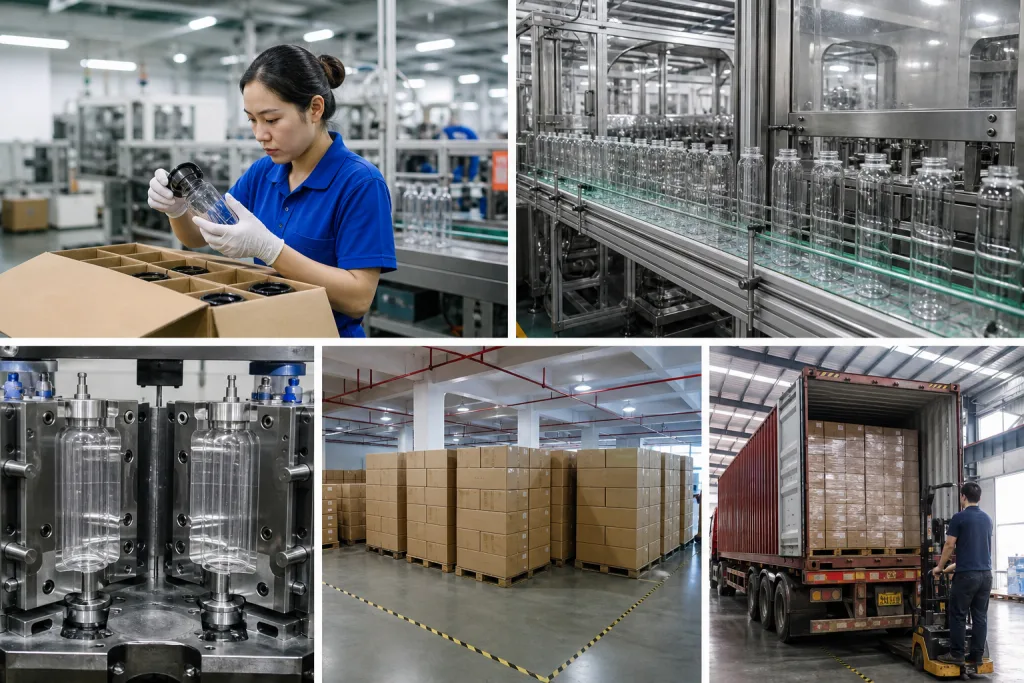
Key Takeaways
- For custom eastman tritan drinkware bulk, practical MOQ is often 1,000-3,000 units per color, while new mold development usually takes 25-40 days
- Decoration choice changes defect risk: silk screen is lower cost by about USD 0.08-0.20 per unit, but laser-marked metal parts and in-mold effects hold up better in dishwashers
- Compliance should match channel: EU buyers commonly ask for REACH and LFGB-related material declarations, while US programs may also need CPSIA or ASTM review for kids items
- Leak testing, drop testing, and AQL 2.5 final inspection reduce claims far more effectively than approving one perfect pre-production sample
You are not buying a generic plastic bottle. When you source eastman tritan drinkware bulk, the hard part is not finding a China factory that can mold a clear body on a 320T injection machine. The hard part is picking the right resin grade, lid structure, decoration method, and compliance package before the first PO fixes your cost and risk. We have seen a sample look clean under showroom lights, then haze after 30 dishwasher cycles, leak in a 0.03 MPa air-pressure test, or get held up because the buyer flagged missing REACH paperwork.
Experienced buyers start from the use case and sales channel, then build the spec sheet. If you sell a premium wholesale drinkware line in Europe or North America, this is the right question to ask, not which catalog page looks best. At our Zhejiang factory, we usually start with four decisions: resin and product fit, mold strategy, compliance level, and total landed cost at MOQ 3,000 pcs. Get those right early, and the sourcing process usually moves 12 days faster than a project that starts with shape only. QC pulled the sample last month on a lid torque issue at 1.8 N·m, and that one detail saved a full rework run on the line.
Start with the four decisions
Most sourcing mistakes start before sampling. Buyers compare quotes too early, then the line goes in circles over details that should have been fixed on page 1 of the PO. Before you ask 5 factories in China or Zhejiang for a unit price, lock 4 decisions.
- First: what job the bottle must do. A gym bottle, office tumbler, bulk canteen, or wholesale growler replacement are not the same item, even if the outer shape looks close. A flip-top for sports use might need a 1.5 m drop test; an office tumbler buyer usually cares more about scratch marks on the lid after 500 open-close cycles.
- Second: whether you need a stock mold or a private mold. Stock molds cut tooling cost and shorten launch time by 30-50 days. On our side, a stock 700 ml body can move to sampling after a quick cap-fit check with a go/no-go gauge, while a private mold means new drawings, T1 shots, and dimension correction in 0.2 mm steps.
- Third: what compliance file your customer actually needs. This is the wrong question to ask too late. Do not pay for tests your channel will never request, and do not miss a file your importer needs for customs or retail onboarding. We have seen buyers ask for a full test pack, then later admit their retailer only needed the food-contact report and a signed declaration.
- Fourth: what landed cost target still leaves you margin after freight, duties, packaging, and rejects. The math does not work if you chase the lowest ex-works price and ignore a 3% reject allowance, thicker export cartons, or a cap that adds 18 grams of resin per unit.
For procurement managers, these 4 decisions matter more than debating whether Tritan is "premium." Eastman Tritan sells well because it is BPA-free, clear, impact resistant, and easier to position than lower-grade plastics. That said, resin is only one line on the spec sheet. QC pulled samples last month where the material was fine, but the thread pitch was off, the gasket was too soft at 50 shore A, and the logo rub test failed after 20 cycles.
If you also source adjacent SKUs such as canteen wholesale models, beer tumbler bulk programs, or alcohol flask bulk promotions, keep the channel logic the same. Retail shelves pay for looks and packaging. Corporate gifting usually pushes for low MOQ, sometimes 1,000 pcs per color, and faster lead time. Outdoor and beverage programs care more about drop resistance, leak rate in a vacuum test, and carry options. Our plant in Zhejiang runs about 1.2 million units per month across stainless steel and plastic drinkware, and the buyers with the smoothest launches are usually the ones who settle these 4 decisions before the first sample hits the bench.
Choose Tritan only where it fits
Not every drinkware program should run on Tritan. It does one job well. Use it where clear appearance, low carry weight, and drop resistance matter more than heat hold. On our line, a 700 ml clear bottle in Tritan usually comes off cleaner in visual inspection than AS after the first sample run, but this is the wrong question to ask if the buyer actually needs insulation.
Where Tritan works well
- Sports bottles from 500 ml to 1,000 ml, where buyers want a glass-like look without the breakage risk
- Infuser bottles and shaker-style bodies, especially when the insert fit needs to stay stable after repeated assembly checks
- Kids bottles needing better drop resistance than basic AS or SAN; QC pulled a 3-drop sample at 1.0 m last month after a buyer flagged cracking on a competitor bottle
- Travel hydration bottles for wholesale drinkware collections, where shelf appeal and lower freight weight help the math
Where Tritan is a weaker fit
- Vacuum thermal products, where stainless steel is the obvious choice and the heat-retention claim has to survive real use, not just lab talk
- Very hot-fill applications above the product's practical design limit; we have seen lids warp first, then the body gets blamed
- Beer growler bulk programs meant for long cold retention or carbonation-sensitive use, where a stainless structure simply performs better
- Alcohol flask wholesale bulk lines where a metallic look is part of the value perception; buyers push back fast when the hand feel misses the gift angle
This matters because buyers often try to force one material across a full catalog. We have seen this go sideways. The result is a mixed range where a Tritan body ends up doing a stainless job, and the product feels off before the first reorder. One PO we received even listed the same SKU as both "clear growler" and "insulated canteen," which told us the spec was already drifting.
For example, if your distributor wants a coordinated collection including drinkware bulk, growler wholesale, and canteen bulk products, split the range by function. Tritan should cover clear daily-carry bottles. Stainless steel should cover insulated canteens, beer tumbler in bulk promotions, and beer growler wholesale bulk lines. A flask-style gift program usually sells better in coated stainless; even if the inquiry says alcohol flask in bulk, the buyer usually means the look as much as the volume.
Good sourcing is not choosing the most expensive material. It is choosing the least risky material that still supports your claim, price point, and sales channel.
Ask your supplier for the resin source, clarity target, recommended wash conditions, and expected drop result at your chosen wall thickness. On a 700 ml Tritan bottle, a body wall around 2.2-2.8 mm is common depending on shape and grip features. We check this with an ultrasonic thickness gauge at three points on the body. Too thin, and you save a few cents but invite deformation and crack complaints. Too thick, and your molding cycle time can move from 28 seconds to 36 seconds, so unit cost climbs fast.
Stock mold or private mold
This is usually the biggest cost call in the project. If you need eastman tritan drinkware bulk fast, stock mold wins on speed and cash. You skip tooling, cut development time, and we often run MOQ at 1,000 units per color or 500 units on selected shapes already on the line. That works for a new wholesale drinkware test, and it also fits Amazon FBA launches where the buyer wants cartons moving before the season slips.
Private mold makes sense for three specific cases: you need a shape competitors cannot copy on sight, you have a lid feature worth protecting, or your master carton count depends on your own bottle geometry. Outside those cases, the math doesn’t work. We have seen buyers pay for custom tooling, then place 8,000 units a year and struggle to spread that cost over the SKU.
Typical trade-offs
- Stock mold: tooling cost USD 0, sampling in 5-10 days, production in 20-35 days after approval. Lowest entry cost, but your shape options are fixed by the molds we already run.
- Semi-custom: existing body plus custom lid, sleeve, color, and logo. Tooling can be USD 800-3,500 depending on part count, and QC usually checks lid fit on a go/no-go gauge before mass production starts.
- Full custom mold: bottle plus lid system, usually USD 4,000-15,000, with 25-40 days for mold build and another 7-15 days for T1/T2 revisions. If the first T1 sample comes out with a thread mismatch of even 0.2 mm, the schedule moves fast in the wrong direction.
For a lot of brand owners, semi-custom is the smarter buy. You start with a body that already passed drop tests and leak checks, then change the lid, handle, bumper, finish, or retail pack to make it yours. We ship those projects faster, and the leak risk is lower than a full new structure because the body side is already proven.
The same logic applies if your range also includes wholesale canteen, beer tumbler wholesale bulk, or alcohol flask wholesale projects. New shells cost money fast. Accessories move faster. One buyer flagged this after seeing a custom flask quote jump once the cap tool and insert tool were added separately. If your annual forecast is below 20,000-30,000 units on one SKU, stock mold or semi-custom is usually the disciplined buy.
Ask your factory in China who owns the mold, where it is stored, whether cavity maintenance is billed separately, and whether your quoted unit price assumes one-cavity or multi-cavity production. Ask that early. We have seen a PO typo on cavity count change the whole unit-cost discussion, and first-time importers usually focus on FOB price while missing the mold terms that actually drive margin.
Compliance is a sourcing filter
Compliance is not a last-minute shipping document. It is a supplier-screening gate. If a factory cannot tell you, in 10 minutes, what file it can issue for Europe and North America, walk away. We ask this early on the line, before mold discussion, because a clean sample means little if the paperwork falls apart.
For Tritan drinkware, buyers usually ask for material declarations and migration test support for food-contact use. The file often pulls in REACH, LFGB-related test references, California Proposition 65 review, CPSIA for kids items, or ASTM checks tied to the product category. If you sell into chain retail, BSCI or ISO 9001 also comes up fast. QC pulled one kids-bottle sample last month because the silicone bite valve spec on the PO was missing, and that changed the test path right away.
- EU programs: buyers usually want REACH, food-contact declarations, and packaging compliance on file. For a kids bottle, review gets tighter, down to small-part risk and migration support for each material set.
- US programs: buyers usually ask for food-contact support, CPSIA for children's products, labeling review, and retailer protocols. We ship programs where the retailer pack is 18 pages before the first PO is approved.
- Corporate gifting: the audit pack is often lighter, but buyers still expect core safety documents and low complaint rates. This is the wrong question to ask if the team only cares about unit price.
Do not assume one report covers every color, lid, and accessory. It does not. A bottle body, PP lid, silicone gasket, printed logo, straw, and carry strap are separate components, and each one can change the file. Add metallic coating, soft-touch paint, or a special ink, and the math changes again. We've seen this go sideways over a 0.2 mm logo ink layer that the buyer added after sample approval.
At BottleForge, buyers from Zhejiang sourcing clusters ask why two 700 ml bottles can follow different testing paths. The answer is usually component count and material mix. A one-piece Tritan body with a PP screw lid is simple to control. A straw lid with a bite valve, carry loop, 4 color parts, and extra assembly stations needs more validation and tighter assembly checks. On one run, the buyer flagged odor on a new strap lot, and that single accessory held the file.
Put the scope in writing early: which tests sit inside the quote, which lab runs them, whether reports are per shipment or per project, and who pays if a late design change triggers re-testing. USD 300-800 is usually easier to settle at quotation stage than after a retailer rejects the file. We have seen one typo on a PO — “silicon” instead of “silicone” — turn into a week of back-and-forth with the lab.
Price the full landed cost
Buyers still line up FOB quotes as if that is the final number. It is not. If you want to judge eastman tritan drinkware bulk correctly, build a landed-cost sheet with packaging, inspection, freight, duty, carton utilization, and a reject allowance. We run this math on live projects, and this is the wrong question to ask: “Who has the lowest FOB?” Ask what the shipped, cleared, usable unit cost is after QC pulled the sample and packing specs are locked.
Example: a 700 ml Tritan sports bottle from Zhejiang might quote at FOB Ningbo or Shanghai around USD 1.45-2.40 depending on volume, lid complexity, and print. On paper, that looks clean. Then the PO adds a color box, one extra straw set, barcode labeling, third-party inspection, and air freight for a late first order. We have seen a buyer flag a “cheap” quote that ended up 18% higher after those add-ons, and one carton revision from 58 x 38 x 42 cm to 60 x 40 x 45 cm pushed freight again. The cheap quote was not cheap.
Cost items buyers forget
- Leak-test labor on complex lids, especially flip-top or straw lids that need 100% vacuum or squeeze checks on the line
- Individual polybag, tissue, or recycled paper wrap differences, which change both material cost and packing speed
- Master carton drop standard and board grade, such as 5-ply export carton, where the board weight can move from 650 gsm to 750 gsm
- FNSKU labeling and Amazon prep, including outer-carton mark placement that gets rejected if the label is off by a few mm
- Spare parts ratio, often 0.5-2.0%, and buyers usually ask for extra straws first
- AQL inspection cost and rework reserve, because the math changes fast if inspection finds print rub or lid-fit issues
If you also buy drinkware wholesale across multiple categories, compare products on carton efficiency, not unit price alone. A large-handle canteen wholesale item may cost less per unit but load fewer cartons per container. A compact bottle may cost USD 0.10 more but ship better. We ship both types, and the math does not lie: 1,860 cartons versus 2,220 cartons in a 40HQ will beat a small unit-price gap every time freight spikes.
The same principle applies to adjacent SKUs like beer growler in bulk, beer tumbler wholesale, wholesale growler programs, or alcohol flask wholesale lines. Packaging style changes the freight math fast. A nested tumbler runs differently from a foam-protected growler, and flask gift-box packs often add dead space that buyers miss until the loading plan is done. We have seen this go sideways when a buyer approved the unit cost first and asked for carton data later.
A disciplined RFQ should ask for: EXW and FOB price, MOQ by color, carton size, units per carton, gross and net weight, sample fee, tooling fee, lead time, standard test scope, and defect policy. Put the figures in one sheet. Check them line by line. One typo on a PO or quote—like 24 pcs/ctn instead of 36 pcs/ctn—will distort the whole comparison. Without those numbers, you are not comparing suppliers. You are comparing incomplete quotes.
Control risk before mass production
After you lock the product direction, the risk work starts. One approved sample does not protect a full shipment. We run process control on the line, batch by batch, and QC pulled the sample again when a lid torque reading drifted 0.3 N·m from the signed spec.
For plastic drinkware, the checkpoint list needs to be specific: raw material traceability by lot, color matching against the master chip, thread fit, gasket seating depth, leak test, odor check, print adhesion, carton drop resistance, and final AQL inspection. A common final inspection level is AQL 2.5 for major defects and 4.0 for minor defects, but premium retail programs often tighten that after one barcode scan failure or a logo rub test miss. This is the wrong question to ask if a factory only says "we check quality." Ask where they record it.
- Pre-production sample: confirms structure, color, logo, packaging. We usually mark key dimensions on the sample card, such as lid height and thread start position in mm.
- Pilot run check: confirms molding consistency and lid assembly. On a 500-1,000 pcs pilot run, the buyer flagged haze on one clear body lot, and the line had to reset dryer temperature.
- In-line QC: catches print shift, contamination, short shots, and thread mismatch before they scale. QC pulled the sample every 1 hour on one recent order because the logo was drifting 1.5 mm off center.
- Final inspection: verifies packaging, barcode, quantity, and random-function testing. We also check the outer carton against the PO because a single digit typo in the item code can jam receiving at the buyer's warehouse.
Ask for the actual test method, not a broad pass statement. For example, leak test at inverted position for 30 minutes, drop test from 1.0-1.2 meters depending on pack style, dishwasher cycle check where applicable, and torque range for cap assembly. We have seen this go sideways when a factory says "passed internal test" but cannot show whether the cap was tightened at 8 kgf·cm or 14 kgf·cm.
If your assortment includes canteen bulk, growler bulk, or beer tumbler wholesale bulk items alongside Tritan, align your QC checklist across categories and keep the category tests separate. Stainless vacuum items need insulation checks. Flasks need seam and coating checks. Tritan needs clarity and stress-crack review under light, and we usually hold the sample under a 6000K lamp to catch fine whitening near the thread root.
Lead time needs the same discipline as QC. In our Zhejiang operation, a normal repeat order on a stock Tritan model is often 25-35 days after deposit and artwork confirmation. A new color master, a gift box with 20 mm EPE, or audit-season congestion can turn that into 32 days vs 41 days fast. Build a buffer for seasonal programs. The math doesn't work once you switch to emergency air freight because planning slipped by 10 days.
Need a clear sourcing path for your Tritan program?
Send your target capacity, channel, MOQ, and compliance market. We will recommend the fastest stock or semi-custom route with realistic pricing and lead time.
Frequently asked questions
What MOQ should I expect for eastman tritan drinkware bulk?
For a stock Tritan bottle, MOQ is commonly 1,000-3,000 units per SKU per color. Some factories in China will offer 500 units for trial orders if they already have raw material in a matching color and simple packaging. For a semi-custom project with a new lid part or custom insert, MOQ often starts around 2,000-5,000 units. For a full custom mold, the commercial minimum is usually tied to tooling recovery, so buyers should expect at least 3,000-10,000 units for the first run. If your range also includes canteen wholesale or wholesale growler items, do not force one MOQ rule across all categories. Material, assembly time, and carton efficiency are different.
Is Tritan suitable for growlers, beer tumblers, and flasks in bulk?
Usually not as the main material if performance is the priority. Tritan can work for clear hydration bottles and some casual cold-drink formats, but a beer growler bulk program normally performs better in stainless steel because you need colder hold time, stronger dent resistance in transit, and better market perception. The same goes for beer tumbler in bulk and alcohol flask wholesale projects. Tritan is light and impact resistant, but it does not replace vacuum insulation or a metallic premium finish. If your catalog mixes drinkware bulk, wholesale canteen, and alcohol flask bulk lines, use Tritan for clear everyday bottles and reserve stainless for thermal, beer, and flask products.
What compliance documents should I request from a Tritan drinkware supplier?
Start with a material declaration for the Tritan resin and the full bill of materials for lid, gasket, straw, paint, and print. For Europe, buyers typically ask for REACH-related declarations and food-contact support; some programs also ask for LFGB-oriented test evidence depending on channel. For North America, the request often includes food-contact documentation, Proposition 65 review where relevant, and CPSIA if the item is marketed to children. If you sell to major retailers, also ask whether the factory has BSCI or ISO 9001 and whether third-party lab testing can be arranged before shipment. Get agreement upfront on who pays if a late artwork or component change requires re-testing.
How do I compare quotations from different factories fairly?
Use one RFQ sheet and force every supplier to price the same assumptions. Ask for EXW and FOB price, MOQ by color, unit weight, carton size, units per carton, sample fee, tooling fee, lead time, standard packaging, test scope, and defect policy. Then add the same assumptions for inspection, freight, duty, and spare parts. A bottle quoted at USD 1.55 FOB can end up costing more than a USD 1.72 option if the cheaper one needs extra leak-test labor, bulkier packaging, or higher reject allowance. This is especially important when you compare eastman tritan drinkware bulk with other items like growler wholesale, wholesale drinkware sets, or beer tumbler wholesale bulk programs.
How long does a custom Tritan drinkware project usually take?
If you use a stock mold with custom color and logo, sampling usually takes 5-10 days and production 20-35 days after sample approval and deposit. A semi-custom project with a new lid or accessory often needs 15-25 days for development plus 25-35 days for production. A full custom mold is slower: 25-40 days for tooling, around 7-15 days for mold revisions after T1 samples, then about 30-45 days for production depending on volume and packaging. In Zhejiang and wider China, these timings can stretch during peak export periods. If your launch is seasonal, build at least a two-week buffer rather than assuming the shortest quoted lead time.