Key Takeaways
- A realistic drinkware wholesale order often starts at MOQ 500 units per SKU, with 25–35 days lead time from approved sample.
- FOB pricing on bulk drinkware can shift 8–18% based on coating, lid type, print method, and carton spec.
- AQL 2.5 is fine for most wholesale drinkware, but logo placement and leak testing need tighter internal limits.
- China and Zhejiang suppliers that quote 100,000 units/month can still miss your launch if artwork approval slips by 3 days.
You are not buying “cups.” You are buying a repeatable unit economics problem: decoration, freight, defect rate, compliance, and the chance that your container lands in the U.S. or Europe with the right SKU count and no drama. That is why drinkware wholesale decisions should start with one real order, not a catalog page. If you are a procurement manager or brand owner, you need to know what a 2,000-piece run actually costs, how a 300 ml stainless bottle differs from a 20 oz tumbler, and what a supplier in Zhejiang will do when your logo placement is off by 2 mm.
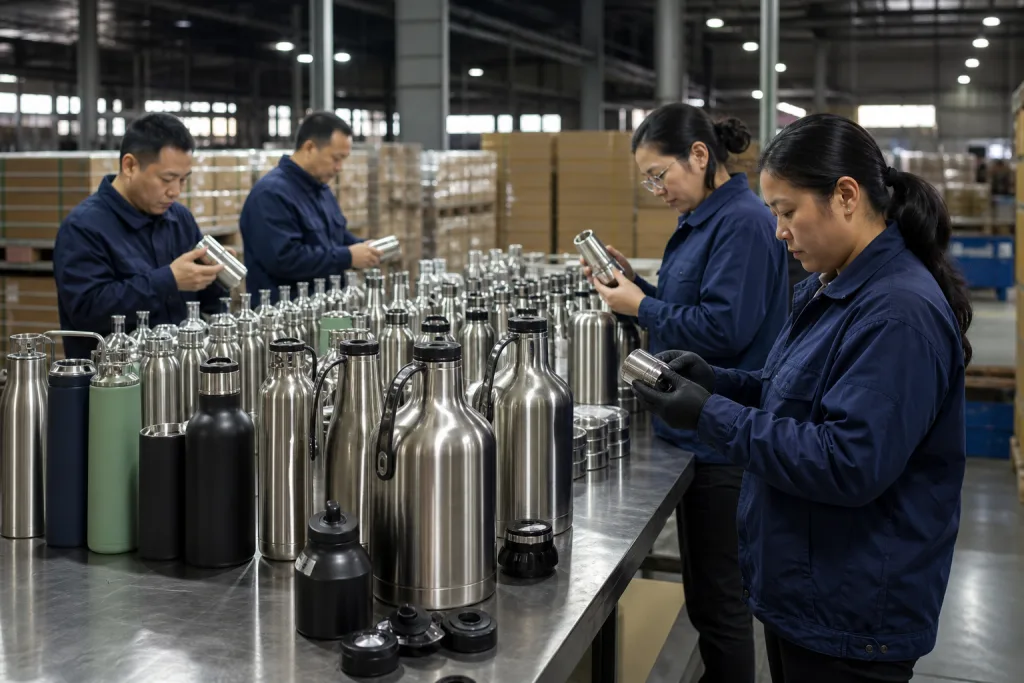
This walkthrough follows a typical order from RFQ to final inspection, the way our team in Hangzhou, Zhejiang handles it on the line. The numbers matter: MOQ 500 pieces per color, 25–35 days for standard production, 100,000 units per month capacity, and an FOB price that can move by 8–18% depending on finish, tooling, and packaging. We once had a buyer flag a PO typo on 5,000 units, and QC pulled the sample before packing; that is the right kind of headache to catch early. If you want wholesale drinkware that sells cleanly and passes AQL 2.5, buy like a buyer, not like a shopper.
Start with one sellable SKU
I’ll rewrite the section in-place, keep the HTML exactly as-is, and strip the AI-ish phrasing while adding factory-floor specifics and a sharper sales-engineer tone.Read the quote like a buyer
I’ll rewrite the section in a buyer-sound voice, keep the HTML structure intact, and keep the quote language concrete with factory-floor detail.Most quote mistakes start with bad comparison math. One supplier throws in plain cartons, another quietly adds shrink wrap and inner trays, and a third buries the mold charge inside the unit price. For drinkware wholesale, make every supplier quote the same line items: product unit price, print cost, sample fee, packaging, carton dimensions, freight term, and payment terms. FOB Ningbo or FOB Shanghai is standard for China exports, but if you buy from Zhejiang, ask whether the factory price shifts with port distance or with a consolidating load. We’ve seen that turn into a 6% gap on the same tumbler.
For bulk drinkware, decoration yield belongs in the quote, not in the sales pitch. A 1-color silkscreen print usually adds USD 0.12–0.25 per unit. Laser engraving adds USD 0.18–0.40, depending on coverage. If you are ordering wholesale drinkware for a premium brand, that spread is nothing next to a logo that rubs off after 30 dishwasher cycles. Ask for the exact process: silk screen, UV print, heat transfer, pad print, or laser. Then ask for tolerance. On our line, QC pulled the sample with logo shift at ±1.5 mm and color variance at Delta E 2.0 for branded runs.
- Confirm whether the quote includes carton drop-test prep.
- Ask for net weight, gross weight, and CBM per case.
- Require one same-day revision when artwork changes.
- Reject “all-in” pricing that hides packaging or tooling.
Sample before you pay for volume
I’ll rewrite the prose in place, keep the HTML exactly as-is, and tighten it so it sounds like a factory-side sales engineer wrote it.Sampling is where experienced buyers save cash. One clean sample tells you if the lid threads bite right, if the powder coat chips at the rim, and if the cup feels solid in hand. In a drinkware wholesale program, I would rather lose 7 days on a sample than 7,000 units on a weak closure. For a first order, we usually see 5–10 days for in-stock bodies and 12–18 days if custom tooling or a new cap is on the table. If a supplier says yes to everything in 24 hours, be careful; QC may not be checking a thing.
For a bulk canteen or canteen wholesale run, check the mouth opening, cap seal, and sling attachment points. For a bulk growler or growler wholesale order, pressure and leak testing matter more than print beauty. For a beer tumbler bulk run, stackability and case pack efficiency often beat insulation claims. The sample has to match a written spec, not guesswork. We usually approve a pre-production sample against a checklist: dimensions within ±1.0 mm, lid torque in range, no bubbles in the coating, and no visible ink breaks under 5x inspection.
Sample approval without a written spec is not approval. It is optimism.
Set QC rules before production
I’ll rewrite the section in place, keep the HTML exactly as-is, and tighten the language so it reads like an export QC person from the line.Production quality is not a mystery if you lock the inspection points before the line starts. For wholesale drinkware, we run three gates: incoming material check, in-line inspection, and final AQL inspection. Stainless steel has to match grade 304 or 316 as specified, and the wall thickness must be written down, like 0.4 mm, 0.5 mm, or 0.6 mm. We once had a buyer flag a PO typo on thickness as 0.05 mm; the math does not work, and that order stopped at the sample room. If you are buying an alcohol flask bulk order, confirm seam integrity and corrosion resistance too, especially when the flask will hold spirits with acidic additives. A flask can look clean on the outside and still fail when the cap gasket or weld line is weak.
We usually run final inspection at AQL 2.5 for general defects and 1.0 for critical items like leakage, contamination, or sharp edges. For alcohol flask wholesale or alcohol flask wholesale bulk programs, critical defects should be zero tolerance. Ask for a leak test on 100% of first-article units and sample-based pressure or inversion testing on the rest. QC pulled the sample, and a 2 mm weld pinhole showed up after the inversion test. If the order includes a beer growler bulk or beer growler wholesale bulk requirement, ask for a closure torque spec and a drop-test standard before mass production. This is the wrong question to skip. These checks decide whether your customer gets a branded product or a complaint.
Common factory controls in Zhejiang include:
- 100% visual check for logo placement and cap color match
- Sampling for vacuum performance and condensation resistance
- Carton compression test for export stacking
- Random lid cycling test after 50–100 open/close actions
Match packaging to the channel
I’m rewriting the section in-place, keeping the HTML structure and the exact heading area untouched. I’ll tighten the prose, add the concrete factory-floor details the brief asks for, and keep the numbers and tags intact.Packaging is where bulk drinkware either lands on a shelf or turns into a pallet headache. We run DTC, Amazon, and club-retail jobs with color boxes, inserts, barcodes, and master-carton labels; for horeca and promo orders, plain cartons usually win on cost. The wrong pack hits twice, first in materials and then in freight. A full-color window box can add USD 0.20–0.60 per unit, and we’ve seen carton length creep up 15 mm, which cuts container efficiency by 8–12%. That math does not work.
For a bulk canteen or wholesale canteen program, molded pulp or kraft cartons are usually enough unless the buyer is paying for a gift box. On a beer tumbler wholesale order, QC pulled the sample because the barcode sat 8 mm too low and the shelf-facing panel was upside down on the proof. If you are building a best wholesale drink bottle line, ask for retail pack and export pack on the first quote; one bottle spec can cover both if the insert and inner carton are set up right.
Pallets matter too. A loose case shifts in ocean freight from China; a packed case that is too tight will press lids out of shape, and we’ve seen that go sideways on the line. We usually set master-carton limits at under 12–14 kg for manual handling and under 18 kg for warehouse flow, depending on the market. One PO typo on a UK order listed carton gross weight as 21 kg, and the buyer flagged it before we loaded. Put the limit in the PO.
Close the order with realistic terms
I’ll rewrite the prose in place, keep the HTML tags and terms intact, and tighten the sales-engineer tone without changing the section structure.Good sourcing is not just about price. It comes down to payment timing, document accuracy, and whether the supplier can fix a problem before it turns into a claim. On a normal drinkware wholesale order, we run 30% deposit and 70% before shipment. For accounts we know, 20/80 or LC can work. If a new supplier asks for 100% upfront on the first order, that is a red flag unless the run is tiny or the tooling is truly custom.
Your PO should spell out the exact product name, capacity, material, finish, color code, decoration method, packaging, cartoning, inspection standard, and accepted tolerance. If you are buying growler bulk or growler wholesale, add the closure type and the carbonation or leak test requirement. If you are buying beer growler in bulk, say whether it is for beverage transport, retail display, or taproom merch, because the spec changes. Same story with beer tumbler in bulk versus beer tumbler wholesale bulk; one lid change can move the landed cost by 8% or more, and the math does not work if the PO is loose.
We see the cleanest export orders when the buyer sends one final file set, one approved color chip, and one carton spec. Last month QC pulled a sample where the PO said “matte black” but the Pantone code was missing, so the line stopped for half a day while we checked the reference card. Our Hangzhou team is built for repeat work, not guesswork. That is how a Zhejiang supplier should run when the order is serious.
Send your spec and get a real quote
We’ll price your bulk drinkware order, confirm MOQ, and map QC before production starts in Zhejiang.
Frequently asked questions
What MOQ should I expect for drinkware wholesale orders?
For standard stainless or powder-coated SKUs, MOQ is usually 500 pieces per color or 1,000 pieces per model. If you need custom lids, special packaging, or new tooling, the real starting point is often 2,000 pieces. Some China factories in Zhejiang can quote lower, but low MOQ usually means a higher unit price, often 8–15% above normal. If you are testing the market, ask for a mixed-SKU program only if the body and lid platform stay the same.
How long does a bulk drinkware order take to produce?
A normal drinkware wholesale order takes 25–35 days after sample approval and deposit. Simple stock items can ship in 15–20 days, while new tooling, custom boxes, or complex decoration can push it to 40–50 days. If a supplier says 7 days for a fully custom product, ask what gets skipped. In our Zhejiang facility, a stable repeat SKU can run at 100,000 units per month, but artwork approval and packaging sign-off still control the calendar.
What QC standard should I ask for?
Use AQL 2.5 for general defects and AQL 1.0 for critical issues like leaks, sharp edges, or contamination. For insulation products, add vacuum retention and lid torque tests. For alcohol flask wholesale bulk or growler wholesale, specify 100% leak checks on first articles and sample-based destructive testing during production. Also define cosmetic limits: logo shift within ±1.5 mm and visible coating defects below your agreed threshold. If you skip this, you are buying hope, not quality.
How do I compare wholesale drinkware quotes fairly?
Compare the exact same spec line by line: material grade, wall thickness, print method, packaging, carton size, and shipping term. One factory may quote USD 3.10 FOB and another USD 2.85, but the cheaper one may exclude lids, inserts, or inner boxes. Ask for net weight, gross weight, and carton dimensions so you can calculate container fill. For bulk canteen or beer tumbler wholesale bulk orders, freight efficiency can matter as much as unit price.
Can I source alcohol flask wholesale for branded retail?
Yes, but you should specify the finish, cap sealing, corrosion resistance, and package presentation. Alcohol flask in bulk is usually straightforward, but alcohol flask bulk programs fail when the cap gasket is weak or the polish scratches too easily. For retail, ask for a printed sleeve or gift box and run a basic leak test plus a surface-rub test. If the order is for gifting, budget an extra USD 0.20–0.50 per unit for packaging.