Key Takeaways
- A workable first quote needs 8 details: capacity, material, finish, logo, packaging, target market, test standard, and destination port.
- For a custom drinkware order, MOQ often starts at 1,000–3,000 units and sample lead time is usually 7–12 days.
- A factory in Zhejiang can run 80,000–150,000 units per month, but only if your spec is stable and artwork is final.
- QC should cover leak testing, torque, coating adhesion, drop test, and carton AQL 2.5 for critical defects.
You are not buying a bottle. You are buying a repeatable order that has to survive quoting, artwork, sampling, QC, packing, and freight without turning into a margin leak. That is why the stronger drinkware vendors do not open with a catalog; they open with process. If you source from Zhejiang or anywhere else in China, the real question is simple: can the factory make your spec, prove it, and ship on time?
Most first-time B2B buyers start with a vague request like “custom canteen, 500 ml, logo.” That is not enough. A serious canteen manufacturer will ask for capacity tolerance, material grade, wall thickness, lid style, test standard, and destination port. We saw one PO lose 12 days because the buyer left out the lid drawing and the line had to stop at the cap sample stage. If you want drinkware vendors to quote cleanly, think like procurement and check the sample like QC pulled it off the line.
Start With the Use Case
Before you ask drinkware vendors for a price, lock down the use case. A distributor order for retail shelves is not the same as a canteen promo run for a sports event, and a custom growler for craft beer has its own build. The factory needs the end use first: cold water, hot tea, coffee, or carbonation. That changes the lid, gasket, coating, and test method. We run into this all the time. If you are buying from a canteen factory in China, lead with the end market first and the SKU second.
Use this simple brief:
- Product type: custom canteen, customizable growler, or other custom drinkware
- Target user: retail, corporate gift, outdoor, school, or e-commerce
- Sales channel: distributor canteen, Amazon, B2B promo, or wholesale
- Performance need: leakproof, insulated, lightweight, BPA-free, dishwasher safe
One page is enough. It saves time for you and for the canteen supplier, and it keeps the quote honest. We have seen buyers send a “simple bottle” brief, then push back when the line quotes a 0.6 mm stainless body with a matte powder coat instead of a thin painted shell. The math does not work the other way. In China, specs decide whether the factory can hold cost, cycle time, and QC.
Build the Spec Sheet
I’ll rewrite the prose in place, keep the HTML exactly as-is, and make it read like a real factory-side sales engineer wrote it.When drinkware vendors ask for a spec sheet, they are not trying to make life harder. They are trying to stop rework before it starts. The bare minimum should list capacity in ml and oz, body material, lid material, finish, logo method, carton pack, and the test standard you want. For a canteen customizable project, add neck diameter, wall thickness, and whether the build is single-wall or vacuum insulation. If you want a canteen customized for a retail brand, give Pantone codes, not words like “dark blue.” We have seen that go sideways on the line.
Numbers do the real work. A stainless custom canteen often runs 18/8 or 304 inside walls with 0.35–0.50 mm thickness, depending on the structure. A growler custom order may need a heavier gauge and a tighter torque spec on the cap; the buyer flagged cap wobble on one 12,000-piece run, and that was the end of the cheap option. Ask the canteen manufacturer to confirm the finish in writing: powder coat, spray paint, polished, or electro-polish. If the item touches food or beverage, request REACH and food-contact compliance for Europe, and ask for FDA-related declarations if your customer is in North America. That is the right question to ask.
Good vendors quote from a document. Weak vendors quote from memory.
A clean spec sheet also lets you compare canteen manufacturers on the same basis. If one canteen vendor shows a lower unit price but leaves out custom insert cards, testing, or a box divider, the math does not work. QC pulled the sample, checked the carton count against the packing list, and found the missing divider in 2 minutes. For custom drinkware, the quote only means something when the spec is locked.
Quote the Order Correctly
I’ll rewrite just the prose inside the existing HTML, keep every tag and the heading structure intact, and make it sound like a real factory-side sales engineer.Now the real buying starts. A solid canteen supplier should split the quote into product cost, logo cost, packaging cost, sample fee, and freight terms. If the vendor sends one flat number with no breakdown, the next change turns into a mess. For a custom drinkware program, ask for FOB China first, then compare DDP only if you know the duty and last-mile math. We run quotes out of Zhejiang in a few hours once the spec is clean; last week the buyer flagged a PO typo on the bottle size, and that alone changed the carton cost.
Commercial terms carry more weight than most buyers think. MOQ for a custom canteen may start at 1,000 units per color, while a heavier insulated SKU often needs 3,000 units. Sample lead time is usually 7–12 days, mass production 25–40 days after approval, and export booking can add another 7–14 days depending on the season. If a canteen factory says 15 days for everything, check whether printing, curing, and carton drop testing are included. QC pulled the sample on one line because the laser logo was 0.3 mm off center; that is the sort of detail that eats time.
Ask about payment as well. Most drinkware vendors want 30 percent deposit and 70 percent balance before shipment. That is standard in China. If you are a canteen distributor buying repeat volume, you can sometimes push the tooling charge down or split production into stages, but only if your forecast is solid. A custom growler with special tooling costs more up front than a blank SKU, so keep tooling, sampling, and production separate in the PO. We’ve seen this go sideways when the buyer mixed them into one line and then tried to change artwork after the mold was already on the machine.
Approve the Sample Before You Scale
I’ll rewrite just the prose, keep the HTML and structure intact, and make it sound like a seasoned buyer-facing factory editor.Sampling is where we catch the expensive mistakes early. Do not treat the sample as a checkbox. Open the box, check logo position, measure the fill line with a 500 ml cup, test the lid on the line, and look at the finish in daylight. For customized drinkware, the sample has to show the exact print method, Pantone color, and carton structure. If you ordered a canteen for a premium brand, the sample should match the retail shelf feel, not just the drawing on the PO.
Run a short test set with discipline:
- Leak test for 10 minutes upside down at room temperature
- Cap torque check and reopen test after 20 cycles
- Drop test from 80–100 cm depending on carton level
- Coating adhesion and scratch inspection
Ask the canteen manufacturer to mark every change between version one and version two. If the sticker shifts 5 mm or the cap shade changes under a different light box, write it down now. QC pulled a sample here last month because the logo sat 3 mm low, and that saved us a reprint. For canteen distributors, sample approval is the last cheap chance to protect margin. Once mass production starts, a small logo error can turn into a 3,000-unit write-off. The math does not work.
QC the Production Run
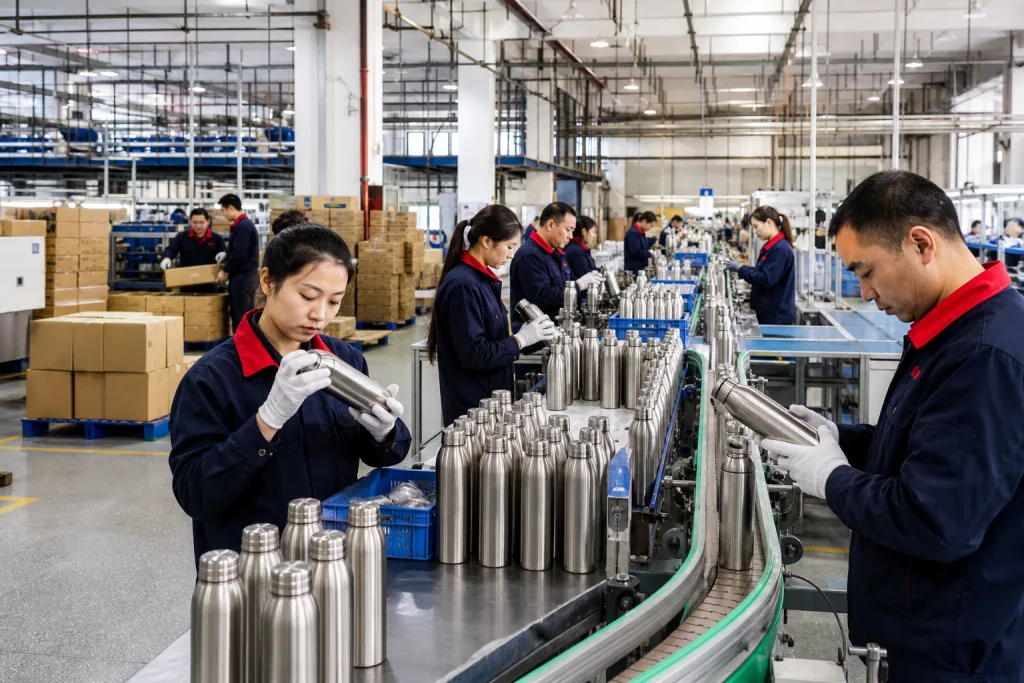
I’ll rewrite the section in-place, keep the HTML tags intact, and tighten the prose so it reads like a factory-side sales engineer wrote it.Production QC needs to follow risk, not optimism. We run incoming raw material checks, in-line assembly checks, final packing, and carton drop tests before a shipment leaves the line. On stainless items, we verify the steel grade and weld consistency with a thickness gauge and a weld seam check. On printed items, we check logo registration and color drift against the approved sample. For a canteen promotional run, the cap and the packaging usually fail first; that is where rushed factories cut corners.
Use AQL limits that match the order value. For most buyer programs, AQL 2.5 for major defects and 4.0 for minor defects is the normal ask, with critical defects at zero tolerance. A leaking lid, sharp edge, or wrong capacity does not pass. The buyer flagged a 500 ml bottle at 470 ml once, and the whole lot went back to recheck. Ask the canteen supplier for a pre-shipment inspection report with photos, lot numbers, and carton count. If your distributor canteen order has 3 or 5 SKUs, label cartons by style and color so the warehouse does not mix them.
For North America, the factory needs to get import labeling, carton marks, and barcode placement right from day one. For Europe, check REACH, phthalates where relevant, and country-specific packaging waste rules. We had one PO where the barcode size was typed as 38 mm instead of 3.8 mm, and QC caught it before packing. A real canteen manufacturer in Zhejiang will send test reports, packing specs, and a production timeline that holds up on the floor. A trade-only canteen distributor usually starts with “no problem.” That is the wrong answer.
Pack, Ship, and Land Cleanly
I’ll keep the HTML intact and rewrite only the prose, with cleaner export-sales phrasing and a few concrete factory-floor details.Shipping is where the first order usually gets messy. Buyers chase unit price; we run the numbers on landed cost, carton size, and pallet fill. For bulky custom drinkware, a 5 mm change in carton width can shift container loading by a real slice. Ask for master carton dimensions, gross weight, and pallet count before the line finishes packing. If the shipment goes to Amazon or a 3PL, set label rules before final packout, not after the truck is booked.
For fulfillment, choose bulk pack, retail box, or gift box early. A custom canteen sold through wholesale may go 24 or 48 pieces per carton, while a premium customizable growler often needs one box, one insert, one barcode. The math changes fast. We’ve seen buyers push for “simple packing” and then get hit with warehousing fees because the carton spec was 10 kg heavier than expected. If you use FNSKU labels, send the artwork early and confirm whether the factory applies them or only prints the outer carton marks.
Once the goods leave the canteen factory, check the bill of lading, packing list, and commercial invoice against the approved sample list. One PO typo on a model code can stall customs for days. If your order ships from Zhejiang, keep the documents tight and consistent; US and Europe delays usually come from mismatched weights or product names, not from the cup itself. QC pulled the sample once and found the carton mark said 450 ml while the invoice said 500 ml. The best drinkware vendors make export paperwork boring. That is the goal.
Send your spec and get a clean quote
We will review your canteen, growler, or custom drinkware brief, confirm MOQ, and return a production plan with Zhejiang lead times.
Frequently asked questions
What MOQ should I expect from drinkware vendors?
For standard custom drinkware, MOQ is often 1,000–3,000 units per design or color. A simple custom canteen may start at 1,000 pieces, while a vacuum-insulated or customized growler can require 3,000 or more because of tooling and coating setup. If you want mixed colors, ask whether the canteen manufacturer allows 500 units per color or if each color needs a separate run. In Zhejiang, larger factories can handle higher volume, but they still need enough pieces to cover machine changeover, printing screens, and packing labor.
How long does a first order take?
A realistic timeline is 7–12 days for samples, 25–40 days for mass production after sample approval, and 7–30 days for freight depending on sea or air. If you need a canteen promotional launch tied to an event date, build in at least 10 extra days for artwork changes and inspection. Drinkware vendors in China can move fast, but only when the spec is final and the deposit is in. If you rush approval, the delay usually shows up later in QC or customs, not in the quote.
What should I check on a sample?
Check logo position, color, lid fit, leak resistance, capacity, and carton packing. For a canteen customized order, fill it with water, invert it for 10 minutes, open and close the lid 20 times, and inspect the coating for scratches after a simple drop test. If you ordered a customizable canteen for retail, confirm the box dimensions and barcode space too. A sample is not just for approval; it is your cheapest chance to catch a 2 mm artwork shift or a weak gasket before 3,000 units are made.
Can a canteen supplier handle compliance for Europe and North America?
Yes, but you need to ask for it upfront. For Europe, request REACH-related declarations and food-contact documents where relevant. For North America, ask for material declarations and any test reports your importer or retailer requires. A serious canteen supplier or canteen manufacturer in China should be able to provide coating, metal, and packaging information for your compliance file. Do not wait until the cargo is ready; if you need testing, it can add 5–15 days and should be planned before production starts.
How do I compare two drinkware vendors fairly?
Compare on the same spec, same Incoterm, same packaging, and same compliance scope. If one canteen vendor quotes FOB Ningbo and another quotes DDP Chicago, the prices are not directly comparable. Put the same logo method, same carton count, same AQL target, and same material grade into both quotes. For a custom drinkware order, the lowest number is often missing something, such as extra packaging, freight, or pre-shipment inspection. The fairest comparison is landed cost, defect risk, and lead time, not just unit price.