Key Takeaways
- A serious drinkware supplier should quote MOQ clearly, often 1,000 to 3,000 units per SKU depending on material and decoration.
- Standard custom lead times from a Zhejiang canteen factory are usually 25 to 45 days after artwork approval and deposit.
- For export, ask for REACH, FDA, LFGB, and an AQL 2.5 / 4.0 inspection plan before you place an order.
- A good custom drinkware project is judged by repeatability: cap fit, leak rate, coating adhesion, and carton drop performance.
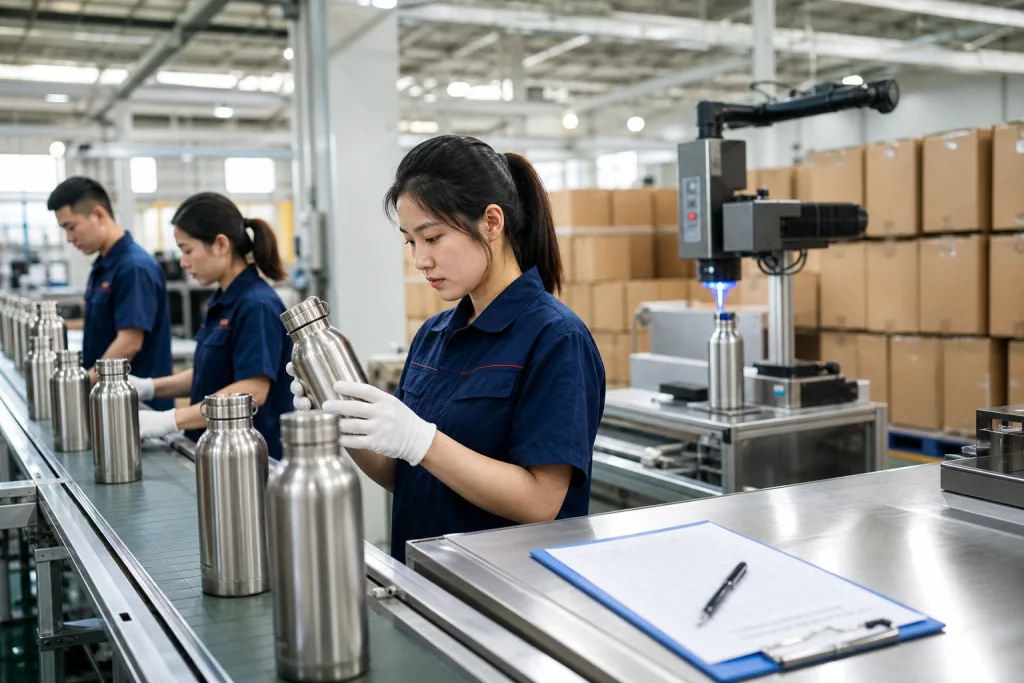
Most buyers do not lose money because they picked the wrong bottle color. They lose money because the factory looked fine on email, then missed dates, skipped testing, or treated your artwork like a suggestion. We see this all the time on a 38mm cap sample. If you are sourcing from a drinkware supplier, the real job is not finding a pretty sample. It is finding a team that can run repeatable production, meet compliance for Europe and North America, and still move fast when your order lands on the wrong week.
At our Zhejiang factory, we see the same pattern every month: brands ask for a canteen custom project, distributors want a faster refill program, and procurement wants a clean FOB quote with no hidden extras. Fine. The buyer pushed back on a 5000 pcs MOQ last week, and the math still had to work. The better question is whether your canteen manufacturer can handle the numbers behind the promise: MOQ, lead time, decoration yield, and shipment accuracy. We ship from Hangzhou, QC pulled the sample, and the line does not forgive sloppy paperwork.
What You Need From Supplier
If you are comparing canteen suppliers, start with what you actually need the factory to do. A canteen vendor that only makes nice samples is not enough. You need a partner that can turn one approved sample into 5,000 or 50,000 units without shifting wall thickness, changing lid torque, or sending colors off batch to batch. That is the gap between a real canteen factory and a trading setup that outsources the hard parts.
For procurement, the checklist is simple:
- Product capability: stainless steel, Tritan, glass, aluminum, or mixed-material assemblies
- Customization: screen print, laser engraving, embossing, powder coat, UV print, and packaging inserts
- Commercial terms: FOB Ningbo or FOB Shanghai, sample cost, tooling cost, and payment schedule
- Production scale: our Zhejiang plant runs about 300,000 units per month across drinkware lines
That number matters. A canteen supplier at 30,000 units per month and one at 300,000 do not run the same way. On our line, a 2 mm cap gasket spec and a simple torque gauge check save more trouble than a glossy brochure ever will. Bigger is not automatically better, but without scale you get burned when peak season hits. The math does not work if the factory cannot keep molds, caps, and cartons moving at the same pace.
Ask for the quality file for your category. A canteen manufacturer handling export orders should show incoming inspection records, in-process checks, final AQL sampling, and carton drop-test results. QC pulled the sample on one order because a PO typo changed the carton count from 24 to 14. If they cannot show that paper trail, you are not buying from a system. You are buying hope.
How To Judge MOQ
MOQ is where a lot of buyers get the math wrong. A custom canteen order does not have one universal minimum. MOQ moves with the base item, the decoration method, and any special packing. A plain laser-marked stainless canteen can start at 500 to 1,000 units. A full-color custom drinkware program with printed boxes can go to 3,000 units or more. A custom growler in thick-wall stainless with a special handle usually sits higher because the body, cap, and coating all add setup cost. We run that calculation on the line before we quote.
Do not ask only, “What is your MOQ?” That is the wrong question to ask. Ask what drives it. A canteen distributor buying stock bottles can often mix colors to reach the run size. A distributor drinkware buyer launching retail packaging cannot. A canteen promotional campaign with one logo and one Pantone is easier than a customizable canteen with multiple SKU variants. If a supplier says they can do everything at 200 units, they usually mean the unit price will hurt. QC pulled a sample last week and the setup loss was obvious.
Useful MOQ questions
- What is the MOQ per color, per size, and per logo method?
- Can I mix lids or finishes within one production run?
- What happens to unit price if I cut MOQ by 30%?
- Is the MOQ different for a custom canteen versus a customized growler?
A serious drinkware supplier should explain MOQ in a way that ties back to production setup, not vague “policy.” If they cannot show you how screen count, mold change, and packing labor affect the number, you are not getting a real quote. We’ve seen this go sideways when the PO said 1,000 and the artwork file called for 3 colors; the buyer flagged it only after the first sample.
What Lead Time Really Means
I’ll rewrite the section in-place, keep the HTML structure untouched, and tune the copy to sound like a real supplier rep with concrete factory details and cleaner lead-time language.Lead time is not the same as production time. Buyers hear “30 days” and think the cartons are already loaded. They are not. On a custom drinkware order, four clocks run at once: artwork sign-off, pre-production sample approval, mass production, and export booking. If QC pulls the sample twice, the whole schedule moves.
For a standard canteen custom order in Zhejiang, we usually see 7 to 10 days for sample confirmation, 25 to 45 days for production, and 5 to 15 days for booking and export handling, depending on destination and peak season. A custom growler with a special coating adds curing time. A custom canteen with 3 accessories adds another round on the line. During school season or Q4 retail runs, the math gets tight.
Good suppliers do not promise the shortest lead time; they promise the lead time they can actually hold under inspection.
Ask the canteen factory when the clock starts: after deposit, after artwork approval, or after sample sign-off. That detail can shift the ship date by 7 to 14 days. Ask one more thing too: do they keep standard lids in stock, or do they machine every part to order? We had a buyer flag a PO once because the lid spec was typed as “PP” instead of “PPS”; that kind of typo burns a week. A factory with stocked caps can save 5 to 7 days. A supplier that starts from zero cannot.
If your launch date is fixed, do not build the plan on best-case timing. Add a 10 to 15 day buffer. That is not pessimism. It is how we avoid emergency air freight and a very expensive phone call.
QC Checks That Matter
I’ll rewrite the section in place, keeping the HTML and the existing numbers/certifications intact. Then I’ll do a quick pass to make sure the tone sounds like a factory-side export salesperson, not generic copy.For custom drinkware, QC has to be boring and measurable. If a supplier only says “good quality” and gives no numbers, walk away. We run the same checks lot after lot. For insulated stainless canteens, that means vacuum retention, leak resistance, coating adhesion, and lid thread fit. For plastic customizable drinkware, we check odor, warpage, and drop results. For glass bottle lines, we watch stress points and carton protection. On one 24,000-piece run, QC pulled the sample and found a lid thread miss by 0.3 mm; that saved a resale headache.
A sane export plan usually starts with AQL inspection at 2.5 major / 4.0 minor for appearance and function, then adds carton and barcode checks. If you sell on Amazon or through retail distribution, FNSKU or barcode placement needs to be confirmed before shipment. We’ve seen this go sideways: a buyer flagged 2,000 units because the label sat on the wrong panel, and the math on relabeling never worked out.
- Leak test: 100% on assembled lids for high-risk SKUs
- Coating test: crosshatch or tape adhesion for powder coat
- Dimension check: mouth diameter, height, and thread pitch
- Packaging check: carton drop test and inner box fit
For Europe, ask for REACH and, when relevant, LFGB support. For North America, request FDA-related material declarations where applicable. A responsible canteen supplier keeps those files sorted before the PO lands, not after. If a vendor says compliance is “not a problem” but cannot name the standard, that is the wrong question to ignore. On our line, a missing declaration can stop a 40HQ from shipping.
Pricing Without Surprises
I’ll rewrite the section in place, keep the HTML exactly as-is, and tighten the pricing language so it sounds like a real factory-side sales engineer.Price is rarely the cheapest line in the quote. The real cost from a drinkware supplier shows up in mold fees, logo setup, packaging, and freight assumptions. We’ve seen a USD 1.42 unit price turn into USD 1.86 once the buyer asked for two extra screens, a custom insert, and a carton spec change. Ask for a line-by-line quote. A single unit price hides too much.
For a simple promotional canteen order, the gap between stock and custom can be small. For a customized canteen with soft-touch paint, laser logo, and gift box, the math changes fast. I’d compare landed cost, not factory price. FOB looks neat on paper, but box size, carton count, and pallet loading move your freight bill. We ran one 12,000-piece program where a 3 mm carton change added 18% to sea freight.
One rule works every time: if the supplier will not say what is included, you are not comparing like for like. Ask whether the quote covers inner cartons, desiccant, spare seals, instruction leaflets, and master carton markings. Ask whether silk screen and laser engraving carry the same price. QC pulled the sample, and the buyer flagged a missing leaflets line on the PO; that typo cost two days. A decent canteen factory should answer in one email, not five days.
Payment terms matter too. The normal export setup is 30% deposit and 70% balance before shipment. For repeat buyers, some canteen suppliers will relax that after 3 or 4 clean shipments. Do not push for it on the first order. Get the PO right, pay on time, then ask. That is how we run it on the line.
Custom Options Buyers Miss
I’ll rewrite the prose in-place, keep the HTML exactly as-is, and make it sound like a real sales engineer wrote it.Most buyers lock onto logo placement and color, then miss the parts that drive sell-through. If you are building custom drinkware for retail or corporate programs, check grip feel, lid rattle, sealing ring color, and how the bottle drops into a case. Those details decide whether the product reads premium or cheap after it leaves the sample room.
A custom canteen can be changed in ways that matter more than the artwork. On stainless, moving wall thickness from 0.4 mm to 0.6 mm stiffens the body and cuts dent risk, but it also adds weight and cost. A customizable growler often needs a wider mouth for faster filling, while a canteen customized for sports use may need a handle or carabiner loop. We had one buyer flag a PO that copied the same cap across three channels; the math did not work, and the line would have sat on slow-moving stock.
- Decoration: screen print, pad print, laser, embossed logo, full wrap UV
- Surface: matte, gloss, sandblasted, powder coat, metallic paint
- Function: strainer, straw lid, wide mouth, carry handle, carry strap
- Packaging: retail box, PDQ display, mailer box, spare gasket pack
Not every customization earns its keep. Some only adds cost. A good canteen manufacturer will say no when a request hurts durability or slows assembly—we’ve seen that go sideways on a lid change that added 12 seconds per unit. QC pulled the sample on that job after the gasket sat 1.5 mm off center. Factories that only say yes usually leave you with the expensive problem later.
Request a quote from a proven supplier
Send your target SKU, logo method, and annual volume. We’ll reply with MOQ, lead time, and FOB pricing that matches real production.
Frequently asked questions
What is a normal MOQ for a custom drinkware order?
For most custom drinkware, MOQ starts around 500 to 1,000 units for simple decoration and can move to 3,000 units for complex printing, special packaging, or multiple colors. A laser-marked stainless canteen is usually easier than a full-color canteen customized for retail. If you need a custom growler or a customized canteen with accessories, expect the minimum to rise because setup and packing labor increase. Always ask whether MOQ is per SKU, per color, or per logo method.
How long should a drinkware supplier take to produce?
A realistic timeline is 25 to 45 days after artwork approval and deposit for standard orders. Add 7 to 10 days for sample confirmation, and more if you need special tooling, multi-color printing, or complex packaging. A Zhejiang canteen factory with stable line scheduling can usually move faster than a small trading setup, but only if your artwork is final. If a supplier promises 15 days for a fully customized order, ask what they are skipping.
What compliance documents should I ask for?
For Europe, ask for REACH and LFGB support where relevant. For North America, request FDA-related material declarations and any migration or material test data your channel requires. If you sell through major retail or e-commerce, also ask for carton labels, barcode checks, and packaging specs. A serious canteen supplier should keep these files organized before production starts, not after shipment is booked.
How do I compare two canteen manufacturers fairly?
Compare them on the same basis: unit price, sample cost, lead time, MOQ, testing plan, and packaging details. Check whether the quote includes logo setup, inner cartons, spare seals, and export marks. Ask for AQL standards, usually 2.5 major and 4.0 minor, and see whether the factory can explain actual process control. A lower quote from a weak canteen factory often becomes more expensive once delays and rework appear.
Can one supplier handle both distributor and retail orders?
Yes, but only if the factory has enough capacity and process control. A distributor drinkware program needs stable replenishment, while retail orders need tighter packaging and barcode accuracy. At our Hangzhou, Zhejiang operation, we run about 300,000 units per month across lines, which helps us separate bulk replenishment from branded retail runs. That separation matters because a canteen distributor does not want retail packaging mistakes, and a retail buyer does not want random stock substitution.