Key Takeaways
- For drinkware promotional orders, decide the use case first: retail, gifting, or employee program changes the right MOQ, finish, and carton spec.
- A typical custom drinkware MOQ starts at 1,000 units, with lead times of 20-35 days after sample approval and deposit.
- For hot-fill or premium gifting, stainless steel 18/8 at 0.4-0.5 mm wall thickness is safer than thin single-wall alternatives.
- If you need branding flexibility, choose one decoration method first; laser engraving, silkscreen, and UV print have different cost, durability, and lead times.
Most drinkware promotional jobs fail for plain reasons: the buyer signed off on a pretty sample, then got burned by a loose lid, a vague coating callout, or an MOQ that missed the campaign math. If you source for retail, events, or corporate gifts, the job is not just picking a mug or bottle. It is deciding where the money goes on material, branding, and compliance so the order ships on time and sells through.
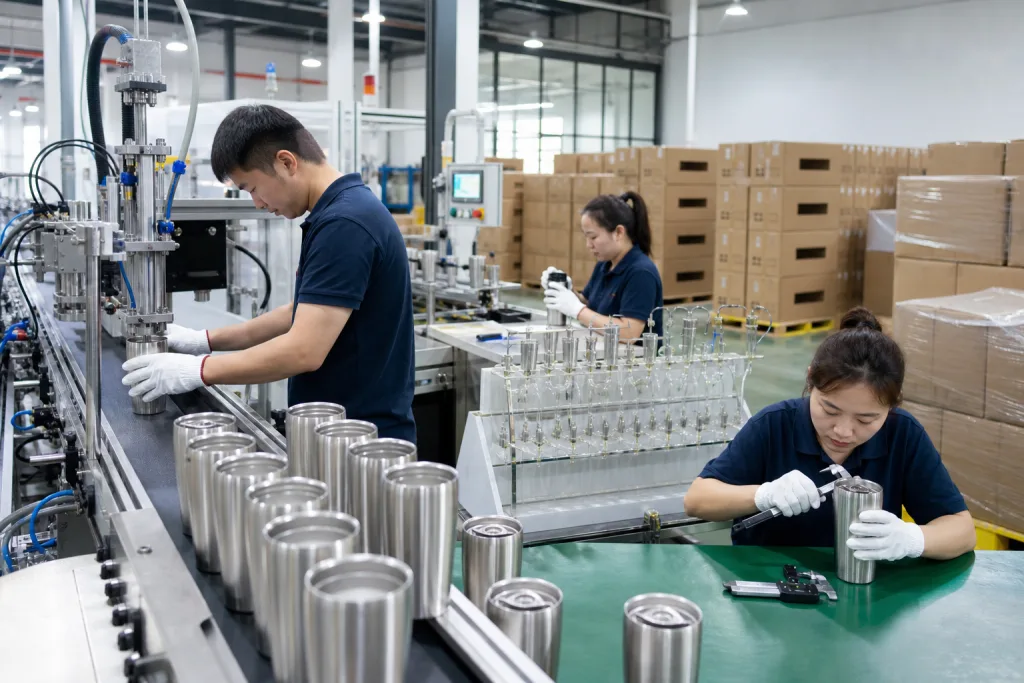
At our Zhejiang factory in Hangzhou, we see this every week on the line. A clean spec sheet saves more than hard price pushing. The wrong custom drinkware setup can turn a USD 2.10 unit into a return headache. The right one gives you steady quality, repeat orders, and a product line your canteen distributor or canteen supplier channel can actually carry.
Start With the Job, Not the Bottle
The first call is about the job, not the bottle. A trade-show giveaway is one thing; a resale SKU for a canteen distributor or a quarterly corporate refill order is another. If the cup gets handed out once and tossed, we keep the spec tight. If it lives in a backpack, cup holder, or on an office desk, we spend on lid fit, coating wear, and leak control.
We start with three numbers: service life, beverage temperature, and branding area. For a low-risk campaign, a 450 ml powder-coated bottle at USD 2.80-3.60 FOB Zhejiang does the job. For a premium custom canteen, the line usually moves to double-wall 304 stainless steel, a 0.45 mm inner shell, and a tighter lid tolerance. That can put the price at USD 4.90-7.20, depending on quantity and finish. QC pulled the sample on this spec and checked the cap gap with a 0.2 mm gauge.
Style should not run the order. We’ve seen a bottle win the mockup and fail after a month of daily use; the buyer flagged it, and the replacement cost hurt more than the original margin. This is the wrong question to ask if you are buying for canteen promotional activity. Think duty cycle, hand feel, and how users actually carry it.
Choose the Right Material Class
Material choice sets the ceiling for quality, cost, and compliance. For drinkware promotional work, stainless steel, tritan, PP, and glass solve different jobs on the line. Stainless steel is still the safest default for perceived value and repeat use. For a custom growler or customized growler, 18/8 stainless with vacuum insulation holds temperature better, and the buyer can see why the carton costs more.
Plastic is cheaper and lighter, but resin grade and heat resistance are where deals go sideways. Tritan is common for customizable drinkware when buyers want clear walls without glass breakage. A 650 ml tritan bottle may weigh under 180 g and cost under USD 2.00 FOB at volume, but we still run cap torque and leak checks, because the buyer flagged loose seals before on a distributor drinkware order.
- Stainless steel: best for premium perception and thermal performance on repeat-use programs
- Tritan: best for lightweight clear bottles and daily carrying
- PP: best for lower-cost campaigns and 10,000+ piece runs
- Glass: best for desk use, but packing and breakage push landed cost up fast
Ask for material declarations, migration compliance, and finished-product test reports. In Zhejiang, a proper factory can hand over REACH and food-contact files without drama; QC pulled the sample, checked the wall thickness at 0.8 mm, and moved on. If a canteen factory cannot explain the material stack clearly, the math does not work.
Decide on Branding That Survives Use
Branding is where a lot of drinkware promotional orders get overdesigned. We see it on the line all the time. You want decoration that still reads after 300 washes, not a logo that looks sharp in the mockup and fades by month two. The method depends on the substrate, the logo colors, and how the cup gets handled. Laser engraving holds up on steel, silkscreen works on flat graphics, and UV print needs tight ink control.
For a custom canteen going into offices or gyms, laser engraving usually gives the best long-term result. For canteen customized work with full-color campaign art, UV print or wrap print can be worth the extra setup. If your buyer wants a canteen customizable program with multiple SKUs and regional logos, keep the print area consistent so we can hold tooling and setup cost under control. We had one PO where the buyer changed the logo width by 6 mm; that alone added USD 0.08-0.25 per piece, and a color swap costs more if the line needs a full washdown.
Good decoration makes the product feel branded. Bad decoration makes the product feel cheap.
When you compare canteen manufacturers, ask for cured-ink abrasion tests, dishwasher cycle expectations, and exact artwork limits. This is the wrong question to ask: “Can you print anything?” A vendor that says yes without limits usually has a weak process, and QC pulled the sample for smudging by the third wash.
Check MOQ Against Real Demand
I’ll rewrite the section in place, keep the HTML structure unchanged, and tighten the sales-engineer tone with concrete factory details and cleaner trade-off language.The MOQ is where a canteen supplier either helps you make money or leaves cash stuck on the shelf. For most standard drinkware promotional items, 500 to 1,000 units works for a first order if the mold is already live. For a custom canteen with a new lid, handle, or mold engraving, 3,000 units or more is normal. That is not greed. It is how the factory covers setup, sampling, and warehouse space.
Do not ask for the lowest MOQ and stop there. Ask what changes when you cut quantity. Does the carton go generic? Does the lid stay stock color? Does print drop from full-wrap to one-color silkscreen? Those are the real trade-offs. We had one buyer push back on 1,200 units, then accept 3 colors instead of 3,600 units of one color. That math works. A canteen program should follow sell-through, not the line’s favorite batch size.
Our Hangzhou line ships about 200,000 units a month across bottle and tumbler categories, and that volume keeps caps, straws, and gaskets moving on time. A small-order canteen vendor job still needs its own schedule. QC pulled the sample, the buyer flagged a 2 mm lid gap, and the whole launch shifted by 6 days. If your launch date is fixed, lock tooling, sample approval, and packaging before the PO goes in.
Price the Real Landed Cost
I’ll rewrite the section in-place, keep the HTML exactly as-is, and tighten the language so it sounds like a factory-side sales engineer.FOB price is one line on the sheet. For drinkware promotional orders, landed cost also includes freight, cartons, decoration, testing, and any prep work like barcode stickers or FNSKU labels. We shipped a bottle at USD 3.20 FOB last month; after master cartons, ocean freight, and domestic delivery, it landed at USD 4.10-4.60. If the buyer sends it to an Amazon prep center, label application and carton compliance can add another USD 0.10-0.35 per unit.
Buying from China or Zhejiang still makes sense when the quote is clean. The cheap quote that leaves out lid inserts, logo setup, or export cartons is not a cheap order. Ask for the same breakdown every time: unit price, mold fee, sample fee, decoration fee, packaging fee, and test fee. The buyer flagged a PO typo on one order—wrong carton count by 200 pcs—and the math stopped working fast. Compare line by line across canteen manufacturers and canteen suppliers.
- FOB price for a basic steel bottle: often USD 2.80-4.50
- Extra for premium lid or coating: USD 0.20-0.80
- Logo setup or plate charge: often USD 30-120 per color
- Testing and compliance: budget USD 80-300 per project
If your campaign lives on margin, stick to repeatable specs. The cheapest customized canteen is the one you can reorder without reopening the artwork file, mold record, or packaging spec. QC pulled the sample twice on a 26 mm lid gap, and that kind of miss turns into a second round of freight nobody wants.
Build QC Into the Order
I’ll rewrite the prose in place, keep the HTML exactly as-is, and tighten it to sound like a factory-side sales engineer with concrete QC details.Quality control belongs in the purchase order, not in a handshake. A buyer with experience writes down AQL levels, appearance limits, leak testing, drop-test height, and carton compression specs before we run the line. For drinkware promotional orders, AQL 2.5 for critical defects and AQL 4.0 for cosmetic issues is a normal setup, but the right number depends on your channel and claim risk.
Ask the factory to confirm closure torque, vacuum retention, coating adhesion, and odor testing where they apply. We had a growler job where the body passed visual check, but the gasket lost seal after 12 hours in transit. QC pulled the sample, checked the torque wrench log, and found the cap was sitting 0.8 mm off spec. A canteen factory that knows export work will show incoming-material records, in-process checks, and final inspection sheets. If they cannot show that flow in one page, the buyer should push back hard.
For European and North American channels, REACH, food-contact safety, and label accuracy are not side issues. We once saw a PO typo on the carton mark turn into a 3-day receiving hold across two warehouses. That is the wrong place to save time. If you ship through a canteen distributor network, one bad carton label can jam the whole intake. Strong factories in Zhejiang treat export QC as part of the unit cost, because the math does not work any other way.
What to lock before PO
- Material grade and wall thickness
- Decoration method and logo placement
- Leak test and drop test criteria
- Packaging format and carton count
- Inspection standard and action limits
Send your spec, get a practical quote
We will review your drinkware promotional target, suggest the right custom canteen setup, and quote FOB China with MOQ, lead time, and QC clearly stated.
Frequently asked questions
What is a realistic MOQ for drinkware promotional orders?
For standard stock-based drinkware promotional items, 500-1,000 units is common. If you need a new mold, special lid, or custom packaging, 3,000 units is more realistic. A canteen customized with multiple logo colors or a non-standard finish can push MOQ higher because setup cost spreads over fewer pieces. Ask the canteen manufacturer to quote both stock and custom options so you can see the cost jump clearly.
How long does custom drinkware usually take?
Typical lead time is 20-35 days after sample approval and deposit for standard custom drinkware. New tooling, complex printing, or special packaging can add 10-20 days. If you need a canteen custom program for a fixed event date, lock the artwork early and confirm carton spec before production starts. In Zhejiang, experienced factories can move faster, but only if your approvals are complete.
Which branding method lasts the longest?
Laser engraving usually lasts longest on stainless steel because it removes material rather than relying on ink. Silkscreen is fine for one-color logos and lower cost, while UV print works for more complex graphics but depends on ink and surface prep. For a customized canteen or customizable growler, choose the method based on wash frequency and whether the product will be handled daily.
How do I compare canteen suppliers fairly?
Compare them on the same sheet: material grade, wall thickness, lid structure, MOQ, FOB price, decoration fee, carton size, test reports, and lead time. A canteen supplier offering USD 3.05 FOB may be more expensive than one quoting USD 2.85 if the second quote excludes logo setup or export cartons. A fair comparison is the only way to judge canteen suppliers and canteen vendors properly.
What compliance documents should I request?
For EU and North America, ask for food-contact declarations, REACH-related documentation where applicable, and any migration or safety test reports relevant to the material. For stainless products, ask for the steel grade declaration; for plastic, ask for resin type and colorant information. A serious canteen factory should also confirm inspection records and packaging specs. If you are importing as distributor drinkware, keep the paper trail with the order file.