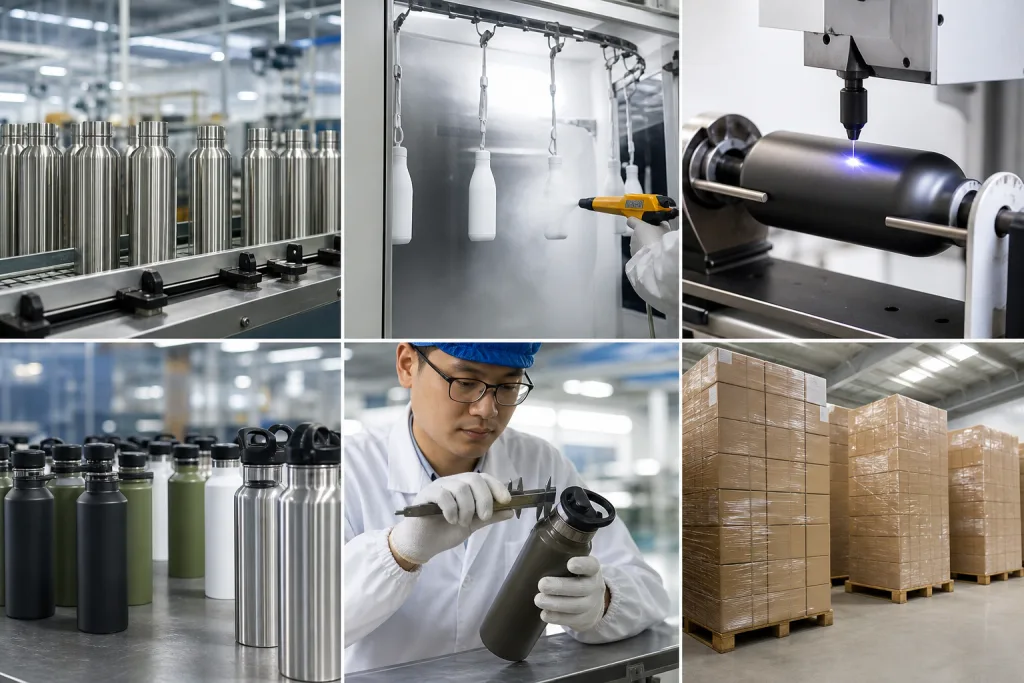
Key Takeaways
- A realistic MOQ for drinkware private labeling is often 1,000-3,000 pcs per color per size, though some stock models start at 500 pcs
- 304 stainless works for most custom drinkware, but 316 is worth the extra 8%-15% for high-salt or premium outdoor use
- Standard lead time is usually 25-45 days after sample approval, with pre-production samples taking 5-10 days
- AQL 2.5/4.0 inspection, REACH testing, and drop/leak checks should be agreed before deposit, not after production
You rarely lose money on custom drinkware from one big failure. It usually leaks out line by line on the spec sheet: the PO says 304 stainless but the inner wall sample feels light at 0.32 mm, the lid thread binds after 200 turns on the torque test, the logo area is drawn too close to the shoulder radius, the carton size adds 18% to freight, or QC pulled the sample and found a compliance miss after production. That is where drinkware private labeling gets expensive, especially for buyers placing their first China order.
If you buy for retail, promotions, or distribution in Europe and North America, read the factory spec sheet like a product engineer, not a trader chasing the lowest FOB. A canteen customizable for a campaign is built for fast visuals and controlled MOQ; a custom growler for outdoor retail gets pushed on seal performance and carry weight; a distributor drinkware SKU for wholesale has its own carton math and reorder pressure. We run into this every month in Zhejiang, China: the factories that save you trouble are usually the ones that will walk through thread pitch, print area, and master carton dimensions with you, even when the buyer flagged the quote as $0.18 higher.
Start with the body material
The first line on any drinkware private labeling spec sheet should state the body material. If it does not, stop. For stainless bottles and tumblers, the standard callout is SUS 304 inside and outside, sometimes marked 18/8. That is the safe default for most custom drinkware sold into Europe and North America. For a custom canteen used for daily hydration, 304 usually gives the right cost-to-performance balance, and we run this grade on the line every week in Zhejiang.
Buyers get tripped up when they assume all stainless is the same. It is not. Some low-price offers quietly switch the exterior to 201 steel to shave off a few cents. That can work on a hard-cost canteen promotional order, but only if the quote spells it out. For outdoor, marine, or high-electrolyte use, 316 stainless is the better pick and usually adds around USD 0.20-0.60 per unit depending on bottle size and order volume. On a 32 oz customizable growler, that bump is easy to justify. On a 500 ml office bottle, the math often does not work.
Wall thickness matters too. A single-wall stainless body may be 0.4-0.5 mm. Double-wall vacuum items are commonly 0.4 mm inner plus 0.5 mm outer, though rugged models go heavier. Heavier does not mean better. It adds freight, slows output, and we have seen QC pull samples with dented shoulders after drop testing when the spec was heavy in the wrong place. Ask your canteen manufacturer or canteen suppliers for the actual thickness in mm, not soft wording like “premium.”
- 304 stainless: standard choice for retail programs and distributor canteen orders
- 316 stainless: better fit for premium outdoor use or high-corrosion environments
- Tritan or PP: lighter, lower-cost option, but not sold the same way as insulated steel
- Borosilicate glass: good for tea or infuser lines, with higher breakage risk during distribution
If you are sourcing from multiple canteen manufacturers or canteen vendors in China, make them quote the same material stack-up. Same steel grade, same wall thickness, same lid resin. We have seen this go sideways over one line on a PO. If the stack-up is different, the price comparison tells you nothing.
Vacuum structure and thermal performance
The next spec line tied to buyer risk is the build: single wall, double wall, vacuum insulated, copper plated, powder coated, and the rest. A customized drinkware project at retail stands or falls on the claim printed on the box. If your sales team says “12 hours hot and 24 hours cold,” the factory needs to show the test method, not just repeat the slogan. Serious canteen suppliers in Zhejiang, China usually run an internal test like this: fill with 95°C water, hold the sample in a 20-25°C room, then record the temperature at 6, 12, and 24 hours with a digital probe. QC pulled samples this way last month on our line.
Do not buy more insulation than your market will pay for. Single-wall bottles are cheaper by USD 0.80-2.00 versus vacuum versions, depending on size. That gap matters fast at 10,000 pcs MOQ. For high-volume giveaways or a canteen promotional campaign, single wall is often the right commercial choice. If you are a distributor growler or distributor drinkware buyer supplying outdoor stores, vacuum performance is not optional. We have seen buyers push for vacuum on entry-price promos, then cut decoration and packaging later because the math does not work.
Check whether the vacuum area includes a copper lining or reflective layer. It can improve heat retention, but it also changes cost and process control on the line. Ask for a cut sample or cross-section; a wall section around 0.4 mm often tells you more than a sales sheet. If the factory cannot explain the build clearly, that is a red flag. This is the wrong place to accept vague answers.
Ask for performance data, not adjectives
You want numbers such as:
- 500 ml bottle: 12 hours hot above 50°C, 24 hours cold below 10°C
- 32 oz customizable growler: 24 hours cold, 10-12 hours hot
- Leak test: 100% inline check before packing
- Vacuum retention failure rate: under 0.5% after aging test
For private labeling, the performance claim on packaging must match what production can repeat batch after batch. A canteen custom project that passes a lab sample but fails in mass production usually comes back to weak vacuum process control, not artwork. We have seen this go sideways after aging tests, where 3 pieces out of 500 lost vacuum and the buyer flagged the whole lot.
Lids, threads, seals, and usability
Most complaints on custom canteen orders do not come from the bottle body. They come from the lid. We see this on the line all the time: cracked flip tabs, loose gaskets, wrong straw length, then carton damage after a 76 cm drop in transit. Your spec sheet should call out the resin grades—PP, Tritan, ABS, silicone—and state if there is a steel insert, handle, straw, or gasket. If you source from a canteen supplier or canteen vendor in China, ask if the lid tooling is owned or shared. This is not a small detail. Shared tooling saves money up front, but we have seen consistency drift after 3 or 4 production cycles.
Thread fit catches new buyers off guard. A custom drinkware sample can feel fine in a hand check, then start cross-threading when 20,000 units run across 3 assembly lines and cap torque shifts by 0.2 N·m between stations. Ask for torque standard, gasket hardness, and leak test method. At minimum, ask for an upside-down leak test, a warm-water test, and a short drop test with filled product. For children’s items or sports lids, ask for bite valve cycle data too. QC pulled one sample last month with flash on the thread start, and the buyer flagged it right away.
You are not buying a bottle and a lid. You are buying a system that has to survive filling, packing, freight, shelf handling, and daily opening hundreds of times.
Usability drives repeat orders. A canteen customized with a narrow mouth may cost less to produce, but users complain about cleaning; we hear this from Amazon and promotion buyers every season. A wide-mouth custom growler takes ice fast and fits outdoor positioning better, but the larger lid diameter adds tooling work and increases packing volume per carton. We have seen 24-pack layouts drop to 20-pack just from a wider cap profile. There is no universal “best” lid. The better question is which lid fits your channel without creating returns.
For B2B buyers, I recommend approving lids separately from bodies. We run this way for several distributor programs because the math works better once monthly volume passes 10,000 pcs. You may want one common body platform with 2-3 lid options, then match each lid to retail, gifting, or sports use. That is how mature canteen distributors and canteen distributor programs cut SKU complexity without giving up shelf variety. One buyer even had a PO typo on lid color code, and separate approval caught it before mass production.
Decoration method decides your margin
On a spec sheet, decoration looks easy: one logo, one color, one position. On the line, this is where margin slips. We see it in setup time, scrap, and rework. For drinkware private labeling, the common methods are silkscreen, heat transfer, water transfer, laser engraving, digital printing, pad printing, and on some lids or sleeves, embossed or debossed branding on accessories. One buyer sent a PO with “1C logo” but forgot the 180 mm wrap note, and the quote changed the same day.
If you need a durable low-cost logo on stainless steel, one-color silkscreen is still the standard. We run this every week on 304 stainless bottles, and it often adds around USD 0.05-0.15 per unit depending on size and quantity. Laser engraving gives a cleaner premium look and avoids ink adhesion issues, but the unit cost is higher and the output speed is slower on the line. Full-wrap artwork on a customizable canteen or customizable drinkware bottle can look strong at retail, but we have seen reject rate jump from 2% to 7% when registration is tight across a curved body. Ask the canteen factory for the maximum printable area in millimeters, not a mockup only. This is the right question to ask.
Coating type changes decoration performance more than some buyers expect. Powder coating usually gives better logo adhesion than bare polished steel if the ink system and curing temperature match, and QC pulled the sample last month where a 180°C bake passed tape test but the under-cured lot did not. Soft-touch coatings look premium on the sales sheet and scratch faster in carton rub tests. A matte bottle body can photograph well and still fail after 12 days in wholesale transit.
- Silkscreen: best cost control for simple logos, especially 1-color side print under 80 x 120 mm
- Laser: sharp, permanent, premium look, common on powder-coated mugs and polished steel flasks
- Heat transfer: better for multicolor art, but the line has more setup risk and more chances for edge lift
- Digital print: workable for smaller runs such as 500-1000 pcs, but check abrasion resistance with actual samples
For a distributor drinkware program, ask for an adhesion test standard such as tape test after curing, plus dishwasher disclaimer wording if needed. We ship plenty of logo programs where the buyer focused on the bottle print and missed the gift box mark, care instruction line, or compliance icon size. Private labeling includes those items too, not just the body logo. The math does not work if the bottle looks good but the carton gets held for a missing mark.
Packing, MOQ, and freight math
First-time buyers usually stare at FOB and miss the packing math. That is where margin leaks. We have seen one master carton size entered 20 mm wider on a PO, and the loading plan dropped enough pieces per 40HQ to erase the price win. A proper drinkware private labeling spec sheet should list unit polybag or egg-crate method, inner box details, master carton size, gross weight, net weight, and quantity per carton. For Amazon FBA or distributor canteen programs, you may also need barcode application, carton marks, pallet pattern, and drop test requirements. QC usually checks carton dimensions with a tape and scale before shipment; this is the right question to ask before you approve packaging, not after.
MOQ in China comes down to tooling, finish, and how many changeovers the line has to run. For stock vacuum bottles, a canteen manufacturer may accept 1,000 pcs per model per color. For more complex coatings or custom packaging, it may move to 2,000-3,000 pcs. If you want a fully canteen customizable setup with unique lid, body, and gift box, MOQ can rise sharply because the factory has to buy materials in full lots and run more setup time. We run into buyer pushback here all the time: “Why can’t you do 300 pcs per color?” Because the math does not work once the line has to change paint, screen, and carton set. At BottleForge-type scale, factories in Zhejiang often run 300,000-500,000 units per month, but that does not mean your mixed low-volume SKU list is efficient to produce.
Freight math is blunt. A 40HQ container rewards compact packing, and 5 mm extra on each side of a gift box adds up fast across a full load. An oversized gift box may increase perceived retail value by USD 1 and add USD 1.50 in landed logistics cost. We have seen this go sideways on customized growler packs and premium holiday sets, where the buyer flagged freight after artwork approval and then had to redo the insert. Ask your canteen vendors or canteen distributors for a packing optimization option before you approve final artwork. We ship cleaner when the factory gives you two box options early: the nice one and the one that actually loads well.
Lead time belongs in the freight conversation too. Buyers ask for a faster ship date, but the better question is 12 days vs 18 days to sample approval, or 35 days vs 45 days to cargo ready, because booking windows move. A realistic schedule is:
- 3-7 days for quotation and artwork check
- 5-10 days for pre-production sample
- 25-35 days for repeat stock model orders
- 35-45 days for new color, custom box, or mixed decoration programs
If a canteen factory in China promises 15 days for a new private label vacuum bottle order in peak season, assume there is a catch. Usually the sample has not been checked, the lid component is not in-house, or the buyer has not seen the final carton drop-test standard yet.
Compliance, QA, and factory controls
The last page of the spec sheet is where orders go sideways. Buyers focus on price, then rush the compliance section and find the gap after deposit. For Europe and North America, lock material compliance, social audit requirements, and inspection rules before payment. Ask for REACH, LFGB, FDA, Prop 65, and for children’s ranges, the relevant ASTM requirements based on the exact SKU. If the bottle has a powder coat, Tritan straw, or silk-screen logo, the lab report must match that build, not a clean 304 stainless body from last season. We have seen buyers send a PO with one lid code and one straw code, then the test file covered neither.
Quality control needs plain numbers. AQL 2.5 for major defects and 4.0 for minor defects is a shipping inspection rule, not a promise of zero problems. This is the wrong question to ask if you stop there. Ask what the line runs every hour: vacuum test frequency, coating adhesion by cross-hatch cutter, salt spray hours for painted parts if relevant, leak test rate, and incoming checks for lids and silicone rings. On our floor, QC pulled the sample when a silicone ring was 0.4 mm off section thickness, and that small miss was enough to create seepage in transit.
If you work through canteen distributors, canteen suppliers, or a direct canteen manufacturer, settle corrective action ownership before mass production. Do not leave that for the first field complaint. Ask who issues the 8D, who pays replacement freight, and who signs off the containment stock by lot number. Good factories in Zhejiang, China usually have a CAPA flow, lot traceability, and basic audit records such as BSCI or ISO 9001. That does not guarantee perfect goods, but it gives both sides a process. Without that, every defect turns into an email fight over 12 cartons and 480 pcs.
The commercial side matters too. Put the quality agreement into the PO. We still see simple PO typos on carton marks, and the buyer flagged it only after the goods reached the forwarder:
- Approved golden sample reference
- Color tolerance for body and logo
- Leakage standard
- Packaging drop expectations
- Barcode accuracy and carton mark format
- Spare parts policy for lids and gaskets
If you read the spec sheet line by line before placing the order, you are ahead of a lot of buyers. That is the gap between a smooth customized drinkware launch and a painful claim file. We ship both kinds of orders. The paperwork usually tells you which one it will be.
Send your spec sheet before you place the order
We will review materials, decoration, MOQ, and compliance points line by line and flag the cost or quality risks before production starts.
Frequently asked questions
What MOQ should I expect for drinkware private labeling?
For stock stainless bottles and tumblers, a practical MOQ is usually 1,000 pcs per model per color. Some factories in China will do 500 pcs if they already have stock shells and simple one-color printing, but unit cost rises fast. If you need a custom color, gift box, or mixed lid configuration, expect 2,000-3,000 pcs. A fully custom canteen manufacturer project with new tooling can start at 5,000 pcs or more, plus mold cost. Always ask whether MOQ applies by SKU, by color, or by total order. Buyers often hear “1,000 pcs MOQ” and later learn that means 1,000 pcs for each size-color combination.
Is 304 stainless enough, or should I ask for 316?
For most custom drinkware sold in Europe and North America, 304 stainless is enough. It is the standard choice for vacuum bottles, travel mugs, and many custom canteen lines because it balances corrosion resistance, food contact safety, and cost. Go to 316 if the product is positioned for marine use, heavy outdoor use, acidic content sensitivity, or a premium customizable growler range. The upcharge is often 8%-15%, sometimes USD 0.20-0.60 per unit depending on size. If a quote is unusually cheap, confirm whether both inner and outer walls are 304, or if the supplier has substituted 201 on the exterior.
Which logo method is best for private label drinkware?
It depends on your channel, price point, and artwork. For cost control, one-color silkscreen is still the standard and may add only USD 0.05-0.15 per unit at volume. For premium retail presentation, laser engraving is cleaner and more permanent, but it costs more and has a different visual effect depending on coating color. Full-wrap transfer printing looks strong on customized canteen or customized growler items, yet reject risk and lead time usually increase. Ask for adhesion testing, color reference by Pantone, and the maximum print area in millimeters. Also confirm whether the logo cost includes one position only or multiple positions.
How long does a normal private label order take from sample to shipment?
A normal schedule is 5-10 days for a pre-production sample after artwork confirmation, then 25-45 days for mass production depending on complexity. Repeat orders on stock models can ship in 25-35 days. New coating colors, custom packaging, or holiday peak season often push lead time to 35-45 days. If you are buying from Zhejiang or other China drinkware clusters before major shipping peaks, book earlier than you think. Add 3-7 days for inspection and export document handling. If your program needs FNSKU labels, pallet rules, or special retailer packaging standards, build that into the timeline from the start.
What quality checks should I require before shipment?
At minimum, require AQL inspection terms in the PO, usually AQL 2.5 for major defects and 4.0 for minor defects. Beyond that, specify 100% leak testing, logo adhesion checks, carton mark verification, and basic drop testing for packed cartons. For vacuum bottles, ask how the factory verifies insulation performance and what failure rate is acceptable. If you are buying a custom growler or lid-heavy sports bottle, add torque and thread-fit checks. Good canteen suppliers and canteen vendors in China can also provide REACH, LFGB, FDA, or Prop 65 test reports depending on your market. Make sure the report matches the actual material and decoration used in your order.