Key Takeaways
- A real drinkware manufacturer in Zhejiang should state MOQ, lead time, and monthly capacity; 1,000-3,000 pcs MOQ and 30,000-80,000 units/month are common for custom lines.
- For custom drinkware, the biggest cost jumps come from mold work, decoration method, and packaging; expect USD 0.35-1.20 per unit for printing and 10-30 days for sampling.
- Ask for compliance up front: REACH for the EU, food-contact declarations, and test reports; for North America, confirm FDA-oriented food-contact status and documentation.
- Use a buyer framework: product fit first, then customization, then factory control, then logistics; that order saves you from overpaying for weak canteen suppliers.
If you are buying from drinkware manufacturers, the hard part is not finding a factory. It is telling a real production partner from a polite trading desk that cannot hold mold tolerance, coating color, or ship dates. In Zhejiang, the lines that get repeat orders do the same plain things well: they quote cleanly, send samples fast, and keep defects inside an AQL target you can live with. QC pulled one sample last week with a 0.8 mm lid gap, and the buyer flagged it before we loaded the cartons.
Your first check should be four questions: what product form you need, how much customization the price can carry, what compliance your market demands, and whether the supplier can ship your volume on time. A canteen manufacturer running 80,000 units per month with a 25-day lead time only matters if the wall thickness, lid fit, and print wear match your channel. We once saw a PO typo turn 25 days into 35 because the spec sheet called for 500 ml but the buyer wanted 550 ml; the math does not work if the drawing is loose.
Start With the Product Decision
I’ll rewrite the section in-place, keep the HTML structure unchanged, and make it sound like a factory-side sales engineer wrote it.Before you compare drinkware manufacturers, lock the product first. A custom canteen, a custom growler, and a travel tumbler solve different jobs, even if they all sit under custom drinkware. On our line, a sports-retail canteen usually lands on a 0.6 mm to 0.8 mm stainless wall, leakproof cap, and matte powder coat. For beverage brands, the buyer usually cares more about a customized growler with a heavy handle and 32 oz or 64 oz capacity than the color chart.
Do not let a canteen vendor push you into a shape that is easier for the factory. Start with use case, target price, and packaging. We had a warehouse-club PO last year where the buyer flagged carton count first, and the math fell apart when damage rate went above 3%. A canteen promotional job is different; you want fast turn and a clean logo. A good canteen factory asks about end use before it quotes. The wrong one just asks for artwork.
Here is the practical filter:
- Channel: retail, promotion, corporate gifting, or distributor canteen program
- Capacity: 350 ml, 500 ml, 750 ml, 1 L, or 64 oz
- Material: stainless steel, aluminum, Tritan, glass, or mixed build
- Decoration: silk screen, laser engraving, UV print, or full-wrap label
If you get this wrong, the sourcing process turns into expensive noise. QC pulled the sample once and the lid spec was fine, but the buyer’s target shelf price was already off by 12%.
Customization Drives Cost
I’ll keep the tags intact and rewrite the prose to sound like a factory-side sales engineer, with tighter numbers and a few shop-floor details.Customization is where a lot of buyers burn margin. “Canteen customizable” sounds easy on paper, but every change lands somewhere: tooling, lead time, labor, reject rate, or carton work. On our line, a one-color logo with a stock lid usually adds USD 0.18-0.45 per unit. Once you go to a shaped body, laser marking, custom box, and matched lid color, the math jumps fast to USD 0.80-2.20 per unit. We’ve seen buyers push back on that number, then send a PO with a lid color typo and ask why the sample quote changed.
Think in layers. A customizable canteen built from stock parts can ship in 7-12 days after sample approval. A customized drinkware project with a new cap or handle often needs 20-35 days for tooling, then another 15-25 days for pilot production. QC pulled the sample last week and flagged a 0.6 mm mismatch on the cap ring; that is the kind of thing that eats time. If you need a canteen manufacturer to move fast, start with existing molds and save real custom engineering for the SKU that can carry volume.
Decoration method changes the cost more than most buyers expect. For a canteen promotional order, silk screen is usually enough and keeps unit cost down. For a premium distributor canteen program, laser engraving gives a cleaner look and better wear resistance, but it adds setup time and locks you into fewer color options. For full-color branding, UV print works, but ask for scratch testing and adhesion data, not just a pretty sample. This is the wrong question to ask: “Can you print it?” Ask how it holds up after 50 wipes and a 1 m drop test.
Practical rule: if your margin is below 25%, skip custom tooling unless you already have forecast for at least 5,000-10,000 pcs per year.
That is where experienced canteen suppliers and canteen manufacturers separate themselves from canteen vendors who only move cartons. We run the line every day, so we can tell you when a 304 stainless body is easy money and when a 2 mm wall change will break your target.
Check Factory Control, Not Sales Talk
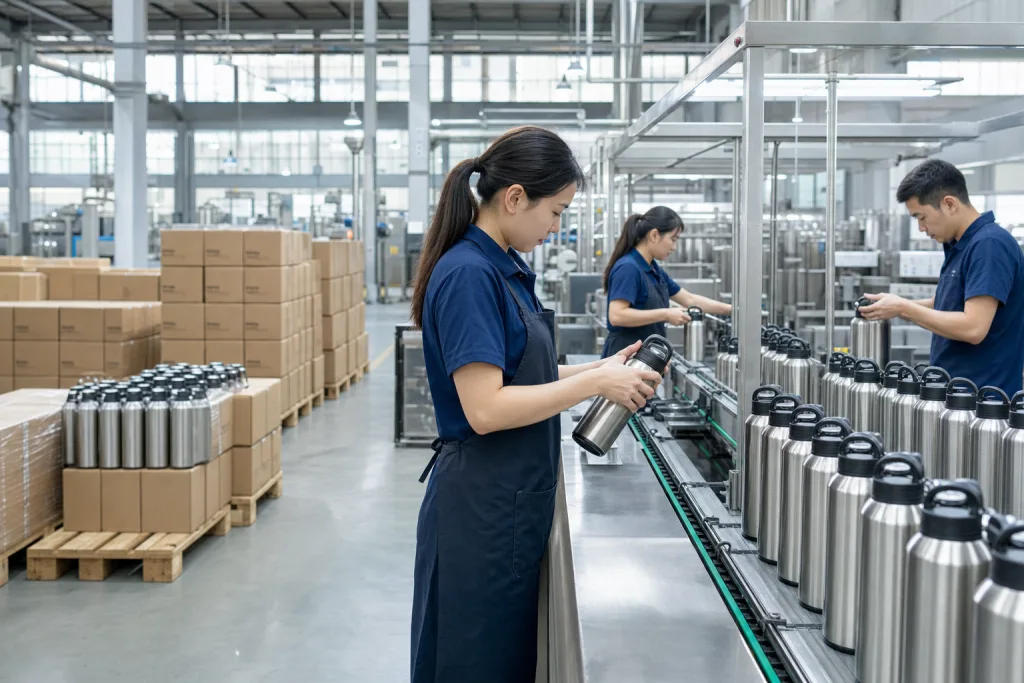
I’ll rewrite the section in-place, keep the HTML exactly as-is, and sharpen it with factory-floor detail, harder numbers, and a more seasoned sales-engineer voice.If you are checking drinkware manufacturers in China, ask what they run in-house and what they push out to outside shops. A real canteen factory should handle forming, welding, polishing, coating, printing, and final inspection, or most of that chain. If they cannot point to the bottleneck on the line, you are probably talking to a trader, not a factory.
For the audit, ask for numbers, not sales talk. A Zhejiang canteen factory we know runs 60,000-120,000 units per month across multiple lines, with 7-15 day sample lead time and 25-35 day mass production after deposit and artwork approval. Ask how many QC gates they use. Three is the floor: incoming material check, in-process inspection, and final inspection under AQL 2.5 or 1.5 depending on product risk. QC pulled the sample on a 500 ml tumbler last month and found a 1.2 mm logo shift; that is the kind of miss you want caught before shipment.
Material specs matter too. For stainless products, ask for the steel grade, wall thickness, and coating system in writing. On mid-market custom drinkware, 304 inner walls with 0.5 mm to 0.7 mm thickness are standard, and the buyer who keeps pushing for a cheaper blank without a spec sheet usually gets burned later. For a growler or insulated canteen, seam quality and vacuum retention matter more than a shiny brochure. If the supplier cannot send a cut-section photo, they probably do not know the product well enough.
Zhejiang has dense supply chains, and that helps when you need tooling, packaging, or accessory changes fast. We run jobs here because a cap mold tweak or a kraft box revision can move in 3 to 5 days, not 2 weeks. China gives you scale; Zhejiang gives you supplier depth. Do not mix that up with quality. Check records, not the map.
Match Compliance to Your Market
Compliance is not optional if you sell into the EU or North America. A serious custom drinkware buyer should ask for REACH-related declarations, food-contact documents, and current test reports before the PI is signed. For U.S. orders, we run a material sheet check against the drink path: 304 stainless body, inner coating if any, silicone gasket, straw, lid resin, and print area near the rim. If a canteen supplier needs 3 days just to say what ink touches the mouth area, that is not a small delay. Move on.
For Europe, buyers need a clean paper trail for metals, coatings, and packaging inks, with the factory name matching across the report, invoice, and carton artwork. For North America, retailers and distributors ask for proof the item can pass internal food-contact review, plus carton labeling that fits their warehouse scan process. We have had a buyer flag one PO because “matte black” became “matt black” on the carton mark. If you are doing Amazon or marketplace fulfillment, FNSKU labels and master carton marks sit inside the real compliance work, along with drop-test packaging.
Do not stop at the product itself. Custom canteen projects fail when a 5-layer export carton crushes in transit or the inner tray sheds paper dust onto the powder-coated surface. Ask the canteen manufacturer for packaging specs: carton strength, drop-test method, and whether the product has been packed for 1.2 m or 0.8 m test profiles. QC pulled the sample after one 1.2 m corner drop last season; the bottle passed, but the gift box split at the glue seam. For a distributor drinkware program, those details affect claim rates more than the logo does. The math does not work if you save USD 0.12 on packaging and eat 2% returns.
If your buyer team is small, use a document checklist and make the supplier fill it before sample approval. We usually ask for it with the first counter sample, not after 5,000 pcs are packed on the line. That keeps the conversation grounded and stops optimistic promises from becoming costly inbound rejections.
Decide on MOQ and Pricing
MOQ is where the spreadsheet meets the shop floor. For a custom canteen with one-color logo and standard PE bag plus white box, we usually see 1,000 pcs as a workable start; a growler with a special lid set often needs 2,000-3,000 pcs because the injection mold setup and first-piece check have to be spread across more units. Some canteen manufacturers will agree to 500 pcs, but the math doesn't work well. Below 1,000 pcs, the line still stops for pad-printing jig setup, color change cleaning, and AQL 2.5 inspection, so the unit price climbs fast.
When you compare quotes, do not just compare FOB price. Ask what is included. A USD 2.10 FOB price may look better than USD 2.28, but if the cheaper offer excludes color box, testing, or pallet packing, your landed cost may be higher. In Zhejiang, experienced drinkware manufacturers usually separate base product cost, decoration cost, packaging cost, and export carton cost; on our side, we also check carton CBM and gross weight before sending the PI, because one wrong 58x38x42 cm carton size can change freight cost. That is how you know the quotation is real.
Use this pricing logic:
- Stock mold, simple logo: best for canteen promotional campaigns and first orders where the buyer needs 15-20 days lead time and no tooling risk
- Minor customization: good for canteen distributor programs that repeat the same body, change Pantone color, and keep the same lid thread
- New mold or lid: only for established volume with clear sell-through; we have seen this go sideways when a buyer approves a 3D drawing but has no confirmed forecast
If a supplier gives you one lump quote and refuses to break it down, you have no room to optimize. A proper canteen supplier will show where the cost comes from and which features can be removed without hurting the product; for example, QC pulled a sample last month where the buyer flagged the silicone carry strap as “nice but not needed,” and cutting it saved USD 0.18 per pc without changing the bottle body.
Work Like a Long-Term Buyer
I’ll rewrite the section in-place, keep the HTML tags and structure unchanged, and tighten the language so it reads like a buyer-side sales engineer.The best buyer mindset is not “Who can make this cheapest?” It is “Which canteen suppliers can repeat the same result for 3, 6, or 12 months?” Repeatability is what distributors, brand owners, and procurement teams pay for. A canteen distributor needs color matching across reorders. A distributor canteen promotion needs cartons that stack the same way every time. A canteen manufacturer with stable process control is worth more than a cheaper vendor that changes coating gloss from batch to batch. We run this check on the line with gloss cards and a simple 60° meter, and the math does not lie.
Ask for the things that protect reorders: approved sample retention, master carton photos, material batch records, and a clear change-control policy. For a custom drinkware program, a 0.3 mm change in lid gasket hardness can create leaks. For a custom growler, handle weld quality can decide whether the item survives shelf stress. This is where buyers get burned. QC pulled one sample with a loose gasket last month, and the buyer flagged it before the pallet left.
Build the relationship the right way. Start with one SKU, confirm the sample, lock the spec sheet, and place a controlled pilot order. If the supplier performs, then expand into a canteen customizable range with packaging variations or a canteen customized line for different markets. We ship this way all the time: one PO, one revision, one approved carton. That is how serious buyers use Chinese manufacturing, and this is the wrong question to ask if you jump straight to 20 SKUs.
In Zhejiang, you can get factories that scale fast. In China, you have a deep base of lids, coatings, cartons, and finishing shops. Use both advantages, but keep your spec sheet tighter than your enthusiasm. We saw a PO once with a carton typo on the inner case count, and it took one afternoon on the packing table to catch it.
Send your spec, get a factory-level quote
We’ll review your MOQ, compliance needs, and target price, then match you with a practical custom drinkware plan from our Zhejiang production line.
Frequently asked questions
How do I know if a drinkware manufacturer is real?
Ask for factory photos with production dates, live video from the line, and a sample schedule tied to actual capacity. A genuine canteen factory can usually state monthly output, such as 40,000 to 120,000 units, and give you a lead time like 25 to 35 days for mass production. They should also explain in-house processes such as coating, printing, and final QC. If they cannot name the steel grade, wall thickness, or inspection standard, they are acting like a trading company. A real manufacturer in Zhejiang or elsewhere in China should be able to support claims with documents, not only sales language.
What MOQ should I expect for custom canteen orders?
For a basic custom canteen with stock mold and one-color logo, 1,000 pcs is a normal starting point. For more customized drinkware, especially if you change lid color, surface finish, or packaging, expect 2,000 to 3,000 pcs. If you need a new mold or special function, 5,000 pcs may be the more realistic economic threshold. The exact MOQ depends on setup time and part sourcing. A serious canteen supplier will tell you where the MOQ comes from instead of using it as a negotiation shield.
What compliance documents should I ask for?
For Europe, request REACH-related declarations and food-contact support documents. For North America, ask for materials and food-contact evidence that supports your internal compliance review. Also request ink, coating, and lid documentation because those parts touch the product path or affect safety perception. If you sell through retail or e-commerce, carton labels, barcode placement, and drop-test packaging should also be documented. A good canteen manufacturer should provide these before mass production, not after shipment. If they serve major distributors, they will already know the paperwork buyers expect.
Is a custom growler more expensive than a custom canteen?
Usually yes, because a custom growler often has a larger body, more material weight, and a more demanding handle or lid structure. A customized growler may also need stronger packaging because the shape is less compact in transit. In many cases, you will see an extra USD 0.30 to USD 1.00 per unit versus a simpler custom canteen, depending on volume and decoration method. If you want a premium feel, the cost can rise further with powder coating or laser marking. The final price depends on whether the supplier is using stock parts or building a true custom assembly.
How long does sampling and mass production take?
For standard custom drinkware, sample lead time is often 7 to 15 days if the factory already has the mold and decoration method ready. If you need custom tooling or a new lid, expect 20 to 35 days for sampling and approval. Mass production after deposit and final sample sign-off is commonly 25 to 35 days for mid-volume orders. Peak season and packaging changes can extend that. A reliable canteen manufacturer will give you a schedule with checkpoints, not a single optimistic date. That matters if you are planning a distributor drinkware launch or a seasonal promotion.