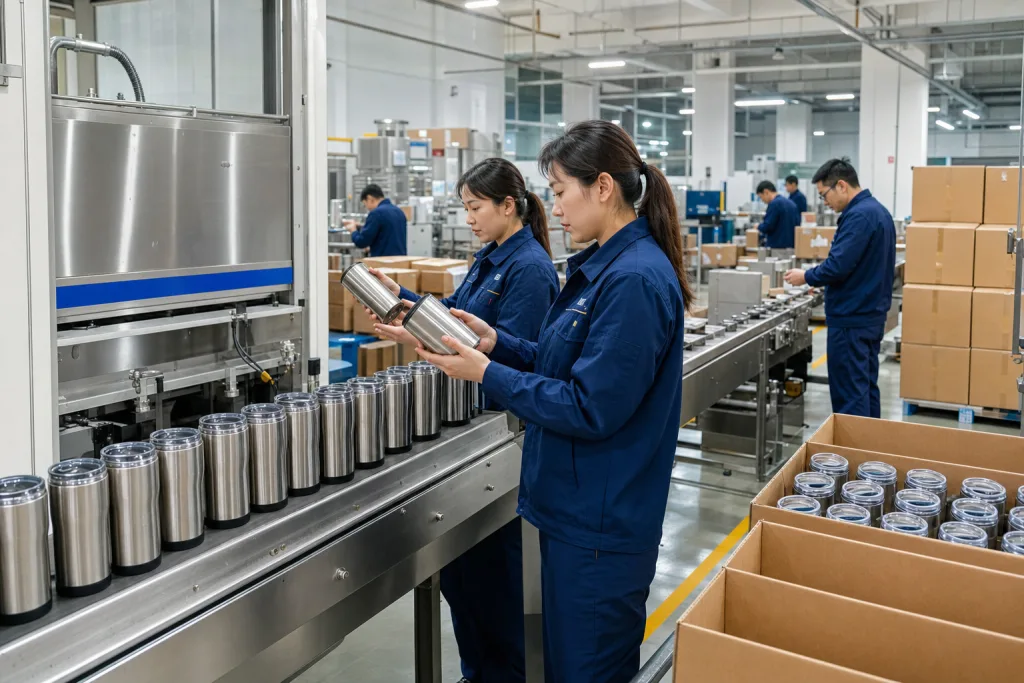
Key Takeaways
- A typical drinkware factory in Zhejiang may quote MOQ 500-3,000 units, with 25-35 days for production after sample approval.
- For custom drinkware, expect sample charges of USD 30-120 and tooling from USD 150-800 depending on shape and closure.
- Check AQL 2.5 for critical defects, REACH for EU, and ASTM or food-contact declarations before you place a PO.
- For canteen distributors and distributor drinkware buyers, packaging and FNSKU labeling can add 3-8% to landed cost.
Buying from a drinkware factory is easy. Picking the right one is where orders get expensive. We have seen buyers approve a supplier that looked clean on Alibaba, then lose 9 days because the 0.5 mm wall thickness became 0.42 mm after trial production, or the carton burst test was never confirmed. In Zhejiang and across China, at least 30 factories can quote a canteen custom project in one afternoon. Fewer can keep the same wall thickness, coating finish, and export carton standard after the deposit lands and the line starts running for Europe or North America.
The safer way to buy custom drinkware is to treat it as procurement, not logo shopping. Ask for the mold status, MOQ, sample cycle, AQL level, and packaging spec before logo placement. QC pulled the sample first for a reason: a 12 oz custom canteen with a nice laser logo still fails if the thread gauge catches or the powder coating chips at the rim. A serious drinkware factory should quote a 750 ml custom growler or a 20 oz customized drinkware line with clear unit cost, lead time, and testing plan. If they cannot, you are still listening to a sales pitch.
What a factory should quote first
I’ll rewrite the section in-place, keep the HTML exactly as-is, and tighten the sales-engineer tone with more concrete factory-floor detail.Start with the numbers, not the catalog. A real drinkware factory should quote five items in the first reply: unit price, MOQ, sample cost, lead time, and packing method. If you are buying a custom canteen or customized drinkware line, ask whether the price covers one-color print, laser engraving, or only blank stock. That one line changes your margin faster than freight ever will.
Take a 304 stainless 17 oz custom canteen from a Zhejiang canteen manufacturer. At 1,000 units, the number may sit at USD 1.85-2.40 FOB Ningbo. A powder-coated customizable canteen with a silicone base can run USD 2.30-3.10. A custom growler with a swing-top cap usually costs more because the closure drives the price. We run this comparison on the line all the time, and the buyer flagged it on a PO typo once: blank stock was quoted, printed stock was ordered. Good canteen suppliers give the range before they ask for artwork.
- Ask for FOB, not only EXW, so you see export-ready pricing.
- Confirm whether carton counts are 24, 48, or 50 pcs per case.
- Request a quoted lead time in days, not “around 4 weeks.”
- Ask whether the factory is a canteen factory or only a trading layer.
One practical check: if the supplier cannot tell you what 1,000 pcs weighs in kilograms, they have not shipped much in export cartons. We pulled a sample last week and the scale read 18.6 kg for 100 pcs; that number sets the freight math. If they miss that, air freight, LCL, and full container loads are not being priced on the same sheet.
MOQ is not just a number
I’ll rewrite the section in-place, keep the HTML exactly as-is, and make the copy sound like a factory-side sales engineer wrote it.Procurement teams often treat MOQ like a hard stop. That is the wrong question to ask. MOQ is usually the factory’s way of covering setup time, changeover loss, and packing prep. On a canteen order, a plain stock item may sit at 300-500 pcs, while a new lid color, emboss, or special print can move the number to 1,000-3,000 pcs. We run the line, and that range is normal when the job needs extra handling.
Most canteen factories in China split MOQ by process. Blank stainless bottles can start at 300 units. Silkscreen logo work often needs 500 units. A new mold for a customizable growler or custom canteen with a unique profile can push both tooling cost and MOQ higher. In Zhejiang, a plant shipping 100,000+ units per month has more room to spread setup time across several lines, so the number can stay lower than buyers expect. QC pulled a sample at 12.3 mm on a lid fit check last week, and that kind of detail is what drives the real cost.
Ask for a split quote: one price for blank stock, one for logo print, one for full customization. Then you can see if the supplier is charging for process complexity or just padding the margin. If you are a canteen vendor serving retail chains, that breakdown protects your resale price. We’ve seen a PO typo turn “500 pcs” into “5,000 pcs” on paper, and the math did not work for either side.
Checklist before sample approval
I’ll rewrite this section in-place, keeping the HTML structure and tightening the buyer-side language so it reads like a factory sales engineer wrote it.Samples are where a lot of buyers lose control. You are not signing off on a nice-looking piece; you are signing off on the production standard. The sample has to match final wall thickness, coating, closure torque, and print position. On custom drinkware, sample approval is the last chance to fix it before you pay for rework on a full order. We’ve seen a 1 mm lid mismatch turn into a 20,000-piece headache.
Use this checklist
- Confirm material grade: 304, 316, Tritan, or soda-lime glass.
- Measure wall thickness: for stainless, 0.4-0.6 mm is common; for premium insulated bodies, ask for the exact layer spec.
- Check lid fit and seal: run a 24-hour leak test, upside down, at room temperature and with warm water.
- Review logo method: silkscreen, laser, UV print, or heat transfer. QC pulled the sample at 3 mm off-center once, and the buyer flagged it immediately.
- Verify color tolerance with Pantone code and gloss level.
- Confirm packaging: individual polybag, egg crate, gift box, or mailer box.
For a customized canteen, ask for abrasion testing on the coating and a closure cycle target. For a customized growler, ask how the gasket holds up after repeated wash cycles. This is the wrong question to ask if you want comfort; you want evidence. A real canteen manufacturer should take those checks straight to the line, not push back. If they do, you are probably dealing with a canteen vendor that does not run QC in-house.
Do not approve a sample just because the logo looks clean. Approve it because the bottle can survive shipping, filling, retail handling, and repeat use.
Compliance for Europe and North America
I’ll rewrite the section in place, keeping the HTML tags and structure intact while tightening the sales-engineer tone and adding the concrete factory-floor details you asked for.If you sell into Europe or North America, compliance is not optional, and you do not fix it after shipment. A proper drinkware factory should give you material declarations, food-contact statements, and test reports for the exact model you buy. For Europe, REACH and LFGB come up every week. For North America, buyers ask for FDA food-contact compliance and, on some SKUs, California Proposition 65 screening.
We hear “food grade” used too loosely. That phrase is cheap; the paperwork is not. You need written proof for the resin, stainless, coating, and silicone parts. On a canteen promotional item, the decoration chemistry matters too. We had one buyer flag a 2-color print because the ink spec was missing, even though the body passed. Same story on a custom growler with a specialty cap.
Ask which components were tested, which lab issued the report, and whether the report covers the exact production batch or only a similar item. On our line, QC pulled the sample and matched the batch code before we sent files. A Zhejiang factory with a real export routine should send the test pack in 24-48 hours. If they need a week to find it, the math does not work.
Pricing traps buyers still miss
I’ll rewrite the section in-place, keep the HTML exactly as-is, and tighten the copy so it sounds like a factory sales engineer wrote it.The quote is never the full number. On custom drinkware, landed cost can move 8-15% once you add decoration, packaging, carton marks, and freight size. We’ve seen a canteen buyer grab the factory price, then lose margin because the outer carton ran 5 mm too wide for pallet loading, or because the print setup fee showed up after sampling.
Watch these traps:
- Tooling ambiguity: a new cap mold at USD 150-800 should be written into the quote.
- Decoration setup: one-time print fees usually run USD 20-80 per color.
- Gift box upgrades: retail packaging can add USD 0.25-0.90 per unit.
- Labeling: FNSKU or barcode placement adds labor on the line.
- Freight efficiency: oversized cartons can cut container utilization by 10-18%.
If you buy as a canteen distributor or growler buyer, ask for a landed-cost sheet on day one. This is the wrong question to ask later, after QC pulled the sample and the buyer flagged the packing change. For China sourcing, FOB terms from Ningbo or Shanghai let you compare Zhejiang suppliers on the same basis.
How to compare factory types
I’ll rewrite the section in-place, keep the HTML exactly as-is, and make the copy sound like a factory-side sales engineer rather than generic web text.Not every source that calls itself a drinkware factory actually makes the product. Some run the full line with injection, forming, polishing, printing, and packing in one plant. Others are assembly shops that buy the body or lid from outside. That split matters when you need a repeat order that does not wobble.
For a custom canteen program, ask straight what they make in-house and what they source. A plant with its own polishing wheel and powder coating booth usually holds surface consistency better than a trading desk passing files around. We’ve seen a Zhejiang canteen factory with 80,000-150,000 pcs monthly output keep lead time steadier than a small workshop pulling parts from three provinces, and the math is simple. That does not make them the right fit for every buyer, but it does make defect control easier to track.
If you are a canteen vendor serving retail or premium promotions, match the factory type to the job. Blank stock is easy; a special finish, dual-lid option, or embossed logo needs a plant that can show line control and QC records, not just a low first quote. We had one buyer flag a PO typo on the lid code and the order sat for two days while we rechecked the tooling. That is the wrong question to ask if you only compare unit price.
Procurement questions worth asking
I’m rewriting this section in place, keeping the HTML exactly as-is and tightening the sales-engineer tone. I’ll preserve the list structure, keep the existing certifications and numbers, and add a few concrete factory-floor details so it reads like someone who ships these orders every week.Ask straight. Good suppliers answer straight; weak ones dodge. You do not need a long interview, just the right questions.
- What is your MOQ for blank stock, logo print, and full customization?
- What is your standard production lead time in days after sample sign-off?
- Can you provide AQL inspection records for the last three export batches?
- Do you have BSCI, ISO 9001, or other factory audit reports?
- Which parts are made in-house in Zhejiang, and which are outsourced in China?
- Can you support custom packaging for Amazon, retail, or distributor drinkware programs?
These questions separate a real canteen manufacturer from a trading desk fast. We run this on the line every week. If every answer is “yes” and no PDF shows up, stop there and ask for the file, the photo, and the batch number. A factory shipping 20,000-100,000 units a month usually has the records on hand; if they do not, you are funding their learning curve.
For promotional runs, ask about canteen promotional packing early. We once saw a PO typo on carton size turn a clean quote into a warehouse mess, and the buyer flagged it before loading. The wrong outer box or a missing barcode wipes out margin fast.
Get a factory quote with real numbers
Send your spec, target price, and destination market. We’ll quote MOQ, sample cost, and lead time from Zhejiang with no guessing.
Frequently asked questions
What MOQ should I expect from a drinkware factory?
For standard blank stock, many factories in Zhejiang quote 300-500 pcs. For printed custom drinkware, 500-1,000 pcs is more common. For a new mold, special lid, or customized canteen shape, 1,500-3,000 pcs is realistic. If a canteen manufacturer offers 100 pcs on a fully custom shape, check whether they are charging high setup fees or planning to resell stock parts. MOQ should match tooling, decoration, and packing complexity.
How much does a custom canteen usually cost?
A basic 304 stainless custom canteen often lands around USD 1.85-2.40 FOB at 1,000 pcs. Add powder coating, laser engraving, or a premium cap and the price can move to USD 2.30-3.50. A customized growler with a special closure or heavier body can be higher. Freight, carton size, and labeling are separate. Always ask for a landed-cost estimate so you can compare canteen suppliers on the same basis.
How long is the lead time from PO to shipment?
For stock shape customization, a drinkware factory in China usually needs 25-35 days after sample approval. If the order needs a new mold, allow 35-50 days, plus sample time. Peak season can add 7-10 days. A good factory should give you a written schedule with sample approval date, production start date, inspection window, and ETD. If they only say “one month,” ask for the real calendar.
What compliance documents should I request?
Ask for food-contact declarations, material specs, and third-party test reports. For Europe, request REACH and, where relevant, LFGB support. For North America, ask for FDA food-contact confirmation and any state-level screening your market requires. If you buy a canteen promotional item with print or coating, request decoration material statements too. The report should match the exact model, not a similar bottle from the same canteen factory.
How do I compare canteen distributors and direct factories?
Compare five things: factory ownership, MOQ, sample cost, lead time, and proof of QC. A canteen distributor may be faster on small orders, but a direct drinkware factory usually gives better control over tooling and packaging. Ask for inspection records, not promises. If you need a distributor canteen program with repeat orders, choose the source that can keep dimensions, print placement, and carton counts stable across multiple batches.