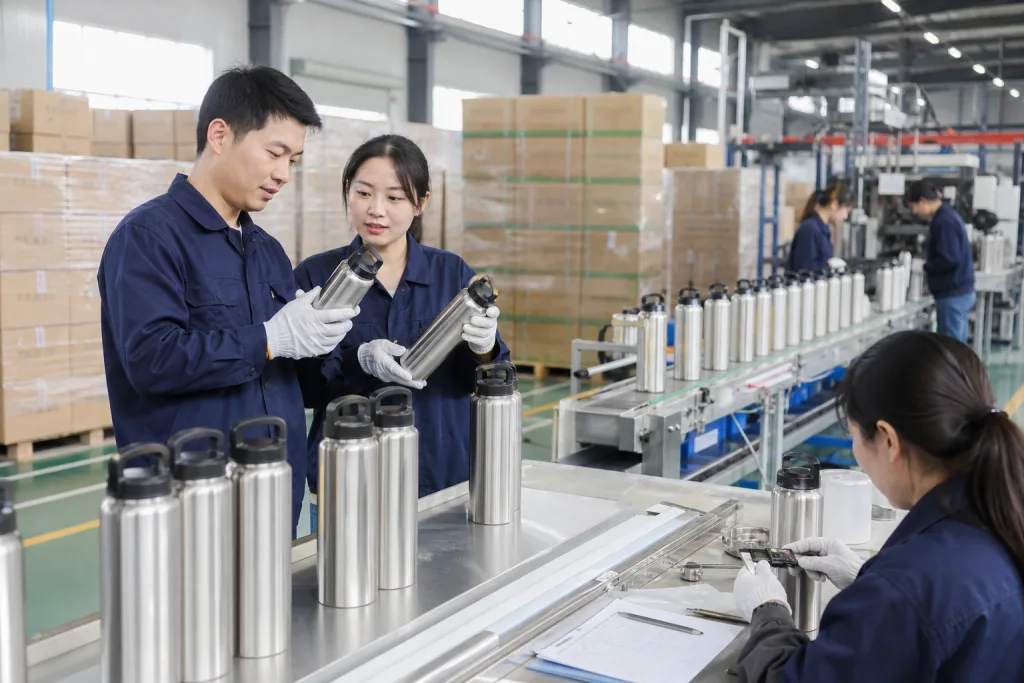
Key Takeaways
- A 0.40 mm wall can dent fast; 0.50-0.60 mm stainless is safer for retail drinkware custom programs
- Ask for leak testing at 100% on lids, plus AQL 2.5 for appearance and AQL 1.0 for function
- Most custom logo failures come from the wrong process: silkscreen for simple art, laser for abrasion resistance
- A serious canteen factory in Zhejiang should quote MOQ, lead time, and monthly capacity up front; 3,000-5,000 pcs MOQ and 80,000-150,000 units/month are normal
If you buy drinkware custom for retail, promo, or marketplace channels, the first sample is rarely the issue. The trouble shows up later: a lid starts leaking after 400 cycles, a powder coat chips in transit, a logo fades after 30 dishwasher runs, or cartons fail a drop test and the chargebacks land on your desk. We see that on the line. It is the gap between a cheap PO and a program that actually ships.
We build and export from Zhejiang, China, where buyers usually want a custom drinkware line that hits the right FOB price and still survives real use. QC pulled the sample at 12 mm thread depth last week because the buyer flagged a lid mismatch on the PO. If you are working with a canteen manufacturer, canteen supplier, or canteen distributor, this is the wrong question to ask: “can you make it?” The better one is, “which failure will hit first, and how do we lock it out before production starts?”
Why the first sample lies
I’m rewriting the section directly in HTML, keeping tags and specs intact while stripping the AI-ish phrasing. I’ll keep the factory detail concrete and make the sales-engineer angle sound lived-in.Leakage starts at the lid
I’ll rewrite the section in place, keeping the HTML structure intact and tightening the copy so it sounds like a factory-side sales engineer wrote it.Leak failure is the fastest way to turn a decent order into a refund headache. On a water bottle, tumbler, or custom growler, the problem is usually not the body; it is the lid geometry, gasket material, or thread finish. A lid can feel tight in hand and still fail after 8 hours in transit or after hot-fill expansion. We run the same check on the line with assembled units, not just loose caps.
For threaded lids, ask for a torque window and gasket specification. Silicone gaskets usually beat cheaper rubber blends when the bottle sees hot water, acidic drinks, or repeated washing. If you sell to distributors or as a canteen promotional item, ask for 100% leak testing on the first production lot, then lock the sampling rule for later lots. AQL 1.0 for leakage is sensible; some buyers push for 0 defect tolerance on function because one wet carton can kill a full pallet. If the product is marketed as customized drinkware for travel, do a 360-degree inversion test for 30 seconds, then repeat after thermal cycling. QC pulled the sample after the first heat-cool cycle, and that is where the bad ones show up.
Do not let a canteen vendor save 2 cents by changing gasket durometer or cutting thread engagement from 5 turns to 4. The math does not work, and we have seen this go sideways into claims. One PO typo even sent the wrong gasket thickness, 1.8 mm instead of 2.2 mm, and the buyer flagged it before the cartons left Hangzhou.
Coating chips are spec problems
I’ll rewrite the prose in place, keep the HTML exactly as-is, and tighten the language so it sounds like a factory-side sales engineer wrote it.Paint and powder coat failures are usually not mystery defects. They are spec problems. If surface prep is weak, the curing oven drifts, or the wall gets too thin, coating chips show up fast in transit and at retail. For a canteen customizable finish, the buyer should call out coating thickness and adhesion targets, not just color. On powder coat, 60-80 micron is a workable range for most metal bottles. Go thinner and the base metal starts showing wear early. Go thicker and the finish goes brittle or turns orange peel.
For wholesale drinkware custom projects, visual approval is not enough. Ask the canteen factory for a cross-hatch adhesion test, salt spray data if the coating will see sweat or coastal shipping, and a transit abrasion check with packed cartons. We had one buyer flag a 0.2 mm wall on a PO, and QC pulled the sample because the coating edge would have failed after two truck legs. If you are buying customized canteen units for sports or outdoor channels, the finish has to survive cup holders, backpacks, and case packing. In Zhejiang, the better factories know coating trouble usually starts at pre-treatment: degreasing, phosphating, and dust control. Skip one step and the part may look fine on day one, then fail by the first quarter.
There is a packaging angle too. A strong coating can still fail if the inner carton rubs the body during vibration. We run a simple rub test with the carton insert and a 15-minute shake table cycle; that catches the weak packs fast. Spec the separator paper, foam ring, or sleeve as part of the product, not as an afterthought.
Logo placement and fading
I’ll rewrite the three paragraphs in-place, keeping the HTML tags untouched and tightening the sales-engineer voice.Logo complaints are usually preventable. We see buyers approve a canteen promotional piece with a busy logo, then pick a print method that cannot hold the artwork. Small text, hairline strokes, gradients, and metallic effects behave differently on stainless steel, powder coat, glass, and plastic. If you want custom drinkware that still looks clean after 3 months on the shelf and after use, match the process to the logo first.
Silkscreen works for bold, flat graphics with one or two colors. Laser engraving gives you abrasion resistance and a permanent mark, which is why it fits a canteen customized for a premium channel. Heat transfer and pad print can handle curved surfaces, but the line needs tighter control on ink thickness and cure time. One process does not fit every order. If a canteen manufacturer pushes that, the math does not work.
Ask for logo placement tolerance, color reference, and rub resistance. A workable spec is 50 double rubs with no major visible loss for a standard retail line, or a tougher target if the item is a customized growler for outdoor and bar use. Approve artwork on the actual substrate, not just a PDF. We had one buyer flag a 2 mm shift on a matte-black bottle because the white sample passed and the production finish did not; warehouse light exposed it fast.
The wall thickness test
I’ll keep the HTML structure untouched and rewrite the prose to sound like a factory-side sales engineer, with tighter language and a few concrete shop-floor details.Wall thickness is where low-cost sourcing usually cuts corners. A cheaper body can still hit the drawing and fail in use because it dents fast, feels flimsy, or loses heat retention. For stainless steel bottles, 0.40 mm is the danger zone for a lot of retail programs. A steadier spec is 0.50-0.60 mm, depending on size and whether we run single-wall, double-wall, or vacuum insulated parts. That extra 0.10 mm shows up in the hand and on the return rate.
If you are sourcing from a canteen distributor or direct from a canteen factory, ask for wall thickness at several spots on the body, not one “average” number. The neck and shoulder often thin out during forming; we see that on the micrometer all the time. On vacuum bottles, bad welds and uneven wall thickness also drag down thermal retention. If the supplier says 24-hour cold or 12-hour hot, ask for the test setup: ambient temperature, fill volume, lid type, and starting water temperature. We had a buyer flag a PO once because “24H” was typed on the spec sheet and the test condition was missing.
The budget tradeoff is simple. An extra USD 0.20-0.60 per piece can buy a lower dent rate and fewer claims. On a 5,000-piece order, that is real money. So are chargebacks from distributor canteen programs. If the channel is retail, the math does not work in favor of the cheapest wall. I would pay the extra cent per gram before we ship dented goods and chase credits later.
Packing is part of product quality
I’m rewriting this section in-place, keeping the HTML structure unchanged and tightening the wording to sound like a factory-side sales engineer.Too many drinkware failures start in packing, not on the line. A bottle can pass leak tests and still show up with scuffed lacquer, crushed mailers, or a missing straw. For drinkware custom orders shipped FOB China, packing belongs in the spec sheet. We write down carton strength, drop-test target, inner protection, barcode position, and FNSKU labeling when the order touches Amazon.
At a Zhejiang export factory, ask for the full pack-out plan: unit box, master carton count, carton size, gross weight, and pallet pattern if the goods palletize. For e-commerce, a single-wall carton often fails after one 60 cm drop; for wholesale, we usually move to a heavier master carton with corner pads. If the shipment goes to a canteen distributor or a drinkware warehouse, set pallet height and compression limits before the PO is confirmed. A carton that looks fine on the sample bench can still collapse when a 1.8 m stack sits in a humid container for 30 days.
Good packing also cuts hidden damage. A foam insert keeps cap threads from rubbing. A polybag blocks dust on matte finishes. A divider protects laser-engraved surfaces from contact marks. If a canteen supplier treats packing as optional, they push the risk onto you and your customer. That math does not work.
How to buy without getting burned
I’ll rewrite the section in-place, keeping the HTML tags and structure unchanged while tightening the prose and adding concrete factory-floor detail.The safest way to buy customizable drinkware is to write the order around failure control, not a marketing brief. Start with the product category, then lock the measurable items: material, capacity, wall thickness, lid structure, logo method, coating, test methods, and carton spec. If the item is a custom canteen, a customizable canteen, or a custom growler, the supplier should state the standard they are building to and the tests they must pass. QC pulled one sample last week at 0.8 mm wall thickness, and that kind of check catches trouble early.
Ask about MOQ, monthly output, and lead time before you spend time on decoration. A canteen factory in Zhejiang may quote a 3,000-piece MOQ for a standard body with custom logo, 5,000 pieces for more complex color work, 25-35 days for production after sample approval, and 80,000-150,000 units per month depending on model. Those numbers tell you whether the factory can support distributor canteen or canteen vendors programs at scale. If they cannot state capacity clearly, you are probably talking to a trading layer, not a real manufacturer. That is fine in some cases, but the math changes fast.
Buy the spec you need, not the sample you like. The sample is a promise; the production control plan is the proof.
For procurement, keep it simple: confirm the test list, inspect to AQL standards, define defect categories, and keep change control tight. If the supplier wants to swap a gasket, coating, or carton, require written approval. We have seen this go sideways on a PO typo for “304 stainless” versus “201,” and the buyer flagged it before the line ran. That is how you keep a canteen customized program from turning into a claims problem six weeks after shipment.
Send your spec. We’ll stress-test it.
If you need drinkware custom done with fewer defects, bring us the drawing, target price, and test list. We’ll tell you where production will break first.
Frequently asked questions
What MOQ should I expect for drinkware custom orders?
For a standard custom drinkware order in Zhejiang, a realistic MOQ is often 3,000-5,000 pieces per design and color. Simpler stainless bottles or canteen custom logo jobs can be lower, but complex coating or multiple print positions can push it up. If a canteen manufacturer offers 500 pieces for everything, check whether they are holding stock bodies, because true custom color and custom tooling usually need more volume. Always ask how MOQ changes with lid style, surface finish, and packaging.
How do I prevent a customized canteen from leaking?
Lock the lid spec before mass production. Ask for gasket material, thread engagement, torque range, and 100% leak testing on assembled units for the first lot. For a customized canteen or customizable growler, require inversion testing after thermal cycling, because some lids pass cold-water tests but fail when the body expands. Also specify whether the drink will be carbonated, hot-filled, or acidic; each condition changes the risk profile. A serious canteen supplier should document the test method, not just say it is “waterproof.”
What is a reasonable FOB price for custom drinkware?
It depends on material and decoration, but a basic stainless custom drinkware item may start around USD 1.20-2.50 FOB for simple logo work, while vacuum-insulated premium items often land around USD 3.20-6.50 or more. A custom growler with heavier gauge, better coating, and premium lid can sit higher. Your price should move with wall thickness, print process, packaging, and certification requirements. If a canteen vendor quotes far below that range, ask what they removed from the spec.
Which tests should I ask a canteen factory to provide?
At minimum, ask for leakage, drop, coating adhesion, dishwasher or rub resistance if relevant, and material compliance documents such as REACH for Europe or ASTM-related data where applicable. For stainless items, you may also request insulation performance and salt spray. A good canteen factory should define AQL levels for appearance and function, not leave inspection vague. For canteen manufacturers supplying retail or distributor drinkware channels, the test report should match the exact SKU, not a generic model.
Should I use silkscreen or laser engraving for logos?
Use silkscreen when you need a clean, low-cost logo with one or two colors and simple shapes. Use laser engraving when abrasion resistance matters and you want a permanent mark on metal. For a canteen promotional item, silkscreen may be enough; for a premium customized drinkware line, laser often performs better. The right answer depends on the substrate, finish, and how hard the product will be used. A canteen supplier should show you both on the actual production surface before you approve.