Key Takeaways
- Powder coating on stainless usually starts at MOQ 1,000 pcs/color and adds about USD 0.35-0.80 per bottle depending on finish and masking
- Masterbatch color for Tritan or PP gives the best unit economics above 5,000 pcs, but exact Pantone matching can vary by 5-10% with resin transparency
- Silicone parts often need separate color approval because the same Pantone can shift visibly against steel or plastic under D65 and store lighting
- A practical export timeline from Zhejiang, China is 7-10 days for pre-production color samples and 30-45 days for bulk after approval
You rarely lose a drinkware order on shape. You lose it on color. The lid gray is half a shade off, the powder coat fails a 3M tape pull after one drop test, the soft-touch finish drags on the packing line, or the translucent Tritan sample looks right at 6500K daylight and wrong under retail LEDs. For a brand launch, seasonal promo, or distributor program, this is where lead time slips from 12 days to 18 days and margin starts getting squeezed.
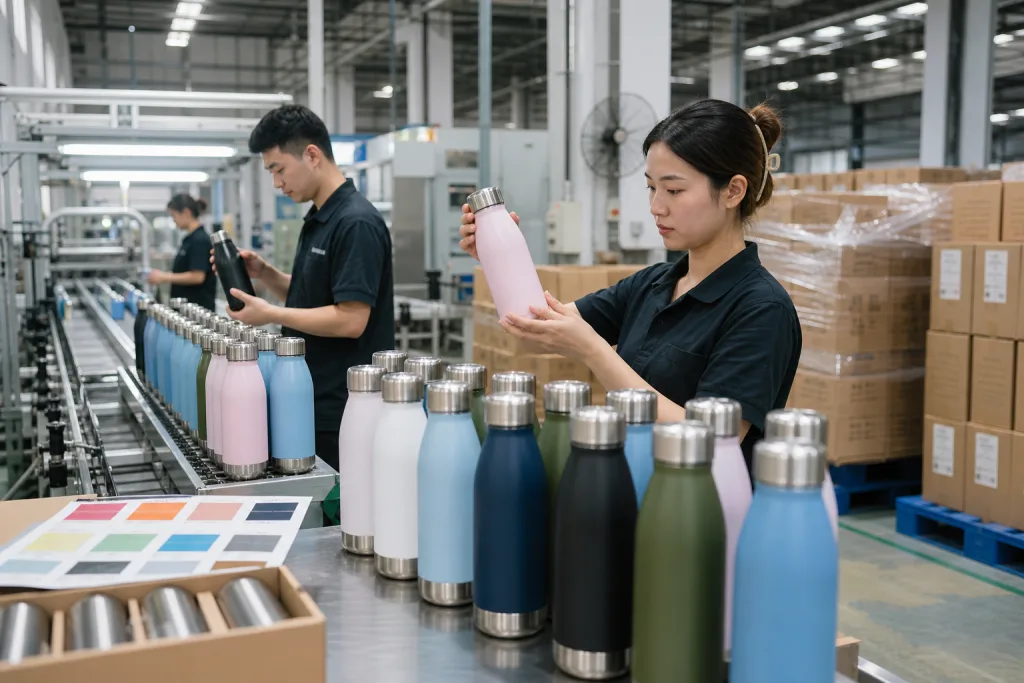
Here in Zhejiang, we see this on the line every month. Buyers ask for a “Pantone match,” then QC pulled the sample and the real issue was the substrate and finish, not the chip book. Stainless steel, Tritan, glass, silicone, and PP do not take color the same way, and this is the wrong question to ask if you want stable approvals. A canteen custom project at 3,000 units needs a different color route than a canteen promotional run at 30,000 units; the math does not work the same once you price molds, spray passes, and rework. If you want fewer claims and cleaner sign-off, compare color methods side by side and by material, not as if they are interchangeable.
Start with the spec table
If you are comparing drinkware custom color options, put the process on one sheet before you discuss artwork. Start with the spec table. Buyers jump to logo size, gift box, and carton marks, but this is the wrong question to ask early. The real cost sits in the color route. The same bottle body can run through four finishing options on the line, and each one changes MOQ, lead time, abrasion result, and complaint risk. We’ve seen a 500ml bottle look approved in the sample room, then fail in mass production because the buyer never pinned down whether the body was powder coat, wet spray, or molded-in color.
| Material/process | Best use | MOQ | Typical adder | Lead time impact | Main risk |
|---|---|---|---|---|---|
| Stainless + powder coat | Premium custom canteen, outdoor, retail | 1,000 pcs/color | USD 0.35-0.80 | +3 to 5 days | Scratch variation, gloss shift |
| Stainless + spray paint | Low-cost promotional | 1,000 pcs/color | USD 0.20-0.45 | +2 to 4 days | Lower abrasion resistance |
| Tritan/PP + masterbatch | Sports bottles, kids, distributor drinkware | 3,000-5,000 pcs/color | USD 0.03-0.12 | Minimal once set | Color shift by wall thickness |
| Glass + sleeve color | Office and gift | 2,000 pcs/color | USD 0.10-0.30 | +3 to 7 days | Silicone batch variation |
| Silicone components only | Lids, boots, grips | 2,000-3,000 pcs/color | USD 0.02-0.15 | +3 to 5 days | Cross-part mismatch |
The point is simple: do not ask your canteen supplier for “custom color” as if it is one thing. Ask which component is colored, by which process, at what wall thickness, and with what acceptance range. If the body is 0.5 mm stainless and the lid is PP with a silicone carry strap, say that up front. A serious canteen factory or canteen vendor should answer in 10 minutes, not after three days of back-and-forth. At BottleForge Industrial in Zhejiang, output is typically 600,000 units/month across mixed drinkware programs, so we see where this goes sideways: the buyer approves a hand sample, QC pulled the sample against bulk later, and the steel body, PP lid, silicone boot, and strap did not match because no tolerance was written on the PO.
Use-case fit matters. If you are a canteen distributor servicing promo accounts, unit cost and speed usually matter more than perfect shade depth. We ship plenty of these programs, and the buyer flagged carton date first, not Delta E. If you are building a retail custom growler or customized canteen line, surface feel and color consistency matter more than saving USD 0.08. The math doesn’t work if you save a few cents and then eat returns for scratch complaints.
Steel bodies: powder coat or paint
For stainless bottles, tumblers, and flasks, the usual choice is powder coating or wet spray paint. They do not wear the same on the shelf or in use. We usually steer premium custom drinkware programs to powder coat because it holds up better to abrasion and feels more even in hand after the line cures it. Typical film thickness is around 60-90 microns. On a 18/8 stainless body with 0.5 mm outer wall, that is usually enough to hide small cosmetic marks from fabrication. On our line, QC pulled samples where the weld shadow was still visible under thin paint but disappeared under a 70-micron powder coat.
Spray paint is cheaper and faster, which is why 6 out of 10 canteen promo orders still go that route in our export mix. For events, giveaways, or 90-day campaigns, that choice can make sense. For daily-use retail bottles, the math often does not work. You should expect lower durability in cross-hatch adhesion and rub tests than a stable powder coat line. Ask your canteen manufacturers for actual results, not verbal assurance. We have seen buyers approve color from one golden sample, then flag chipping after carton drop tests. A practical request is:
- Cross-hatch adhesion result to ASTM-style internal standard
- 24-hour salt spray if relevant for outdoor use
- Dishwasher disclaimer or limitation in writing
- Photo of the same Pantone in matte and gloss finish
Color matching on steel is usually closer to Pantone than on translucent plastics, but texture changes what the eye sees. Matte powder can make a color look slightly lighter; gloss can deepen it. Soft-touch coatings look premium, but they add cost, attract dust during packing, and mark more easily on dark shades. We run an air gun and tack cloth check before polybag packing on soft-touch black because dust shows up fast under warehouse lights. For a customizable canteen program with multiple SKUs, that matters.
Where buyers misjudge cost
The cost is not just the coating. This is the wrong question to ask if the RFQ only says “custom blue body.” If you need a body color, a different lid color, a matching silicone boot, and laser logo windows, the masking and handling cost rises fast. A canteen customized order with three masked zones can add USD 0.20-0.35 in labor alone. We have also had POs with the lid finish typed as gloss while the body was approved in matte, and that small typo slowed sample confirmation by 2 days. If your canteen supplier quotes one flat color adder without asking about parts separation, check again.
You are not buying a Pantone chip on steel. You are buying a finish system with a visual tolerance.
Plastic and Tritan color reality
For sports bottles, shaker bottles, kids items, and some lids, molded-in color from masterbatch is usually the cleanest route. After the color is locked, the unit adder stays low, and there is no paint or spray line to scratch on the packing table. On our line, a 5,000 pc Tritan bottle run with molded color is usually easier to hold than a coated bottle run with one more process to manage. That is why a canteen manufacturer or canteen factory handling volume plastic programs will usually push molded color first.
Still, plastics do not show color the same way. Tritan, PETG, PP, and HDPE each shift for different reasons, and this is where buyers get surprised. A translucent customizable drinkware bottle can change shade from a 2.2 mm wall to a 3.0 mm wall, and QC pulled the sample once because the gate blush made the shoulder look 1 tone darker. On export programs, many buyers specify 0% regrind for food-contact visible parts to keep color stable, even if that adds cost. If your canteen suppliers are using Tritan, ask for clarity and haze comments on the sample report, not just the CAD color chip. We have seen this go sideways.
For opaque PP lids and handles, matching is easier, but it is never perfect across materials. A Pantone approved on a PP swatch will not look identical on silicone or powder-coated steel beside it, and the buyer flagged this on one set after seeing the straw boot next to the cap. That is normal. The right way is to approve the full component set under defined lighting, usually D65 daylight conditions, then do one warm indoor check at 3000K. Good canteen vendors and canteen distributors already know the claim risk here.
- Best for: large-volume custom canteen and sports bottle programs
- Typical MOQ: 3,000 pcs for common colors, 5,000+ pcs for exact custom masterbatch
- Typical sample timing: 7-12 days if mold exists
- Testing to request: BPA-free declaration, REACH, LFGB or FDA as applicable, color migration checks for decorated parts
If you are sourcing from Zhejiang or elsewhere in China for retail, ask whether color chips are retained by batch number and date code. We file them by lot in labeled bags at the injection shop, and that simple habit saves time on repeat orders. For a distributor growler or distributor canteen program that repeats every quarter, retained chips matter more than a pretty first sample. Frankly, this is the right question to ask before you approve the PO, not after the second shipment lands.
Lids, straps, boots, and mismatch risk
Most complaints we see on custom drinkware are not on the bottle body. They start with the add-ons. The 304 stainless body passes color approval, then QC pulled the sample and found the silicone seal reading bluer, the PP cap flatter, and the woven strap one shade darker after carton packing. On mixed-material canteen customizable projects, forcing a perfect match is the wrong question to ask. The job is to lock a visual standard on the assembled set before bulk starts.
Silicone is usually where the fight starts. Pigment loading, cure temperature, and surface grain all change what the eye sees. A food-grade silicone boot in shore A 50-60 can read different from a carry ring at another wall thickness, even with the same nominal color formula; we have seen a 2.5 mm ring and a 4.0 mm boot come out visibly off on the same line. This is why experienced canteen manufacturers send assembled sets instead of loose color chips.
What to lock before bulk production
- Master approval sample signed against actual assembled components
- Allowed visual delta under daylight and indoor light
- Which part is the reference part: body, lid, or sleeve
- Packaging method to avoid rub marks on dark coatings
- AQL level for cosmetic inspection, commonly AQL 2.5 major / 4.0 minor
For a custom growler or customizable growler, dark matte colors sell well, but they pick up dust, lint, and insertion marks fast during packing. We run this on the line every week. Add a PE bag or tissue wrap if presentation matters. That usually adds USD 0.03-0.08 per unit, and the math still works better than re-sorting 2,000 units at destination because the buyer flagged scuffing in e-commerce photos. A canteen distributor or distributor drinkware buyer selling across retail and online should take this seriously.
If a canteen vendor says “same Pantone on all parts” without qualification, push back. Across steel, PP, Tritan, and silicone, that is a sales phrase, not a production reality. We have seen this go sideways over one PO typo and one unapproved strap lot.
Choose by channel, not preference
The right drinkware custom color route depends on the sales channel, not the sample that looks best under meeting-room lights. Buyers pick the prettiest sample on the table all the time. We get it. It is also the wrong question to ask if the item has to survive freight, retail handling, and margin targets. The channel should decide.
Promotional and event orders: keep the build simple and repeatable. A spray-painted body, one-color screen logo, standard lid color, and MOQ around 1,000-3,000 pcs usually make sense. We run these on the line faster, and landed cost stays tighter. For a short campaign, the product only needs to hold up through distribution and use, not pass two years of shelf wear. A canteen promotional program rarely gains anything from soft-touch coating; the math does not work. On these orders, buyers usually push back on carton count first, not on whether the Pantone match is perfect to 0.5 Delta E.
Retail shelf or DTC: buy for durability and color consistency. Powder coat, laser engraving, or high-quality silk screen on a coated body is the safer route. If you are selling a custom canteen or custom growler at USD 24.99-39.99 retail, bad reviews show up fast when one lot ships navy and the next lot reads blue-black. We have seen QC pull samples because gloss varied between cups in the same 500 pcs check table. Here, a 30-45 day lead time from China is normal and acceptable if reorders are controlled.
Distributor programs: lock the palette early. If you are a distributor canteen buyer or distributor growler buyer managing many accounts, use a limited approved palette: black, white, navy, red, forest green, and one seasonal accent. Six core colors plus one seasonal slot is enough for most programs. This helps your canteen suppliers consolidate production and hold pricing, especially when we ship mixed POs across 2 or 3 account groups. It also cuts obsolete packaging and spare-part confusion. We have seen this go sideways over one PO typo on lid color code BK becoming BL.
Corporate gifting: metallic, soft-touch, or pastel colors can work, but write the protection rules into the spec sheet. Specify carton drop standard and assembly scratch protection. Good-looking finishes fail fast when gift pack handling is rough. On gift sets, our QC team often adds a PE bag or 1 mm foam sleeve after finding rub marks at the handle or base ring during packing checks.
For most B2B buyers, the best commercial balance is boring but effective: one body color, one neutral lid family, one decoration method, and one approved accessory color. That setup scales better whether you buy from one canteen factory in Zhejiang or from multiple canteen vendors in China. Fancy combinations are possible. They just need more budget, tighter process control, and cleaner forecasting.
Questions to settle before you place PO
A color program is won or lost before deposit, not after. Ask the factory a short technical checklist before you release the PO. This matters most with a new canteen supplier, canteen manufacturer, or canteen distributors buying through a trading layer, because once the Pantone chip is signed and the 60° gloss meter reading is missed, the line starts arguing about who approved what. We’ve seen this go sideways.
- What is the MOQ by color and by component? Body MOQ may be 1,000 pcs, but lid insert MOQ may be 3,000 pcs. Ask for the split by painted body, lid, straw, silicone ring, and print pass. The wrong question is total MOQ only.
- What is the reorder rule? Some colors can be repeated at 500 pcs if material remains; some require fresh setup at full MOQ. We run leftovers by batch record, not memory, and QC usually checks whether there is enough coating left for one more 500-pc run.
- What testing is included? Ask for REACH, LFGB or FDA depending on market, plus coating adhesion and insulation report if relevant. If the supplier says “food grade” without a test scope, push back. Last month a buyer flagged that exact wording on a PO.
- What is the approval path? Digital mockup, color chip, pre-production sample, then bulk. Put sign-off points in writing, because a Delta E target approved on screen is not the same as a sprayed sample from the line.
- How are defects inspected? Confirm AQL standard, visual distance, and lighting. Ask whether QC pulled the sample under 1000 lux or daylight box conditions, and whether they judge color from 30 cm or 50 cm.
- What Incoterm is quoted? FOB Ningbo or FOB Shanghai is common from Zhejiang, China. Clarify carton count and CBM. We ship from both ports, and 0.3 CBM off the packing estimate is enough to break the freight math.
For Amazon or other barcode-heavy channels, also confirm whether the factory can apply FNSKU labels and segregate mixed colors by carton. This sounds basic. It is not. On customized canteen and customized growler sets, the buyer flagged mixed charcoal and navy units in one outer carton because the pack-out line skipped the divider card at final loading.
A capable canteen factory should also tell you what not to do. If you want a light beige on recycled stainless with a rough matte texture and black silicone parts, they should warn you about visible contamination during assembly, especially around the 2 mm lid seam where dust and dark rub marks show first. Straight answers save money. At BottleForge Industrial, standard lead time is usually 35 days after sample approval for repeat structures, but heavily customized drinkware with multiple color-matched parts can move to 45 days. That is normal. What is not normal is promising a complex build will run like stock goods.
Get your color spec reviewed before you place PO
Send your target Pantone, material, quantity, and market. We will flag MOQ, finish risk, testing needs, and realistic lead time from Zhejiang, China.
Frequently asked questions
Can you match any Pantone for drinkware custom color?
Usually yes for a close commercial match, but not with the same visual result on every material. Powder-coated stainless can often get very close to a Pantone reference. Tritan, PP, and silicone may vary more because transparency, wall thickness, and texture change the way color reads. For B2B programs, the better question is the allowed tolerance by component. We normally suggest approving one assembled pre-production sample and treating the body as the master reference part. For exact custom colors, MOQ is often 1,000 pcs on coated steel and 3,000-5,000 pcs on molded plastic parts. Expect 7-10 days for color sample preparation in China, plus courier time.
What is the best color process for a premium custom canteen?
For a premium custom canteen, powder coating on 18/8 stainless is usually the safest choice. It gives better scratch resistance than basic spray paint and a more consistent surface for retail or corporate gifting. A matte or fine-texture powder coat typically adds around USD 0.35-0.80 per unit depending on bottle size, masking, and finish complexity. If you also need a matching lid, silicone boot, and strap, approve the whole set together because accessories will not match the body perfectly under every light. For long-term reorder programs, ask the canteen manufacturer to retain signed color chips and batch records so your second PO does not drift from the first.
How do canteen suppliers usually set MOQ by color?
Most canteen suppliers set MOQ by process, not just by SKU. For coated stainless bodies, MOQ is commonly 1,000 pcs per color. For molded PP or Tritan with custom masterbatch, MOQ is more often 3,000-5,000 pcs per color because resin preparation and machine scheduling need volume. Silicone parts such as boots or straps can have separate MOQ, often 2,000-3,000 pcs. This is why a canteen customized project with one bottle body and three accessory colors can become more expensive than expected. Ask for MOQ by body, lid, accessory, logo method, and carton packout before confirming PO. That one step prevents many pricing disputes with canteen vendors and canteen manufacturers.
What should a distributor drinkware buyer check before approving color?
If you are a distributor drinkware buyer, check assembled samples under at least two lighting conditions, confirm carton-level segregation by color, and define the cosmetic inspection standard. Many distributors focus on the bottle body and ignore the lid insert, strap, or silicone seal, which is where mismatch claims start. Confirm AQL 2.5/4.0 or your own standard, along with the viewing distance for cosmetic checks. Ask whether the canteen factory in China keeps retain samples by batch and whether repeat orders can use the same production line settings. For mixed-SKU channel programs, also confirm barcode labeling, inner pack count, and whether dark finishes need PE bag protection to avoid rub marks.
Is custom color worth it for canteen promotional orders?
Often yes, but only if you simplify the build. For canteen promotional orders, custom color works best when you limit the project to one body color, one standard lid family, and one straightforward logo process such as silk screen or laser on coated steel. That keeps unit adders manageable, usually in the USD 0.20-0.50 range above a stock-color baseline for simple programs. If the event run is only 1,000-2,000 pcs, avoid complex multi-part matching unless the client accepts the cost and lead time. A canteen distributor or canteen supplier serving promo accounts usually gets better margin from fast, clean execution than from trying to imitate a high-end retail finish at giveaway pricing.