Key Takeaways
- Set the spec before price talks: changing from 18/8 stainless to 18/0 can cut unit cost by 8%-15% but changes corrosion performance.
- For custom bulk drinkware, practical MOQ is often 1,000-3,000 pcs per SKU, while laser-engraved stainless items can sometimes start at 500 pcs.
- Plan 30-45 days for production and 7-10 extra days if you need third-party testing, drop tests, or retail gift box assembly.
- Use an AQL 2.5/4.0 inspection standard and approve carton dimensions early; freight cost can move 12%-20% on bulky formats.
You usually do not get into trouble on the first quotation. Trouble starts after the sample signs off, then the master carton jumps from 57 cm to 61 cm, the silk-screen logo fails the 3M tape test, or your 8,000-unit reorder ships 12 days late. If you are handling drinkware buy in bulk, chasing the lowest unit price is the wrong question to ask. The real job is locking the trade-offs early so your landed margin, compliance file, and delivery plan still hold 60 days later.
For procurement managers and brand owners in Europe and North America, the best approach is a clear buying filter. Start with four choices: product type, material and construction, decoration method, and supplier execution. In Zhejiang, China, factories quote fast; we see RFQs turned in 24 hours on a 5,000 pcs MOQ. That does not mean the factory controls the line. A Hangzhou factory with 600,000 units/month capacity and a 30- to 45-day lead time helps only when the spec sheet, AQL pull plan, and packaging details are fixed before production.
Start with the four buying decisions
If you are sourcing drinkware buy in bulk, most bad outcomes start with four calls buyers make too late, or make off a quote sheet with half the numbers missing. We see it on the line. A PO says “same as sample,” then the carton spec or lid resin was never locked.
- Decision 1: Which product family fits the sales channel? A 32 oz insulated bottle, a bulk canteen, a beer tumbler bulk program, and a bulk growler do not sell or ship the same way. A 40HQ that fits 18,000 straight bottles might only take 12,500 handled tumblers once you account for carton size and divider space. The buyer usually asks about unit price first. This is the wrong question to ask.
- Decision 2: Which material and construction match the use case? Single-wall stainless, double-wall vacuum stainless, Tritan, soda-lime glass, borosilicate glass, and aluminum each solve a different job. Double-wall vacuum means copper coating, vacuum hold, and weld consistency; Tritan means drop resistance and odor control; borosilicate usually comes up when buyers want thermal shock performance. We check wall thickness in mm and QC pulled the sample more than once because a bottle looked the same but ran heavier.
- Decision 3: Which decoration and packaging method protect margin? Silkscreen, heat transfer, powder coat, laser engraving, and retail box packing can each add USD 0.12 to USD 1.80 per unit. That spread is real. A powder coat line with a fine matte finish looks good, but if your MOQ is 3,000 and the logo has 2 colors plus an insert card, the math doesn't work for every channel.
- Decision 4: Which supplier can execute consistently? You are not buying a sample. You are buying a process: raw material control, welding consistency, leak testing, packaging accuracy, and export documentation from China. In our factory, leak test failure on one lid lot can stop shipment faster than any sales promise, and we have seen this go sideways over a small PO typo on carton marks.
A practical framework means ranking these decisions in order. Do not start with “best price for wholesale drinkware.” Start with your channel, target retail price, required compliance, and delivery window. If you sell ecommerce in the US, a 40 oz travel tumbler may move well, but oversized cartons and handle breakage can wipe out margin; we have seen 12 days in local replenishment planning turn into 18 days after replacement handling. If you sell to corporate gifting in Germany, a matte powder-coated wholesale canteen is often the better fit because the logo panel and shelf look matter more than ounce capacity.
Buyers new to Zhejiang often assume the cheapest ex-works quote is the safest starting point. It is usually not. If a supplier quotes 12% below the market but cannot lock steel grade, lid resin, and vacuum yield rate, your final delivered cost usually climbs back through rework, claim handling, and air shipment. We ship plenty of orders where the first inspection finding is not the bottle — it is mixed pack-out or the wrong barcode position by 5 mm. Your job is to compare trade-offs on one sheet: product, spec, compliance, pack-out, lead time, and landed cost.
Choose the right format for your channel
Bulk drinkware does not carry the same commercial risk. Pick the format by channel first. Chasing a trend alone is the wrong question to ask, and we’ve seen this go sideways when a buyer chose a hot shape that did not survive a 1.2 m carton drop test.
Low-risk staples
For a first run, 500 ml to 750 ml insulated bottles, 20 oz tumblers, and basic sports bottles are the safe SKUs we ship every week. The tooling is usually mature, lid options are broad, and the packing line is simpler because inserts and master cartons are standard. MOQ is often 1,000 pcs per color for custom logo orders, sometimes 3,000 pcs if you want custom mold colors or unique lid parts. On the line, a standard neck thread saves trouble because QC can check fit with the go/no-go gauge in seconds.
Higher-margin but trickier formats
A wholesale growler or beer growler wholesale bulk program fits breweries, outdoor brands, and regional distributors, but the freight math changes fast. Common capacities are 64 oz and 128 oz. These units are bulky, heavy, and more sensitive to handle welding quality, lid seal performance, and carton drop resistance. Freight per piece is much higher than for a standard bottle. We run leak checks on these with air-pressure fixtures, and the buyer flagged pinhole leaks on one 128 oz sample set after handle weld heat distorted the shoulder.
The same issue shows up in beer tumbler in bulk programs and alcohol flask bulk orders. A beer tumbler wholesale item looks attractive because it uses less steel than a full bottle, but shape variation changes nesting efficiency and pushes coating rejects up on the spray line. An alcohol flask wholesale bulk order looks easy on paper, but curved-body polishing, cap tether quality, and food-contact declarations carry more risk than first-time buyers expect. One PO even came in with the flask cap finish typed wrong, and that 0.3 mm spec error would have created loose caps across the lot.
If your first PO is under 5,000 units total, standard shapes usually beat custom molds. Save the custom silhouette for the second or third order when demand is proven.
For canteen bulk and canteen wholesale projects, ask one blunt question: is your customer buying hydration, gifting, or lifestyle positioning? A bulk canteen sold into campus retail needs different colors and lower price points than a wholesale canteen for a premium outdoor label. The same factory in China can quote both, but not with the same specification logic. We usually push buyers to decide this before sampling, because the logo size, Pantone match, and even the 5-layer gift box all change the quote.
If you want the best wholesale drink bottle for a mixed channel strategy, start with a proven size, a standard lid thread, and an easy-to-replace gasket. That choice usually cuts reorder lead time to 12 days vs 18 days on custom-fit closures, and defect exposure is lower because the gasket seat has already been tested across repeat runs. We ship more repeat orders on these basics for a reason.
Material choices decide margin and complaints
Material choice decides whether the order makes money or comes back as claims. We’ve seen projects go sideways here. You need to match the build to actual use, compliance, and target cost before the first sample hits the line.
- 18/8 stainless steel: The standard pick for premium insulated drinkware. It gives better corrosion resistance, works for repeated beverage contact, and buyers in Europe and North America ask for it on POs every week.
- 18/0 stainless steel: Lower nickel, lower cost. We run this more often on outer walls, bases, or non-contact parts. Using it as a straight swap for inner walls is the wrong question to ask.
- 304 stainless / 201 stainless: Ask the supplier to mark exactly where each grade sits—inner wall, outer wall, lid plate, or filter. If the answer stays vague, walk. QC pulled a sample last month where the PO said 304, but the outer shell was 201 and nobody had written it down.
- Tritan or food-grade PP: A practical choice for lower-cost sports bottles and higher-volume promotions, often from 3,000 pcs MOQ. The price works, but the shelf feel and branding value are not the same as vacuum stainless.
- Glass: Looks clean on shelf and photographs well. It also breaks. We usually need thicker dividers, stronger drop-test packaging, and a tighter carton spec to keep transit claims under control.
For double-wall vacuum items, ask for hard construction data. Inner wall thickness 0.4 mm and outer wall 0.5 mm is common on value models; 0.5/0.5 mm or thicker gives better dent resistance, but it adds weight and cost per unit. We check this with an ultrasonic thickness gauge, not guesswork. Copper coating in the vacuum layer can improve thermal performance, but if your retail market does not pay for a 6- to 12-hour gain, the math doesn’t work.
For growler bulk and beer growler in bulk orders, heat retention is only half the job. Seal stability under carbonation and handle strength matter more after launch. The buyer flagged leakage on one 64 oz sample set because the lid silicone felt soft and the thread fit was sloppy by less than 0.3 mm. If a growler lid uses low-grade silicone or poor thread tolerances, the savings disappear fast in claims.
For alcohol flask in bulk projects, check the stainless grade, weld smoothness, and cap hinge life first. Finish sells the sample, but leakage drives returns. On the floor, we look at the weld seam under a polishing lamp and cycle the hinge dozens of times because flask buyers often miss that odor transfer and cap leaks are what kill repeat orders.
In Zhejiang and wider China, responsible factories should support REACH, LFGB, FDA food-contact declarations depending on target market, and test migration or heavy-metal risks where applicable. If your buyer asks for ASTM or CPSIA because the item is for children, the material plan changes on day one: resin, decoration ink, and test scope all shift. We’ve even seen a PO typo turn “adult bottle” into “kids bottle,” which changed the lab checklist the same afternoon. Lock the material before final quote approval, not after sampling.
Decoration, packaging, and MOQ are linked
Buyers often split logo method, carton setup, and MOQ into three separate discussions. On the factory side, we run them together. Change the print, and the packing spec usually moves. Change the packing, and the MOQ or unit cost moves with it.
A one-color silkscreen logo on a standard powder-coated bottle may add only USD 0.08 to USD 0.20 per unit at 3,000 pcs. Laser engraving on stainless can run USD 0.12 to USD 0.35 depending on area and fixture complexity. Once the artwork shifts to full-wrap heat transfer, special Pantone powder coat, or embossing, the math changes fast. We have seen a custom Pantone lid-shell match fail at first spray-out on the line, which meant extra setup waste and a higher MOQ to cover it.
Packaging works the same way. Egg-crate bulk packing is cheap. A printed gift box with barcode label, manual, and tissue bag can add USD 0.55 to USD 1.80 per unit and 5-7 days to the line schedule. If you need FNSKU labels, suffocation warnings, or retail-ready display cartons for Amazon or big-box channels, say it before the first quote. Not after deposit. QC pulled a sample last month where the buyer flagged one PO typo in the barcode text, and 2,000 labels had to be reprinted.
Typical MOQ ranges
- Standard stainless bottle with one logo: 1,000-3,000 pcs/SKU
- Travel tumbler with stock lid and color: 1,000 pcs can be workable
- Custom-color silicone or custom mold lid parts: often 3,000-5,000 pcs
- Laser-marked flask or tumbler on stock body: sometimes 500-1,000 pcs
For drinkware wholesale buying, a lower MOQ is not always cheaper. This is the wrong question to ask if the target is landed cost. A 500-piece order may carry a 15%-25% unit-cost premium because setup, line changeover, and QC overhead are spread across fewer units. When buyers compare wholesale growler or wholesale canteen offers from China, we ask them to quote 1,000 pcs, 3,000 pcs, and 5,000 pcs side by side. That is where the real break usually shows.
Ask for master carton dimensions and gross weight early. Early means before artwork approval. A carton that grows from 58 cm to 62 cm can cut pallet efficiency enough to wipe out a strong factory price; we have seen buyers push for a larger gift box, then pull back once the gross weight passed 18 kg per master carton.
Audit the supplier, not just the sample
A clean sample shows the factory can make one good piece. That does not tell you if they can run 10,000 pcs on the line with the same weld, print position, and lid fit. This is the wrong question to ask if you only judge the sample. For drinkware bulk orders, check process control first, not showroom polish.
Ask direct questions:
- What is the monthly output for this category: 200,000 units or 800,000 units?
- Is welding, polishing, coating, and vacuuming done in-house or outsourced?
- What is the normal lead time in peak season, not just today?
- Do they follow BSCI, ISO 9001, or other audited systems?
- How do they handle incoming material inspection and leak testing?
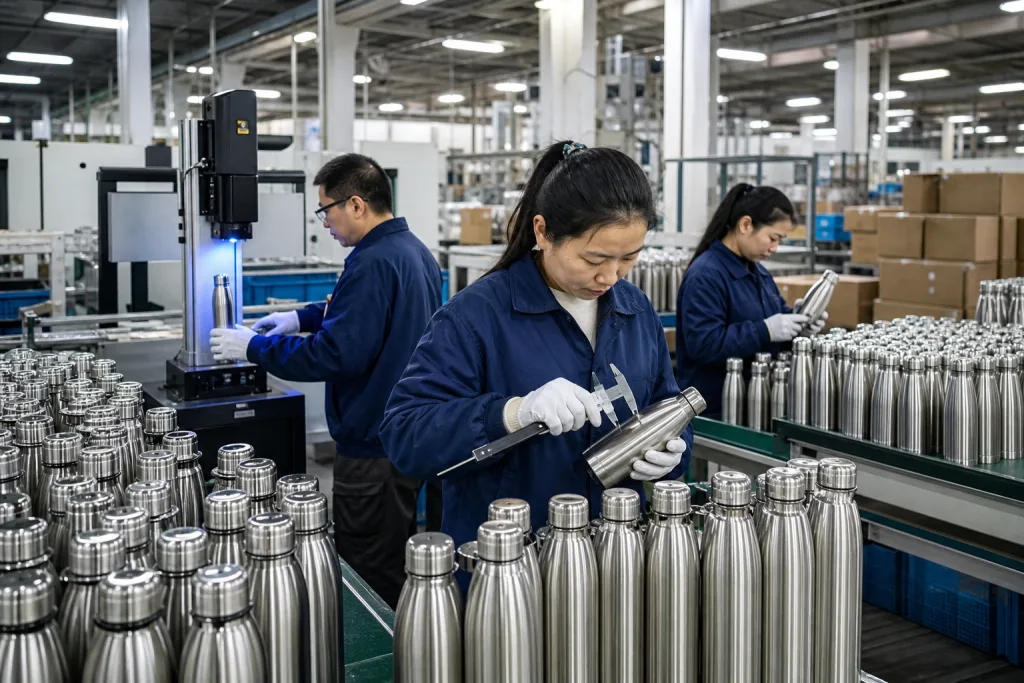
A serious supplier in Zhejiang should explain the process in plain words, with numbers. We expect to hear vacuum yield rate, leak-test method, coating adhesion result, and carton drop-test standard without someone going back to “check with the workshop.” On our floor, QC pulled the sample after 100% air-pressure leak testing on insulated bottles at 0.6 MPa, then checked vacuum retention by batch and ran cross-hatch tape testing on coated surfaces. That is normal control, not a sales pitch.
For inspections, lock AQL before production starts. A common level is AQL 2.5 for major defects and 4.0 for minor defects. Write the defect standard in black and white: leaking lid, crooked print over 2 mm, sharp edge at the rim, dented base, wrong barcode, mixed gasket color. We have seen this go sideways when the buyer flagged “bad finish” after packing, but the PO never defined what bad meant.
Do not skip the document check. For wholesale drinkware sold into the EU or North America, ask for test reports, declaration of conformity where relevant, carton spec sheet, packing list format, and production timeline. Check whether the model number matches the drawing and the report. We have seen factories send a report from another bottle size, or a PO typo like 350 ml instead of 380 ml, and that small mistake turns into a full rework discussion.
The most useful supplier is not the one who says yes first. It is the one that tells you your spec does not work before the PO is signed.
This matters even more with alcohol flask wholesale, growler wholesale, and specialty beer tumbler wholesale bulk projects. The claim risk is higher. A seal ring that sits 0.5 mm loose or a color batch that drifts after baking will create more trouble than a basic sports bottle, and the math does not work if you find it after 5,000 pcs are packed.
Build the cost model before you place PO
Do not approve a bulk drinkware order on unit price alone. Build a six-line cost sheet before you place the PO: unit price, decoration, packaging, testing, inland charges, and freight. Then add one more line for risk—expected claims, replacement stock, or 1%-2% overrun stock. This is the right place to argue, not after the goods hit port. On our side, sales usually checks this against the carton spec in the ERP before we run the line.
Example: a 20 oz vacuum tumbler may quote at FOB Ningbo USD 3.10 at 3,000 pcs. Add laser logo USD 0.18, gift box USD 0.72, barcode label USD 0.03, third-party testing amortized at USD 0.06, and your actual buying cost becomes USD 4.09 before ocean freight. If carton efficiency is poor, freight can add another USD 0.45 to USD 0.90 depending on season and destination. We have seen buyers spend hours pushing USD 0.03 off unit price while losing USD 0.22 per piece on oversized gift boxes. The math doesn't work.
Now compare that to a simpler pack-out at USD 3.28 total buying cost and ask whether the market will pay for the more expensive presentation. Brand owners get this wrong more often than procurement teams. The buyer flagged it once on a promo tumbler project: shelf price stayed the same, but the box added cost, cube, and damage risk. QC pulled the sample, and the corner crush was obvious before shipment.
Lead time belongs in the same model. Put dates against each step, not just a factory promise. Typical timing from China for a repeat-order wholesale canteen or wholesale drinkware item can be:
- 3-7 days for sample confirmation or pre-production sample revision
- 30-45 days mass production
- 5-7 days for inspection and final document release
- Sea transit depending on port and season
If you are launching a beer tumbler in bulk for a summer program or a beer growler wholesale run for brewery merchandising, add buffer. A realistic buffer is 10-14 days. Peak season in Zhejiang squeezes coating slots and packaging capacity even if the bottle body is ready. We have seen this go sideways when the spray line was open but the custom color box supplier was already full for 12 days. One PO even had a lid color typo, black instead of navy, and that alone burned 4 days on approval.
Align Incoterms with your team’s strength. FOB works well if your freight forwarder is reliable. DDP looks easier for smaller buyers, but check what is included, who clears the shipment, and who owns claim resolution if 18 cartons arrive wet. This is the wrong question to ask: “Which term is cheaper?” Ask who controls the problem when it happens. Good sourcing is not winning a quote sheet. It is arriving on shelf, on time, with the margin you planned.
Get a workable bulk drinkware sourcing plan
Send your target SKU, quantity, market, and packaging needs. We will review MOQ, compliance, lead time, and factory-fit options from Zhejiang, China.
Frequently asked questions
What is a realistic MOQ for drinkware buy in bulk?
For standard stainless bottles, tumblers, and sports bottles, a realistic MOQ is usually 1,000 to 3,000 pcs per SKU with one logo and stock colors. If you want custom Pantone coating, custom lid parts, or retail gift boxes, MOQ often moves to 3,000 to 5,000 pcs. Some stock-body projects, especially laser-engraved tumblers or flasks, can start at 500 to 1,000 pcs. For growler wholesale or beer growler bulk items, MOQ may stay at 1,000 pcs but freight and carton volume are higher, so small orders are less efficient. In China, always ask suppliers to quote at three breaks: 1,000, 3,000, and 5,000 pcs. That shows whether the factory is truly manufacturing or just trading on someone else’s capacity.
How do I compare suppliers for wholesale drinkware beyond price?
Use a scorecard. Compare price, but also compare lead time, monthly capacity, QC system, compliance support, and packaging accuracy. A useful factory in Zhejiang should state normal lead time, such as 30 to 45 days, monthly output such as 300,000 or 600,000 units, and whether leak testing is 100% or sampling only. Ask for BSCI or ISO records if relevant, plus recent REACH, LFGB, or FDA-related reports for similar models. Then review defect handling: do they use AQL 2.5/4.0, define major and minor defects clearly, and accept third-party inspection? A cheaper supplier that misses barcode labels, gasket colors, or carton specs is often more expensive after rework and claims.
Which material is best for bulk canteen, growler, and tumbler orders?
It depends on the selling channel and use case. For premium bulk canteen and drinkware wholesale orders, 18/8 stainless steel is the safest default because of corrosion resistance and market acceptance in Europe and North America. For double-wall vacuum tumblers and bottles, a common structure is 0.4 mm inner wall and 0.5 mm outer wall; thicker walls improve dent resistance but raise cost. For growler bulk programs, focus on seal integrity and handle strength as much as thermal retention. For beer tumbler bulk projects, coating adhesion and rim finish matter because consumers notice touch and appearance immediately. Glass works for shelf appeal, but it raises breakage risk and packaging cost. Do not accept vague terms like “food-grade steel” without exact grade confirmation.
How long does a custom drinkware wholesale order usually take?
For a first order, a practical timeline is 3 to 7 days for sample review, then 30 to 45 days for production after deposit and artwork approval. Add 5 to 7 days if you need third-party lab testing, retail gift box assembly, or detailed barcode application. Peak-season schedules in China can stretch another 7 to 10 days, especially if coating lines and packaging teams are full. Reorders on standard items can be faster if color, logo, and packaging stay unchanged. If you are buying beer growler wholesale bulk, alcohol flask wholesale, or specialty lid formats, leave buffer because leak testing and assembly checks are more sensitive. Buyers should build at least 10 to 14 days of schedule protection into launch plans.
What quality checks matter most for alcohol flask bulk and growler wholesale orders?
For alcohol flask bulk orders, the critical checks are cap sealing, hinge durability, weld smoothness, odor control, and finish consistency. A flask can look attractive and still fail if the cap leaks after a few openings. For growler wholesale orders, focus on lid seal compression, handle attachment, dent resistance, and carton drop performance. In both categories, define defects in writing and inspect to AQL 2.5 for major defects and 4.0 for minor defects. Ask whether the factory runs 100% leak testing or only sampling. Also confirm food-contact compliance documents for your target market. In Zhejiang and across China, capable factories will usually support these requests, but you need the requirements listed on the PO and approved sample, not discussed casually by email.