Key Takeaways
- A usable RFQ should define capacity, material grade, finish, logo method, packaging, testing, and Incoterm in 1 document before sampling starts
- For most custom drinkware programs, sample lead time is 7-12 days and bulk lead time is 25-40 days after deposit and artwork approval
- Set quality terms early: AQL 2.5/4.0, leak test standard, logo adhesion, carton drop expectations, and spare part ratio such as 0.5%-1.0%
- Many Zhejiang, China suppliers accept MOQ from 500-1,000 units per SKU, while complex color mixes or custom molds often start at 3,000 units
You are not buying a bottle. You are buying repeatability from the first pre-production sample to 10,000 pcs in bulk: logo position within 2 mm, lid torque that stays in spec, FDA or LFGB paperwork that matches the item, carton marks that match the PO, and a ship date the line can actually hold. We have seen polished catalogs hide expensive problems after the first run. QC pulled the sample, the print looked fine, then bulk came back with a logo shift, thin master cartons, delayed lids, failed migration testing, or one typo on the PO that left no room to claim.
If you source custom drinkware for retail, corporate gifting, or distribution in Europe or North America, start the process before sampling and carry it through final inspection. This is the wrong question to ask if you only compare unit price. In Zhejiang, we run fast, and some projects move from sample approval to mass production in 12 days vs 18 days, but speed does not save a loose RFQ or missing PO details. The buyer flagged it, usually late: no pantone sign-off, no drop-test standard, MOQ unclear, barcode side not confirmed. That is where new B2B buyers protect margin—or lose it.
Start with a usable RFQ
The fastest way to lose two weeks is sending a drink bottle vendor one photo and a target price. We’ll send a number back, sure, but it is not a quote you can place a PO against. A usable RFQ needs enough detail that a canteen manufacturer or canteen supplier in China can price the same item the same way next Tuesday, not just this afternoon. On our side, the sales engineer usually checks the drawing against a 0.5 mm wall callout before the line even looks at costing.
Your RFQ should put commercial terms and technical specs on one sheet. No gaps. Include capacity, bottle type, steel grade, wall construction, lid style, finish, color, logo process, unit pack, master carton standard, target market, and shipping term. If you need a custom canteen, customizable canteen, customized canteen, custom growler, or customizable growler, list each SKU as its own line. This is the wrong question to ask: “Can you quote this family?” A 500 ml single-wall sports bottle does not price like a 750 ml double-wall vacuum flask with powder coating and laser engraving. We’ve seen this go sideways when a buyer typed “same as last order” on the PO and forgot the lid had changed from PP to Tritan.
- Material: 18/8 stainless steel for body, PP or Tritan lid components, food-grade silicone seals
- Construction: single wall, double wall, vacuum insulated, copper coating if required
- Decoration: silk screen, heat transfer, UV print, laser engraving, embossed logo
- Packaging: polybag, egg crate, white box, color box, PDQ, barcode label, FNSKU
- Compliance: REACH, LFGB, FDA, CPSIA, ASTM where applicable
Ask the factory to split out tooling, sample charges, unit price by quantity, and carton data. If you are speaking with a canteen factory in Zhejiang, ask for MOQ by color and by logo, not just total MOQ. The math changes fast. A common MOQ is 1,000 units per model with 250 units per color, but a canteen customized with a special lid color or custom insert can push that higher. Last month, one buyer flagged a quote after QC pulled the sample and found the custom straw lid needed a separate mold core, which added 12 days.
At BottleForge Industrial in Hangzhou, Zhejiang, we usually see serious buyers cut quotation revisions by 30% to 40% by sending a complete RFQ on day one. That saves time on both sides and gives you numbers you can defend internally. On a normal week, we run 6 to 10 RFQs through costing, and the complete ones move first because the line does not have to stop for missing carton size or logo area.
Compare suppliers beyond unit price
Once quotes land, don’t sort the sheet by lowest FOB and call it done. We’ve seen a bottle come in $0.18 cheaper because the body dropped from 0.5 mm to 0.4 mm, the lid came from an outside shop, and the carton failed a simple drop check. Cheap often means risk. That is the wrong question to ask.
Check what kind of supplier you are dealing with: canteen vendor, trading company, or direct canteen factory. None is automatically a problem. Visibility is the issue. If the seller is a canteen distributor, or one of 2 or 3 distributors running outsourced production, ask who owns sampling, incoming inspection, and final QA. On our line, QC pulled the sample before mass print because one PO had the lid color typed wrong. If the seller is a direct canteen manufacturer in China, ask what stays in-house and what gets subcontracted.
What you should compare line by line
- MOQ: 500, 1,000, or 3,000 units changes your inventory exposure and your carton count fast
- Lead time: 25 days quoted by one vendor may mean 25 working days, not calendar days, so ask 25 working days or 25 calendar days
- Wall thickness: for stainless items, 0.4 mm vs 0.5 mm affects dent resistance and weight, and we see it immediately on the scale in kg and in drop-test results
- Vacuum performance: ask for hot/cold retention test data, not just marketing claims; if the factory runs a vacuum gauge test, ask for the record
- Decoration yield: some logos have higher reject rates on textured powder coat, and the buyer flagged this on a 2-color wrap print last season
- Compliance file: current REACH and food-contact declarations should match the actual materials offered, not a file from another lid or straw set
Ask for production capacity too. A stable Zhejiang supplier should give you a direct number, such as 300,000 to 500,000 units per month across stainless and plastic drinkware lines, not “we can handle it.” We run into this with new buyers all the time. If they cannot answer, planning risk is already on the table. For a distributor drinkware program or distributor growler launch, capacity matters more than the first quoted cent. The math doesn’t work if you save $0.05 and miss the ship window.
A useful quote is not the cheapest quote. It is the quote with the fewest hidden assumptions.
If you plan to sell canteen promotional items seasonally, ask about peak-month loading before you place the PO. In China, pre-holiday congestion can add 7 to 10 days even when production itself is on time. We ship plenty of orders where production is done in 12 days but pickup slips to day 18 because trucking and port slots tighten up.
Lock the sample before the PO
Sampling is where deals slip. Buyers sign off a pre-production sample because it looks “close enough,” then bulk lands with a different coating shade, logo drifting 3 mm, or a handle fit that feels loose on the line. If the approval note is vague, the factory will build to what QC recorded on the sample card, not what you meant in your head. We have seen this go sideways.
For custom drinkware, you need two checkpoints, not one: an unbranded construction sample first, then a branded pre-production sample after artwork is locked. A standard timeline in China is 3 to 7 days for an existing mold sample and 7 to 12 days for a printed or engraved sample. New mold development for a customized growler or canteen custom project may take 20 to 35 days depending on tooling complexity. If a supplier promises a new mold in 8 days, ask what tool steel they are cutting and whether the trial shot is included. This is the wrong place to rush.
Your sample approval should confirm:
- Capacity tolerance: for example 750 ml nominal capacity with acceptable fill tolerance, checked with a graduated cylinder at room temperature
- Color reference: Pantone code or approved sprayed sample, not “matte blue” written on a PO
- Logo size and position: e.g. 45 mm wide, centered 70 mm from base, because buyers flag this first
- Finish: powder coat texture, gloss level, or brushed direction, with the actual panel kept from the spray booth
- Lid fit: torque feel, thread engagement, gasket compression, tested by hand and with the torque gauge if the closure is tight-spec
- Packaging: box print, insert, barcode location, carton marks, down to the outer carton shipping mark
If you are buying from a canteen supplier or canteen vendors for Amazon FBA, ask for barcode application on the sample carton and the unit box. We ship too many orders where the buyer checks the bottle and skips the carton label, then the FBA warehouse rejects the lot for a barcode placement error. If you are buying for a retail chain, request transit testing expectations early. A color box can look fine in photos and still crush at the pallet level in a 1.2 m drop test.
For canteen customizable programs, sample sign-off should happen on photos and physical retained samples. Keep one retained sample with your team and ask the Zhejiang factory to keep a sealed golden sample on site, packed with the signed sample card and PO number. QC pulled the sample more than once during a bulk dispute, and it stopped the argument in 10 minutes. When bulk quality disputes happen, the golden sample is the fastest way to stop opinion-based arguments.
Write a purchase order that works
A purchase order needs to do more than show quantity and price. It should tell the line what to run, tell QC what to check, and tell shipping what to load. We see this go sideways when the PO stays vague and the buyer tries to renegotiate after an issue shows up. Last month, QC pulled the sample and the PO only said “matte blue bottle,” with no Pantone, no logo size, no carton limit.
Whether you buy from canteen manufacturers, canteen suppliers, or a broader custom drinkware exporter in Zhejiang, tie the approved sample to measurable specs on the PO. “Same as sample” is not enough. This is the wrong question to ask if the sample itself has 3 versions on the table. Put numbers on it: color code, 50 mm logo width, 15 kg carton cap, 12 days for sample approval instead of 18 days of back-and-forth.
PO line items worth writing clearly
- SKU and description: 650 ml vacuum bottle, SUS304 inner and outer, powder coated navy body
- Quantity breakdown: 4,000 units total, 2,000 navy, 1,000 black, 1,000 white
- Logo method: 1-color silk screen in white, 1 side, 50 mm x 32 mm
- Packaging: each in polybag and kraft box, 24 pcs/master carton, carton weight under 15 kg
- Testing: 100% leak test, vacuum test by batch, coating adhesion cross-hatch standard
- QC level: AQL 2.5 for major defects, 4.0 for minor defects
- Spare parts: 1% extra lids and 0.5% extra straws if applicable
- Delivery term: FOB Ningbo or EXW Hangzhou, latest ship date stated
- Documents: packing list, commercial invoice, test reports, carton photos before loading
Payment terms need the same precision. Common terms are 30% deposit and 70% balance before shipment. Larger buyers sometimes move to 20%/80% or OA after 3 to 5 orders run clean. If you need BSCI, ISO 9001 documentation, or third-party inspection booking support, write it into the PO notes. Do not assume the factory will arrange it automatically; we had one PO with a typo on the inspection date, and the buyer flagged it only after the booking window closed.
This matters for custom canteen and customized drinkware projects because every missing point turns into cost later—rework, air freight, or claim deductions. A good PO replaces “we thought” with “we agreed.” The math works better that way.
Control bulk production and inspection
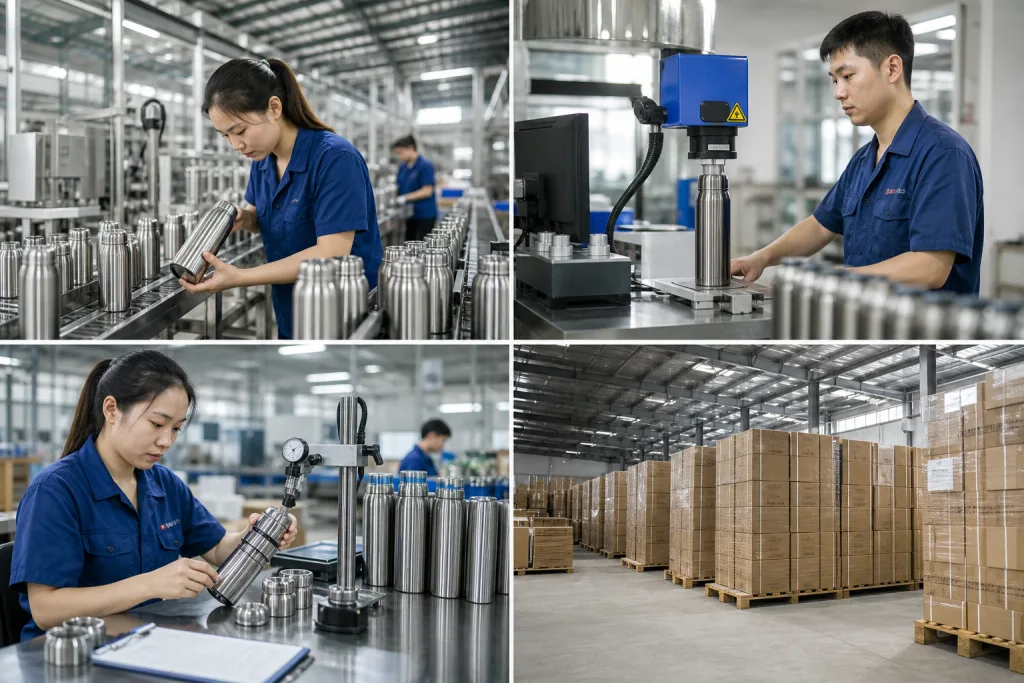
After the deposit hits, the real work starts. On bulk drinkware orders, the same failures show up again and again on the line: coating shade off against the signed chip, logo adhesion failing the tape test, lids leaking at the silicone ring, scratches from the conveyor guide rail, and carton assortment packed against the wrong PO line. If your QC plan starts at final inspection, you are late already. We have seen this go sideways.
Ask your drink bottle vendor for a dated production schedule, not a one-line promise. It should list material prep, body forming, welding, vacuuming if insulated, painting, decoration, assembly, packing, and inspection by day. In China, a repeat custom drinkware order usually runs 25 to 35 days. New decoration or mixed packaging can push that to 40 days, especially if the buyer flagged a gift-box insert change or the PO has a barcode typo.
A practical inspection plan often includes:
- Pre-production check: confirm raw material grade, color standard, artwork, and packaging layout; we usually also lock the Pantone chip, carton mark, and sample weight in kg before the line starts
- During-production inspection: review first packed cartons when 20% to 30% is complete; QC pulled the sample, checked print position in mm, and opened cartons to catch assortment errors early
- Final random inspection: inspect when 80% to 100% is packed according to AQL; this is where seal test, drop check, barcode scan, and carton count need to match the report
For stainless vacuum bottles, ask how vacuum integrity is checked. Some factories test by sample batch; others run tighter checks on models that have given trouble before, such as narrow-mouth SKUs with a 0.4 mm weld variation. For straws, flip lids, and multi-part assemblies, ask how they control fit consistency and spare-part matching. If you are buying a customizable canteen or customizable drinkware range with several accessories, body quality is only half the job. The wrong question is “Does the bottle look good?” Ask whether the parts still fit after 5,000 sets run through assembly.
Good factories in Zhejiang, China will send carton photos, pallet photos, and bulk logo photos before inspection. Ask for defect photos too. Not just the pretty units. We ship those updates every week, and the useful ones include issues like dented rims, logo ghosting, or a pallet label stuck over the shipping mark. If a supplier only shows perfect pieces, you are not seeing the line as it is. For canteen promotional orders tied to event dates, one honest update on day 12 is worth more than three optimistic messages in week one.
Plan shipping, claims, and repeat orders
The last stage is not shipment alone. It is the handoff. A solid drink bottle vendor should help you close the loop from factory gate to your warehouse, FBA center, or distributor network. We have seen first-time canteen distributors, distributor canteen buyers, and distributor growler importers focus on unit price, then get hit on receiving cost because the pallet height was 40 mm over target or the outer carton was weaker than the drop test sample.
Confirm carton dimensions, gross weight, pallet plan, and loading quantity before balance payment. This is the right checkpoint. A small packaging change can reduce container efficiency by 8% to 12%. If you buy FOB from Zhejiang or nearby Ningbo, ask the factory to send final carton count, CBM, and shipping mark photos at least 3 days before cargo handover. We ship this set after final packing, not from an early mockup, because the math does not work if the live carton comes out 12 mm wider than the approved spec.
Claims handling should be agreed in advance and written into the order file. Spell out what evidence is required for shortages, leaks, or logo defects, and state how claims are settled. Serious canteen manufacturers and canteen vendors usually settle by credit note, replacement in the next order, or partial refund based on defect ratio. Define the timeline too, such as notification within 30 days of arrival with photos, count, and lot references. QC pulled the sample once on a leak claim and found the buyer mixed two lot numbers in one carton photo; that kind of mess slows everything down.
Think one order ahead. After the first shipment, build a repeat-order sheet with every correction: carton mark updates, torque preference, revised Pantone, spare gasket quantity, new barcode location, and any compliance document expiry dates. One typo on a PO can follow you for 3 runs. That file becomes your internal sourcing memory, and it saves time when you manage 4 or 5 canteen suppliers or canteen manufacturers in China. We run these notes line by line before mass production.
If your program is growing, ask the factory to reserve material or production slots for forecasted POs. This is where disciplined buyers pull ahead. In Zhejiang, factories that value long-term business usually support forecast planning when your volumes are credible and your specifications are tight. We have seen this go sideways when a buyer asks us to hold 304 stainless and color boxes with no 60-day forecast, no MOQ commitment, and no clear release date.
Send your RFQ and get a practical review
Share your bottle spec, target quantity, logo file, and delivery term. We will review MOQ, lead time, compliance points, and packaging risks before sampling.
Frequently asked questions
What MOQ should I expect from a drink bottle vendor?
For existing models, many China factories quote 500 to 1,000 units per SKU, often with 100 to 250 units per color. Stainless insulated items usually start closer to 1,000 units because setup, painting, and decoration losses are higher. If you need a custom mold, special cap, or customized growler body, MOQ often moves to 3,000 to 5,000 units plus tooling cost. Packaging also affects MOQ. A standard kraft box may work at 1,000 units, while a fully printed gift box may require 2,000 units or more to keep cost reasonable. Always ask for MOQ by model, by color, by logo, and by packaging type, not one blended MOQ number.
How long does sampling and bulk production usually take?
For an existing bottle shape, an unbranded sample often takes 3 to 7 days. A decorated pre-production sample usually takes 7 to 12 days after artwork confirmation. If you need new tooling for a custom canteen or customizable growler, mold development can take 20 to 35 days before sample revision. Bulk production for repeat items is commonly 25 to 35 days after deposit and sample approval. More complex orders with multiple colors, custom packaging, or mixed accessories often need 35 to 45 days. Around Chinese peak periods, especially before major holidays, add a buffer of 7 to 10 days. Ask your Zhejiang supplier whether lead time is counted in calendar days or working days.
What quality standards should I put on the PO?
Use measurable standards. A typical starting point is AQL 2.5 for major defects and 4.0 for minor defects. Define major defects clearly: leakage, missing components, wrong logo, severe dents, unstable base, unsafe burrs, or wrong carton assortment. Require 100% leak testing for applicable bottles and batch vacuum testing for insulated items. For decoration, state logo position tolerance, color reference such as Pantone, and adhesion expectation for coated surfaces. Add packaging standards too, including carton drop expectation, max carton weight like 15 kg, and barcode placement. If replacement parts matter, specify extra lids, straws, or seals at 0.5% to 1.0%. Good China suppliers can work to these standards if they are written before production starts.
Should I buy from a factory, trading company, or distributor?
Any of the three can work if control is clear. A direct canteen factory may offer better technical detail, faster issue resolution, and cleaner pricing, especially for repeat orders over 5,000 units. A trading company can still be a good partner if they consolidate several product categories and manage QA actively. A distributor model can make sense if you need local stock, lower MOQ, or domestic after-sales support. The key question is who owns the process. Ask who makes samples, who checks incoming materials, who approves bulk color, and who handles claims. Also ask for factory audit status such as BSCI or ISO 9001 and whether production is in Zhejiang, other parts of China, or split across subcontractors.
What documents should I request before shipment?
At minimum, request the commercial invoice, packing list, carton dimensions, gross and net weights, and final carton count. For custom drinkware entering Europe or North America, also ask for relevant compliance paperwork such as REACH declarations, LFGB or FDA-related food-contact statements depending on the program, and any test reports tied to the actual materials. If you use Amazon FBA, request FNSKU confirmation, carton labels, and pallet details if applicable. It is also smart to ask for final inspection reports, pallet photos, carton mark photos, and a copy of the approved artwork reference. If the order is FOB Ningbo or another China port, get CBM and handover timing at least 2 to 3 days before balance payment.