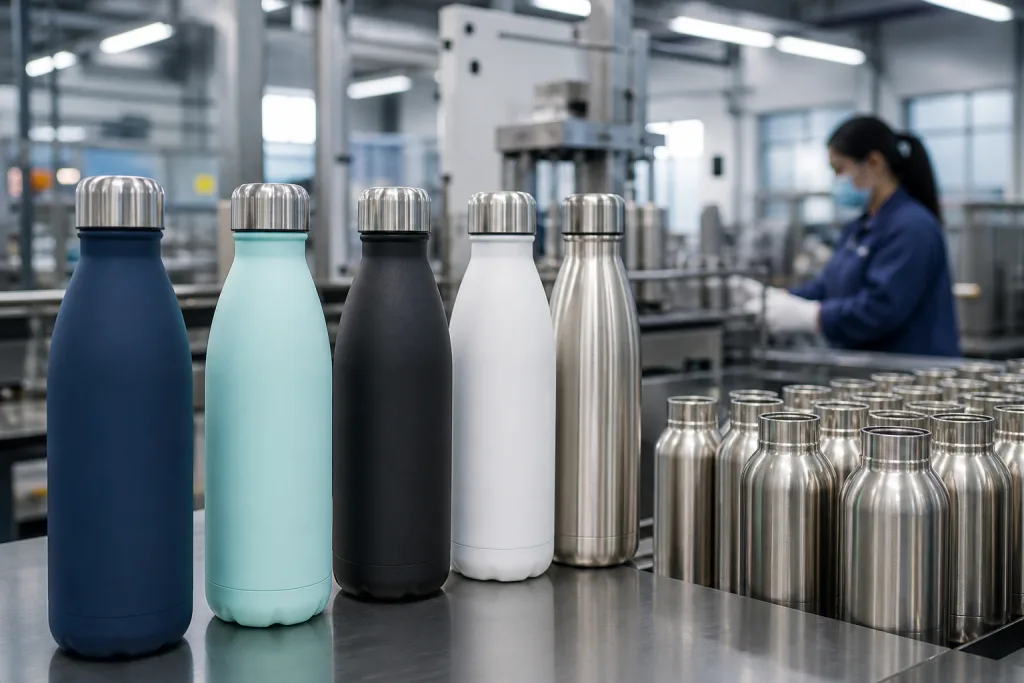
Key Takeaways
- Typical MOQ runs from 300 units for stock-color blanks to 3,000 units for fully customized drinkware with new molds
- A 500 ml double-wall stainless bottle often lands at USD 2.80-5.20 FOB China depending on steel grade, lid complexity, and print method
- Normal production lead time is 25-45 days after sample approval, while custom mold projects usually need 45-70 days
- AQL 2.5 inspection, REACH/LFGB testing, and carton drop tests can add 3-7 days but reduce rework risk by more than 20%
You usually do not struggle to find a drink bottle supplier list. The hard part is cutting 20 names down to 3 you can buy from without surprises. Five suppliers may all claim stainless steel, custom logo service, and fast delivery, yet one quotes USD 2.85 FOB Ningbo at 3,000 units, another quotes USD 4.10 at 1,000 units, and neither tells you if the gap comes from 304 stainless, thinner wall thickness, a different carton pack, or a weaker QC standard. We have seen this go sideways fast. On the line, even a 0.2 mm wall change can move weight, freight, and drop-test results.
If you buy for retail, promo, ecommerce, or distribution in Europe or North America, you need a tighter way to compare cost and timing. A serious canteen manufacturer in Zhejiang or elsewhere in China should be able to break down material grade, decoration, tooling, MOQ, inspection level, and transit time in plain numbers. Not sales talk. QC pulled one sample last month where the PO said powder coat black, but the artwork file was marked matte navy, and the buyer flagged it before mass production. If a factory cannot explain lead time as 12 days vs 18 days, or why MOQ starts at 1,000 instead of 3,000, they do not belong on your working supplier list. Frankly, this is the wrong question to ask: do they look competitive on paper? The better question is whether they can quote cleanly and ship without drama.
What belongs on your shortlist
A good drink bottle supplier list is not a spreadsheet full of names. It is a screen. Cut out traders who do not run production, factories that only do simple logo work, and small workshops that stall the moment you ask for LFGB or a migration test report. We have seen this go sideways after the PO is placed, which is the expensive time to find out.
Start with four checks. First, confirm whether you are dealing with a canteen factory or a middleman. Ask for monthly capacity, such as 300,000 to 500,000 units, and ask which steps are done in-house: tube cutting, hydroforming, welding, powder coating, laser engraving, and packing. Ask what tube diameter they run, what leak-test standard the line uses, and how many auto welding stations are on the floor. A real canteen manufacturer in Zhejiang will answer with numbers, machine names, and MOQ details, not sales slogans.
Second, match the supplier to your channel. A canteen promotional order for an event can work at 500 units with stock colors and a simple silk-screen setup. A retail launch for custom drinkware or a custom canteen line usually needs tighter color control, barcode labels in the right position, and packaging that stays consistent from lot 1 to lot 5. If you are a distributor drinkware buyer or a canteen distributor, carton size, pallet pattern, and reorder stability matter just as much as decoration. We ship both, and the wrong question to ask is only “What is your best price?”
Third, ask which product families they actually make well. Some canteen manufacturers run vacuum bottles cleanly but struggle with shaker lids that leak at the hinge or tea infusers with poor mesh fit. Others can build a customized growler or customizable growler with a 64 oz body and solid powder coat, but they cannot make a children’s bottle that passes ASTM-related mechanical safety checks. QC pulled one sample last season with a straw bite valve that failed pull force. Put capabilities next to each supplier name, not just unit prices. That comparison saves time.
Fourth, screen for compliance. For Europe, you may need REACH, LFGB, and packaging compliance. For North America, FDA-contact expectations, CPSIA for kids items, and retailer-specific testing may matter. Add BSCI or Sedex only if your customer requires social audit status. Ask how fast they can send the latest test file, declaration, and factory audit copy. If the buyer flagged a missing stamp on a report, did the supplier fix it in 2 hours or 2 days? A supplier in China that sends clean documents fast is usually running a tighter line too.
- Good shortlist size: 5 to 8 suppliers
- Initial quote turnaround: 24 to 72 hours
- Sample lead time: 3 to 10 days for stock items, 10 to 20 days for pre-production samples
Why bottle prices vary so much
Buyers make this mistake all the time: they treat every 500 ml bottle as the same item. It is not the same item. A basic single-wall bottle in 0.4 mm 201 stainless is one cost level; a double-wall vacuum bottle in 0.5 mm 304 stainless inside and outside, with copper coating on the line, is a different build and a different FOB.
Material drives the price first. For stainless vacuum bottles, 18/8 or 304 stainless is the normal spec for mid to upper-tier export work. If a quote comes in unusually low, this is the first place to check. We usually ask for body thickness, inner and outer grade, and lid BOM on the same sheet, because buyers have sent POs marked “304 bottle” while the outer shell was quoted thinner. On a common 500 ml model, the gap between entry-level and reliable retail quality is often USD 0.60 to 1.20 per unit. The wrong question is “who is cheapest.” Ask what was cut.
Decoration is the next big swing. A one-color silkscreen logo may add USD 0.08 to 0.18 per piece. Laser engraving often adds USD 0.12 to 0.25. Full-wrap heat transfer or digital print can add USD 0.35 to 0.80 depending on coverage. If you need a canteen customized to Pantone-matched brand colors, custom powder coating setup may also bring a small setup fee or a higher unit price under low volume. We run color cards at the booth first, and QC pulled samples before because the gloss level was off by one step from the approved chip.
Lids change the math fast. A plain screw cap is cheap and stable. A flip straw lid, carry handle, bamboo top, or leak-proof sport cap means more parts, more hand assembly, and more leak-test failures at 0.03 MPa. We have seen this go sideways when a buyer wants one bottle body with two lid options but still expects the same carton count and packing speed. The same applies if you want a custom growler with a pressure-style closure or a customizable canteen with two lid options in one program.
Typical FOB China price bands
- Single-wall stainless bottle, 600 ml: USD 1.20-2.10
- Double-wall vacuum bottle, 500 ml: USD 2.80-5.20
- Travel tumbler, 30 oz: USD 3.40-6.20
- Growler, 64 oz insulated: USD 6.50-11.50
If a supplier quotes far below market, assume something is missing. We usually find it in 1 of 5 places: testing, thicker steel, individual polybag, barcode labeling, or vacuum performance targets. The buyer flagged one quote last month that looked sharp on price, then the sample came without the promised hold-time spec.
MOQ tiers that change your economics
MOQ is not just a factory preference. It changes your unit cost, decoration choices, and lead time on the line. Buyers ask for a customized drinkware program at 300 units, then flag the quote as too high. The math doesn't work. Screen setup, Pantone ink mixing, carton breakpack, and lid changeover time still sit there; on one 300-unit PO, QC pulled the sample and the outer carton was only 62% full.
For stock molds and stock colors, most China factories will start at 300 to 500 units per SKU. That usually means a simple laser logo or 1-color screen print, not a full custom build. We ship these for trial orders, market testing, and smaller canteen vendors covering local promo demand. A realistic FOB range runs 10% to 25% higher than a 3,000-unit run, and lead time is often 12 days versus 18 days only if the bottle, lid, and insert card are all standard.
At 1,000 to 3,000 units, you get into the workable range for most export programs. This is where a canteen supplier can usually offer Pantone color matching, retail boxes, mixed lid options, with freight packed more cleanly into master cartons. We run this tier every week. For plenty of buyers, this is the right level for customizable drinkware, custom canteen, and entry-level customizable growler projects; below this point, the buyer wants retail-box detail but not retail-box cost.
Above 5,000 units per model, you can push on cost, packaging detail, and reserved production slots. This matters for a distributor canteen business, for regional canteen distributors, or for a brand planning seasonal replenishment with fixed ship windows. We have seen buyers hold 2 pallet spaces for spare lids and request AQL pull rates on leak test samples at this stage. That is normal. At this volume, the factory will also take split shipment windows more seriously because the line time is worth protecting.
- 300-500 units: stock molds, limited colors, simple logo jobs, usually no new carton size
- 1,000-3,000 units: best range for a serious private-label launch, with cleaner packaging and freight math
- 5,000+ units: strongest leverage on price and packaging, plus better slot priority in production
- New mold MOQ: often 3,000 to 10,000 units depending on body and lid complexity; a flip straw lid with 4 parts will land higher than a plain screw cap
If a canteen vendor offers a low MOQ with full customization, ask what is actually custom. This is the right question. Often it is only logo printing on an existing bottle, not a fully canteen customizable platform. We have even seen a PO marked "custom body color" where the buyer only approved a stock blue by mistake.
Lead times from inquiry to shipment
Count lead time from the first drawing, not from the day the PO is signed. This is the right place to start, because we see buyers lose 12 days in artwork, cap approval, and one PO typo before the line even gets a slot.
For an existing bottle shape in standard colors, the schedule is usually clear. Quotation takes 1 to 3 days. Stock sample dispatch takes 3 to 7 days. A pre-production sample with your logo and box usually takes 7 to 15 days. Once approved and deposit received, mass production often takes 25 to 35 days for 1,000 to 3,000 units. In peak season, especially before August holiday shipping and Q4 promo demand, it can stretch to 40 to 45 days. On our floor, QC pulled a sample last month because the Pantone on the lid ring was 1 shade off, and that single issue cost 2 days.
If you need a canteen custom shape, a unique lid, or a customized canteen family built around new tooling, add development time. CAD confirmation, prototype sampling, mold machining, and function correction can add 20 to 40 days before you even reach production approval. We’ve seen this go sideways when a buyer asks for a new handle and “same timing as stock mold” — the math doesn’t work. A prototype checked with a caliper at 0.3 mm off on the thread can send the lid fit back for correction. A real canteen factory in Zhejiang should say this before deposit, not after.
Packaging also moves the ship date. Color boxes, instruction sheets, and shipper mark approval may add 3 to 7 days. If you sell on Amazon or through big-box retail, FNSKU labels, suffocation warnings, drop-test packaging, and pallet rules can add another 2 to 5 days. The buyer flagged one case where the carton mark showed 24 pcs instead of 12 pcs, and we had to stop packing to fix the print file. That matters for every distributor growler or private-label account, because chargebacks hit harder than a small unit-cost gap.
Typical timeline ranges
- Stock sample: 3-7 days
- Pre-production sample: 7-15 days
- Bulk production, stock mold: 25-45 days
- Bulk production, new mold project: 45-70 days
- Sea freight China to EU/US: 20-40 days depending on port and routing
Zhejiang factories close or slow during Lunar New Year, and many China supply chains tighten before Golden Week. Build those calendar effects into your buying plan. We usually tell buyers to add 10 to 18 buffer days around those periods, because after the cutoff the vessel space is the problem, not the bottle.
Hidden costs buyers miss first
The unit price is the part buyers see first. The money usually leaks out in the quote gaps. We see this on the line all the time: two factories look close on a supplier list, then the PI lands with 7 extra charges and the math changes fast.
Start with tooling and setup. A new lid mold may cost USD 2,000 to 8,000. A new bottle body tool can run from USD 3,000 to 15,000 depending on geometry and volume. Print screens, laser fixtures, or digital artwork setup may add USD 30 to 200 per design. Last month a buyer flagged a 0.3 mm logo shift on a pre-production sample, and that meant reworking the screen position before mass print. If you are planning a customized growler line or a canteen customized holiday range, spread these costs over your forecast quantity from day one. If the order is only 1,000 pcs, this is the wrong question to ask: “What is your best unit price?” Ask what the full landed project cost is.
Then check packaging. A plain white box may cost USD 0.12 to 0.25, while a custom printed gift box can cost USD 0.35 to 1.20. Inserts, hangtags, paper wraps, and master carton upgrades all change the number. We ship retail packs after drop-test checks, and a 5-ply master carton at 62 x 42 x 28 cm does not cost the same as a basic export carton. For a canteen distributor or canteen suppliers serving retail chains, carton bursting strength and pallet stability are not optional. We have seen this go sideways when the buyer approved the gift box but forgot the pallet stacking requirement.
Quality costs are the charges smart buyers accept early. Third-party inspections in China commonly cost around USD 250 to 350 per man-day. Lab testing for LFGB, REACH relevant items, or coating migration can range from a few hundred dollars to over USD 1,500 depending on scope. QC pulled the sample on one order because the lid torque was out by 0.4 N·m, which is exactly why test points need to be fixed before bulk starts. Vacuum insulation testing, leak tests, salt spray for coatings, and dishwasher claims should be agreed before bulk production. If not, retest fees and rework show up later, and nobody likes paying for those twice.
- Common payment terms: 30% deposit, 70% before shipment
- Inspection standard: AQL 2.5 major / 4.0 minor is common for finished drinkware
- Port basis: FOB Ningbo or FOB Shanghai should be stated clearly
A canteen supplier that looks USD 0.20 cheaper can end up costing more after retest fees, repacking, delayed vessel cutoff, and replacement claims. We have seen buyers lose 12 days on a simple carton mark correction because one PO had the color code typed wrong.
How to compare suppliers fairly
If you want a clean supplier comparison, issue one spec sheet and make every factory quote against that file. Otherwise you are pricing guesses. Send the same capacity, material grade, wall structure, lid type, decoration area in mm, packaging spec, testing requirement, and delivery term to every canteen manufacturer and canteen suppliers on your list. We see buyers miss one line on the PO—like 0.5 mm thicker outer wall—and the quote gap suddenly looks bigger than it is.
Use a scoring model and keep it boring. Price matters, but if it swallows the whole decision, the math doesn't work. Many professional buyers weight it close to 35% price, 25% quality confidence, 20% lead time reliability, 10% communication speed, and 10% documentation/compliance. That kind of split stops a low quote from beating a stable factory that ships on time. On our line, a rushed order can mean 12 days vs 18 days only if stock tubes are ready and the screen-print fixture is already set.
Ask each supplier for the same proof points:
- Latest similar production photos or video
- Material certificates for 304 stainless and plastic parts
- Vacuum retention data, for example 12 hours hot / 24 hours cold target
- AQL process and final inspection flow
- Monthly capacity and current lead time
- Audit status if required, such as BSCI
This matters even more if your list mixes a canteen vendor, a larger canteen manufacturers group, and factory-direct plus trading companies in China. The weaker suppliers usually sound fine on email. They slip on consistency. QC pulled the sample, thread fit was off by 0.3 mm, and the buyer flagged it only after logo approval. We've seen this go sideways.
Ask one more thing up front: who owns the mold, who keeps the color formula, and what system controls repeat orders. This is the right question to ask if you are building a customizable canteen, customized drinkware, or customizable growler line for long-term distribution. Reorder stability matters more than saving 5% on the first PO. Zhejiang suppliers with mature export systems usually track Pantone mixes, mold numbers, and carton marks better than small workshops that still run on verbal promises.
Send your spec sheet and get a usable quote
If you need pricing, MOQ, and lead-time ranges you can actually compare, send your bottle spec, target quantity, and delivery term. We will quote it clearly.
Frequently asked questions
What is a realistic MOQ for custom drinkware?
For stock molds, a realistic MOQ is usually 300 to 500 units per SKU if you only need a simple logo on an existing bottle. For more serious custom drinkware projects with Pantone body color, custom box, and multiple packaging marks, 1,000 to 3,000 units is more normal. If you want a new body shape, custom lid, or a fully customized canteen platform, MOQ often moves to 3,000 to 10,000 units because tooling and setup must be spread across more pieces. When a canteen supplier promises 100 units with full customization, check the details carefully. In many cases, only the print is custom while the bottle, lid, and box remain standard stock items from China.
How long does a custom bottle order usually take?
For an existing mold, expect 7 to 15 days for a pre-production sample after artwork confirmation, then 25 to 45 days for bulk production after sample approval and deposit. If your order includes custom packaging, barcode labels, or retailer packing rules, add 3 to 7 days. A new mold project is slower: design review, prototype, tool making, and correction can add 20 to 40 extra days, so total lead time often lands at 45 to 70 days before shipment. Sea freight from China to Europe or North America usually adds another 20 to 40 days. If your supplier is in Zhejiang, also account for congestion before Lunar New Year and Golden Week.
What should I ask a canteen manufacturer before placing an order?
Ask for five things first: exact material spec, exact MOQ, exact lead time, exact QC standard, and exact packaging basis. For material, confirm whether the bottle uses 304 stainless inside and outside, the wall thickness, and what plastics touch liquid. For QC, ask whether final inspection follows AQL 2.5 major and 4.0 minor, and whether leak and vacuum tests are done per batch. For packaging, confirm whether the price includes polybag, white box, color box, carton marks, and pallet requirements. Also ask whether the canteen factory owns key processes in-house and what its monthly capacity is. A serious supplier should answer with numbers, not general claims.
How can I compare prices from different canteen suppliers fairly?
Use one unified RFQ sheet and force every supplier to quote the same bottle size, steel grade, lid type, print method, packaging, testing, and shipping term such as FOB Ningbo. If one canteen vendor quotes USD 2.95 and another quotes USD 3.40, the difference may come from copper-coated vacuum insulation, thicker steel, better powder coating, or included color box packaging. Also ask if the quote includes spare parts, barcode labels, and export carton upgrades. A fair comparison should include sample fees, tooling charges, and estimated defect handling. Many buyers learn too late that a lower unit price from China becomes a higher landed cost after repacking, retesting, or delayed shipment.
Do I need testing and third-party inspection for customized drinkware?
If you sell into Europe or North America, usually yes. The exact scope depends on the product and channel, but REACH-related review, LFGB or food-contact checks, and packaging compliance are common for EU business, while US buyers often request FDA-relevant food-contact documentation and extra retailer-specific testing. For kids bottles, ASTM or CPSIA-related requirements may apply depending on components and age grading. Third-party final inspection in China usually costs around USD 250 to 350 per man-day and can catch printing defects, dents, wrong labels, and leak failures before shipment. That small cost is usually worth it once your order value passes roughly USD 5,000 to 8,000.