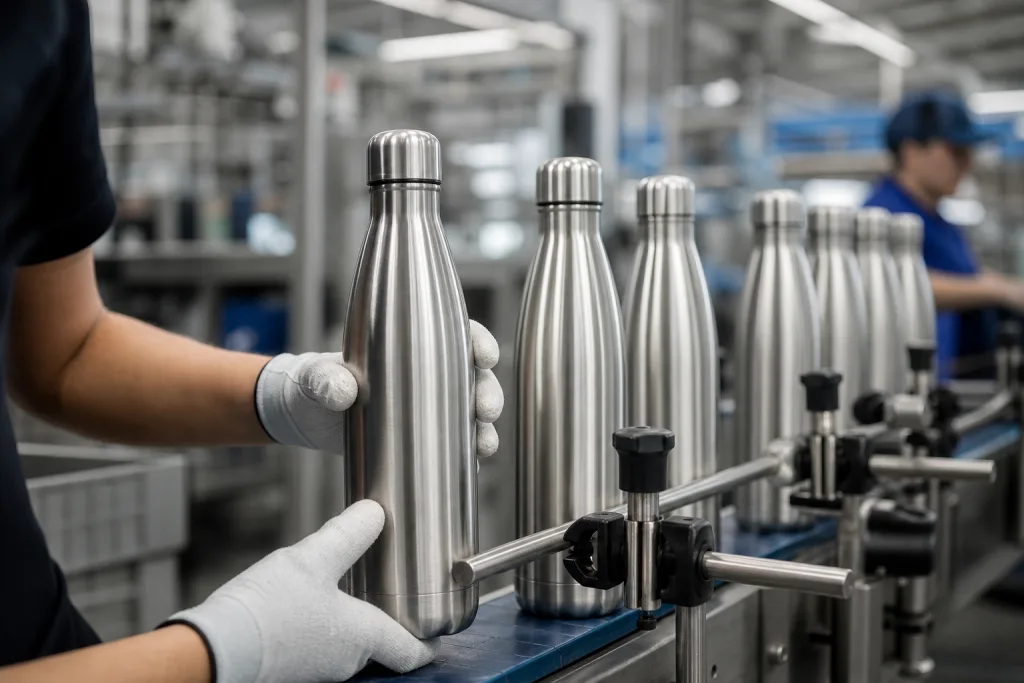
Key Takeaways
- For most stainless steel custom drinkware, practical MOQ starts at 1,000-3,000 pcs per SKU, while stock-color trials can begin around 500 pcs
- A standard private label project usually needs 25-40 days production after sample approval, plus 3-7 days for pre-production samples and 25-35 days ocean transit
- Silkscreen logo cost can be as low as USD 0.05-0.18 per unit, while laser engraving often runs USD 0.12-0.35 depending on size and position
- Use written QC points with AQL 2.5/4.0, drop test standards, and migration requirements before deposit payment, not after mass production starts
You can source a bottle from hundreds of canteen suppliers in China. Easy enough. Getting drink bottle private labeling right is where orders stall: compliance review, packaging checks, freight cost pressure, and a ship date your sales team already promised to retail or Amazon FBA. Most failures do not start with the bottle body. They start with fuzzy artwork files, the wrong decoration process, or a quote that looks low until testing fees, carton upgrades, and rework hit. We have seen a 0.3 mm logo line fill in on the screen-print line and trigger a full sample remake.
If you are a procurement manager, brand owner, or canteen distributor in Europe or North America, you need numbers, not sales talk. This is the right question. At BottleForge Industrial in Zhejiang, China, we get the same buyer pushback every week: MOQ is too high, tooling feels unclear, logo durability is not defined, and nobody explains how REACH, ASTM, AQL, and packaging specs move cost. This guide answers those points directly and gives you a checklist to use before you approve a PO. Last month QC pulled the sample because the PO listed matte black, but the artwork file note said gloss black.
What private labeling really includes
Buyers often ask for drink bottle private labeling, but on the factory side that usually means one of three jobs, and the pricing gap is not small. First is basic branding on an existing model: stock mold, standard lid, one-color print, your barcode, your carton. We run this kind of order on the line with standard screens and carton mark confirmation, so setup stays simple. Second is semi-custom: custom color, mixed finish, upgraded straw lid, hangtag, gift box, maybe a silicone boot. Third is full OEM development with a new body shape, custom cap tooling, and testing from zero. This is the wrong question to ask at RFQ stage if all you say is “private label,” because you will collect quotes for 3 different scopes and the math doesn’t work.
For a practical B2B order, most buyers in Europe and North America start with existing molds from a canteen factory or canteen manufacturer. That keeps tooling at USD 0 and puts the project into a realistic MOQ range of 1,000 to 3,000 pieces per size. We ship this route every month from Zhejiang. It fits private-label launches, promo programs, and distributor replenishment because lead time stays under control and the buyer is not paying for new tooling before the first sell-through. A true custom canteen or customized growler with new tooling may need USD 2,000 to 8,000 in mold cost and 45 to 70 extra days. We have seen this go sideways when a buyer asks for a new lid shape, then pushes back on a 0.3 mm parting line tolerance after tooling starts.
Your checklist should define these items before asking for final pricing:
- Capacity and body type: 350 ml, 500 ml, 750 ml, 1,000 ml, growler
- Material: 18/8 stainless steel, Tritan, borosilicate glass
- Construction: single wall or double wall vacuum
- Decoration: silkscreen, heat transfer, powder coat, laser, UV print
- Packaging: polybag, white box, color box, PDQ, master carton marks
- Compliance: REACH, LFGB, FDA, Proposition 65, ASTM for kids items
If you are a canteen distributor, distributor drinkware buyer, or canteen vendor sourcing for several customer programs at once, standardization matters. One shared bottle platform across 3 capacities usually saves more money than chasing the lowest unit price on 3 unrelated designs. QC pulled the sample on one recent mixed program and found the same lid thread was being forced onto 2 different neck finishes; that kind of shortcut creates rework, claims, and late shipment. Keep one platform tight, then build the colors and packaging around it.
MOQ, cost, and where quotes move
Buyers ask for a target price before the spec is locked. We get it. The problem is that it sets the wrong anchor. A 500 ml double-wall stainless bottle with powder coating and a one-color logo may land at USD 2.80 to 4.60 FOB Ningbo in volume. Change the outer wall from 0.4 mm to 0.5 mm, add copper plating to hold heat longer, switch to a custom lid, and pack each piece in an individual color box, and the same bottle can move above USD 5.20. We see this on the line all the time. One lid change means a new mold quote, a fit check with the torque tester, and sometimes a higher carton drop-failure rate. That is not a supplier trick. It is material, labor, yield loss, and packaging cost.
At our Zhejiang operation, a normal MOQ for stock models is 1,000 pcs per colorway or 3,000 pcs mixed across a program, with monthly capacity above 600,000 units across vacuum bottles, tumblers, and sports bottles. Some canteen manufacturers or canteen suppliers will offer 500 pcs for a trial if you stay with stock powder colors and simple silkscreen. We ship those orders too. For a small canteen promotional campaign, it can work, but the unit cost usually rises 8% to 20% because screen fees, line changeover time, and 24-piece export carton layouts do not scale down cleanly. Buyers push back on this point. The math doesn't work any other way.
Cost checklist buyers should confirm
- Material grade: 18/8 or 304 stainless for body and inner wall; 201 should not be accepted for food-contact inner walls
- Thickness: common bottle body specs are 0.4 mm to 0.5 mm; thinner walls save cents but raise dent risk, and QC pulled samples last month with shoulder deformation after a 60 cm drop test
- Lid structure: PP, Tritan, stainless cap shell, silicone ring count, straw assembly; one extra sealing ring sounds small until the buyer flagged leakage at 45 degrees in pre-shipment inspection
- Decoration pass count: one-side one-color print is cheaper than wrap print or multiple positions; on our screen-print line, each added pass means more setup and more chances for logo registration drift
- Packaging: custom gift box can add USD 0.25 to 0.90 per unit; if the box insert is off by 2 mm, bottles shake in transit and the complaint comes back to the factory
- Testing: third-party lab work may add USD 300 to 1,200 per SKU depending on scope; this is where buyers should ask for the exact test list, not just "test included"
If a quote looks 15% below market, check whether testing, cartons, spare parts, and defective allowance are simply missing.
This applies whether you are sourcing a customizable canteen, a customized drinkware set, or a distributor growler program. We have seen clean-looking quotes go sideways because the PO said "white box" while the artwork file showed a retail color box. FOB price is only useful when the commercial assumptions are written down line by line.
Which decoration method fits your program
Private-label results rise or fall on decoration choice. Buyers still pick the option that looks best on a PDF mockup, then the buyer flagged it after the first dishwasher test or carton rub. For customized canteen and customizable drinkware programs, match the method to logo detail, bottle finish, MOQ, and actual use. On our line, a 0.3 mm stroke that looks sharp on screen can fill in fast on a textured powder coat. This is the wrong question to ask: “Which print looks best?” Ask which one still looks good after shelf handling and 800 rubs.
Silkscreen printing is the standard low-cost option. It fits bold 1-color logos on powder-coated or painted bottles, and we run it every week on straight-wall SKUs. Typical add-on cost is USD 0.05 to 0.18 per unit. Registration on curved surfaces is acceptable, though fine detail is where this method starts to fight you. If your small text is below 1.2 mm height, don’t force silkscreen. We’ve seen this go sideways on artwork with thin serif fonts, and QC pulled the sample before mass production.
Laser engraving is a common pick for premium corporate gifts and long-life branding. It burns off the coating to show the stainless below, or marks directly on bare metal with a fiber laser. Expect USD 0.12 to 0.35 per unit depending on logo size. It lasts. It looks clean. It also reads more technical than retail, so if you want bright shelf color, the math doesn’t work with laser alone.
Heat transfer and water transfer fit wrap graphics and multicolor artwork. They can make a custom canteen or customized growler look closer to retail packaging, but setup is heavier and rejection risk is higher because film position, edge sealing, and baking all matter. Fine for stable volume above 3,000 pcs per SKU. Not good for artwork that changes every PO. We had one buyer revise a mascot outline after plate prep, and that change alone pushed shipment from 12 days to 18 days.
UV digital print handles complex color and short runs well, especially when the order is 500 to 1,000 pcs and the logo has gradients. Scratch resistance still depends on the coating system under the ink. Always ask for abrasion testing on the actual production finish, not a stock sample from another bottle. We usually check with a 3M tape pull and rub test first, because glossy paint and matte powder coat do not behave the same.
Your decoration checklist should ask:
- Will the logo survive 500 to 1,000 rub cycles?
- Is the logo dishwasher safe, or hand-wash only?
- What is the maximum print area in mm?
- Can Pantone matching be held within reasonable variance?
- Do you approve a flat proof only, or an actual pre-production sample?
For a canteen customizable program sold through distributors, consistency matters more than novelty. We ship fewer claim cases on a simple powder-coated bottle with a laser logo than on a full wrap print under a rushed lead time. Last month, the line caught a PO typo that switched black Pantone to a warmer tone, and that kind of small miss causes more trouble than buyers expect.
Compliance is not an extra service
If you sell into the EU, UK, US, or Canada, compliance does not belong as an optional line at the bottom of the quote. It needs to be built into the project from day 1. Any serious canteen vendor or canteen factory should tell you exactly which parts touch liquid, which declarations are on file, and which third-party tests are standard for that SKU. On our line, QC pulled one sample last month and cut the lid gasket to confirm the silicone matched the approved BOM. That is normal work, not extra service.
For stainless vacuum bottles and tumblers, buyers usually ask for food-contact compliance such as FDA or LFGB, based on the market, plus REACH screening for relevant components and packaging materials. For children’s items, ASTM-related safety checks can matter, especially on accessible small parts, straws, or coatings in the full program. If your branded bottle uses wood, soft-touch paint, or a special finish, say it early. We have seen this go sideways: one soft-touch coat added 12 days to the test plan versus 18 days for the original shipment target because the lab needed extra migration work. The buyer flagged it late, and the schedule took the hit.
Ask a canteen manufacturer or canteen suppliers these direct questions:
- What exact resin is used in lids and straws: PP, Tritan, PE, silicone?
- Do you have migration test reports from an ISO 17025-accredited lab?
- Can you provide REACH and Proposition 65 statements for current materials?
- Do production lots match the same material declarations as the approved sample?
- Is the factory audited under BSCI, Sedex, or similar social compliance programs?
China has 1000+ capable plants, but documentation discipline is uneven. This is the wrong question to ask: “Do you have a test report?” The better question is whether the factory keeps BOM control, supplier declarations, and test history by SKU family, lot by lot. In Zhejiang, the stronger export factories do. We run spot checks on lid resin codes and keep archived files for at least 12 months, because retailers ask for follow-up documents 8 months after shipment and expect them the same day.
Do not rely on a generic report from a different bottle or an old lid. Put the tested construction into the PO: body, cap, seal, straw, coating, and packaging. We once saw a PO typo swap a painted lid for a powder-coated lid, and the documents no longer matched the shipped goods. If you are buying custom growler or customizable growler products for alcoholic beverages, state the use conditions clearly, because carbonation, fill temperature, and cap structure change the test scope and performance target versus a standard water bottle.
Sampling, QC, and shipment control
The fastest way to lose margin on custom drinkware is skipping control points between artwork sign-off and container loading. Set the sampling path and QC plan before the line starts, and get both sides to sign it. We usually lock this on the PO and sample approval sheet, down to logo position tolerance and carton size in mm. Any factory pushing back on that is a risk. A clean exporter will accept it because fewer surprises means fewer arguments after shipment.
A practical sequence looks like this: stock sample in 2 to 5 days, digital artwork proof in 1 to 2 days, pre-production sample in 5 to 7 days after deposit and artwork confirmation, mass production in 25 to 40 days, then pre-shipment inspection. If the order includes a new mold or a complex custom canteen lid, add 20 to 35 days for tooling and validation. During peak season from August to November, add another 7 to 15 days in many Zhejiang plants. On our side, a new lid usually needs fixture checks and at least one leak-test round before we release the mold. Buyers often ask for the fastest lead time first; this is the wrong question to ask. Ask when the golden sample is approved and when QC pulled the sample from the line.
QC checklist worth putting on the PO
- AQL level: commonly 2.5 for major defects and 4.0 for minor defects
- Vacuum retention test: for example, hot water temperature drop after 6 or 12 hours
- Leak test: inverted bottle test for 30 minutes, 100% for finished goods
- Coating adhesion: cross-hatch or tape test standard
- Logo position tolerance: for example, plus or minus 2 mm
- Carton drop test: 1A style or buyer-specific requirement
- Barcode scan rate and FNSKU label location if using Amazon FBA
For distributor canteen, canteen distributors, and canteen promotional orders, packaging accuracy creates as many claims as product defects. We have seen a 24-pack master carton shipped with a 12-pack inner setup because one PO line had the wrong pack-out note. That kind of miss gets flagged at the warehouse fast. Check assortment count, inner pack quantity, carton mark, country-of-origin mark, and spare straw quantity. One bad master carton setup can miss an appointment slot and cost more than a minor scratch issue.
If your order value justifies it, book a third-party inspection before balance payment. On a 5,000 or 10,000 unit order, one inspection fee is cheap next to sorting, relabeling, or reworking finished stock. We ship plenty of orders this way, and the usual inspection point is after at least 80% packed. If a supplier asks you to skip that step to save a few hundred dollars, the math doesn't work.
How to choose the right factory partner
Not every canteen supplier should be a long-term partner. Some shops are trading consolidators that buy from 3 to 8 workshops and manage paperwork. Others are actual canteen manufacturers with forming, welding, vacuuming, coating, and assembly on one site. Both models can work. The wrong move is not asking which one you are dealing with before the first PO lands on the line, because response time, process control, and price room are not the same.
When you screen a canteen factory or canteen manufacturer, ask what is done in-house and what is sent out. For stainless drinkware, the core steps usually include tube cutting, hydroforming or deep drawing, neck shaping, automatic welding, vacuum furnace, powder coating, logo application, and final assembly. Ask for the machine list. We look for details like tube cutter capacity, vacuum furnace chamber size, or whether the seam is handled by auto TIG or manual touch-up. More in-house control usually means shorter lead time—12 days versus 18 days on repeat parts is common—and one clear owner when QC pulled the sample and found a weld shadow.
Useful screening questions:
- What is your monthly output by category?
- What is your standard MOQ by stock mold and by custom packaging?
- Which certifications and audit reports can you share now?
- How many export markets do you ship to regularly?
- Do you control tooling, painting, and print internally or by subcontractor?
- Can you support replenishment orders within 20 to 30 days for repeat SKUs?
A canteen vendor that cannot answer basic process questions is probably passing information through too many layers. That does not make them bad by default, but we have seen this go sideways fast. One buyer flagged a lid leak, and the answer took 4 days because it moved from trader to factory to cap supplier and back again. For private labeling, communication risk turns into cost fast.
If you are a distributor drinkware buyer managing several brands, choose a partner that documents version control well. Good factories in Zhejiang and broader China do not just send samples. They track BOM version, coating code, print screen file, carton drawing, and approved golden sample by item number, often down to a carton size change like 52.5 cm vs 53 cm. This matters. We have seen repeat orders blocked because the PO had a logo color typo and the old salesperson had already left.
The point is simple: buy capability, not promises. A factory with a slightly higher FOB price but 97% on-time shipment and stable QC is usually cheaper over 12 months than a low-price source that misses one retail launch. This is the wrong question to ask: “Who is cheapest today?” Ask who can ship the same bottle, same coating, same carton, on the third repeat order without drama.
Questions to settle before you place the PO
Most PO problems show up in the loose ends, not in the bottle body. The vacuum test passes, the 304 stainless is fine, and then the argument starts over logo files, claim handling, carton artwork delays, payment release, or shipment terms. Before you wire a deposit for a customized drinkware, customizable canteen, or custom growler project, close each gap in writing. We’ve seen this go sideways over one wrong carton mark and one PO typo.
Use this final buyer checklist:
- Commercial term: FOB Ningbo, FOB Shanghai, EXW, or DDP? Write the exact term on the PO. This is the wrong question to leave “as discussed.”
- Payment: common term is 30% deposit, 70% before shipment; larger repeat buyers may negotiate better terms. On our side, production usually starts after deposit receipt and signed pre-production artwork.
- Tolerance: define acceptable color variance, logo position, and packed quantity variance. Put a number on it, such as logo offset within 1.5 mm, or QC pulled the sample and the buyer flagged a print shift no one had defined.
- Spare parts: extra lids, straws, and seals at 1% to 3% for after-sales support. For flip lids, we often ship 2% extra seals because that part gets claimed first.
- Warranty claim process: photo standard, sample return, credit timing, and claim window. A clear rule like 7 days for visible carton damage and 30 days for function claims saves weeks later.
- Packaging approval deadline: if you delay the carton file, lead time should shift in writing. The line cannot run while the outer carton size is still open, and one missing barcode panel can hold packing for 2 days.
- IP and artwork: confirm logo use only for your PO and no overshipment without written approval. State who owns the print file, film, and cylinder if those costs appear on the quote.
For a canteen distributor program, ask whether the supplier can hold neutral stock components for fast logoed replenishment. On selected SKUs, that cuts repeat lead time to 20 to 25 days from 35 days because we run stock bodies first and add logo and packing later. Buyers ask for this after the first rush order. Reserve capacity 6 to 8 weeks ahead for seasonal canteen promotional projects. China factories get tight before gifting season and before Chinese New Year, and silk-screen slots on the line fill early.
If you need a canteen customized range, not just one item, build around shared lids, shared cartons, or one accessory spec across the range. A 63 mm mouth lid used on a customized canteen, customized growler, and sports bottle line makes forecasting cleaner and cuts dead stock. The math doesn't work if each SKU needs its own straw, seal, and master carton. Good procurement is not about winning the first quote. It is about making the fourth repeat order boring, predictable, and profitable.
Send your bottle spec, get a workable factory quote
Share capacity, material, logo method, packaging, target market, and quantity. We will review MOQ, lead time, compliance, and FOB pricing without vague assumptions.
Frequently asked questions
What is a realistic MOQ for drink bottle private labeling?
For existing stainless steel molds, a realistic MOQ is usually 1,000 pcs per SKU or color, with some programs mixed to 3,000 pcs across several colors. If you accept stock colors and simple one-color silkscreen, some China suppliers can support 500 pcs as a trial run, but unit cost often rises 8% to 20%. For custom packaging, gift boxes, or special lids, MOQ usually climbs because print setup and packing labor are less efficient. A fully custom body or cap mold is a different project and may need 3,000 to 10,000 pcs plus tooling fees.
How long does a private label bottle order usually take?
If you use a stock bottle model, expect 2 to 5 days for a blank sample, 5 to 7 days for a pre-production logo sample, and 25 to 40 days for mass production after sample approval and deposit. Add 3 to 7 days if third-party lab testing is required before shipment. Ocean freight to Europe or North America often takes 25 to 35 days port to port, not counting customs and inland delivery. During peak season in Zhejiang and other China drinkware hubs, production can stretch by another 7 to 15 days, so reserve capacity early.
Which logo method is best for durable branded drinkware?
For low-cost and simple graphics, silkscreen is still the workhorse at roughly USD 0.05 to 0.18 per unit. For premium durability and a cleaner technical look, laser engraving is usually better and often costs USD 0.12 to 0.35. If you need full-wrap multicolor graphics, heat transfer or UV printing may fit, but you should verify abrasion resistance on actual coated bottles. There is no universal best method. The right choice depends on whether the bottle is for retail, gifting, or promotional use, how detailed the logo is, and whether the user expects dishwasher performance.
What compliance documents should I request from a canteen manufacturer?
At minimum, ask for material declarations for all food-contact parts, plus market-relevant test reports such as FDA or LFGB for food contact. If you sell in the EU, request REACH-related statements and make sure packaging materials are also covered where necessary. For the US, many buyers also ask about Proposition 65. If the product is for children, include the relevant ASTM or retailer-specific safety requirements. The important point is matching the report to the exact construction you buy: body, lid resin, silicone seal, straw, coating, and packaging. Generic old reports are not enough.
How do I reduce quality claims on repeat bottle orders?
Use a written specification pack and keep a golden sample. Your pack should include bottle dimensions, steel grade, wall thickness, coating code, Pantone reference, logo size in mm, packaging layout, barcode position, and QC standards such as AQL 2.5/4.0. Require a pre-production sample whenever artwork or components change. For repeat orders, confirm that the bill of materials is unchanged before deposit. Add 1% to 3% spare lids, straws, or seals for after-sales support. If the shipment is important, book a third-party pre-shipment inspection before you release the final 70% balance.