Key Takeaways
- For stainless drink bottle private label, MOQ is typically 1,000 pcs per color; sample lead time is 7-12 days and mass production is 25-35 days from deposit.
- 18/8 stainless steel with a 0.4-0.5 mm inner wall and copper-coated vacuum structure usually gives 12-24 hour thermal performance at a practical FOB price of USD 2.80-6.50.
- Decoration choice changes failure risk: silkscreen is lower cost at about USD 0.05-0.12, laser engraving at USD 0.10-0.25, and powder coat improves grip but adds curing control requirements.
- Use AQL 2.5 for major defects, request REACH and LFGB or FDA migration tests, and confirm master carton gross weight stays below 18 kg for easier EU and North America handling.
You rarely lose money on a drink bottle private label project from one big failure. We’ve seen it come from five small misses buried in the spec sheet: 201 instead of 304 stainless, a lid thread that starts leaking after 2,000 cycles on the torque rig, a logo finish that scuffs after a 1.2 m carton drop test, or a carton size that wrecks a 40HQ pallet plan. If you buy custom drinkware for retail, promo, or distribution, the spec line matters more than the render. This is the wrong question to ask first, but buyers still start with the mockup.
At BottleForge Industrial in Zhejiang, China, we see new buyers lock onto color chips and silhouette first, then get hit later by tooling cost, testing scope, and freight CBM. Last month a buyer flagged a PO typo on lid fitment after QC pulled the sample, and that 1 line would have delayed shipment by 12 days vs 18 days if caught after mold polishing. A capable canteen manufacturer should walk you through each line item before sampling, down to neck diameter in mm and master carton count. That is how you avoid dead stock, chargebacks, and slow reorders.
Start with bottle body spec
The first line on a drink bottle private label sheet should state the body material, wall thickness, and build method. If that line is soft, the whole project starts shaky. For insulated bottles, the normal baseline is food-contact 18/8 stainless steel, also called SUS304. Some China canteen suppliers still quote 201 stainless on non-contact parts to shave cost, and this is where buyers need to press: where exactly is 201 used, and what touches the drinking path? We’ve seen POs with “304 body” typed in one line and “201 outer” buried in the remark column. If the drinking surface is 304 and the outer shell is 201, the price may drop by USD 0.15-0.30 per unit, but corrosion resistance drops and the shelf feel gets weaker. Frankly, “stainless is stainless” is the wrong question to ask.
Wall thickness matters more than first-time buyers expect. A practical range is 0.4-0.5 mm for the inner wall and 0.45-0.5 mm for the outer wall on a 500 ml vacuum bottle. We check this with a micrometer after forming, and QC pulled the sample more than once because an outer wall came in at 0.42 mm. That 0.03 mm looks small on paper. It is not small after ocean transit. Lighter gauge saves material cost and freight, but dent rate goes up in container loading, carton compression, and retail handling. A serious canteen factory should give you the empty weight tolerance, usually plus or minus 5-8 g. If you sell through a distributor drinkware channel, stable weight from batch to batch helps avoid the buyer flagging that the new lot feels cheaper than the last one.
Capacity needs the same discipline. A bottle sold as 500 ml may have a brimful capacity of 520-540 ml and a usable fill of about 500 ml. Ask the canteen manufacturer how they measure it: brimful by water weight, or practical fill below the thread. We run both checks on the line with a digital scale, and the number on the drawing does not always match what the market expects. Retail buyers in Europe usually want honest nominal capacity labeling. Promotional buyers often care more about the silhouette and print area. For custom canteen and custom growler projects, this point changes carton count and price because a body that is 12 mm taller may need a different insert and sometimes a different forming mold. We’ve seen this go sideways late, after artwork approval, because nobody confirmed whether 500 ml meant brimful or usable fill.
- Good spec line: 500 ml, SUS304 inner and outer, vacuum insulated, inner 0.4 mm, outer 0.45 mm, electropolished interior.
- Weak spec line: stainless vacuum bottle, 500 ml approx.
In Zhejiang, China, factories with stable output usually standardize these measurements across several body shapes. That helps on development cost. One lid platform may fit 6-8 SKUs if the neck finish stays within the same tolerance band, often within 0.2 mm on the thread start. We ship these shared-platform programs every season, and the math works better for a canteen customizable range than opening new tooling for each silhouette.
Vacuum structure and thermal claim
Thermal performance is where brochure copy and factory reality split. If you are sourcing customizable drinkware or a customized growler for retail, skip soft claims like “keeps hot all day.” Ask for the vacuum structure and the exact test condition behind the number. A standard double-wall stainless bottle usually runs vacuum extraction plus copper coating on the outer side of the inner wall to cut heat transfer. On our line, QC checks the vacuum plug area and weld ring before packing. Without copper coating, FOB might drop by $0.12 to $0.28 per piece on a 500 ml body, but heat retention usually falls 10-20% in daily use. Buyers ask for the cheaper version all the time. The math doesn’t work if the product comes back.
A realistic factory claim for a 500 ml bottle is hot above 42°C after 12 hours and cold below 10°C after 24 hours, tested from 95°C hot fill or 4°C cold fill at room temperature around 20-25°C. We normally test with a digital probe thermometer after standing samples for the full cycle, not just a quick bench check. If a canteen vendor offers 24-hour hot retention on a lightweight 500 ml body with no test report, treat it as sales copy. We have seen this go sideways. One buyer flagged a 280 g bottle that claimed 24-hour heat hold, and the sample missed by 3.8°C at the 12-hour mark. You do not need laboratory perfection for every canteen promotional order, but you do need batch consistency. If you supply chain stores, one failed claim can trigger returns across a 12,000-piece shipment.
What to request before approval
- Vacuum rate or internal production vacuum standard
- Heat retention test protocol and result sheet
- Sweating test for cold-fill condensation
- Drop test outcome after vacuum aging
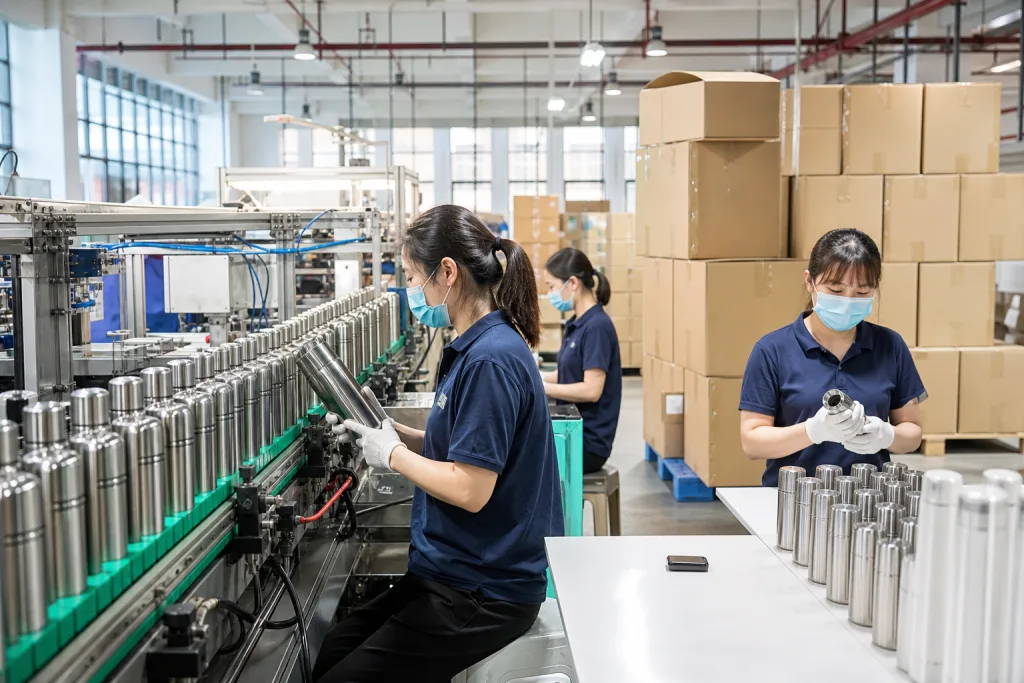
For larger customized canteen programs, ask whether the same body is already in mass production. This is the right question. At BottleForge Industrial, our Zhejiang plant capacity is up to 600,000 units per month across bottle and tumbler lines, so we usually run proven vacuum platforms for private label orders. QC pulled the sample from the same line setup, same neck tooling, same insulation process. You get fewer surprises than with a fresh mold and an aggressive launch date. That matters if your calendar is tied to back-to-school, holiday gift sets, or Amazon FBA inbound windows. We ship these projects against fixed booking dates, and 12 days vs 18 days matters.
A cheap vacuum bottle usually fails quietly: weaker retention, easier denting, and a higher leak rate after shipping. None of that shows in the first sample photo.
Lid system decides complaint rate
Buyers spend hours on bottle color chips and then sign off the lid in 5 minutes. That is the wrong question to ask. On most private label bottle programs, the lid system drives more post-shipment claims than the body. We usually lock 5 points first: lid resin, seal material, thread style, carry feature, and cycle test standard. On our line, a simple PP screw cap with a food-grade silicone gasket still gives the lowest complaint rate. Push-button lids, flip straws, and dual-use caps look stronger on the sales sheet, but we have seen them go sideways after 2 containers when spring force or seal compression drifts by 0.3 mm.
Thread compatibility decides whether the SKU family stays clean or turns messy fast. Check if the neck finish is shared across 350 ml, 500 ml, and 750 ml bodies. We run programs where 3 bottle sizes use 1 lid platform, and that cuts spare-part count, speeds reorders, and keeps warehouse bins under control. One buyer flagged this only after the second PO, when replacement lids for the 500 ml were packed against the 750 ml by mistake. If each size needs its own lid, the math does not work as well for distributors.
Testing needs numbers, not general promises. Ask for leak test under inverted static condition, thermal shock exposure, and open-close cycle counts, then ask how QC records the result. For standard screw lids, 2,000 cycles is a solid internal benchmark. For hinged lids, 3,000-5,000 cycles is safer because the hinge pin and latch tab are where QC pulled the sample failures first. If your project involves a customizable growler or custom growler with a metal handle cap, add handle pull-force testing with a hanging load in kg. A 64 oz growler that fails at the handle is not cosmetic. It is a product liability problem.
- PP lid: lower cost, stable color matching, good for retail basics; we usually see fewer shade complaints lot to lot.
- Tritan lid: better clarity and premium look, usually adds USD 0.12-0.25; buyers often accept this on gift-channel SKUs.
- Stainless cap shell: stronger premium feel, but watch denting and paint adhesion; cross-hatch tape tests catch weak coating fast.
If you work with a canteen factory in China, ask whether silicone gaskets are molded in-house or sourced. Outsourced seals are normal, but incoming inspection must be tight. We check gasket OD and thickness with a digital caliper, then run fit verification before mass packing. AQL and fit verification on gaskets stop the slow leak issue that shows up after 3-4 weeks in transit and storage, which is exactly when the buyer starts asking why random cartons smell damp.
Decoration line changes unit economics
The decoration line on the spec sheet changes more than shelf look. It hits margin, defect rate, and how easily we can rerun the same SKU 6 months later. On custom drinkware, the usual body finishes are spray paint, powder coating, base stainless, rubber finish, and gradient or other effect coatings. Powder coat stays popular for a reason: better grip, better hiding of minor dent marks and polishing lines than gloss spray. The weak point is process control. On the line, we watch curing temperature, coating thickness, and surface cleanliness closely; if film build drifts from 60-80 μm, QC pulled the sample more than once for adhesion risk.
Then the logo method decides the next chunk of cost. Silkscreen is still the low-cost choice for a canteen customized order with simple 1-2 color artwork, often around USD 0.05-0.12 depending on size and print count. Heat transfer works for full-color graphics, but the math does not always work on lower-ticket bottles, and we have seen edge wear show up after repeated bag rub. Laser engraving is durable and clean, usually USD 0.10-0.25, though it only works when the material and finish give enough contrast. We ship plenty of outdoor and gym programs, and engraving usually brings fewer complaint photos than a large glossy print.
Imprint area should be written in millimeters, not left as a sketch on a PDF silhouette. A straight 500 ml bottle may allow 180 x 90 mm wrap print, while a tapered bottle may only give 160 x 70 mm of clean print space after we check it on the fixture. This is where buyers get stuck. A retail line extension that fits your current artwork on one shape may need a full redraw on the next, and we have even seen a PO come through with the wrap width typed as 190 mm instead of 180 mm. That kind of miss costs days.
Ask how the factory checks decoration durability, because this is where cheap quotes go sideways. A practical standard includes tape test, alcohol rub test, dishwasher disclaimer review, and visual comparison against approved PMS or coated swatch. On our side, we usually run 3M tape, 50-cycle alcohol rub, and first-article signoff before mass production. If the project is canteen promotional for event giveaways, a lower-cost print can make sense. If it is a long-life distributor growler or premium customized canteen line, spend more on durable finishing. The wrong decoration method will wipe out the body-cost savings the buyer flagged in round one.
Packaging, carton, and freight math
Private label margin usually gets hit at the end, not on the first quote. We see it after production, when the buyer flags the carton plan because it does not fit their warehouse rack, retailer spec, or 3PL intake rule. Packaging belongs in the first drink bottle private label spec, not in the last email before shipment. Start with the unit pack: polybag, egg-crate divider, white box, color box, tube, or gift set. A white box may cost only USD 0.08-0.18, while a printed color box can run USD 0.18-0.45 depending on size, board grade, and finish. At 10,000 units, that gap is not small. On our line, QC will usually pull the first folded box and check board thickness and fit before mass packing starts.
Master carton details should include outer dimensions, gross weight, net weight, and units per carton. For North America and Europe, buyers usually try to stay under 18 kg gross per carton for easier manual handling and fewer warehouse complaints. That is a real limit. We have had 3PLs reject cartons at 19.6 kg because the PO said 18 kg max. If your canteen distributor or canteen distributors sell through club, grocery, or e-commerce channels, carton dimensions need to match pallet pattern and parcel rules, not just what is easy for the packing team. The wrong question to ask is, “How many pieces can you squeeze into one carton?”
Here is where bottle geometry bites. A wide-body customizable canteen may look good on screen but waste cubic volume, and the math does not forgive that. On FOB terms from Zhejiang, China, freight efficiency can swing landed cost more than unit factory price. Saving USD 0.10 on production means little if you lose 8-12% on container utilization. We ship enough mixed orders to see this go sideways fast, especially when a 92 mm body forces a larger color box and then a larger master carton. Ask the canteen manufacturer for 20GP and 40HQ loading estimates early. For Amazon or other marketplace replenishment, ask for barcode placement, suffocation warning needs, FNSKU labeling, and a drop-test suitable mailer strategy if units ship individually.
- Confirm carton marks and inner pack count before artwork approval.
- Check pallet height limits for your destination warehouse.
- Ask whether color box dimensions change with each lid style.
- Review barcode scan quality on curved packaging surfaces.
A canteen supplier with export experience should treat packaging as a logistics tool. Not a design afterthought. We have even seen one typo on a PO inner-pack count turn a clean 40HQ loading plan into a repack job.
Compliance, QC, and reorder discipline
The last part of the spec sheet is where experienced buyers protect margin. Write the compliance list, inspection standard, and reorder controls before deposit, not after the PO is stamped. For Europe, REACH and LFGB may be required based on the sales channel and customer brief. For North America, FDA contact compliance and ASTM-related requirements usually matter more on kids items and school programs, so ask what is tested on the exact SKU, not the catalog photo. We have seen this go sideways when a buyer approved a 500 ml bottle but the lab report covered the old lid only. If the bottle includes coatings, straws, or odd handles, expand the test scope and list each part.
Quality control should not stop at “factory checks before shipment.” Ask for incoming material inspection, in-process leak test, vacuum check, and final random inspection standard. AQL 2.5 for major defects and 4.0 for minor defects is a common baseline on drinkware exports from China. On our line, QC pulled the sample after the 0.3 MPa air-pressure leak test and caught a straw gasket shaving that would have passed a fast visual check. Premium retail programs should run tighter than the baseline. For short campaign stock, you might allow a looser print tolerance of 1 mm on logo position, but never loosen leakage or food-contact risk. That is the wrong place to save cost.
Reorder discipline is the quiet advantage of a solid canteen factory. Record Pantone reference, body weight, lid batch code, carton spec, and approved golden sample number. Add small details too: coating gloss level, logo height in mm, and master carton drop direction mark. Without that file, batch two drifts from batch one and the buyer flags it as “normal tolerance” only after goods land. We have seen a PO typo swap matte navy for Pantone 2965 C, and then everyone argues for 10 days. Stable canteen manufacturers in Zhejiang usually keep SOP sheets and retained samples for repeat programs. That is why 30-day replenishment stays realistic on running items, especially when the MOQ stays at 1,000 pcs per color or 3,000 pcs mixed across a standard body platform.
If you are screening canteen vendors, ask blunt questions:
- What is your normal MOQ by body and finish?
- How many leak tests are performed per batch?
- Do you support BSCI or other social audit requirements?
- What documents ship with the goods: test report, packing list, inspection report?
That is how you judge whether a canteen manufacturer or canteen supplier can support a real private label business. A good-looking pre-production sample proves almost nothing. We ship plenty of first samples that look clean; the hard part is holding the same seal, color, and packing spec on the 2,000th piece.
Send your target spec sheet for a fast factory review
Share capacity, material, lid type, logo method, MOQ, and destination market. We will flag cost risks, compliance gaps, and realistic lead time from Zhejiang, China.
Frequently asked questions
What is a normal MOQ for drink bottle private label orders?
For standard stainless steel bottles, a practical MOQ is 1,000 pieces per color per size if you use an existing mold and a common lid. Some canteen manufacturers in China allow 500 pieces for stock colors, but the unit price usually rises by USD 0.20-0.50 and decoration options narrow. For a new mold, MOQ can move to 3,000-5,000 pieces. If you want a mixed assortment for a distributor drinkware program, many factories can combine colors across 3,000 pieces total on one body platform. Always ask whether MOQ is based on bottle body, lid color, or packaging type, because each one can trigger a separate production minimum.
How much should I expect to pay for a private label stainless bottle?
FOB China pricing depends on size, steel thickness, lid type, finish, and decoration. A basic 500 ml single-wall bottle may land around USD 1.20-2.20 FOB. A 500 ml double-wall vacuum bottle in SUS304 with powder coat and one-color logo is more commonly USD 2.80-4.50 FOB. Premium builds with Tritan components, complex lids, or gift box packaging can reach USD 5.50-6.50. A custom growler at 64 oz is usually higher because of steel weight and larger cartons. Ask your canteen supplier for price broken into body, lid, logo, and packaging. That helps you value-engineer without guessing.
How long does sampling and mass production usually take?
For a standard drink bottle private label project using existing molds, pre-production samples usually take 7-12 days after artwork and color confirmation. If you need a new mold, allow 20-30 days for tool development plus another 7-10 days for sample validation. Mass production on repeatable items is often 25-35 days from deposit and approval, though peak season can push it to 40-50 days. In Zhejiang, China, experienced canteen factories often hold standard lids and some stock materials to protect lead time. If your launch depends on a retail ship window, ask for a backward schedule covering sample approval, lab testing, packaging print lead time, and vessel cutoff.
Which tests matter most for custom drinkware orders?
Start with food-contact compliance and leak performance. For Europe, buyers commonly request REACH review plus LFGB or similar food-contact testing depending on the channel. For North America, FDA-related food-contact compliance is often the baseline. Then add functional tests: leak test, heat retention verification, coating adhesion, drop test, and lid cycle life. For kids items, straws, or specialty lids, the scope may widen. On the QC side, use final random inspection with AQL 2.5 for major defects and 4.0 for minor defects as a starting point. A smart canteen vendor will also run 100% leak checks in production, not just random checks at the end.
How do I choose between promotional and retail-grade specifications?
Decide based on intended life, selling price, and return tolerance. Canteen promotional orders often accept simpler single-wall or lighter vacuum bodies, basic silkscreen logos, and plain white boxes to hit a target budget. Retail-grade customized drinkware should usually use SUS304 contact surfaces, stronger finish durability, tighter color matching, and more formal compliance documentation. If your brand plans reorder volume through canteen distributors or direct e-commerce, spend more on lid reliability and packaging integrity first. The cost gap may only be USD 0.40-1.20 per unit, but it can reduce complaint rates by several percentage points. Retail buyers should optimize for repeatability, not just first-order price.