Key Takeaways
- A practical MOQ for custom stainless drinkware bulk is usually 1,000-3,000 units per SKU, while stock-color logo orders can start at 500 units
- FOB China pricing for a 500 ml single-wall stainless bottle typically lands at USD 1.60-2.40; double-wall vacuum runs about USD 3.20-5.80 depending on lid and finish
- Lead time is usually 7-12 days for samples and 25-40 days for production after deposit, with output around 300,000 units/month in Zhejiang factories
- For Europe and North America, ask for REACH, LFGB or FDA-contact compliance, plus AQL 2.5 inspection and drop-leak testing before shipment
You can buy a drink bottle in bulk from 20 suppliers in China by Friday. Easy enough. The hard part is getting a bottle your market can still sell in October. Most mistakes happen before sampling starts: the PO says 304 stainless but the body wall comes in at 0.32 mm, the lid thread feels loose after 200 open-close cycles, the logo ink fails dishwasher testing, or the master carton is 6 cm too tall for your pallet plan. If you buy for retail, corporate gifting, Amazon FBA, or distribution, this is the wrong question to ask: “Which bottle looks best in the catalog?” The spec matters more than the photo.
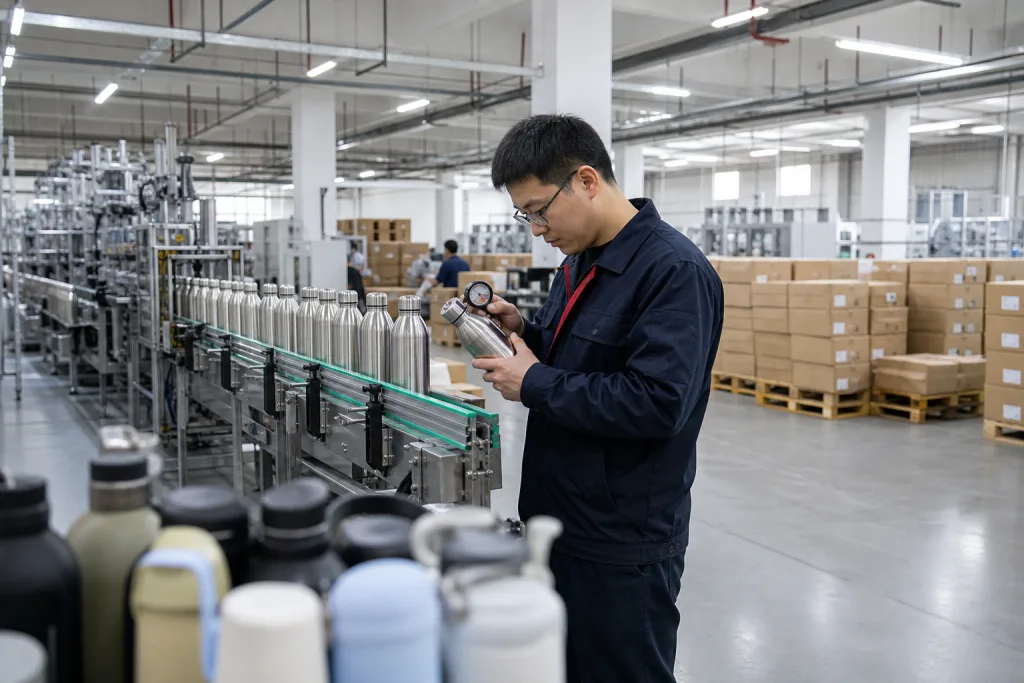
At BottleForge Industrial in Hangzhou, Zhejiang, we see the same pattern with new buyers from Europe and North America. The buyer asks for the best wholesale drink bottle; on the line, that usually means they have not fixed the actual brief yet. What they need is a fit between use case, compliance, MOQ, and landed cost. A 500 ml sports bottle, a bulk canteen, and a bulk growler do different jobs, and the math doesn't work if you treat them the same. Last month QC pulled the sample on a 750 ml bottle because the customer’s PO had the wrong carton qty printed as 48 pcs instead of 36. Numbers first, sample second. We’ve seen this go sideways.
Start with the commercial use case
Buyers often start with shape: slim bottle, canteen, tumbler, growler. We think that is the wrong question to ask. Start with the sales channel and the actual use. A wholesale drinkware program for supermarket retail is built one way; drinkware wholesale for brewery merchandise or outdoor distributors is built another way. On our line, the same 500 ml body can pass for retail and fail for promo once freight and return rate are added back into the quote.
For branded retail, the usual target is shelf price against complaint rate. That usually points to 18/8 stainless steel, wall thickness around 0.4 mm for single-wall or 0.4/0.4 mm for double-wall, and a lid with a silicone gasket that survives repeated torque cycles. We check this on a torque meter, not by hand feel. For promotional campaigns, buyers usually push for logo area, low MOQ, and carton efficiency. In that case, a 500-750 ml single-wall bottle often beats an insulated model by USD 1.20-2.50 per unit. The math does not work if the campaign only runs 8 weeks and the buyer wants to keep landed cost under a fixed cap.
Use-case fit also separates categories that buyers mix together:
- Drink bottle in bulk: daily hydration for gyms, schools, corporate promotions, and general retail. Most orders we ship here are 5,000 pcs and up, usually straight-body shapes that run faster on screen print.
- Bulk canteen or canteen bulk: outdoor, military-style, heritage gift sets, camping stores. Flatter profile, often powder coated. The line needs different nesting trays because the shoulder gets marked fast if packing pressure is wrong.
- Bulk growler or beer growler bulk: breweries, taprooms, beverage transport. Usually 32 oz, 64 oz, or 128 oz with wider mouth and pressure-conscious closures. We have seen buyers flag lid fit after carbonation use, so neck tooling control matters more than the body output.
- Beer tumbler bulk: on-premise beverage service, branded merchandise, insulated beer cups, event use. QC pulled the sample once on a 20 oz tumbler because the base wobble was over 1.5 mm.
- Alcohol flask bulk: gifting, souvenir, and spirits promotions. Smaller volume, often 6 oz to 8 oz, with stricter finish expectations. A tiny weld shadow at the shoulder will get rejected here even if the same mark passes on a sports bottle.
If you are sourcing from Zhejiang, China, ask your supplier which category they actually build every month. Ask for the last 3 POs if needed. A factory that makes 200,000 sports bottles can still struggle with wholesale growler neck tooling or welded flask shoulder consistency. We have seen this go sideways. Capacity is not the same as category competence.
Head-to-head spec table that matters
For a comparison that means something, line up the main formats and judge them on unit cost, carton efficiency, and where they actually sell. The table below is based on common factory ranges in China for mid-volume OEM orders. Not clearance leftovers. On our line, this usually means a 1,000 pcs start with standard export cartons, not a rushed mixed-stock job where QC pulled the sample and found three lid colors in one case.
| Format | Typical Capacity | MOQ | FOB China | Best Fit | Main Watchout |
|---|---|---|---|---|---|
| Single-wall bottle | 500-750 ml | 1,000 pcs | USD 1.60-2.40 | Promo, schools, price-sensitive retail | Sweating, no heat retention |
| Vacuum bottle | 500-1,000 ml | 1,000 pcs | USD 3.20-5.80 | Outdoor, premium retail, DTC | Vacuum failure risk if QC is weak |
| Bulk canteen | 17-25 oz | 1,000-2,000 pcs | USD 3.40-5.20 | Outdoor, gift sets, heritage style | Non-standard cartons and strap accessories |
| Beer tumbler wholesale | 12-30 oz | 1,000 pcs | USD 2.40-4.50 | Events, breweries, gift retail | Lid fit and coating scratches |
| Beer growler wholesale bulk | 32-64 oz | 500-1,000 pcs | USD 5.80-10.50 | Breweries, refill programs, outdoor | Closure sealing and weight |
| Alcohol flask wholesale bulk | 6-8 oz | 2,000 pcs | USD 1.20-2.20 | Souvenir, gifting, spirits promo | Dent visibility and polish quality |
This table usually speeds up the decision. Fast. If your target shelf price is under USD 14.99, a double-wall bottle with a two-color box, straw lid, and laser engraving often leaves too little room for margin after freight and channel markup. We have seen buyers push for all three, then cut the order after the first cost sheet. The math doesn't work. If the item will sit in a brewery taproom, a beer growler in bulk with a weak closure is worse than not listing a growler at all. One leak test failure at 0.03 MPa is enough to turn saved cost into returns.
Rule of thumb: if the product is refill-intensive, put the extra money into closure quality and thread consistency before you upgrade the packaging. This is the wrong question to ask first, but buyers ask it all the time. We ship repeat orders where the cap thread tolerance is held within 0.2 mm, and those projects stay cleaner than the ones with fancy gift boxes and average lids. Reverse the order and we've seen it go sideways. Expensive sideways.
Material and construction choices compared
Most buyers ask for 304 stainless steel because procurement and sales both recognize the term. That part is fine. The better question is where the grade sits in the bottle. For most drink bottle in bulk orders, we specify food-contact 18/8 stainless, equal to SUS304, for the main body and inner contact area. If the bottle will hold acidic drinks, go through frequent dishwasher cycles, or sit in a premium line, some buyers switch to 316 on the interior of selected SKUs. Cost goes up fast. On our line, that change is usually felt first in raw material price per kg, not in appearance.
Construction has a direct effect on complaint rate:
- Single-wall stainless: lighter, cheaper, easy to run. Good for drinkware bulk promotions, school programs, and hot-weather markets where insulation is not the sales point.
- Double-wall vacuum: easier to sell at a higher margin because performance is clear, but freight weight climbs and process control gets tighter. We run vacuum check fixtures on these, and weak welds show up fast.
- Tritan or RPET: lower weight and common in sports shapes. Check what the market expects on recycled-content claims, because buyers have flagged mismatched RPET wording on outer cartons before shipment.
- Glass with silicone sleeve: strong shelf appeal, weaker drop resistance in transit. If the packout is loose by even 2 mm at the divider, breakage starts showing in distribution.
Where buyers get caught
Thickness and weld quality matter more than first-time importers expect. We have seen a 0.3 mm body pass sample approval, then pick up dents during local delivery. A 0.4 mm to 0.5 mm body is safer for wholesale drinkware going into retail channels with more handling. For vacuum models, ask for heat-retention test data, vacuum inspection rate, and whether 100% of units get a leakage check before packing. This is the wrong place to save pennies. QC pulled the sample once on a 500 ml bottle where the seam looked clean, but the leak test failed after the third cycle.
Ask your supplier one simple question: what is the real reject rate on this structure over the last three production runs? If they cannot answer clearly, the catalog means very little.
For bulk canteen and wholesale canteen orders, body profile matters too. A flatter shape changes the draw process and usually lifts cosmetic rejects on the line. We have seen this go sideways when a buyer approved a round sample, then changed to a flattened silhouette after tool sign-off. For alcohol flask in bulk, mirror polish is unforgiving. Every dent, weld shadow, and edge mismatch shows. That is why flask pricing often looks high for such a small item. The polishing wheel does not care that the flask weighs less.
Factories in Zhejiang, China with mature stainless lines usually control these points well, but only when the specification is locked early and left alone after tool approval. We ship smoother when details like wall thickness, neck finish, and logo position are fixed before first trial. Last year one PO even had the lid color code typed wrong, and that small error held the line for half a day.
Decoration, packaging, and channel fit
You are not buying a bare container. You are buying a sellable unit. Decoration changes shelf look and return rate at the same time. On our line, QC pulled samples with logo edge lift after 50 dishwasher cycles, even though the print looked fine at first glance. The standard options are silkscreen, heat transfer, water transfer, laser engraving, digital printing, and powder coating. Each one hits cost, lead time, and wear in a different way.
For canteen wholesale and drinkware wholesale programs, powder coating plus laser engraving is the safe combo we ship most often. It looks clean, feels premium, and hides handling marks better than basic spray paint. Silkscreen still works for big simple logos at 5,000 pcs MOQ, but the buyer flagged mis-registration more than once when the artwork crossed a curved shoulder or rough powder surface. Ask for adhesion test results and dishwasher guidance in writing. If a factory dodges that question, we've seen this go sideways.
Packaging is where channel strategy gets real:
- Big-box retail: color box dimensions need to match shelf footprint and master carton cube; we have had buyers cap the box depth at 92 mm because one extra centimeter broke the planogram.
- Amazon FBA: each unit often needs FNSKU label placement, suffocation warning rules for polybags, and stricter drop testing; on one PO, the label callout was typed as “FSNKU,” and the line had to stop for reconfirmation.
- Corporate gifting: gift box quality matters, but box cost should not run past 12-18% of FOB without a clear reason; the math doesn't work on repeat programs.
- Distributor stock sales: plain white box or egg-crate divider usually gives better turnover and lower damage; we run more of these because distributors care about clean arrivals, not fancy unboxing.
For beer tumbler in bulk or beer tumbler wholesale bulk, gift-ready packaging is tempting. We get that pushback every season. Still, tumblers sell on hand feel and daily use, not carton art by itself. If your end market is wholesale drinkware to distributors, a plain box can improve case-pack efficiency and cut landed cost by USD 0.20-0.60 per unit, and it usually packs faster on the line too.
If your item is a beer growler in bulk, take carton design seriously. A 64 oz insulated growler is heavy. Weak inserts lead to freight claims fast. We usually tell buyers to spend money on transit protection first, then premium print effects later. Last month we increased an insert wall from 1.5 mm to 2.2 mm on a drop-test sample after the base corner collapsed. That is practical sourcing. Not glamorous sourcing.
MOQ, lead time, and pricing reality
New buyers to China often send a wish list like this: 3 colors, 2 lid options, 4 sizes, a custom box, and a 500-piece MOQ. The math doesn’t work. If you want clean wholesale drink bottle pricing, strip down the first PO and get the core SKU running first. We’ve seen this go sideways on the line over a 2 mm lid fit change that looked minor on paper.
Typical ranges for a Zhejiang factory with stable OEM business look like this:
- Stock item with one-color logo: 500-1,000 pcs, lead time 15-25 days.
- Custom color + logo: 1,000-3,000 pcs per SKU, lead time 25-35 days.
- New mold or unique lid: usually 3,000 pcs and up, lead time 35-55 days plus tooling.
- Sampling: 7-12 days for logo sample, 15-20 days if new color or structure is involved.
At BottleForge Industrial, a practical planning number is 300,000 units/month across standard stainless lines, but that does not mean every SKU ships at the same speed. We run standard bodies faster than mixed-lid programs, and peak season before Q4 gift programs usually adds 7-12 days. Last year, QC pulled the sample because the Pantone callout on the PO had one digit wrong, and that single typo cost 6 days. Buyers who send artwork late and blame production are blaming the wrong step.
Pricing needs context. FOB is not landed cost. For Europe and North America, freight, duty, testing, inspection, and local warehousing can add 20-45% depending on product category and shipment mode. We ship enough to know one failed drop test or one AQL hold burns more money than a small FOB gap. A cheap drink bottle in bulk that fails inspection is not cheap. A slightly higher FOB with stable AQL performance often gives a lower total cost.
If you compare bulk growler, wholesale canteen, and drink bottle in bulk on unit price alone, you’ll make the wrong call. This is the wrong question to ask. Compare margin after compliance cost, freight cube, packaging spec, and expected return rate. One buyer flagged a carton size increase of 8 mm because it cut pallet efficiency, and he was right to do it. That is the commercial comparison that matters.
Compliance and QC you should insist on
Serious buyers do not leave compliance until the paperwork stage. We build it into the RFQ, the pre-production sample, and the approval sheet on day one. For Europe, ask for REACH-related conformity on the materials that touch the product and, where needed, LFGB food-contact testing. For North America, FDA food-contact alignment is standard on most programs we ship. For children’s products, ASTM or CPSIA-related requirements depend on the exact SKU and where it will be sold. On the line, this starts with basic material traceability—304 stainless coil lot, lid resin, and silicone ring batch—not a last-minute PDF.
For factory control, the basic checklist should include:
- BSCI or equivalent social compliance status if your retailer requires it; one U.S. chain buyer flagged this before even reviewing our 3,000 pcs quote
- ISO-oriented process control or internal SOPs for incoming, in-process, and final inspection, with clear checkpoints like mouth diameter tolerance at ±0.3 mm
- AQL standard for pre-shipment inspection, often AQL 2.5 for major defects and 4.0 for minor; this is the wrong question to skip because the math changes fast once rework starts
- Leak test, vacuum test, coating adhesion, carton drop test, and barcode scan verification where applicable; QC pulled the sample and ran a 1 m carton drop plus 100% barcode spot check on the outer case
Common major defects in drinkware wholesale are leaking lids, crooked print, dents, vacuum loss, burrs on threads, unstable base, and odor from low-grade accessory material. We have seen buyers reject goods over a logo offset of 1.5 mm. For alcohol flask wholesale, cap hinge alignment and surface scratches show up often, especially after polishing. For beer growler wholesale, watch sealing performance and handle weld consistency; we have seen this go sideways when the weld bead looks clean but fails under repeated carry-load checks.
One practical move: approve a golden sample with a signed spec sheet covering dimensions, net weight, steel grade, finish code, logo position, carton marks, and test method. Add photo points and seal one sample in the sample room if the order is repeat business. Without that, your supplier and your inspection company are often judging two different standards. We once saw a PO typo on carton mark text hold shipment for 2 days.
China has 100+ capable drinkware factories, but capability is proven by repeatable control, not by a polished brochure. We would rather see 6 months of inspection records than a sales deck. If your supplier in Zhejiang can show recent test reports, in-process inspection logs, and corrective actions tied to an actual defect, you are dealing with a manufacturing partner, not a trading guess.
How to choose the right format fast
If you need a fast buying shortcut, match the format to the sales channel and the reorder math. This is the right question. On our side, we run this check before opening tooling options or custom packaging.
Choose a standard drink bottle in bulk if you want broad appeal, easier logistics, and lower risk on a first PO. A 500 ml or 750 ml insulated bottle is still the safest platform for wholesale drinkware across retail and DTC. We ship more first orders in this format than anything else. It is easier to quote, easier to pack into standard export cartons, and easier to reorder after QC pulled the sample and the buyer approved the first color.
Choose a bulk canteen or wholesale canteen if your brand story is outdoor, heritage, or military-inspired. This format is more style-driven, so color, strap width, and cap finish need tighter control. Keep SKUs controlled from day one. We have seen a buyer ask for 6 body colors x 4 straps x 3 caps, and the math does not work. Too many combinations will hurt your MOQ position and slow the line.
Choose a bulk growler or beer growler wholesale only if your channel has a real use for refill or take-home beverage transport. The unit is heavier, more expensive, and less impulse-friendly than a standard bottle. A packed 64 oz growler also changes carton weight fast, and that hits freight. For breweries and outdoor stores, it can still be the right hero item. For general gift retail, we have seen this go sideways.
Choose beer tumbler bulk if your buyers want immediate-use beverage merch with lower price resistance than bottles. It works well for event programs and branded barware bundles. A common starting point is 20 oz because lid options are simple and master carton loading is cleaner. The buyer flagged loose splash lids on one project last year, so now we push sample checks earlier on this item.
Choose alcohol flask bulk for gift and souvenir channels, not for broad hydration retail. It is a smaller niche, but the right finish and box can hold good margin. Surface details matter here more than capacity does. On flask orders, our QC team spends extra time checking coating scratches and hinge fit because a 0.5 mm lid gap gets noticed fast.
If you are still undecided, ask for three quotations only: one 500 ml vacuum bottle, one 20 oz tumbler, and one 64 oz growler. Then compare FOB, carton cube, compliance scope, and sample quality side by side. We do this with buyers every week. The head-to-head check usually shows which product belongs in your line and which one only looks good in a PDF. If one quote looks cheap but the carton cube is bad, stop there—the landed-cost math is wrong.
Get a practical bulk drinkware quotation
Send your target market, capacity, finish, MOQ, and packaging needs. We will recommend the right bottle format and quote workable FOB options from Zhejiang, China.
Frequently asked questions
What is a realistic MOQ for a custom drink bottle in bulk order?
For a standard stainless bottle with custom logo and stock lid, 1,000 pieces per SKU is a realistic starting point in China. If you want a custom powder-coat color, printed box, and mixed sizes, many factories will push that to 2,000-3,000 pieces. Stock-color orders with simple silkscreen can sometimes start at 500 pieces. New molds, unique lids, or highly customized canteen wholesale projects usually require higher volume because tooling and setup costs need to be amortized. If you are testing a new market, ask for one body style in two stock colors rather than four custom colors. That usually gives you a better unit price and a cleaner first production run.
How do I compare prices between bottles, tumblers, and growlers fairly?
Do not compare only by FOB unit price. Compare by usable volume, wall construction, carton cube, and expected complaint risk. A 500 ml vacuum bottle at USD 4.10 FOB may outperform a USD 3.40 tumbler if your retail price and return rate support it. A beer growler in bulk at USD 7.80-9.50 FOB can still be the better buy for a brewery if the product drives refill traffic and branded visibility. Add packaging, inspection, freight, and duty before making the call. I suggest using a simple spreadsheet with five columns: unit FOB, carton quantity, carton size, estimated landed cost, and target gross margin. That removes the guesswork quickly.
Which compliance documents should I request for Europe and North America?
For Europe, ask for relevant food-contact compliance support, commonly REACH-related material conformity and, depending on the product, LFGB test reports. For North America, FDA food-contact alignment is typical for drinkware. If the product is for children, additional standards such as ASTM or CPSIA-related testing may be needed depending on design and sales channel. Also request factory audit status if your customer requires BSCI or similar social compliance. The key point is product-specific evidence. A generic certificate is not enough. Match the report to the exact material set: body, lid, gasket, straw, coating, and decoration. If any accessory changes after sampling, the compliance file may need updating.
What quality checks matter most before I place a reorder?
Look at three things: leakage, cosmetic consistency, and packaging damage rate. For insulated drinkware bulk, vacuum performance and leak testing should be standard on every production lot. For printed items, confirm color match, logo position tolerance, and adhesion results. For heavy items like beer growler wholesale bulk, review carton drop performance and insert strength because transit damage can ruin an otherwise good order. On the inspection side, many buyers use AQL 2.5 for major defects and 4.0 for minor defects. Ask for photos of defect categories from the last run. If a supplier can show corrective actions with actual numbers, such as reducing leak failures from 1.8% to 0.3%, that is a strong sign.
How long should I plan for samples and production from China?
For a stock-style bottle with your logo, 7-12 days for samples is normal. If you need custom color matching, special finish, or revised packaging, sample time can move to 12-20 days. Production for a standard 1,000-3,000 piece order is commonly 25-35 days after deposit and artwork approval. If your order includes new tooling, peak-season scheduling, or multiple SKUs, expect 35-55 days. Add time for inspection and freight booking. From Zhejiang, China, sea freight planning for Europe or North America can easily add several weeks, so do not build your retail launch around the factory finish date alone. Work backward from shelf date, not from PO date.