Key Takeaways
- For most stainless custom drinkware, realistic MOQ starts at 1,000-3,000 pcs per color, while stock-color quick runs can begin around 500 pcs
- A decoration choice can move scrap rates by 3%-8% and shift unit cost by USD 0.12-0.60 depending on silkscreen, powder coat, laser, or heat transfer
- Typical production lead time from Zhejiang, China is 25-45 days after sample approval and deposit, plus 7-10 days for packaging validation
- Use an AQL 2.5/4.0 inspection plan and confirm REACH, LFGB, FDA, ASTM or CPSIA relevance before mass production, not after shipment
You are not buying a bottle. You are buying repeatability: the same powder-coat gloss on 5,000 units, the same leak result after torque testing at 1.8 N·m, the same barcode position so your warehouse scanner reads the outer carton on first pass. This is where first orders go sideways. We have seen a hand-polished sample look fine, then the line slows down at mass production, decoration yield drops below 92%, or QC pulls the sample and finds a compliance gap only after the goods are booked for Europe or North America.
If you source from China or switch suppliers in Zhejiang, “Who is cheapest?” is the wrong question to ask. The better question is: which factory can run your exact program with the lowest total risk? For custom drinkware, that means locking a few basics early: body material, decoration method, MOQ and packaging, then quality controls and shipping terms. One typo on a PO, one unlabeled inner box spec, or one loose tolerance like ±3 mm on logo position can cost more than the price gap. Get these points right early, and you avoid expensive surprises later.
Start with four buying decisions
When you compare a drink bottle factory, do not start with catalog photos. Start with four decisions that set cost, risk, and ship date. We see buyers lose 2 weeks here because the RFQ looks clean, but the spec sheet is missing lid style, carton pack, or even a typo in the PO capacity.
- Decision 1: Product platform. Pick the body type first: single-wall aluminum, double-wall 18/8 stainless, tritan, glass, or a custom growler. A 500 ml single-wall sports bottle and a 40 oz vacuum tumbler should not sit in the same quote sheet. They run on different lines, use different tooling, and hit different test points. On our floor, the vacuum flask line checks weld and heat retention; the aluminum line watches dent rate and neck tolerance in mm.
- Decision 2: Custom level. Decide if you need a stock body with logo or a fully customized canteen with a new lid, handle, base, and retail box. This is where the math often breaks. A custom canteen program with new molds may add USD 2,000-12,000 in tooling and 15-30 days to the timeline, and that is before the first pre-production sample gets adjusted. We have seen buyers ask for a fresh lid mold at 1,000 pcs MOQ; usually that goes sideways.
- Decision 3: Compliance market. Lock the sales market early. Europe may require REACH and LFGB attention; North America may add FDA contact requirements, California labeling review, or ASTM/CPSIA issues for kids items. This is not paperwork at the end. QC pulled the sample once because the warning copy on a kids bottle hangtag did not match the approved file, and the buyer flagged it one day before booking.
- Decision 4: Fulfillment model. Be clear on how the goods ship. Are you importing pallets to a distributor drinkware warehouse, shipping split cartons to canteen distributors, or preparing FNSKU-labeled retail units for Amazon? Packaging and carton marks change the workflow fast. A plain export master carton is one thing; an Amazon unit with barcode placement, drop test risk, and insert card count is another.
Most sourcing mistakes happen when buyers mix these decisions and ask every canteen manufacturer for “best price.” That is the wrong question to ask. It gives you numbers, not a clean comparison. A canteen supplier that runs stock promotional drinkware well may be weak on mold development. A canteen factory shipping 600,000 units per month may still be the wrong fit if your order needs low-MOQ customized drinkware with six artwork versions, mixed lid colors, and registration held tight on a curved print area.
Build your shortlist around fit. In Zhejiang, China, 20 factories can make a good-looking sample this month. Far fewer can hold stable quality across repeat POs with the same gasket hardness, powder coat thickness, print registration, and carton consistency. We run durometer checks on silicone, measure coating after cure, and log repeat issues by PO number. That is the standard to buy against.
Match factory type to your program
Suppliers in China are not the same shop with different names. Some are trading companies that source across 20 or 30 factories. Some are actual canteen manufacturers with tube cutting, auto welding, vacuuming, painting, printing, and assembly under one roof. Some sit in the middle: they run their own line for core SKUs and push overflow outside during peak months. That last model is common. The key is simple: know who is making your bottle, on which line, and who owns the problem if the cap fit is off by 0.3 mm.
For a repeatable B2B program, ask direct questions:
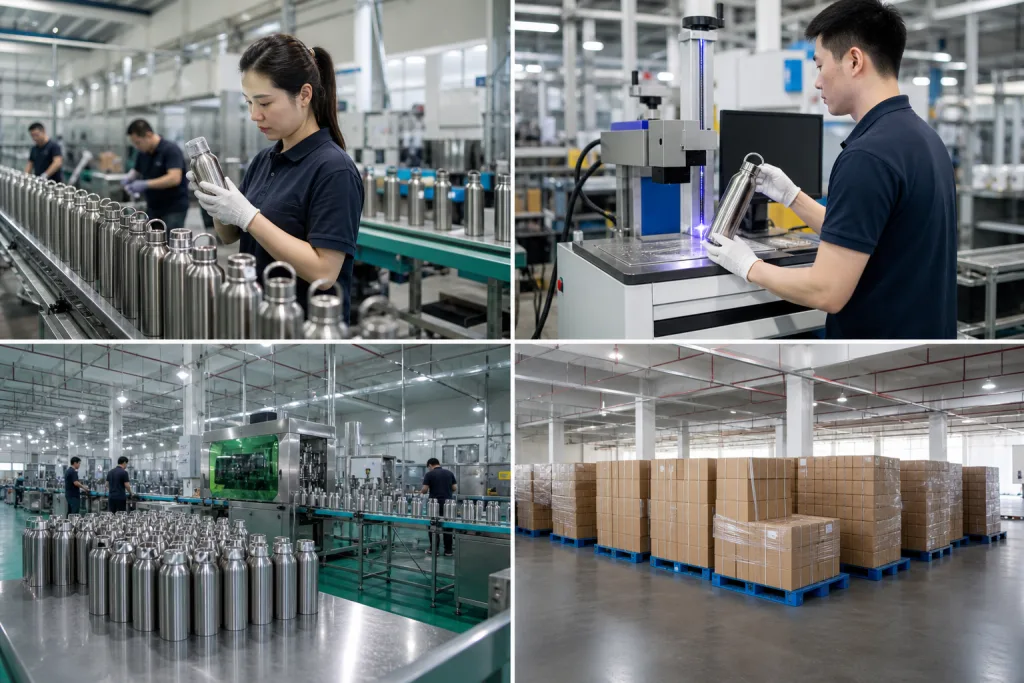
- What processes are in-house: tube cutting, hydroforming, auto welding, vacuuming, electropolishing, powder coating, silkscreen, laser engraving, pack-out?
- What is monthly capacity for my category: 300,000 sports bottles or 150,000 vacuum bottles?
- What is the normal MOQ by SKU and color?
- How much of the order is subcontracted?
- Can the factory manage BSCI, ISO 9001, audit records, and lab test coordination?
A true drink bottle factory usually fits better if you need schedule control, engineering changes, or custom growler and customizable canteen development. We have seen this go sideways when a buyer approved a new lid mold on Tuesday, but the trading company did not get the revised drawing to the outsourced cap supplier until Friday. Four days lost. If you buy proven stock items with light branding, a capable trading partner can still do the job well, especially if they already ship mixed containers and know how to keep carton specs, print files, and booking dates lined up.
Where factory structure matters most
Factory structure matters when the program has moving parts. Think 4 lid options, Pantone color matching, barcode labels, retail display boxes, and a SKU family that shares one base bottle but uses different pack-outs. If you are a distributor canteen buyer serving several accounts, an integrated factory usually cuts communication loss. QC pulled the sample, engineering updates one file, and the line works from the same approved standard. You do not spend three days chasing one vendor for color, another for print, and a third for cartons because someone typed the wrong PO suffix.
A supplier is not strong because the price is low. A supplier is strong because the same specification survives purchasing, production, inspection, and shipping without changing shape halfway through.
This is why buyers often choose a canteen factory in Zhejiang with stable export routines. The support base here is dense: carton plants, decal suppliers, mold shops, powder coat vendors, and lid tooling are usually within a short drive, not three provinces away. That helps on custom jobs. The wrong question to ask is who has the lowest unit price. Ask who can hold the spec from first sample to final inspection without the buyer flagged it at pre-shipment.
Choose material before chasing price
If you want pricing that holds up, lock the material and construction first. We see buyers send one RFQ to 6 canteen suppliers with half the spec missing, then wonder why the lowest offer falls apart at sample stage. The cheap number usually comes from lighter steel, a 0.03-0.05 mm thinner powder coat, or a simpler lid stack that was never discussed. We’ve seen this go sideways.
For stainless programs, call out grade and structure in plain terms. Most export vacuum bottles use 18/8 stainless outside and inside, often marked SUS304. For tougher use, some buyers ask for SUS316 inner walls. Common wall thickness is 0.4-0.5 mm for body parts, but the same thickness does not perform the same on every shape; a deep-draw die behaves one way on a slim 500 ml bottle and another on a 32 oz customized canteen with a wide mouth, carry handle, and boot. This is the wrong question to ask if the only question is price.
- Single-wall stainless or aluminum: lower cost and lighter freight, better for canteen promotional events, usually USD 1.20-2.80 FOB China depending on size and decoration. On the line, these are also easier to pack tighter by carton count.
- Double-wall vacuum stainless: most common for premium customizable drinkware, usually USD 2.80-6.50 FOB China in mainstream volumes. QC pulled the sample on one recent run because the vacuum bottom was off-center by 1.2 mm, and that changes both appearance and stability.
- Tritan or RPET: lighter for sports use, but branding method and heat-resistance target need to be written down. Buyers flag this later when the bottle goes from cold-fill use to dishwasher claims.
- Glass with sleeve: clean shelf look, but breakage planning and drop-test packaging matter more. If you skip this, the math doesn’t work once transit damage starts hitting 2 or 3 cartons per shipment.
- Growlers: a custom growler or customizable growler often needs stronger lid testing, carbonation-use disclaimers, and heavier carton design. We usually bump the carton board grade here because gross weight climbs fast.
Ask for actual weight per unit, not only capacity. Two bottles with the same volume can differ by 40-90 grams, and buyers feel that difference the moment they hold the sample. It also changes freight and dent performance. Confirm whether accessories are virgin PP, Tritan, silicone, or TPE, because odor, dishwasher behavior, and migration tests depend on that callout. We once got a PO with “silicon” typed instead of “silicone,” and yes, the buyer flagged it during approval.
Any serious canteen manufacturer should issue a drawing or specification sheet before sampling. We run that sheet against tooling, lid fit, and packing details before the first sample is signed off. If a supplier cannot define the structure, they will not control it in production.
Decoration, packaging, and MOQ trade-offs
Most custom drinkware orders get expensive in the last 20% of the spec. The bottle body may be standard, but logo finish, gift box, inserts, and carton rules can turn a clean PO into a slow one. We see this on the line all the time: the buyer approves the bottle fast, then spends 6 days going back and forth on a 3 mm EVA insert and outer carton mark.
Decoration needs to match the brand and the way the bottle will be used. Silkscreen is still the best value for simple art, often adding around USD 0.08-0.18 per color position, and it stays crisp if the artwork is not too fine. Laser engraving is durable and premium, usually USD 0.12-0.35, and buyers pick it when they do not want print wear on high-use SKUs. Heat transfer or digital wrap works for complex artwork but can add USD 0.25-0.60, and QC pulled samples before for seam alignment drifting 1.5 mm on full-wrap art. Powder coating helps grip and shelf feel, but this is the wrong question to ask if nobody defines texture first. Ask how the factory checks coating thickness and color variance, because a matte black sample and a mass-run matte black can look different if the line does not control both.
MOQ moves with customization level:
- Stock body + 1-color logo: often 500-1,000 pcs per SKU
- Custom body color + retail box: often 1,000-3,000 pcs
- New lid or base mold: often 3,000-10,000 pcs plus tooling
- Mixed-size family programs: sometimes feasible if total volume hits 3,000-5,000 pcs
If you are buying for canteen distributors or a distributor growler program, ask early whether the supplier supports assortment packing, barcode application, and retailer carton rules. We ship these jobs every month, but they need to be quoted before artwork is locked and before the PO lands with a typo in the shipping mark. A plain white box may cost USD 0.12-0.20. A printed mailer or display-ready color box can cost USD 0.35-1.20 depending on board grade, inserts, and finish. The math does not work if you build a USD 0.18 bottle decoration plan and then add a USD 0.95 box at the end.
For canteen customizable projects, push your team to rank what actually sells the product. If your buyer says “premium,” define it in plain terms: heavier steel, matte powder coat, giftable packaging, or laser branding. You rarely need all four at once, and we have seen this go sideways when the buyer flagged “premium feel” but never set a target weight in grams. Choice discipline keeps a customized canteen order commercially healthy.
Quality control is your real insurance
A low quote is easy to compare. QC is not. New buyers skip detail here, then the claim cost lands on them later. Do not leave inspection to promises. Write a control plan with numbers, sample size, defect limits, and who signs off at each stage.
For a drink bottle factory, the base setup should cover incoming material, in-line checks on the line, and final inspection before shipment. Ask how they confirm stainless grade, vacuum performance, leak integrity, paint adhesion, logo position, and carton drop resistance. We usually show the spectrometer record for 304 stainless, pull a vacuum sample every batch, and check logo offset in mm against the approved artwork. If the answer stays general, the system is general. This is the wrong question to ask: “Do you have QC?” Ask what they check, how often, and what failed last month.
- Inspection standard: A lot of buyers run AQL 2.5 for major defects and 4.0 for minor defects; on one 10,000-piece PO, QC pulled the sample size from the plan before sealing cartons.
- Leak test: 100% check for screw-lid SKUs is common; we run air-pressure or inverted-water checks, and the buyer flagged 3 drips once from a cap thread issue.
- Vacuum test: Spot checks by batch, plus insulation retention testing; a 500 ml flask should not pass if the temperature-drop curve is off spec after the hold test.
- Adhesion test: Cross-hatch or tape test after coating or printing; the line uses a cutter grid, and failed squares mean rework, not debate.
- Packaging test: Carton drop tests, barcode scan checks, and count verification; we also catch simple mistakes here, like a PO typo on carton marks or 1 piece short in a master carton.
For kids items or reusable bottles with straws, ask more pointed questions on bite valves, small parts, and odor after sealing. We have seen silicone parts pass size check but fail smell review after 24 hours in a closed bag. If the goods target the EU, confirm REACH-related material declarations and LFGB test planning where relevant. For the US or Canada, discuss FDA-contact suitability and any ASTM or CPSIA issues if the product category touches children’s use. A solid canteen supplier in Zhejiang will usually book the third-party lab work, but decide early if testing is for the first order only or every production lot. The math does not work if you ask for lot-by-lot testing after goods are already on the water.
Ask for defect photos from past runs. Mature canteen manufacturers should have them ready. We have seen pinholes in coating, ghosted prints, tilted handles by 2 mm, dust under transfers, weld marks, and mixed gasket colors in one packing area check. Quality sounds real when the factory can say what went wrong, where QC caught it, and whether they sorted, reworked, or scrapped the batch.
Lead time, Incoterms, and total landed cost
Most delays are not on the water. They start before production. At our Hangzhou plant, the hold-up is usually a missing signoff on the pre-production sample, a logo file still in RGB, or a color box proof waiting in someone's inbox for 3 days. If you buy from a drink bottle factory in China, break the schedule into fixed steps: sample confirmation, artwork approval, packaging proof, mass production, inspection, and vessel booking. This is the right question to ask, not “How fast can you ship?”
Typical timings for standard custom drinkware programs are straightforward:
- Pre-production sample: 5-10 days
- Color box proof or packaging mockup: 5-7 days
- Mass production: 25-45 days after deposit and approvals
- Third-party inspection booking: 2-5 days
- Sea freight to Europe or North America: usually 20-40 days depending on route
If you are sourcing customized drinkware or a customized growler with new tooling, add 15-30 days for development and pilot validation. A new lid or base mold means trial shots, leak testing, and pilot checks on the line, sometimes with a 0.3 mm fit issue that QC pulled on the first sample set. If you need rush output, ask what actually moves the date: assembly capacity, the print queue, or whether the carton supplier needs 6 more days. We have seen buyers mark a PO “ASAP” and assume that solves it. It doesn't.
On pricing, compare on the same Incoterm. FOB Ningbo or FOB Shanghai is still the cleanest benchmark for many buyers in Zhejiang supply chains, and we ship both every week. EXW prices often look lower because they leave out trucking, export documents, and the local handoff fee, which can add USD 300-800 on a small order. DDP works for trial orders or a 500-piece test buy, but still ask for the underlying factory FOB price. If a supplier avoids that number, the buyer should push back.
Total landed cost should include unit price, packaging, testing, inspection, freight, duty, warehouse handling, and expected defect allowance. We have seen a canteen vendor come in USD 0.18 lower per unit, then lose that edge with 10 extra production days, weak carton compression on a 5-layer master carton, or mixed lid colors found at final inspection. The math doesn't work if your promotion misses the shelf date. This hits harder for canteen distributors and distributor canteen importers handling seasonal programs, where one late container can wipe out the saving on the full PO.
What to ask before placing the PO
Before you commit, pull the factory discussion into one written approval pack. This is where seasoned buyers cut the usual misses with canteen vendors, canteen manufacturers, and custom drinkware suppliers. On our side, the line follows the latest signed sheet, not the last WhatsApp message.
Your purchase order package should include the approved specification sheet, Pantone references, logo size and position, packaging artwork, barcode file, carton marks, test requirements, defect standards, spare parts quantity if any, and shipping term. If you need a custom canteen or customizable canteen program, add mold ownership terms and maintenance responsibility. Ask for revision control too. We have seen POs with V3 artwork attached and V2 carton marks still in production files, and QC pulled the sample only after the outer box print was already approved.
- Confirm MOQ by SKU, color, and print version.
- Confirm unit weight tolerance and capacity tolerance.
- Confirm accessory material and color.
- Confirm inspection timing: in-line, pre-shipment, or both.
- Confirm payment terms, usually 30% deposit and 70% before shipment for new accounts.
- Confirm whether replacement policy is credit, remake, or parts supply.
For buyers working with a canteen distributor network, ask whether the supplier can hold approved components for repeat orders. This matters more than people think. Shared lids, straws, and gaskets across multiple SKUs make reorders cleaner and cut spare-part headaches. We run programs where one gasket fits 4 bottle bodies, and that saves warehouse mix-ups later. For distributor growler or distributor drinkware programs, the wrong question is only asking unit price; ask what parts the factory will reserve and for how long.
Test the supplier’s communication discipline before you place volume. Send 6 technical questions. If the reply comes back with 2 answers, expect the same after deposit. We have seen this go sideways. One buyer flagged a leak issue that was traced back to a 1.5 mm silicone gasket change never approved on the PO. The best canteen factory is not the one that says yes first. It is the one that defines the job clearly, pushes back when your specification is risky, and ships the same product again on the next PO.
Send your bottle spec and get a factory-fit quote
Share your target market, MOQ, decoration, and packaging needs. We will review feasibility, lead time, compliance points, and FOB pricing from our Zhejiang, China team.
Frequently asked questions
What MOQ should I expect from a drink bottle factory?
For standard stock-body custom drinkware, MOQ is often 500-1,000 pcs per SKU with one logo treatment. For double-wall stainless bottles with custom body color, expect 1,000-3,000 pcs. If you need a custom canteen, customized canteen, or customizable growler with new tooling, MOQ usually starts around 3,000 pcs and can reach 10,000 pcs depending on lid complexity and mold amortization. In Zhejiang, China, some factories will accept lower trial quantities, but the unit cost may rise by USD 0.30-1.20 and decoration choices may be limited. Always ask whether MOQ is based on total order quantity, per color, or per print design, because that changes your real commitment.
How do I verify a canteen factory is really manufacturing in-house?
Ask for a process list and be specific. A real canteen factory should tell you which steps are in-house: tube cutting, body forming, automatic welding, vacuuming, powder coating, silkscreen, laser, assembly, and final pack-out. Then ask for monthly capacity, such as 300,000 vacuum bottles or 500,000 sports bottles, plus normal lead time like 30-40 days. You can also request workshop photos matched to your product type, audit reports such as BSCI or ISO 9001, and a live video walkthrough during your working hours. A supplier that only shows catalog images and cannot explain subcontracted steps is likely acting as a canteen vendor or trader rather than a fully integrated canteen manufacturer.
Which compliance documents matter for Europe and North America?
That depends on the item and market, but for most custom drinkware you should at least discuss food-contact suitability, REACH screening for applicable materials, and LFGB considerations for EU-facing programs. For North America, ask about FDA-contact compliance and whether any state-level labeling issues apply. For kids bottles, ASTM or CPSIA relevance may need review if the design includes components used by children. Do not just ask for “test reports.” Ask whether the reports match your exact SKU, material, decoration, and lid assembly. A report for a plain bottle may not cover a customized drinkware version with different paint, silicone, straw, or printing. Good factories in China usually coordinate third-party labs within 5-7 working days.
What is a realistic lead time for customized drinkware orders?
For a standard bottle with logo and normal packaging, plan around 5-10 days for samples, 5-7 days for packaging proofing, and 25-45 days for mass production after final approvals and deposit. Add 2-5 days for inspection scheduling. If your order includes a custom growler, customized growler, or new lid mold, add 15-30 days for development and pilot confirmation. During peak season, especially before Q4 promotions, coating and packaging queues in Zhejiang can stretch lead time by another 7-10 days. The key is to lock artwork, carton marks, and barcode files early. Many late shipments are caused by packaging changes, not by bottle production itself.
How should I compare quotes from different canteen suppliers?
Compare on one fixed specification and one Incoterm, ideally FOB from China. Make sure each canteen supplier quotes the same steel grade, capacity, unit weight, lid material, decoration method, packaging style, and carton pack. Then add non-unit costs: tooling, testing, third-party inspection, barcode application, and spare parts. A quote that is USD 0.20 lower can become worse if the factory uses thinner walls, has a 45-day lead time instead of 30 days, or rejects 5% more units during decoration. If you sell through canteen distributors or run a distributor drinkware program, also price the operational details such as assortment packing and retailer labels. The useful comparison is landed, saleable cost, not factory headline price.