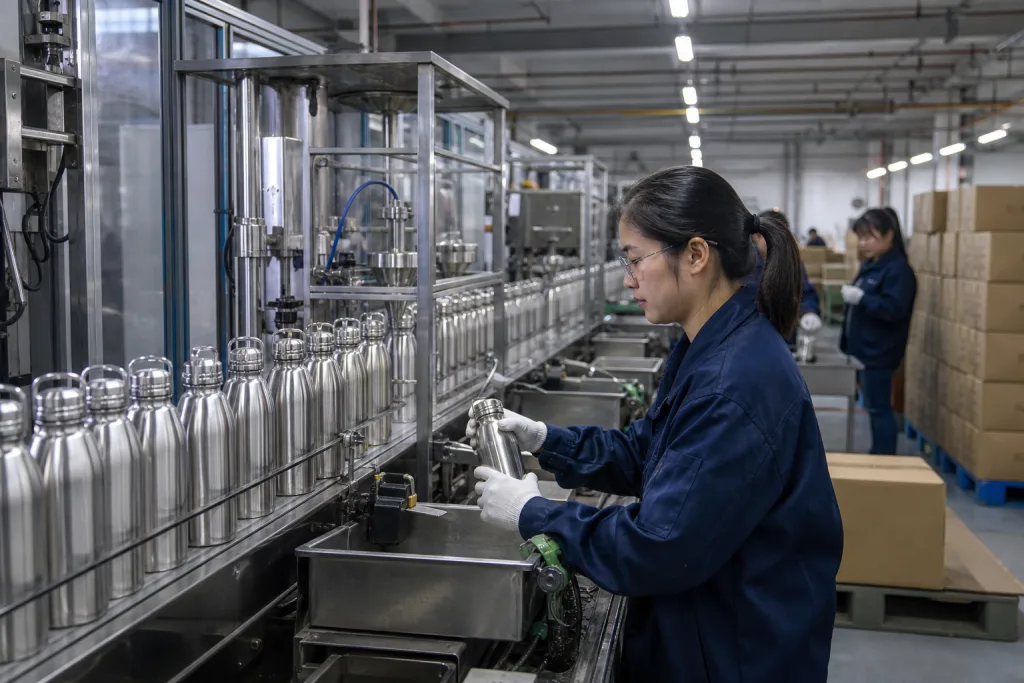
Key Takeaways
- For painted stainless bottles, 18/8 single-wall usually starts around USD 1.60-2.40 FOB China, while double-wall vacuum often lands at USD 3.20-6.80 FOB at 1,000-3,000 pcs MOQ
- A realistic MOQ for custom drinkware is 500-1,000 pcs per color per size, but some Zhejiang factories can mix 2-3 lid colors within a 3,000 pcs order
- Lead time is commonly 7-12 days for pre-production samples and 30-45 days for mass production after artwork approval and deposit
- For bulk imports, ask for REACH, LFGB or FDA contact-material declarations, plus AQL 2.5 final inspection and leak-test records before balance payment
If you buy for retail, promo, or corporate programs, the hard part is not finding a drink bottle distributor. The hard part is finding one that hits your margin, decoration method, compliance file set, and repeat order timing without nasty surprises after the 30% deposit lands. We have seen a quote at USD 2.10 go bad fast: 0.35 mm wall instead of 0.45 mm, a logo area cut down by 12 mm, then lid leak complaints once the goods reached the warehouse. That is where the math breaks.
You need a comparison sheet that works on the line, not polished catalog copy. In Zhejiang, China, 20 factories can send a decent bottle sample in a week; maybe 5 can keep the same coating finish across 30,000 units, run AQL inspection cleanly, and ship on a 35 to 45 day production calendar. QC pulled the sample, passed it, then the buyer flagged color drift on mass goods — we have seen this go sideways. If you are choosing a distributor drinkware program or building a private-label range, the right questions are both technical and commercial.
What you are really comparing
Sourcing through a drink bottle distributor means comparing the supply model, not just bottle shape or FOB price. That is the wrong question to ask. Some buyers need a canteen distributor with local stock that can ship mixed cartons in 48 hours. Others need a canteen factory in China to run a private-label line with custom molds, Pantone color matching, and retail packaging checked on the line against a signed sample. Those are different jobs. We’ve seen this go sideways when a buyer expects factory-level development from a stock seller.
For B2B drinkware buyers, the first split is usually stock program versus custom production. A stock program fits 500 to 2,000 pieces on a faster timeline, usually with laser logo or one-color screen print. A custom program makes sense when margin depends on a unique lid, a 60-70 micron powder-coat finish, or a canteen customizable format built around your brand. In Zhejiang, China, plenty of established makers run both models, but not at the same speed or the same MOQ. On our side, one stock order can ship in 7 days, while a new custom SKU often needs 25 to 35 days after sample approval.
If you are a distributor growler or distributor canteen buyer, ask these questions before you compare quotes:
- Is the supplier acting as a trader, stocking distributor, or actual canteen manufacturer?
- What is the real MOQ per SKU, per color, and per print design?
- Are accessories such as straws, paracord handles, tea filters, or silicone boots standard or outsourced?
- Can they provide REACH, LFGB, FDA, ASTM or CPSIA paperwork where relevant?
- Do they inspect to AQL 2.5, and do they share defect photos before shipment?
A capable canteen supplier should answer those points clearly in one email. QC pulled the sample, checked the logo position at 12 mm from the base, and the reply should still be straight. If the buyer flagged vague answers, the issue is usually process control, not language. We ship enough of these orders to say that with confidence.
Spec table: side-by-side bottle types
Most distributor programs land in four buckets: single-wall stainless, vacuum stainless, Tritan sports bottles, and growlers. Start here. The right pick comes down to channel, target margin, and what the bottle needs to do on the shelf. On our line, this is usually the first table buyers mark up after they check MOQ and carton count.
| Type | Typical MOQ | FOB China | Lead Time | Best Use |
|---|---|---|---|---|
| Single-wall stainless 500-750ml | 1,000 pcs | USD 1.60-2.40 | 30-35 days | Promotional, school, entry retail |
| Double-wall vacuum 500-1,000ml | 500-1,000 pcs | USD 3.20-6.80 | 35-45 days | Retail, corporate gifting, outdoor |
| Tritan sports bottle 600-900ml | 1,000-3,000 pcs | USD 1.10-2.20 | 25-35 days | Gym, youth, value channel |
| Stainless growler 1.2-1.9L | 500 pcs | USD 6.50-11.50 | 35-50 days | Brewery, outdoor, premium sets |
A custom canteen or customized drinkware line usually starts with vacuum stainless because the margin is easier to work with once you add powder coating, laser engraving, gift box inserts, or a strap lid. That is the plain math. If the brief is canteen promotional volume at the lowest landed cost, single-wall stainless or Tritan usually wins. We ship plenty of 500ml single-wall programs in 1,000 pc runs where the buyer flagged price first and decoration second.
Use-case fit matters more than trend. A customizable growler may look strong on a roadmap, but we have seen this go sideways in airport retail and school fundraising because the filled weight is high and the carton efficiency is poor. A 1.9L body changes the freight equation fast. The same thing happens with a customized canteen that uses a complex lid system: it looks premium in the sample room, then returns start once replacement straws, seals, or spouts are not stocked. QC pulled one sample last season where the silicone seal measured 1 mm thin, and that was enough to create leakage complaints.
Ask your canteen vendors for three numbers tied to landed cost: unit net weight, master carton quantity, and carton gross weight. This is the right question. Buyers sometimes spend a week pushing for USD 0.18 off ex-works and ignore freight density. A bottle that is USD 0.18 cheaper can still land higher per unit if the carton is inefficient. We run these checks before quoting because a 24-pack master at 13.5 kg ships differently from a 20-pack at 14.2 kg.
Material and build quality differences
If two suppliers quote the same bottle size with a USD 0.40 gap, look at the build first. On stainless bottles, the normal spec is 18/8 on the interior contact surface, often marked SUS304. Some lower quotes use 201 stainless on the outer shell where it does not touch the drink, and that can work if the supplier states it clearly on the PO. For premium retail custom drinkware, most buyers in Europe and North America still ask for 304 inside and outside. We ship plenty of both options, but hiding the steel grade is where claims start.
Wall thickness changes hand feel and drop performance fast. A common range for stainless bottle bodies is 0.4mm to 0.5mm, and QC usually checks it with a micrometer at the shoulder and straight wall. A lot of cheap quotes come from thinner steel or lighter lids. The saving is small. The dent rate is not. Vacuum bottles also differ in copper coating coverage, vacuum hold, and seal design. A serious canteen manufacturer should give a heat retention range such as 8-12 hours hot and 12-24 hours cold, based on capacity and ambient conditions, not just say "longer insulation." This is the wrong question to ask if you only compare price per piece.
Where build quality shows up fastest
- Lid threading: poor alignment causes cross-threading, and the buyer flagged it on one 5,000-piece order within 3 weeks of receipt.
- Powder coating: uneven film thickness, often under 60μm at the base edge, leads to chipping after carton rub.
- Silicone seals: low-grade silicone can trap odor or loosen after repeated washing; QC pulled the sample when the ring stretched out of the groove by 1.5mm.
- Electropolish interior: smoother inner walls clean easier and cut down metallic taste complaints, especially on narrow-mouth bottles.
For Tritan or PP items, ask for BPA-free declarations and confirm whether the resin grade is virgin or reprocessed. For kids' lines or a customizable canteen aimed at school channels, ASTM and CPSIA relevance should be checked at RFQ stage, not after sampling. We have seen this go sideways when a buyer approved the artwork first and the test path second. Good canteen manufacturers in Zhejiang usually know this and will flag the required test path before mass production.
A bottle is not premium because the render looks premium. It is premium when the lid torque, coating adhesion, and leak rate stay consistent across the full batch.
Branding methods and minimums
Most branding complaints start one step earlier: the buyer picked decoration before they picked the sales channel. That is the wrong question to ask first. A canteen built for e-commerce needs different decoration than a canteen for promo giveaways. If the bottle has to win on a shelf, laser engraving or a powder-coat print that passes tape pull on the line usually sells better than a cheap single-pass silkscreen. If the item is for a 30-day campaign, silkscreen with lower setup cost is often enough.
Typical options for customized canteen and customized growler programs include:
- Silkscreen: low setup cost, good for 1-2 spot colors, usually best at 500+ pcs.
- Heat transfer: supports multicolor graphics, but unit cost rises fast once the graphic gets large.
- Laser engraving: clean, durable, ideal for stainless and premium gifting; we run this a lot on 304 stainless gift programs.
- Digital print or UV print: works for short-run visuals, but scratch resistance varies, so QC should check with a cross-hatch test.
- Embossed or molded logo: better for long-term private label, usually with tooling cost and a higher opening MOQ.
For custom canteen work, ask the supplier for print area dimensions in millimeters, not only a mockup. We ship too many projects where the buyer approved artwork, then flagged the sample because the wrap looked tight on the shoulder radius. A 210 mm wrap on a straight wall behaves one way; on a bottle with curved shoulders, reject rate climbs fast. On vacuum bottles, realistic MOQ is often 500 to 1,000 pieces per artwork, while full-wrap transfer or unusual coatings may require 2,000 pieces or more.
If you are a canteen vendor or canteen distributor building repeat business, do not ignore replacement consistency. Pantone matching on one order is easy. Matching the same matte navy 6 months later on a new steel batch is harder, and we have seen this go sideways after a buyer approved a photo instead of a sprayed panel. A stable canteen factory should keep color chips, sample retention, and coating batch records. At BottleForge Industrial in Hangzhou, Zhejiang, our practical benchmark is to log pre-production color references and sample approvals for every repeat SKU, and keep a retained sample at the line so reorders stay within reasonable visual tolerance.
Compliance, inspection, and defect control
If you import into Europe or North America, paperwork sits inside the product cost. A canteen supplier that sends only a photo and unit price is not set up for serious B2B work. By material and sales market, buyers usually ask for REACH declarations, LFGB or FDA food-contact statements, and test reports for lead and cadmium in coatings. For children’s items, ASTM or CPSIA-related checks often land on the list too. We’ve seen approval stall for 12 days because the PO said “silcone sleeve” and the lab report used the correct silicone wording, so document matching is not a side issue.
Agree inspection terms before you place the PO. The usual export standard is AQL 2.5 for major defects and AQL 4.0 for minor defects, but premium retail programs often push tighter. Leak testing is the classic buyer assumption, and this is the wrong question to leave open. Put it in writing. For example, require 100% vacuum bottles to be leak-tested, plus 1 thermal retention check per batch with a recorded start and end temperature. If the bottle has a straw lid, define whether upside-down seepage is acceptable, because one lid might pass after 30 seconds while another shows a ring at the cap seam in 8 seconds.
Useful control points include:
- Incoming raw material check for steel grade or resin batch
- Adhesion test after powder coating or print curing
- Vacuum and leak test before packing
- Drop test or carton compression check for mail-order channels
- Final random inspection with photos and count by defect type
A reliable canteen factory in China should also say up front whether social compliance documents such as BSCI are available if your customer asks. We get this request after sampling on about 3 out of 10 new programs, and then the line waits for paperwork instead of production. If your project needs FNSKU labels, barcode placement, or retail PDQ trays for Amazon or club channels, lock those into the packaging spec early. QC pulled a sample once where the barcode sat 6 mm over the panel break, and the buyer flagged it at once. Packaging errors usually cost more than bottle defects. We ship replacements for dents; bad retail packing can hold the whole container.
Cost structure and reorder logic
You do not protect margin by chasing the lowest opening quote. You protect it by knowing which costs move on the second and third PO. On a custom drinkware program, we usually quote five layers: bottle body, lid assembly, decoration, packaging, and freight. Tooling is the sixth cost if you need a new lid mold or a new body profile. On the line, that usually means a new gauge check and another sample round before mass production.
For example, a stock 750ml vacuum bottle may quote at USD 3.85 FOB China with silkscreen and white box at 1,000 pieces. Change it to a custom lid, Pantone body, laser logo, and color retail box, and the same item can move to USD 5.20-5.90 fast. That is not overcharging. It is a different SKU. We have seen buyers send the same PO code with four spec changes buried in the notes, then push back on price. The buyer flagged it; QC pulled the sample; the specs did not match the first approval.
Where buyers save money sensibly:
- Keep the body shape standard, then customize coating, logo, and packaging first. A standard body already has stable welding settings and carton fit.
- Use one lid across multiple capacities to cut spare-part headaches. One shared lid thread, like the same cap on 500ml and 750ml, saves stock and reduces leak-test variation.
- Consolidate artwork across 2-3 colors instead of 8 low-volume variants. The math does not work when each color runs below one carton stack or one coating batch.
- Increase order quantity at carton-break points, not random increments. We run master cartons in fixed pack counts, so 1,200 pieces often lands better than 1,130.
Reorders matter more than the first PO. Ask your canteen suppliers if they will reserve lids, paint, or carton stock against a rolling forecast. If your monthly demand is steady, say 20,000 to 40,000 units across styles, a factory with 500,000+ units monthly capacity can usually hold a tighter schedule than a 40-person workshop. We ship faster when components are already booked. In Zhejiang, larger organized factories are not always cheaper, but they are often easier to scale with as your distributor canteen line grows. This is the right question to ask, not who is cheaper by USD 0.06 on the opening order.
Ask what happens below MOQ. Some canteen vendors will accept 300-500 pieces on repeat orders if they can use existing coating, lid, and carton stock. That flexibility is often worth more than a small unit-price gap. We have seen this go sideways when a buyer changed the carton mark by one line and expected the old stock to work; the line stopped for a PO typo and 500 boxes had to be relabeled.
Best fit by channel and buying model
The best drink bottle distributor for you depends on two things: where you sell and how you reorder. Promo buyers usually push for lead time first, then logo options. Retail chain buyers ask for the test file pack, carton marks, and pack consistency; we have seen them reject a shipment over a barcode position drifting 3 mm, even when the unit price was only USD 0.12 lower.
Here is the practical fit most buyers use:
- Promotional market: single-wall stainless or Tritan, simple print, MOQ 1,000+, fast replenishment. We run these on the line with standard screens and spot-color art, and buyers usually care more about 12-day repeat orders than fancy lid tooling.
- Outdoor retail: double-wall custom canteen, powder coat, accessory lids, stronger packaging. This channel usually needs tighter carton drop performance; our QC pulled the sample after a corner crush on a 5-layer export carton.
- Breweries and gifting: custom growler or customizable growler, lower MOQ, premium print or engraving. Laser marking depth and color fill matter here, and the buyer often flags small finish differences batch to batch.
- School and youth: lightweight customizable drinkware with compliance focus and easier-clean lids. This is where lid structure matters more than decoration, and we have had buyers ask for fewer parts after finding residue under the straw seal ring.
- E-commerce private label: customized drinkware with barcode control, inserts, and drop-tested carton spec. Amazon-style channels are less forgiving; one PO even came through with the barcode suffix typed wrong, and the outer carton had to be reworked before we ship.
If you need broad assortment without tying up cash, a local canteen distributor or canteen distributors with stock is often the better first move. If you need exclusivity and better gross margin, work closer to a canteen manufacturer in China. Most buyers do this in 2 stages: start with stock models, check sell-through for 60 to 90 days, then move into canteen custom or canteen customizable versions once repeat volume can cover mold cost, packing stock, and forecast risk. This is the wrong question to ask if you only compare factory price. The math doesn't work unless the reorder is there.
The right supplier should tell you when not to customize. If your forecast is uncertain, a standard mold with custom branding is usually the better commercial call; you save tooling cost and avoid sitting on 3,000 lids from a slow-moving shape. If your volume is stable and your customer needs a differentiated silhouette, then customized canteen development makes sense. Practical sourcing is not about buying the most features. It is about buying the level of complexity your business can actually support.
Compare your bottle specs before you place the PO
Send your target price, quantity, and channel. We will review material, branding, packaging, and realistic MOQ options from our Zhejiang production network.
Frequently asked questions
What MOQ should I expect from a drink bottle distributor for custom orders?
For standard custom drinkware using existing molds, expect 500 to 1,000 pieces per size and color for vacuum stainless, and 1,000 to 3,000 pieces for simpler plastic bottles. A custom growler often starts at 500 pieces because the unit value is higher. If you want a fully custom lid or body, MOQ can jump to 3,000 to 5,000 pieces plus tooling. In China, some factories will bend MOQ on repeat orders if they can reuse coating, cartons, and spare lids. Always ask whether MOQ applies per SKU, per Pantone color, or per logo design. Those are not the same thing, and they change your true buying requirement fast.
Is it better to buy from a canteen distributor or directly from a canteen factory?
It depends on speed, volume, and how much customization you need. A canteen distributor is usually better if you need smaller mixed orders, local stock, or fast delivery in 7 to 15 days. A canteen factory in Zhejiang or elsewhere in China is usually better if you need private label, lower FOB pricing, or technical control over coating, packaging, and testing. Direct factory buying starts to make more sense when your volume reaches 3,000 to 5,000 units per style annually. Below that, a stocking distributor can save you time and inventory risk, even if the unit price is higher by 10% to 25%.
How do I compare quotes from different canteen suppliers fairly?
Use one spec sheet and make every supplier quote the same points: capacity, steel grade, wall thickness, lid type, finish, logo method, packaging, carton quantity, and inspection standard. Ask for FOB China pricing at the same quantity, such as 1,000 and 3,000 pieces, plus sample cost and lead time. Also confirm whether the quote includes mold charges, barcode labels, and leak testing. Many quote gaps come from hidden differences: 0.4mm versus 0.5mm steel, plain white box versus retail box, or no final inspection included. If you compare only by bottle photo and unit price, you are not comparing the same product.
What compliance documents should a custom drinkware supplier provide?
For Europe and North America, start with food-contact declarations relevant to the material, such as FDA or LFGB-related documentation, and REACH declarations where applicable. For coated products, ask about lead and cadmium limits in paints or decorations. For kids' items, check whether ASTM or CPSIA-related testing is needed. On the factory side, many buyers also ask for BSCI or ISO process documentation. Beyond paperwork, require an inspection standard such as AQL 2.5 for major defects, leak-test confirmation, and packaging approval before shipment. Documents alone do not guarantee quality, but a supplier without them is usually not ready for serious import business.
What lead time is realistic for customized canteen production from China?
For existing molds, pre-production samples usually take 7 to 12 days after artwork and Pantone confirmation. Mass production is commonly 30 to 45 days after deposit and sample approval. If your order includes a new mold, special packaging, or peak-season booking before holiday shutdowns in China, lead time can move to 45 to 60 days. Sea freight to Europe often adds 30 to 40 days, and to North America around 20 to 35 days depending on route and customs handling. If your project is seasonal, build in at least 2 extra weeks for artwork revisions, test requests, and final inspection scheduling.