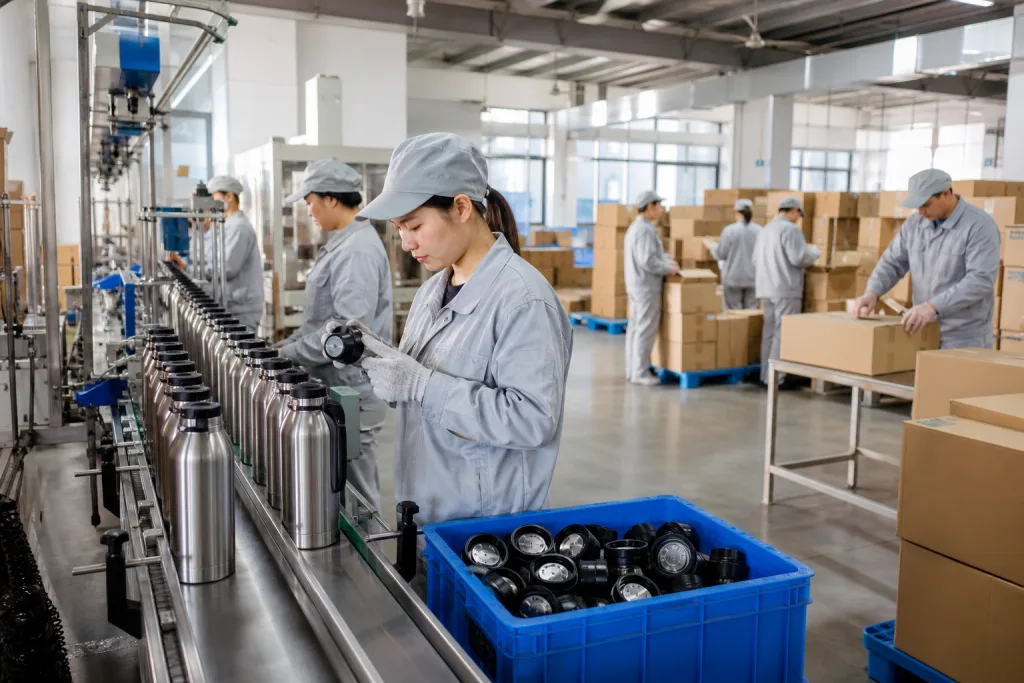
Key Takeaways
- For most stainless steel programs, practical MOQ starts at 1,000-3,000 pcs per SKU, while fully new mold projects usually start around USD 3,000-8,000 in tooling
- A realistic lead time is 7-12 days for samples and 35-55 days for bulk after sample approval and deposit
- Double-wall 18/8 stainless bottles usually land around USD 2.80-6.50 FOB China depending on size, coating, lid type, and print method
- Use written standards for AQL 2.5, coating adhesion, leak test, and carton drop test before you issue the PO
You need a drink bottle customized, but the main risk is not the Pantone color or logo print. It is placing 5,000 units and finding the lid torque is off by 0.4 N·m, the coating fails a cross-hatch adhesion check, or the master carton gets rejected at Amazon FBA for label placement. We have seen first-time B2B buyers send the RFQ first and define the bottle later. That is the wrong order.
If you are sourcing from Zhejiang or wider China, the quickest way to control cost and quality is to ask better questions before sampling starts. A capable canteen manufacturer or canteen supplier should reply with thread tolerances in mm, test standards, MOQ, and lead times like 12 days vs 18 days—not soft promises. QC pulled samples last month where a buyer flagged cap wobble at 1.2 mm, and the factory answer told us everything. That is how you tell a real canteen factory in China from a trading layer that just forwards emails.
What are you really buying?
When you ask for a drink bottle customized quote, you are not buying one bottle. You are buying a spec sheet that drives the whole job on the line: body material, vacuum structure, lid fit, print method, retail pack, compliance file, and shipping terms. Leave one item open, and the quote is only a budget number. We see this every week. A buyer sends “500 ml matte black” and then flags the price later, but the lid thread, logo size, and box style were never fixed.
For B2B buyers, the first cut is use case. A custom drinkware program for gifting is not priced like a retail shelf SKU or a distributor drinkware line for wholesalers. Promo buyers usually push landed cost and fast reorders, often at 3,000 pcs per color. Retail buyers look harder at coating consistency, carton presentation, and claim rates below 1.5%. On our side, QC pulled the sample more than once because the powder coat delta on the same PO was outside the approved panel. That matters in retail. It matters less in a giveaway run.
Most canteen manufacturers in Zhejiang ask the same core questions because they move cost fast, sometimes by USD 0.20 to USD 0.60 per piece on the same bottle size. This is the right question set:
- Capacity: 350 ml, 500 ml, 750 ml, 1,000 ml
- Construction: single wall or double wall vacuum
- Steel grade: 18/8 stainless inside, sometimes 18/0 outside on lower-cost SKUs
- Decoration: silkscreen, heat transfer, powder coating, laser engraving, digital print
- Lid style: screw cap, straw lid, flip lid, bamboo top, leakproof carry lid
- Packaging: white box, color box, PDQ, mailer, master carton mark
If you also source a custom canteen, customized canteen, or customized growler, the same rule applies. The details just change. A growler needs carbonation tolerance and tighter closure control; we usually check lid torque on a meter and watch for pressure loss after 24 hours. A canteen promotional order may run fine with a stock lid and 1-color print. A customizable growler for retail often needs a pressure-tested lid, UPC label placement, and a shipper that passes a drop check. We have seen this go sideways when the buyer approved the bottle but forgot the barcode position on the color box.
You save more money by locking specs early than by pushing for another USD 0.08 off a quote that is still half open.
A factory in China with output above 300,000 units per month should still quote in clear tiers. Ask for ex-works unit price, print add-on, packaging add-on, test fee if required, and tooling if a new lid or mold insert is involved. If a supplier sends one blended number, this is the wrong question to dodge. We run quotes this way because buyers compare faster, and because a typo on the PO—like 10,000 pcs white box instead of color box—changes the math at once.
Which factory questions matter first?
Most buyers open with price. That is the wrong question to ask first. Start with capability, then process control, then price. Ask if the supplier is a canteen factory, a direct canteen manufacturer, or a mixed model with outsourced bottle bodies and in-house printing or powder coating. Subcontracting is common in Zhejiang. We see it every week. What matters is who controls neck threading, vacuum check, and final packing at the line.
Use a short checklist on the first call or email:
- Are you the direct canteen supplier for stainless steel vacuum bottles?
- What is your normal MOQ by size and finish?
- What is your monthly capacity for double-wall bottles?
- Do you run incoming inspection, in-process inspection, and final AQL inspection?
- Can you provide REACH, LFGB, FDA-contact material declarations, or ASTM test reports if needed?
- Do you have BSCI, ISO 9001, or audit records from recent customers?
Good canteen suppliers and canteen vendors answer with numbers, not soft talk. A solid reply sounds like this: MOQ 1,000 pcs per color for a standard 500 ml bottle, sample lead time 10 days, bulk lead time 40 days, daily vacuum output 8,000 pcs, final inspection at AQL 2.5 for major defects and AQL 4.0 for minor defects. QC pulled the sample, checked the mouth diameter with a caliper, and signed off the seal fit. Weak suppliers say “depends” six times in one email. We have seen that go sideways.
If you are buying through canteen distributors or a distributor canteen channel, ask who owns the mold and who issues the quality standard. That point decides the claim path later. A strong canteen distributor still adds value if they bundle 3 or 4 categories into one shipment, but you need to know whether a lid leak claim goes to the distributor or back to the factory. We once saw a PO with the logo size typed as 35 mm instead of 53 mm, and nobody wanted to own the rework.
Three signs you are dealing with a serious supplier
- They ask for artwork file type, Pantone reference, and logo size before confirming decoration pricing.
- They specify wall thickness, such as 0.4 mm inner and 0.5 mm outer, rather than saying “standard quality.”
- They define leak test and vacuum retention targets in writing.
The point is simple. Whether you need a canteen custom order or a broad customizable drinkware range, the supplier should be specific on operations before the quote looks attractive. If they cannot tell you the vacuum hold spec, the leak test method, or the MOQ by finish, the math does not work.
How do MOQ and price really work?
MOQ is almost never one clean number. On the line, we split it by body, surface finish, logo process, and packing. Buyers hear “1,000 pieces MOQ” and think they can mix 6 colors, 3 box designs, and 2 logo positions in one PO. That is usually where it breaks. Last month a buyer even typed “1000 pcs assorted any artwork” on the PO, and sales had to send it back before sampling.
For a standard double-wall stainless steel bottle from a canteen manufacturer in China, practical MOQ often looks like this:
- Plain stock color with 1-color logo: 500-1,000 pcs
- Custom powder coat color: 1,000 pcs per color
- New color box: 1,000-3,000 pcs depending on print format
- New lid mold or body mold: tooling charge plus 3,000-10,000 pcs project volume
Price moves in layers too. A 500 ml single-wall bottle may be USD 1.10-1.90 FOB China. A 500 ml double-wall vacuum bottle may be USD 2.80-4.50 FOB. A premium customizable canteen with special lid, rubber paint, and individual gift box may reach USD 5.20-6.50 FOB. A 64 oz custom growler or customized growler with handle lid can easily sit in the USD 6.50-9.80 range depending on steel weight and finish. The gap is not random. On one 64 oz job, changing the body weight from 0.42 kg to 0.48 kg pushed cost up fast, but dent performance passed drop check more cleanly. This is the wrong question to ask: “What is your cheapest price?” Ask what is included.
Ask your canteen vendor or canteen manufacturers for cost breakouts:
- Unit price by quantity break: 1,000 / 3,000 / 5,000 / 10,000 pcs
- Decoration cost by method and color count
- Packaging cost per unit
- Sample charge and refund condition
- Tooling amortization if the order repeats
This matters if you work with distributor growler or wholesale programs, because margin is often tight. We have seen buyers fight for USD 0.18 on bottle weight, then QC pulled the sample and found sidewall dents after transit simulation. The math does not work if returns go up. On the other hand, switching from engraved logo to 1-color silkscreen can save USD 0.22 with no commercial downside for a canteen promotional campaign, especially on runs above 3,000 pcs.
If your supplier cannot explain why MOQ exists, they probably do not control production deeply enough to protect your margin later.
What sample stage should you insist on?
A serious buyer should treat sampling as a control stage, not a photo opportunity. On a drink bottle customized project, we usually insist on three checkpoints before the line runs. Skip one, and problems show up later at packing or final inspection.
- Reference sample: an existing model to lock the body shape, hand feel, lid thread fit, and unit weight; QC usually checks thread engagement with a go/no-go gauge
- Pre-production sample: your logo, your finish, and your packaging, built before bulk starts; this is where the buyer usually flags color drift or a 1.5 mm print shift
- Golden sample: the signed final sample kept by both you and the factory as the inspection standard; we bag and label it by PO and date so AQL checks do not turn into arguments
Most Zhejiang factories can turn a logo sample in 7-12 days if the bottle is an existing model. New mold sampling usually takes 20-35 days. For a customized drinkware line or a customizable growler with a new cap or closure, this is the wrong stage to compress. We have seen thread mismatch at 58 mm necks and silicone seals fail after a simple upside-down hold because the shore hardness was off.
Your pre-production sample review should include measurable checkpoints. Not general comments. We run these against actual numbers, usually with a digital scale and caliper on the bench:
- Weight tolerance, for example plus or minus 5%
- Color match to Pantone, or agreed visual tolerance under daylight
- Logo position tolerance, such as plus or minus 2 mm
- Leak test upside down for 2 hours
- Vacuum performance, such as hot retention above 45 degrees C after 6 hours for a given fill condition
- Barcode scan and carton mark accuracy
If you supply to Amazon or big-box retail, ask for packaging mockups before mass production. FNSKU label position, suffocation warning text, carton dimensions, and drop protection all need to be checked on the table, not after 3,000 sets are packed. A solid canteen supplier or canteen vendors team should also confirm master carton gross weight stays under your target, often 15-18 kg; we have had buyers push back at 18.6 kg because warehouse teams rejected the pallet.
This stage also tells you how the factory communicates. The best canteen customized suppliers in China send sample photos with caliper readings, capacity checks, and print alignment notes. QC pulled the sample, marked the reading card, and sent it the same day. That can save 2 days versus 5 days of email back-and-forth, and the math on delayed approvals does not work in peak season.
How do you control compliance and quality?
Quality issues in drinkware are not glamorous. They are repetitive and expensive: leaks on the tilt test, seal odor after wash, chipped powder coat, loose lids, dents at the base, and the wrong print because one PO line had a color code typo. You cut these problems with a written spec and line checks, not with trust.
Start with compliance. Match the paperwork to the market and the item. Europe may require REACH-related declarations and, in some programs, LFGB-oriented testing. North America may ask for FDA-contact declarations, CPSIA points for children’s items, or ASTM references where applicable. If you run a kids line with a custom canteen, the scope gets wider fast, and this is where buyers often ask the wrong question: “Is it food grade?” That is too loose. Ask which material, which test item, and which report date.
Then lock the production quality plan before mass production. We usually put it in the purchase spec and on the QC sheet the line carries in a plastic sleeve. A practical purchase specification should include:
- Material: 18/8 stainless steel for inner wall, BPA-free polypropylene or Tritan lid parts if used
- Finish standard: no exposed steel, no pinholes, no sharp burrs
- Leak standard: 100% leak test before packing
- Vacuum standard: sample-based retention test every lot
- Inspection standard: AQL 2.5 major, AQL 4.0 minor unless your customer requires tighter
- Carton standard: drop test, barcode readability, shipping mark format
Ask the factory how they run vacuum testing in-house and how they record traceability—by production date, line code, or both. That answer tells you a lot. If QC pulled the sample and one lot fails heat retention at 6 hours, you need root-cause analysis, not guessing. A capable canteen manufacturer in Zhejiang should trace the coating batch, lid supplier, and packing date within 30 minutes from the lot card.
Defects you should define before production
- Logo scratch visible at 30 cm
- Base wobble over 1 mm
- Lid cross-threading
- Color variance between lots
- Seal odor after washing
Do not skip pre-shipment inspection. Even if your canteen distributors or distributor channels manage the relationship, book final inspection at 80% packed and 100% produced. We have seen this go sideways when buyers checked too early: the approved sample was fine, but the last 2,000 pcs came off the line with a shade drift the buyer flagged only after arrival. That 80% timing gives the factory room to rework before the container loads instead of arguing after sailing.
What shipping terms prevent expensive surprises?
We see the same problem after goods are finished: the bottle passes inspection, then the extra cost starts. The item is fine, but the shipping mark is wrong, the booking missed the CY cutoff by 2 days, the pallet spec does not match the warehouse rule, or the paperwork carries a typo from the PO. If you are buying from China for Europe or North America, fix the logistics terms before deposit. We’ve seen this go sideways.
For most B2B drinkware orders, you will compare FOB China, EXW, and sometimes DDP. FOB China is usually the cleaner setup if your forwarder already books from Ningbo or Shanghai and knows the line. EXW often looks lower on the quote, then local charges show up later: truck pickup, export clearance, terminal handling, document fee. The math doesn’t work if you only compare unit price. DDP fits some smaller promo orders under 500 cartons, but you need the duty basis, delivery address, and who pays if customs re-checks the file.
Use a shipping checklist with your canteen suppliers or canteen vendor:
- Master carton size and gross weight, such as 58 x 39 x 27 cm and 12.6 kg
- Units per carton and pallet configuration, plus pallet height limit like 1.6 m
- Country of origin marking on bottle, carton, or both
- HS code confirmation before booking
- Booking window and cargo ready date, not “mid-month” on the PO
- Spare units percentage, often 0.3%-1.0% for large programs
If your program is for retail or canteen distributors, ask whether the factory can apply UPC, FNSKU, carton labels, or retailer-specific routing marks. We run this on the packing line all the time, but the artwork has to land before bulk packing starts. One missed label file can hold 2,000 pcs. QC pulled the sample on one order because the buyer flagged a 3 mm barcode shift, and re-labeling after packing cost 2 days plus extra labor.
Transit packaging is part of product quality. Full stop. A bottle that passes inspection but lands with dents is still a failed order. For higher-value customizable drinkware, ask for a protective bag plus egg-crate divider or a molded insert, then run a drop test on the shipper carton. For a customized growler, check handle orientation inside the carton and top-load protection, because cap areas take hits first and we often see damage there during carton compression.
The cheapest freight plan is not the one with the lowest quote. It is the one that arrives without rework, relabeling, or damage claims.
Experienced buyers treat logistics data as part of the quote package. This is the right question to ask early, not after production is done and the goods are already stacked on 1100 x 1100 mm pallets.
A short buyer checklist before PO
Before you send the deposit, do one last PO check. This is where clean procurement wins and firefighting starts to drop off. Whether this is your first order with a canteen manufacturer, an expansion through canteen distributors, or a new distributor growler assortment, the checklist stays the same. On our side, QC usually pulls the sample and PO copy together on one table before the line starts.
- PO lists the exact SKU, capacity, color, lid, logo method, packaging, and Incoterm
- Approved artwork file and Pantone references are attached
- Approved pre-production sample date is recorded
- Testing and compliance documents required for your market are listed
- Inspection standard and defect definitions are written into the order
- Production lead time starts only after sample approval and deposit
- Balance payment term is clear, such as against inspection pass and copy B/L
Ask one more commercial question before you wire funds: what happens if one component slips? This is the right question. We have seen a bamboo lid insert land 4 days late, and the buyer flagged whether we could ship bottles first and lids after. Sometimes we split shipment. Sometimes we switch to an approved PP lid if the signed sample allows it. The math does not work if you discuss this after packing starts.
For repeat business, review claim data after the first shipment and put numbers on it. If leak claims exceed 0.5%, or dent claims exceed 1.0%, do not stop at compensation. Ask for root cause and ask for evidence from the line: seal hardness reading, thread tolerance in mm, carton compression result, or pallet overhang found during loading. We have seen this go sideways from one small PO typo on carton count.
A good supplier relationship is practical. Your canteen supplier should push back when your spec adds risk, not just approve everything. We run into this on large custom drinkware programs, mixed custom canteen assortments, and retail-ready customized drinkware lines where 1 print position mistake repeats across 5,000 units.
If a factory in Zhejiang or elsewhere in China answers these questions with numbers, signed documents, and sample control, you are close to a clean shipment. That is the target. A solid factory will show you the approval sheet, the AQL 2.5 note, and the sample date instead of giving broad promises.
Get a quote with real factory numbers
Send your target quantity, bottle type, logo file, and packaging requirement. We will reply with MOQ, FOB pricing, sample timing, and compliance options.
Frequently asked questions
What MOQ should I expect for a drink bottle customized order?
For standard stainless steel bottles using an existing mold, expect MOQ around 1,000 pcs per size and often 1,000 pcs per color. Some stock models can start at 500 pcs if you accept limited color options and simple 1-color print. If you need a custom lid, body change, or retail color box, MOQ usually moves to 3,000-5,000 pcs. A fully new mold project can require tooling of roughly USD 3,000-8,000 plus volume commitments. Ask your canteen factory to separate body MOQ, coating MOQ, print MOQ, and packaging MOQ. That gives you a real commercial picture instead of one headline number that later changes.
How long does production usually take from sample approval?
For an existing model, logo samples usually take 7-12 days. After you approve the pre-production sample and pay deposit, bulk production commonly takes 35-55 days depending on quantity, finish, and season. Simpler canteen promotional orders may finish in 30-40 days. A more complex customized growler or customizable canteen with special lid parts can push to 50-60 days. Add another 3-7 days if individual gift boxes, barcode labels, or retailer-specific carton marks are needed. During peak season from August to November in China, book earlier. Ask for a schedule with sampling, material purchase, production, packing, inspection, and cargo-ready date.
What tests should I require before shipment?
At minimum, require 100% leak testing before packing, visual inspection to your approved sample, and final random inspection using an agreed AQL standard such as AQL 2.5 major and 4.0 minor. For double-wall bottles, ask for vacuum retention checks by lot. For coated bottles, include adhesion and scratch resistance review. If you sell in Europe or North America, request the relevant food-contact documentation, such as REACH-related declarations, LFGB-oriented testing where needed, or FDA-contact material statements. For e-commerce packs, add carton drop testing and barcode scan checks. If the product is a kids bottle, expand the compliance list and confirm any ASTM or CPSIA-related points that apply to your market.
Is it better to buy from a canteen manufacturer or a distributor?
If your order volume is stable and you need control over spec, cost, and repeat quality, a direct canteen manufacturer in Zhejiang or another China production cluster is usually the better fit. You get clearer pricing, faster technical answers, and fewer layers during claims. If your annual volume is low or you need mixed categories in one shipment, a canteen distributor can still make sense. The key question is who controls the quality standard and who resolves defects. Ask whether the distributor owns the project sample, who performs final AQL inspection, and whether the factory is disclosed. For many buyers, direct factory for core SKUs and distributor for fill-in items is the most practical model.
What information should I send to get an accurate quote fast?
Send a short but complete RFQ pack. Include bottle type, capacity, target material, single or double wall, lid style, logo method, print colors, target quantity, packaging type, and delivery term such as FOB China. Add reference photos or a sketch with dimensions if shape matters. If you need a canteen custom or custom growler project, mention whether you want an existing mold or a new design. Include compliance market, such as EU or US, and any special requirements like FNSKU, pallet limits, or carton gross weight under 18 kg. With that information, most experienced canteen suppliers can quote within 24-72 hours and give realistic sample and bulk lead times.