Key Takeaways
- Lock bottle, lid, and decoration specs before deposit; a 2 mm tolerance gap can ruin 3,000 units
- For most stainless SKUs, MOQ starts at 1,000 pcs per color, with 25-35 day lead time from sample approval in Zhejiang, China
- Use AQL 2.5/4.0 plus 100% leak testing; random inspection alone misses high-cost lid failures
- Ask for coating, drop, salt spray, and migration test standards up front, not after mass production
You usually spot a bad drink bottle custom job too late: the logo is off by 3 mm, the lid starts leaking after a 1.2 m drop test, the powder coat chips when cartons rub in transit, or the warehouse rejects outer boxes for crush damage. Then the launch date is already slipping. This is the wrong question to ask—buyers keep asking which factory made the mistake, but on the line we see the same root cause: 5 small spec gaps left open at PO stage, sometimes as simple as a logo position note missing or a typo in the carton mark.
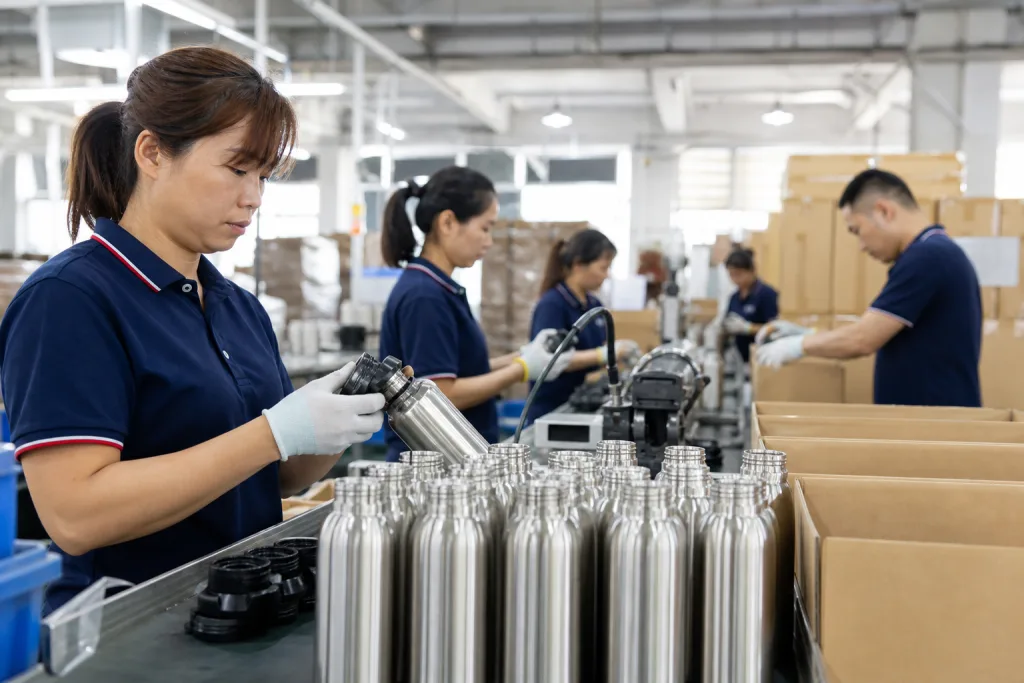
If you buy custom drinkware for retail, promo, or distributor programs in Europe and North America, you need to think like a quality engineer before production starts. At BottleForge Industrial in Zhejiang, China, we run into the same preventable failures on stainless bottles, tumblers, and custom canteen orders; QC pulled the sample and flagged the same issues again last month on a 3,000-piece run. Most of this is avoidable with tighter drawings, realistic tolerances, and a QC plan tied to AQL instead of hope. If the drawing says “center logo” with no mm callout, we’ve seen this go sideways fast.
Where custom bottle projects actually fail
Most buyers think the canteen factory fails on the line. Sometimes it does. We’ve seen bad welds and crooked seams. More often, the miss starts in the spec sheet the buyer signed off. A stainless body can be welded clean on the argon station and still fail your market because the mouth diameter is 3 mm off, the handle overhang wastes pallet space, or the print area will not take the artwork at line speed.
For drink bottle custom work, you are not buying a generic item. You are buying tolerances with numbers behind them: capacity in ml, wall thickness in mm, neck finish, seal material, coating thickness, logo position, carton burst strength, barcode placement, retail pack size. Leave one item vague and the canteen manufacturer will default to house standard. That is where projects drift. We’ve seen this go sideways on Europe programs where the factory packed to its China wholesale carton spec and the buyer flagged the load after a 1.2 m drop test.
- Common early-stage misses: no approved Pantone reference, no lid torque range in N·m, no stated allowable dent rate, no carton drop requirement, no packaging weight limit; QC pulled the sample and the blue lid was already off-shade against the signed chip.
- Common commercial misses: MOQ not split by color, tooling fee not clarified, spare part policy missing, no decision on FOB Ningbo versus EXW Zhejiang; we also see PO typos where 3,000 pcs becomes 30,000 pcs, and the math doesn't work once paint and carton are booked.
At our Zhejiang, China facility, output can reach 600,000 units/month across bottles and tumblers, but capacity does not rescue a weak spec. This is the wrong question to ask: “Can you make it?” Better ask, “What exactly are we approving?” If you are working with canteen suppliers or canteen vendors for a custom canteen, start with a control sheet that defines the bottle by numbers, not by photo. That matters most when you source customizable canteen or customizable drinkware styles that use one body with 2 or 3 lid options. The body is often standard. The risk usually sits in the accessories and decoration, where the line changes silicone hardness, straw cut length, or logo position by 1.5 mm and you do not catch it until pre-shipment.
Your first sample is not proof of consistency. It is only proof that one unit can be made.
Leaks, vacuum loss, and bad lid fit
If one issue turns a good customized drinkware order into a claims mess, it is lid performance. Leak complaints kill repeat business because the consumer blames your brand, not the canteen supplier. Bottle bodies in stainless are usually stable. Lids are where trouble starts. We run parts in PP, Tritan, stainless, and silicone on the same lid, then add threads, straws, or push buttons, and each part brings its own tolerance stack.
What fails on the line? A thread can feel fine on the golden sample, then start binding in production when the neck curl shifts by 0.3 mm. QC pulled samples before where the silicone gasket had rolled during hand assembly. Straw lids often pass a bench check, then leak after 4 hours flat in a carton. Vacuum bottles lose insulation when the weld point is off or the vacuum station is not holding stable pressure. We have seen this go sideways.
What to spec before you place the order
- Leak standard: 100% water leak test, inverted 30 minutes for screw lids; 4 hours horizontal for straw lids.
- Vacuum standard: define temperature retention target, for example under 10°C rise after 6 hours for cold or above 42°C after 6 hours for hot, based on your market claim.
- Lid torque: set an opening and closing torque range so lids feel secure but usable. Ask for the actual torque data in N·m from the torque meter, not “open-close OK.” That is the wrong question to ask.
- Seal material: specify food-contact silicone and request REACH or LFGB support where relevant. We normally also check gasket hardness because a 1 mm section that is too soft will creep out of the groove.
If you are buying custom growler or customizable growler products, treat the lid as its own sourcing item. A swing-top or threaded cap on a larger body carries more risk because the fill weight is higher, often 1.5 kg to 2 kg when full, and users grab it by the lid. For canteen customizable programs, ask the canteen factory whether one lid fits multiple body molds. Buyers push for shared lids to save tooling, and sometimes the PO even says “same lid all models.” That saves money upfront, but mismatch risk goes up fast if different neck tolerances are already running in the field.
QC should include 100% leak testing and a pre-shipment AQL inspection at 2.5 major / 4.0 minor. Do not accept “sample pass” as enough. If your order is 5,000 units and 3% leak in the market, that is 150 failures. At USD 6.50 FOB each plus reverse logistics and account penalties, the math does not work. We ship plenty of 5,000-unit orders, and one bad lid batch can cost more than the margin on the whole run.
Decoration defects that buyers under-spec
Most custom drinkware programs win or lose on decoration. Buyers will spend 3 days on artwork, then release production with one note: “logo centered.” That is not a production spec. Whether you buy canteen promotional stock, a customized canteen for retail, or a distributor drinkware program, decoration needs numbers the line can run against—position in mm, color target, and pass/fail limits. We see this go sideways fast when the PO has one vague sentence and no marked-up drawing.
The common defects are plain enough on the factory floor: silkscreen registration drift, laser engraving that comes out too light, decal bubbles, powder coat orange peel, color mismatch between lid and body, and print rubbing off during transit. QC pulled the sample last month and caught 1.2 mm screen shift on a 750 ml bottle before packing. Most of these issues start with process mismatch. A glossy curved bottle with deep taper does not suit wrap screen printing, and a textured powder coat will break up thin 0.3 mm lines. Buyers often ask for the cheapest print method first; this is the wrong question to ask.
Spec the decoration like a factory would
- Artwork position tolerance: ±1.5 mm is realistic for many round bottles; demanding ±0.5 mm on mass production often adds cost without real benefit.
- Color reference: Pantone code plus finish callout, such as matte, gloss, or metallic.
- Durability test: tape test, alcohol rub test, or dishwasher claim if you plan to market one.
- Print size and safe area: define maximum width and height around weld seam, taper, and base radius.
For canteen custom and custom canteen orders, ask whether the factory uses in-house coating or an outsourced line. Outsourced coating is workable if incoming inspection is strict. We usually check coating lots with a cross-hatch cutter and compare lid/body color under the light box before assembly. At BottleForge Industrial, we recommend pre-production decorated samples from the actual line, not digital mockups or hand-finished samples. Lead time for a proper pre-production sample is usually 7-12 days, and that step saves more time than it costs.
If you sell through a canteen distributor or canteen distributors with mixed color assortments, lock carton labeling rules at the same time. We ship to 3PLs that reject inbound if the outer label color code does not match the scan file, even when the bottle inside is right. One buyer flagged a case where the PO typo said BK instead of BLK, and the warehouse split 1,200 units into the wrong racks. The same applies to distributor growler and distributor canteen programs headed into 3PL networks that rely on scan accuracy.
Material shortcuts and compliance surprises
Stainless drinkware is not one material, and compliance files are often read too loosely. We see this on POs every month. “Food grade” is not a full spec. You need the exact material, the exact contact area, and the test basis for the destination market. On the line, QC will separate body, lid, straw, and seal because each one can trigger a different failure.
For a lot of bottles, the body is 18/8 stainless steel, often marked SUS304. Some price-driven models use 201 on the outer wall or other non-contact parts to shave cost by about $0.18 to $0.35 per unit at 5,000 pcs. That is not automatically wrong. It does need to be disclosed. For premium retail custom growler and customizable drinkware programs, hidden grade changes are where the trouble starts. We have seen salt-spray complaints after 28 days in transit, then the buyer flagged rust spots around the base seam.
- Body material: list inner and outer grade separately if needed, not just “stainless.”
- Wall structure: state single wall or double wall vacuum, with target thickness such as 0.4 mm inner / 0.5 mm outer.
- Plastic parts: call out PP, Tritan, or the actual resin for lids, straws, and fitments.
- Compliance pack: include REACH, LFGB, FDA-related declarations as applicable, plus test reports tied to the actual SKU.
European buyers should slow down on recycled-content or sustainability claims unless the canteen manufacturers can back them with paperwork for that production batch or claim basis. North American buyers should also check California-related chemical compliance where it applies. Ask a blunt question: is the report for the same construction, the same coating, and the same seal material? If the lab file is from another shape with a different silicone ring hardness, the math does not work.
From China, a document set can look complete and still be useless for a claim defense. This is the right question to ask: does the report cover the actual bottle, with the actual lid, from the actual canteen manufacturer? If your canteen customized project uses soft-touch paint, metallic ink, or odd accessories, send a fresh lab sample before mass shipment. We run this step all the time. It usually adds 3 to 5 days, not 2 weeks, and it saves months of argument after arrival.
Packaging damage and barcode chaos
Buyers spend weeks on bottle shape and logo color, then leave packaging to the last 7 days. We’ve seen this go sideways. Cartons, inserts, polybags, and barcode labels decide if the goods arrive sellable. A stainless growler that looks clean on the line is still a bad order if 8% of gift boxes collapse after a 1-meter drop, or Amazon rejects the pallet because the FNSKU label runs across the carton seam by 12 mm.
The usual packaging failures are not hard to spot. Carton board is too light for the shipment weight, the insert folds at the handle pressure point, nobody defined a drop test, mixed SKU cartons ship with no count mark on two sides, or the label file was approved without a placement template. QC pulled the sample on one order because the barcode sat 18 mm too low and the scanner missed it on curved shrink wrap. Promo buyers also miss condensation and odor issues when coated bottles are bagged too fast after oven curing; we normally hold them 24 hours before sealing.
Packaging points to define at PO stage
- Master carton spec: dimensions, board grade, bursting strength or edge crush expectation, and max gross weight such as 12-15 kg.
- Inner pack: egg-crate divider, recycled paper sleeve, or individual white box with tape position defined.
- Barcode rule: SKU, UPC, EAN, or FNSKU location with scan test sample approval.
- Drop standard: packed product drop from 76 cm or 1 meter depending on channel requirement.
If you supply distributor channels as a canteen vendor, ask the canteen vendors and canteen suppliers how they palletize export cartons before PO release. This is not a small detail. A standard EU pallet and a North American pallet do not fail the same way, and 20 mm of overhang is enough to start corner crush on the bottom layer. We often tell buyers to accept a carton that is 15 mm wider if it gives a tighter stack pattern for a bottle with a heavy base or wide handle. The math doesn't work if the unit pack looks compact but the pallet breaks down in transit.
For Zhejiang export shipments, the incoterm changes the argument, not the damage. Under FOB, factory responsibility usually ends when cargo is on board, but the buyer still eats weeks of claim handling after landing. We ship plenty of FOB loads, and this is the wrong question to ask: “Who owns it after loading?” The better question is whether packaging passed pre-shipment checks. Inspect carton compression, barcode position, and pallet wrap at pre-shipment, not just bottle appearance. AQL without carton performance review is incomplete.
MOQ, lead time, and change-order traps
Buyers often treat MOQ and lead time as commercial terms and quality as a separate issue. On the factory floor, they tie together. If you split 1,000 pcs into too many colors or change artwork after the line is booked, we run short on matched parts, swap materials, or rework finished stock. That is where mixed lids, shade drift, and weak carton sealing show up. Last month QC pulled a sample with top and bottom cartons sealed at 42 mm tape width instead of the approved 48 mm because packing was rushing to catch the vessel cutoff.
For a typical drink bottle custom order in Zhejiang, China, a realistic MOQ is 1,000 pcs per color for an existing stainless model, sometimes 3,000-5,000 pcs if you need a new mold or complex lid. Sample lead time is often 7-12 days. Mass production is commonly 25-35 days after sample approval and deposit, longer in peak season. If a canteen factory promises 12 days for a brand-new customizable canteen with custom packaging, ask what exactly is being skipped. This is the wrong question to dodge. Are they skipping mold trial, print approval, drop test, or incoming inspection for the lid set?
Change orders are the quiet killer. You approve a custom canteen sample, then marketing updates the logo, sales asks for a different cap color, and the 3PL sends a new carton mark. Each change looks minor. Together they break material planning and push up error rates on the line. We have seen this go sideways over one PO typo: cap color changed from BK to Matt Black after labels were printed, and 600 lids had to be sorted by hand.
- Freeze date: set a hard cutoff for artwork and packaging edits, often 5-7 days before mass production starts.
- Color split rule: define acceptable overrun and underrun by color, such as ±5%.
- Spare ratio: request 1-2% extra lids or straws for service stock.
- Approval path: one person on your side gives final signoff to avoid conflicting instructions.
This matters whether you buy from one canteen manufacturer or multiple canteen manufacturers. Multi-source programs protect capacity, but they also magnify inconsistency if suppliers are working from different revisions. We ship cleaner programs when every factory signs off on the same revision-controlled spec, right down to carton mark size and Pantone callout. If you are a canteen distributor managing several private-label accounts, your internal document control is just as important as the factory’s process control; one unchecked Excel tab can create 2 mm logo shifts across three suppliers.
The QC plan you should demand
If your only control method is “send me photos before shipment,” that is not a QC plan. It is wishful thinking. On custom drinkware, we see the same return drivers over and over on the line: leaks, scratched coating, off-center logos, wrong lid assembly, mixed packing, and dimensions out by 1-2 mm. This is the right place to get picky. A buyer once approved photos, then flagged 600 pcs because the straw lid and flip lid were packed into the wrong inner boxes.
A practical setup is three gates. First, check raw materials and incoming accessories. We usually verify body material, lid color, gasket hardness, and print artwork against the PO before mass production starts. Second, approve a pre-production sample from the actual line, not a hand-built office sample. QC pulled the sample after the pad printing station and checked logo position with a ruler. Third, run in-line and final random inspection using a defined AQL level. For many programs, AQL 2.5 for major defects and 4.0 for minor defects is workable, with critical defects at zero tolerance. Major means functional failure or appearance problems a consumer will reject on first look. Minor means cosmetic issues within reason. The math doesn't work if you skip the middle gate and expect final inspection to catch process drift.
- 100% checks: leak test, vacuum check if applicable, and barcode presence when channel requires it.
- Random checks: dimensions, logo position, color consistency, coating defects, carton marks, and pack count.
- Functional tests: handle pull, lid cycle test, drop test, and insulation verification by sample lot.
- Audit items: BSCI or social compliance status, ISO-based quality process, and traceable production date coding.
If you use a third-party inspector in China, send the defect classification sheet before they arrive at the factory. “Looks good” is not a standard, and we have seen this go sideways. One inspector passed bottles with a 3 mm logo shift because the buyer had no limit written down. For distributor growler, distributor canteen, or canteen promotional programs with fast reorders, ask the factory to keep one golden sample and one sealed production sample from each PO. Write the PO number on the master carton and on the sample bag. Future claims get settled faster when both sides are looking at the same reference.
A solid canteen supplier should not push back on this structure. Good factories like clear specs because we ship faster with fewer arguments, and the line knows what fails and what passes. Bad factories dislike it because the gray area disappears. That tells you plenty before the first container leaves Zhejiang.
Send your bottle spec and get a real factory review
We will flag leak, decoration, packaging, and MOQ risks before you place the PO, with practical corrections from our Zhejiang production team.
Frequently asked questions
What MOQ should I expect for a drink bottle custom order?
For an existing stainless model, a normal MOQ is 1,000 pcs per color and 3,000 pcs total if you want efficient coating and packaging setup. If you need a new lid mold, embossed body, or a fully customized growler structure, MOQ can rise to 3,000-5,000 pcs. White-box packaging keeps MOQ lower; custom gift boxes often add another 1,000 pcs per design. Ask whether MOQ applies by SKU, color, lid, or carton assortment. Many disputes start because the buyer assumes mixed colors count toward one MOQ while the canteen manufacturer counts each coating batch separately.
How long does production take from sample approval?
For most custom drinkware orders from Zhejiang, China, plan 7-12 days for a proper pre-production sample and 25-35 days for mass production after deposit and sample approval. Complex packaging, holiday congestion, or new tooling can push that to 40-50 days. If your PO includes lab testing on final decorated samples, add 5-10 days depending on the test scope. You should also allow 2-3 days for pre-shipment inspection and booking. If a canteen factory offers a much shorter lead time, ask whether they are using standard stock components, outsourcing coating, or skipping approval steps.
Which quality tests matter most for customized drinkware?
The core tests are 100% leak testing, vacuum or insulation verification for double-wall bottles, decoration adhesion testing, and packaged drop testing. For lids, specify invert and horizontal leak tests depending on the design. For decoration, ask for tape or alcohol rub tests and define pass criteria. For retail shipments, carton compression and drop checks matter more than many buyers expect. On inspection, AQL 2.5 major and 4.0 minor is a practical baseline for most B2B orders. If your product is headed to children’s use or premium retail, add stricter appearance standards and dimensional checks on mouth diameter and thread fit.
What compliance documents should I ask a canteen supplier for?
Ask for documentation tied to the exact SKU and material stack, not just generic factory certificates. For Europe, REACH and LFGB-related food-contact support are common discussion points. For North America, request material declarations and any market-specific chemical compliance support relevant to your category. If the bottle uses powder coating, soft-touch paint, Tritan lids, or silicone seals, confirm those materials are included in the report scope. Factory-level documents like BSCI or ISO process certification are useful, but they do not replace product-level test reports. The report should match the actual body, lid, decoration, and contact surfaces you are buying.
How do I compare canteen manufacturers without getting lost in price?
Compare total landed risk, not just FOB unit price. A supplier quoting USD 5.90 may look better than one quoting USD 6.40, but if the cheaper quote excludes upgraded carton board, 100% leak testing, or in-line logo inspection, the saving disappears fast. Ask each canteen manufacturer for the same spec sheet: stainless grade, wall thickness, lid material, decoration process, MOQ, lead time, spare part policy, carton spec, and inspection standard. Also ask how many units per month they can run on similar bottles. A stable Zhejiang, China factory with 600,000 units/month and disciplined QC is usually a safer long-term partner than a lower quote built on vague assumptions.