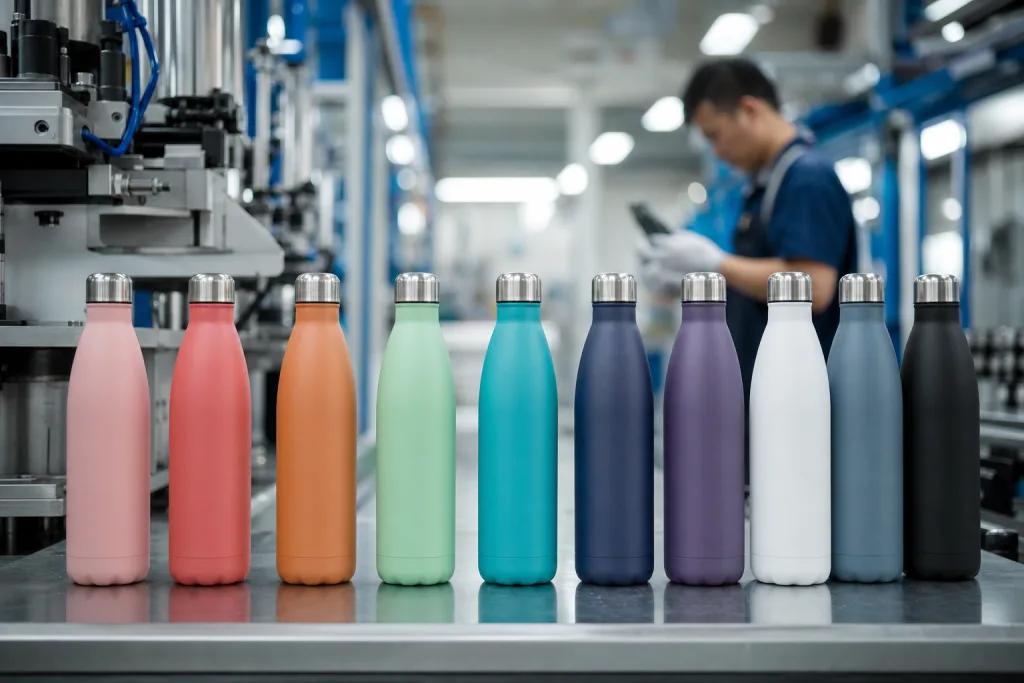
Key Takeaways
- Pantone-matched body colors usually need 1,000-3,000 units per SKU, while logo-only decoration can start at 500 units
- Expect mass-production color variance of about Delta E 1.5-2.5 on coated metal, and wider variance across plastic, silicone, and ink
- Pre-production samples add 5-10 days, but they prevent the 30-40 day delay that comes with rework after bulk coating
- Standard FOB Zhejiang, China lead time for custom drinkware is often 35-55 days after sample approval and deposit
You already know a brand-guide color is not the same as the color that lands on coated stainless steel, powder coating, Tritan, or a silicone ring. That gap is where drinkware projects stall. We’ve seen approvals slip 12 days vs 18 days just because the first sample was checked under office light, not a D65 light box on the line. If you are buying drink bottle custom Pantone programs for retail, promo, or distributor channels, get the approval standard fixed before tooling, sampling, and mass production start.
Here in Zhejiang, we run into the same issue every month: the buyer asks for Pantone matching, then finds the MOQ moved from 1,000 pcs to 3,000 pcs, the print method changed, and no one wrote down the pass/fail standard. QC pulled the sample, and the buyer flagged it because the lid looked warmer than the body by about 1.5 ΔE. A practical buyer guide should lock color, decoration, compliance, and delivery into one signed spec. If your next project involves a custom canteen, customized growler, or a full customizable drinkware line, this is the wrong question to ask: “Can you match Pantone?” The right question is, “How will you match it on this material, at this MOQ, with this finish?” That checklist saves weeks and protects margin.
What does Pantone matching really mean?
When you ask for drink bottle custom pantone, you are not buying a blanket promise that every bottle part will read the same under daylight, showroom LEDs, and warehouse fluorescent tubes. You are buying a controlled process with agreed tolerances. That distinction saves arguments later. On our line, QC usually checks color at the light box before packing starts.
For a stainless steel bottle body, Pantone matching usually means the factory mixes paint or powder to visually match a Pantone reference under standard light conditions, then compares the approved sample against the bulk lot. For logo printing, the match applies to ink. For plastic lids, straws, bumpers, and silicone seals, the same Pantone number can still shift because each substrate throws light back differently. We have seen a 304 stainless body and a PP lid both called 186C, yet the buyer flagged the lid as darker at first article review.
A smart procurement spec should define four things. This is not paperwork for its own sake; it keeps the line from guessing.
- Reference standard: Pantone Solid Coated, Pantone Solid Uncoated, or a physical swatch you provide. If you send a swatch, seal that exact chip version, because one worn card from a sales bag can already drift.
- Application area: body coating, silkscreen logo, heat transfer, lid plastic, or silicone ring. A 0.2 mm ink layer and a thicker powder coat will not read the same.
- Acceptance method: visual approval from a sealed sample, not only artwork on screen. We ship against the signed sample, not a PDF on somebody's laptop.
- Tolerance: practical mass-production variance, often Delta E 1.5-2.5 for coated metal. If a buyer asks for zero deviation across metal and silicone, the math does not work.
Buyers new to a canteen manufacturer in China often assume a Pantone code is enough. It is not enough. If you only write “match Pantone 186C,” the canteen factory still has to decide gloss level, texture, coating thickness, and inspection light source. This is the wrong question to ask. Ask how the color will be made, checked, and approved. A matte powder coat at 60° gloss can make the same red look darker than a glossy sprayed finish, even if both were mixed to the same code.
Best practice: approve one sealed pre-production sample and make that sample the visual master for bulk inspection.
That approach works whether you are sourcing a custom canteen, a customizable growler, or a broader customized drinkware range for Europe and North America. We have seen this go sideways on mixed-material sets, especially when the PO says “Pantone match” but misses the lid and gasket callout.
Which bottle parts can match Pantone?
This is where 7 out of 10 custom color projects start slipping. Bottle parts do not match Pantone the same way, they do not cost the same, and they do not hold the same tolerance once the line starts running.
On one vacuum bottle, you might have an 18/8 stainless body, PP or Tritan lid parts, a silicone seal, printed logo ink, and a polyester carry strap. Each one reacts differently in curing, molding, or dyeing. We see this on the factory floor all the time: QC pulled the sample, the body was fine, and the buyer flagged the lid as half a shade off under D65 light. A reliable canteen supplier or canteen vendor should say this before sampling, not after sample approval fails.
Body coating
This is usually the easiest part to control. Powder coating and wet spray can get close on single-color bodies, and the visual result is often the cleanest at arm's length. We run a 60-80 μm coating thickness target on standard bottles, and that helps color stay more stable batch to batch. MOQ is often 1,000 units per color for a standard model, though some canteen manufacturers in Zhejiang can start at 500 units if they already run a similar coating line. If a buyer asks for exact same color on body, lid, and seal, this is the wrong question to ask.
Printed logo
Silkscreen and heat transfer can match Pantone well if the artwork is practical. Fine type below 1.2 mm stroke width and metallic inks give us more rejects, and we have seen logos look right on the first sample then shift after curing. Laser engraving does not use Pantone at all. It just exposes base metal or coating contrast.
Lid plastic and silicone
This is the hard part. Injection-molded PP, ABS, Tritan, and silicone each need their own masterbatch or pigment formula, and gloss changes the eye test even when the lab number looks acceptable. We have had buyers send one Pantone number and expect four materials to land the same; the math doesn't work. Even if your canteen customized program uses one Pantone number, the lid and ring may be within tolerance but not identical to the body. On one PO, the buyer even typed the wrong suffix after the Pantone code, and the sample had to be remade.
- Stainless body: usually the closest visual match, especially with matte powder coat and flat viewing angle
- Plastic lid: good control, but resin grade, mold temperature, and surface gloss still move the final shade
- Silicone seal: acceptable match in most programs, often a little darker or more muted after curing
- Webbing strap: often nearest-stock color unless volume is high enough for custom dyeing, usually 3,000 pcs or more
If you are building a full canteen customizable assortment for a retail launch, ask your canteen factory to split the color plan into exact-match, close-match, and stock-color only. We ship faster when that chart is signed before sampling. One simple table can save 12 days instead of 18 days of back-and-forth.
What MOQ and cost should you expect?
Buyers ask for Pantone on 300 pieces all the time, then the quote lands and they push back. The cost is not just paint. We run ink mixing by batch, clean the spray line between colors, wait on a signed sample, and absorb scrap if the first pass misses the chip. On a body-color change, QC often pulls 5 pcs right off the line for delta check under the light box. That is why MOQ jumps faster on full-body Pantone than on a simple logo print.
For mainstream stainless drinkware from China, practical starting points look like this:
- Logo-only on stock color: 500-1,000 units per SKU
- Custom body Pantone + 1 logo: 1,000-3,000 units per SKU
- Custom lid color too: usually 2,000 units or more
- New mold or unique lid structure: separate tooling, often USD 2,000-8,000
On price, a stock-color 500 ml double-wall bottle might be USD 3.20-4.80 FOB Zhejiang depending on finish and packaging. A custom Pantone body may add USD 0.15-0.45 per unit. Custom lid color can add another USD 0.08-0.25. Individual box redesign, barcode labeling, or Amazon prep adds more. We have also seen small PO errors drive cost up fast; last quarter a buyer flagged a lid color mismatch that started with one typo in the PO color code. This is the wrong question to ask if you only compare the adder. Setup loss is usually the bigger issue.
At BottleForge-scale output, a plant running 300,000-500,000 units per month can sometimes combine colors across orders and reduce setup waste. If two orders use close body shades, the line can run them back to back and save one cleaning cycle. That helps a canteen distributor, distributor canteen buyer, or distributor drinkware program manager keep MOQ realistic. But do not expect a customizable canteen project at 300 pieces to get true Pantone body matching at an efficient price. The math doesn't work.
If you are buying for promo, ask whether the project is really a canteen promotional order or a retail-color order. Promo buyers usually care more about logo placement and event deadline than perfect body color. We ship plenty of event orders where a 2 mm logo shift gets more attention than a slight body shade drift. Retail buyers usually need color consistency across multiple shipments, sometimes 60 days apart, and that means tighter sample control. Those are different sourcing strategies.
If the order value is tight, spend your budget on body color and logo quality first. Custom-matching every strap, bumper, and gasket is usually where margin disappears.
How do you approve color without delays?
The fastest way to lose 3 weeks is simple: approve artwork, then skip the physical color sample. Screens are not standards. PDF proofs are not standards. For a serious custom drinkware or customized canteen program, the sample route needs to match the line, the coating, and the actual substrate. We’ve seen this go sideways when a buyer signed off from a laptop, then QC pulled the sample and the bottle body was 1.5 Delta E off target.
Use this approval checklist with your canteen suppliers or canteen vendors:
- Send the exact Pantone reference, with finish requirement such as matte, gloss, or fine texture.
- Confirm substrate by part: stainless body, PP lid, Tritan cap, silicone ring.
- Ask for one pre-production sample made with actual coating or molded color, not a hand-painted mockup.
- Approve under D65 or equivalent neutral light, not warm office lighting only.
- Record acceptable variance in writing and attach sample photos.
- Seal the approved sample for QC reference during bulk inspection.
A pre-production sample usually adds 5-10 days and costs USD 80-200 including courier, depending on model and decoration. That feels slow until the math shows up: reworking 2,000 bottles in the wrong shade costs far more than one extra sample round. On our side in Zhejiang, China, we’d rather hold the line for 7 days on sample confirmation than fight a 5,000-unit claim later. Last month, a buyer flagged a cap color shift that looked minor on screen but was obvious under the light box.
If you work with multiple canteen distributors or resellers, assign one person for final color sign-off. Group approvals are the wrong setup. We get mixed comments like “more orange,” “less warm,” or “closer to web color,” and none of that gives the spray booth or molding shop a measurable target. One decision maker, one physical sample, one approval email. We once got a PO note with “Pantone 2025” typed instead of the actual coated code, and that alone burned 2 days.
This matters more for a customized growler or customizable growler because the larger curved surface shows color shift faster than a small tumbler. Small difference, big visual impact. On a 64 oz growler body, the reflected area is wide enough that a slight coating variation is easy to spot from 1 meter away.
What quality controls protect your order?
Pantone match is only one checkpoint. If the bottle hits the color chip but leaks at the lid, dents after carton drop, or fails a 3M tape pull on the line, you still have a bad order. We tell buyers this upfront because color approval without product QC is the wrong question to ask.
Ask your canteen manufacturer for the inspection standard before mass production starts, not after the first 500 pcs are packed. For export programs from China, common practice is AQL 2.5 for major defects and AQL 4.0 for minor defects, and premium retail programs often tighten that after pre-production sample signoff. QC pulled a sample last month where the PO typo said “mat Pantone” instead of “matte Pantone,” and that small miss turned into a finish dispute.
Your QC checklist should cover:
- Color consistency: compare against sealed sample by lot under the same light source, not one carton under office light and the next under warehouse light
- Coating adhesion: cross-hatch or tape test where applicable; we usually mark the grid with a 1 mm cutter before the pull
- Vacuum performance: heat retention and condensation checks for insulated models, especially on SKUs the buyer flagged for all-day office use
- Leak testing: 100% or sampling by model risk level; for flip lids, we’ve seen this go sideways if hinge parts come from a new supplier
- Dimensional fit: lid thread and gasket seating; a 0.3 mm gasket variance is enough to create slow leaks
- Drop and carton tests: especially for e-commerce channels, where a 1A carton pass matters more than a clean factory table sample
- Compliance documents: REACH, LFGB, FDA-contact basis, CPSIA where relevant, ASTM for children’s items
If the order is for a custom growler or distributor growler program, also check handle strength, cap torque, and pressure expectations if carbonated use is mentioned in marketing. Do not assume every growler is built for the same use case. We ship some growlers with torque checks at 12-15 lbf·in, and some buyers still push for carbonated claims on bodies that were never designed for that pressure.
In our region of Zhejiang, 7 out of 10 larger buyers also ask for BSCI or ISO-style system documentation before placing annual volume. Fair ask. Still, paperwork is not product inspection, and the math doesn’t work if the audit file looks clean while the actual lot has print registration drift of 1.5 mm or mixed shades between cartons. The buyer sees the shelf, not the certificate.
For repeat orders, ask the factory to retain a golden sample and batch records. When the next PO ships 90 days later, you want the same reference bottle, same spray setting, same lid assembly note. We run into trouble when a repeat order is judged against memory instead of a sealed sample.
How should you plan lead time and shipping?
Most delays on Pantone projects do not start on the water. We see them earlier on the line: color confirmation against the Pantone chip, carton mark approval, and booking one lid part that is still 2 mm off from the signed sample. If you want a delivery date that holds up, split the job into stages and ask what can slip in each one.
For a standard stainless bottle with custom Pantone body and one logo, a typical schedule from Zhejiang might look like this:
- Artwork and spec confirmation: 2-4 days
- Pre-production sample: 5-10 days
- Sample courier and approval: 3-7 days
- Mass production: 25-40 days
- Final inspection and booking: 3-5 days
That puts most orders at 35-55 days ex-factory after deposit and sample approval. We ship plenty in that window. Sea freight sits on top of it by port and season, and the math changes fast if you add retail packaging, barcode application, pallet rules, or FNSKU labels for marketplace fulfillment. We have seen a 40HQ booking hold while the buyer was still correcting one typo on the outer carton PO. A lot of distributor drinkware programs miss the target because carton marks were signed late, not because bottle production ran slow.
Ask your canteen supplier one direct question: which component controls the schedule? This is the right question. Sometimes it is the bottle body curing time after coating. Sometimes QC pulled the sample and the molded lid color was outside tolerance. Sometimes the custom gift box supplier needs 6 extra days because the insert knife mold is not ready. Once you know the control point, you know where the risk sits.
If timing is tight, cut variables. A stock lid with a custom body often ships 7-12 days faster than a fully color-matched lid-and-body set, and we run that combination all the time for launch orders. Buyers push back on this because they want a full set match, but we have seen this go sideways when the lid masterbatch is late. That gap can decide whether you catch a seasonal launch or pay for air freight.
Procurement managers who buy from China repeatedly usually separate must-have brand elements from nice-to-have details. Short sentence. The ones who do this early tend to save 8-12 days and avoid change requests after sampling. One common example is dropping a custom EVA insert in the gift box and keeping the bottle finish and logo locked. That discipline matters more than bargaining over 3 cents. It is how you keep a customized drinkware project commercially workable.
Send your Pantone code and bottle spec today
We will review MOQ, color feasibility, decoration method, and lead time for your custom drinkware project from Zhejiang, China within one working day.
Frequently asked questions
Can you match any Pantone color exactly on a bottle?
Not on every material, and not with zero variance. On coated stainless steel, a good factory can usually reach a close visual match, often within Delta E 1.5-2.5 on the approved finish. On PP, Tritan, silicone, and fabric straps, the same Pantone may look slightly different because the substrate, gloss, and texture change light reflection. If you need tight control, define the Pantone book reference, finish level, and the exact parts to be matched. Then approve one physical pre-production sample as the standard. For B2B orders, that sample matters more than a digital proof.
What is the usual MOQ for drink bottle custom Pantone orders?
For stock models with a custom body color, 1,000 units per SKU is a common starting point in China, though some factories accept 500 units on simpler programs. If you want custom body color plus custom lid color, MOQ often moves to 2,000-3,000 units because paint, plastic color masterbatch, and line setup all increase cost. Logo-only orders on stock bottle colors can often start at 500-1,000 units. If your order is under 500 pieces, the most efficient route is usually stock color plus customized logo, not full Pantone body matching.
How much more does Pantone customization usually cost?
For a standard 500 ml insulated bottle, custom Pantone body color often adds USD 0.15-0.45 per unit over a stock-color version. A custom-matched plastic lid can add another USD 0.08-0.25 depending on resin, mold complexity, and order quantity. A pre-production color sample may cost USD 80-200 plus courier. These are normal ranges, not fixed rules. The real cost driver is how many parts need matching. One body plus one logo is manageable. Once you add lid, strap, bumper, and custom box, the project cost can rise 8-15% quickly.
How do I reduce the risk of color disputes with a canteen factory?
Write the requirement in a way production can inspect. Specify the Pantone code, finish type, decoration method, and the parts included in the color match. Ask for a pre-production sample made with actual production coating or molded color, then approve that sample under neutral light. Keep one sealed sample for final inspection and state the inspection standard, such as AQL 2.5 major and 4.0 minor. Also name one decision maker on your side. When three people approve by photo from different screens, disputes are almost guaranteed. Good records save more money than long email chains.
What documents should I ask for on custom drinkware orders?
Start with the documents tied to your sales market and product type. For Europe, ask about REACH and LFGB basis where applicable. For North America, request FDA-contact basis and any retailer-specific requirements. For kids' items, ASTM or CPSIA-related testing may matter. Beyond compliance, ask for the approved artwork file, packaging spec, carton marks, QC standard, and sample approval record. If the order goes to e-commerce, include barcode rules such as FNSKU and carton labeling. A capable canteen supplier in Zhejiang, China should be able to package these records with your PO and inspection file.