Key Takeaways
- Typical MOQ starts at 500-1,000 units per SKU for stock molds, while fully new molds usually need 3,000-5,000 units
- A 500 ml double-wall stainless bottle often lands around USD 3.20-6.80 FOB China before freight, depending on coating, lid, print, and packaging
- Pre-production sampling usually takes 7-12 days; bulk production is commonly 25-40 days after deposit and artwork approval
- AQL 2.5 inspection, REACH/LFGB testing, and drop-test packaging checks can add 3-7 days but reduce claim risk later
You are usually not short of ideas. You are short of clean numbers. A supplier says a drink bottle custom made project is “easy,” then the quote moves after packaging, print method, lid choice, and testing are added. We see this on the line all the time: one carton spec changes from 24 pcs to 20 pcs, and the unit cost shifts before the buyer even catches it. Lead time slips too, because “sample approved” often means the photo sample passed, not that the final mold, print file, and packing drop test are signed off. This is where first China orders go sideways.
If you buy for retail, promotions, Amazon, or distribution, you need cost and timing before you ask for artwork. This is the right question to ask. In Zhejiang, China, the practical points are plain: what pushes unit price up, what MOQ makes sense at 1,000 pcs or 3,000 pcs, and whether your schedule is 12 days or 18 days from drawing to shipment. QC pulled samples last month where the PO had a lid color typo, and that alone held packing for two days. Those numbers matter more than broad promises, whether you are comparing a canteen factory, a custom drinkware program, or a custom growler line for next season.
Where the unit cost really moves
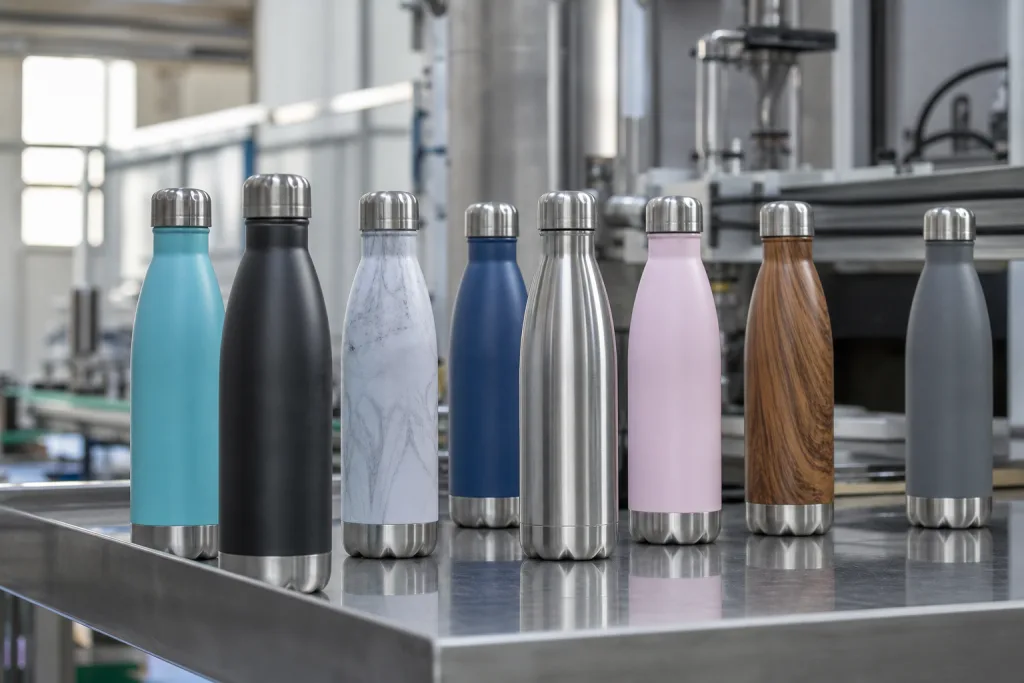
On a drink bottle custom made quote, the bottle body is only part of the number. For a standard 500 ml double-wall 18/8 stainless steel bottle with copper coating and a screw lid, the body may account for 45-60% of the FOB price. The rest comes from decoration, lid construction, packaging, testing, and how messy the order is to run. We see this every week on the line. Two bottles that look almost the same in a photo can still land USD 1.20 apart per unit.
Material and structure move cost first. Single-wall stainless bottles may sit around USD 1.80-3.20 FOB China in medium volume, while double-wall vacuum bottles often fall in the USD 3.20-6.80 range. Tritan sports bottles can be lower, often USD 1.40-2.80, though testing and branding details still matter. If you are buying a custom canteen, customizable drinkware, or a customizable growler, wall thickness is one of the first specs we check with the micrometer. Common body thickness is 0.4 mm outside and 0.3-0.4 mm inside. Move to 0.5 mm for dent resistance and you may add 6-10%. Buyers ask for heavier steel all the time, but this is the wrong question to ask if the target shelf price is fixed.
- Coating: standard powder coating is usually cheaper than rubber paint or special gradient spray. A normal matte powder coat runs clean on the line; gradient spray adds masking and more rejects from color drift.
- Decoration: silk screen may add USD 0.08-0.20; laser engraving USD 0.12-0.35; full-wrap heat transfer can add USD 0.35-0.80. QC pulled the sample on one order because the wrap seam was 2 mm off the back logo.
- Lids: plain PP screw caps cost less than stainless caps with handle loops, straws, or multi-part seals. Every extra seal ring and fitment adds assembly time and leak-risk checks.
- Packaging: white box is the cheapest; color gift box, inserts, and barcode labeling push cost up quickly. We ship faster in a plain white box; a gift box with EVA insert often adds 7-12 days just on print and pack materials.
From our side in Zhejiang, China, one more factor matters: line efficiency. A canteen customized order split into four colors, three logo positions, and two lid packs will cost more than one clean SKU, even if total quantity is the same. The math doesn't work any other way. We run more changeovers, more carton marks, and more pick-and-pack checks, and that labor shows up in the FOB. A lot of canteen manufacturers will not spell this out. Ask for a cost breakout by bottle, lid, print, and pack-out, so you can cut features without guessing. We have even seen a PO typo on lid pack ratios turn a smooth shipment into a half-day recount.
MOQ tiers that make commercial sense
MOQ is not a random number. It comes from setup cost on the line, powder coating batch efficiency, carton buying, and the scrap buffer we need to run clean production. On our side, QC pulled the first-off samples and the math is plain: a stock model and a new development do not belong in the same MOQ discussion. This is the wrong question to ask if the drawing is still changing.
For a stock bottle from a canteen manufacturer or canteen supplier, 500 units per color is a workable starting point if you stay with one body color, one lid style, and one print method. We run this kind of order every month. Most drink bottle custom made programs start to make commercial sense at 1,000 units, because setup gets spread over more pieces and the carton supplier will quote better at that break. At 3,000 units, the price drop is usually real, often 5-12% below a 500-unit run. At 5,000 units, decoration yield and carton pack-out improve again; on a 24-pack master carton, even small void reduction shows up in freight.
Typical MOQ ranges
- Stock stainless bottle: 500-1,000 units per SKU
- Stock Tritan bottle: 1,000-3,000 units per SKU
- Custom color gift box: often 1,000 units per design
- New lid mold: commonly 3,000-5,000 units
- Full new bottle mold: often 5,000-10,000 units plus tooling
If you are a canteen distributor, distributor drinkware buyer, or one of several canteen distributors serving different channels, do not push into a full custom shape too early. We have seen this go sideways. A stock mold with a custom PMS coating, laser mark, and private-label carton is usually the faster commercial test, and it avoids early tooling risk. Tooling for a new stainless body can range from roughly USD 3,000 to USD 12,000 depending on complexity; a deep-draw body with a non-standard shoulder radius takes more work on the tooling side. For a custom growler or customized growler with a special closure system, tooling can go higher.
You save more money by choosing the right MOQ tier than by pushing a supplier for another USD 0.05 on a badly structured order.
Our factory capacity in Hangzhou, Zhejiang is up to 600,000 units per month across mixed drinkware lines, but low MOQ projects still need discipline. Below 1,000 pieces, keep the spec tight: one coating, one lid, one print position, one carton version. Last month a buyer flagged a PO with two logo sizes on the same SKU, and that single typo held pricing for a day. That is the cleanest way to get reliable pricing from canteen vendors, canteen suppliers, or a canteen factory in China.
Samples, tooling and approval timing
Lead time starts before the line runs. A lot of buyers count only factory days, then lose 4 days on an open spec and a logo file that still says “final_v6.ai.” For a stock item, digital mockup approval usually takes 1-3 days. A pre-production sample needs about 7-12 days, based on coating and logo process. If the bottle needs a custom cap color, a special finish, or a new insert, sampling often shifts to 10-15 days because we have to match chips, pull material, and test fit on the sample bench.
For new tooling, add engineering time first. A new plastic lid mold may need 15-25 days for tool build and first trial, and QC usually checks the first off-tool parts with a caliper for flash and hinge gap. A new bottle shape can require 20-35 days before you even have a proper sample. Then plan for at least one correction round. This is the wrong question to ask: “Can you rush it?” If the concept is not frozen, we’ve seen this go sideways.
- Artwork review: 1-3 days
- Stock sample: 7-12 days
- Tooling sample: 20-35 days
- Sample revisions: 5-10 days each round
Testing is where the calendar gets hit without warning. If you need REACH for Europe, LFGB for food-contact parts, or ASTM support for a kids line, testing samples may add another 5-10 working days depending on the lab queue. On mixed-material canteen customizable projects, the buyer flagged odor on a silicone straw set after 48 hours in a sealed bag. That happens. Silicone parts, painted straws, and overmolded components need extra checks because migration and smell complaints usually start there.
The practical fix is simple: approve one full specification sheet before sampling. We run better, and buyers get cleaner dates. That sheet should include capacity, net weight tolerance, body thickness, Pantone color, logo size, logo position, packaging method, carton drop standard, and barcode requirement. If you sell through Amazon FBA, include FNSKU and carton label rules early; we still see POs with outer carton marks missing or the barcode position typed wrong by 12 mm. Whether you buy from canteen manufacturers in Zhejiang or elsewhere in China, the cleanest timeline comes from a frozen spec, not a fast email reply.
Production windows buyers should actually use
After sample and artwork sign-off, bulk production for a drink bottle custom made order is usually 25-40 days. That is the range we actually quote for most stock-model stainless programs. A simple run—1,000-3,000 bottles, one coating color, one logo—can move in 25-30 days. Add mixed SKUs, gift boxes, or accessory assembly, and 35-40 days is the safer window. We have seen buyers push for 18 days on a 3,000-piece run, and the math doesn’t work once the line books powder coat and packing.
The factory process is not one straight pass. We run tube cutting, neck forming, welding, vacuuming, polishing, coating, logo printing, inspection, packaging, and carton sealing in separate stages, often on separate schedules. If one stage slips, the next one waits. A vacuum leak found at 0.03 MPa during QC can hold cartons that were supposed to close the same day. Powder coating ovens are a common bottleneck from August to November, especially when 2 colors share the same line.
Useful planning ranges
- 1,000 stock bottles: 25-30 days
- 3,000-5,000 mixed-color bottles: 30-35 days
- Orders with gift boxes or inserts: 35-45 days
- Peak season buffer: add 7-10 days
If you are a canteen distributor, distributor canteen program manager, or canteen promotional buyer working against a trade campaign date, count back from ETD, not from the day the factory says production starts. This is the right question to ask. Also ask how the supplier books the order after deposit. Some canteen factories quote “30 days lead time,” but they mean 30 days after all packaging materials arrive, not 30 days after PI confirmation. We have even seen a PO typo on an insert size hold printing for 2 days. Get the definition in writing.
At BottleForge Industrial, typical MOQ for stock custom drinkware starts at 500 units, and standard lead time is 30-35 days after deposit and final approval. Those are normal Zhejiang export numbers, not rush numbers. If a factory in China promises 12 days for a decorated vacuum bottle order in peak season, ask which process they are cutting. QC pulled the sample on one rush order like that, and the issue was uncured coating near the shoulder radius. Most times the weak point is coating cure time, full inspection, or packaging readiness.
Packaging, compliance and hidden extras
The quote problem most new buyers face is not fraud. It is missing scope. A bottle quoted at USD 3.60 can turn into USD 4.35 once the inner box, barcode sticker, stronger export carton, and testing get added. We see this every month. The buyer flags the jump late, then the launch date slips. Packaging and compliance are where 2 canteen suppliers can look cheaper on page 1 and lose the comparison by page 2.
For packaging, a plain white box may add only USD 0.12-0.22. A full-color mailer or gift box with foam or pulp insert can add USD 0.35-0.90. If your order needs multilingual instruction sheets, that is another small but real cost, and the copy length changes box size more often than buyers expect. On the line, even a 3 mm taller insert can change the master carton pack-out. Amazon-ready carton labeling, suffocation warnings, and scan labels are not expensive one by one, but they drive labor and checking time. If you buy customizable canteen lines for retail shelves, balance shelf impact with transport protection. Treating packaging only as a cost cut is the wrong question to ask.
- Lab testing: REACH, LFGB, FDA, or California Proposition 65 screening can range from a few hundred to over USD 1,000 depending on scope.
- Inspection: third-party AQL 2.5 inspection often costs USD 250-400 per man-day in China.
- Drop testing: carton validation may add 1-2 days but reduces transit claims.
- Barcode and relabeling: usually USD 0.02-0.08 per unit depending on complexity.
For European and North American buyers, ask the canteen factory or canteen manufacturer which claims they can support with documents. “Food safe” is not a document. You need test reports tied to the material and the finished product where relevant. QC pulled a sample last month where the PO had a barcode suffix typo, and that kind of small miss turns into warehouse rejection fast. BSCI and ISO audits are also worth checking if your procurement policy requires them, but do not mix social audit paperwork with product compliance. We have seen this go sideways.
Custom drinkware margins are often won or lost in these extras. A customized drinkware program that lands cleanly in the warehouse, scans correctly, and passes retailer checks is cheaper than a “low-cost” order with relabeling, carton failures, and customer returns. The math doesn't work if you save USD 0.08 on packing and lose 12 days fixing labels after arrival.
How buyers compare suppliers properly
If you are comparing a canteen supplier, canteen factory, canteen manufacturers, or multiple canteen vendors, put every quote into one spreadsheet and lock the format first. This is the right question to ask. If one factory quotes FOB Ningbo on 5,000 pcs with white box packing, and another quotes based on 3,000 pcs with color box and no drop test, the math doesn't work. Ask each supplier to quote FOB terms, same quantity, same packaging, same logo method, same testing basis, and same inspection level. Then you can see who runs a tighter line and who is hiding cost in the assumptions.
A serious supplier answers technical points without circling around them. Ask what stainless grade is used, whether the vacuum retention target is 6 hours or 12 hours for hot and cold hold, what the body thickness is in mm, what the lid leak-test standard is, and what scrap allowance they build into the order. QC pulled the sample on one project because the body came in at 0.32 mm instead of 0.4 mm, and that changed the feel in hand right away. For a custom growler, ask about carbonation suitability and closure pressure performance. For a customized canteen or canteen custom line, ask whether spare lids can be supplied at 1-3% overrun for after-sales support.
Check communication discipline too. Does the supplier send a drawing with dimensions in millimeters? Do they confirm Pantone references? Do they define carton size, gross weight, and loading quantity? We still see POs with a typo in the logo color code, and then the buyer flagged it after sampling. In Zhejiang and wider China, good export factories are usually clear on these basics because they ship repeat projects every month, often 20 to 30 SKUs through the same merchandiser team.
- Ask for capacity proof: monthly output, number of vacuum lines, and normal MOQ. If a factory claims 200,000 pcs per month, ask how many auto welding stations they run.
- Ask for QC method: in-line checks, 100% leak test, and final AQL standard. Ask what pressure they use on the leak tester and whether QC records stay with the lot number.
- Ask for shipment realism: ex-factory date, FOB port, and booking buffer. We've seen this go sideways when a supplier promises Friday ex-factory but has not finished carton drop testing.
- Ask for claim handling: photo standard, replacement policy, and credit timing. A clean answer includes defect photos, carton marks, and a reply window like 48 hours.
The best canteen distributor relationships usually start with a simple first order, not the most complicated one. Start with a stock mold, controlled artwork, and clear QC rules. We usually suggest 3,000 to 5,000 pcs on the first run so the line stays stable and both sides can check the packing result. Once the supplier proves cost stability and lead-time discipline, then move into canteen promotional programs, customizable growler projects, or a broader distributor growler range. That is how you cut risk and still build a product line that feels customized to your brand.
Get a clean quote for your next bottle project
Send your target quantity, bottle type, logo method, and packaging spec. We will break down MOQ, FOB cost, and lead time clearly.
Frequently asked questions
What is a realistic starting MOQ for a drink bottle custom made order?
For a stock model, 500 units per SKU is a realistic starting point, and 1,000 units usually gives better pricing. If you need a custom body color plus one logo, 500-1,000 pieces works for many stainless bottles. If you want a new lid, custom insert, or color gift box, the MOQ often moves to 1,000-3,000 pieces. For a full new mold, expect 3,000-5,000 units at minimum, sometimes higher. In China, the MOQ is tied to coating setup, box printing minimums, and scrap control, not just sales policy. If your target volume is small, keep the bottle shape standard and customize coating, logo, and packaging first.
How much should I budget per unit for custom drinkware?
For a common 500 ml double-wall stainless bottle, a reasonable FOB China budget is USD 3.20-6.80 per unit depending on lid style, coating, and branding. A single-wall stainless item may be closer to USD 1.80-3.20, and a Tritan sports bottle may sit around USD 1.40-2.80. Add roughly USD 0.08-0.35 for logo work depending on silk screen or laser, and USD 0.12-0.90 for packaging depending on white box versus color box. If you need testing, third-party inspection, or Amazon FBA labeling, those are extra. Buyers usually get into trouble by budgeting only for the bottle and forgetting the pack-out and compliance scope.
How long does production take after sample approval?
For most stock-model orders, bulk production takes about 25-40 days after deposit, final artwork, and sample approval. A simple 1,000-piece order with one color and one print can finish in 25-30 days. Mixed SKUs, gift boxes, and accessory assembly usually push lead time to 30-40 days. During peak season, especially from late summer into Q4, add another 7-10 days for safety. If you also need lab testing or a third-party AQL inspection before shipment, reserve an extra 3-7 working days. Always ask the factory whether lead time starts from PI approval or from the date all packaging materials are ready.
What documents should I ask from a canteen manufacturer or supplier?
Ask for a full quotation sheet, specification drawing, packaging details, and any relevant compliance reports. For Europe, REACH or LFGB may matter depending on product and material. For North America, FDA-contact statements or Proposition 65 screening may be requested by some buyers. If your company requires audits, ask whether the factory has BSCI or ISO documentation. For QC, request the leak-test method, vacuum retention target, and final inspection standard such as AQL 2.5. Also ask for carton dimensions, gross weight, and loading quantity. A serious canteen manufacturer in Zhejiang or elsewhere in China should be able to provide these without vague language.
Is it better to start with a stock bottle or develop a fully custom canteen?
For most first orders, start with a stock mold. You can still make it feel branded through Pantone coating, laser logo, custom carton, and accessory choices, but you avoid tooling cost and save 20-35 days of development time. A fully customized canteen or customized growler makes sense when your annual volume can support tooling, usually 3,000-5,000 pieces or more per design, and when shape differentiation really matters to your channel. For distributors and promotional buyers, stock molds are usually the safer commercial test. Once the supplier proves stable quality, lead time, and claim handling, you can move into a custom body or lid program with less risk.