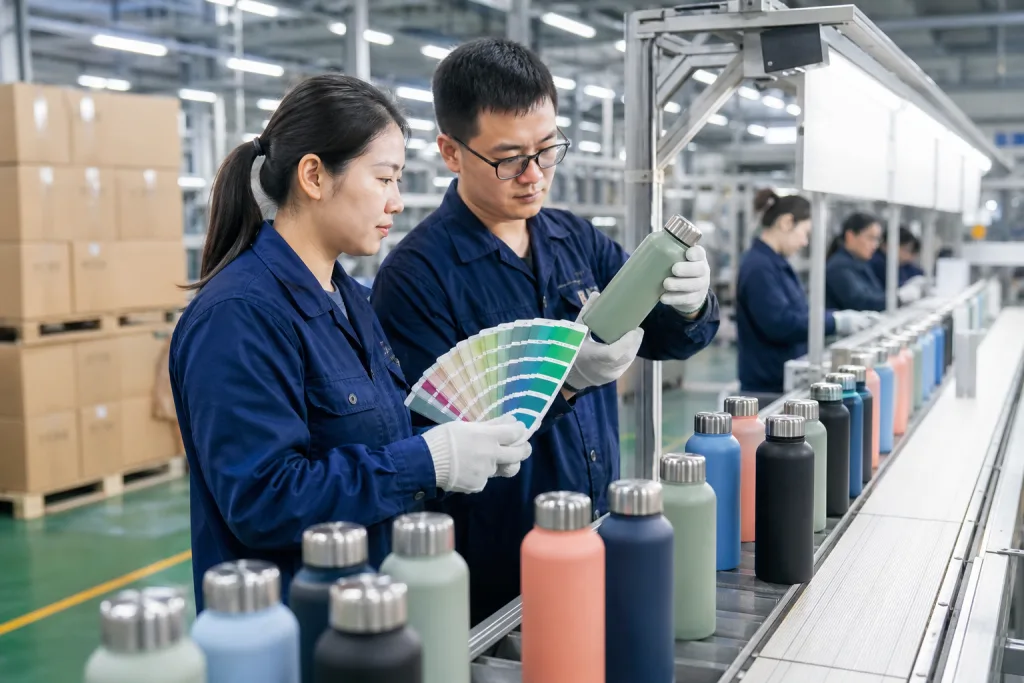
Key Takeaways
- Powder-coated stainless bottles usually need MOQ 1,000 pcs per color, while stock-color programs can start around 300-500 pcs
- Expect Pantone matching tolerance to vary by material; ±1.0 to 1.5 Delta E is realistic for many painted steel surfaces
- Custom color sampling typically takes 5-7 days, mass production 25-35 days after deposit and artwork approval
- AQL 2.5 for major defects and 4.0 for minor defects is a common shipment standard for customized drinkware orders
You usually catch color trouble late. The lab dip passed, then the mass run comes back warmer, glossier, or patchy between the lid and body, sometimes with a Delta E gap the buyer flagged on first carton opening. For a B2B buyer, drink bottle custom color is not a styling issue. It hits approval time, return rate, marketplace reviews, and whether the next PO stays with the same canteen supplier.
At BottleForge Industrial in Zhejiang, China, we see this on the line with new buyers from Europe and North America. You want a custom drinkware program that matches the Pantone target closely enough, survives a 1.2 m drop test and sea freight rub, and still lands at a workable FOB cost. So ask the practical questions early: which material, which finish, what tolerance in writing, what MOQ, and what quality plan the canteen factory will run. If those points are fuzzy at sampling, we've seen this go sideways before mass production starts.
What exactly are you approving?
For drink bottle custom color, you are not approving one color chip. You are approving a stack of production variables: base material, coating type, gloss level, surface feel, print method, and the light used for inspection. A matte powder coat on 18/8 stainless steel will read differently from a 60° gloss spray finish on Tritan, and neither will match a painted PP lid the same way. This is the wrong question to ask if the first line is only price. We usually ask buyers to lock the approval standard first, then we quote.
A practical color approval sheet should include:
- Pantone reference, including coated or uncoated version
- Finish target: matte, satin, gloss, rubberized, metallic, pearl, gradient
- Material by part: bottle body, lid cap, handle, straw, bumper
- Viewing condition: D65 light or equivalent daylight standard
- Allowed variation between components
- Print method if logo sits on top of the coating
At our Zhejiang, China facility, buyers often assume the cap and bottle body should be a perfect match at first glance. QC pulled the sample under a D65 light box last month and the delta looked fine on steel, then shifted on the injection-molded polypropylene cap. Sometimes we can hit it. Sometimes we cannot, especially across stainless and PP in the same set. We have seen buyers flag this at pre-shipment, then approve it after side-by-side review at 30 cm. A solid canteen factory should say clearly where exact matching is realistic and where “commercially acceptable match” is the honest answer.
You do not buy color by Pantone number alone. You buy a Pantone number on a specific material, with a specific finish, under a specific process window.
If you are sourcing from canteen manufacturers or canteen vendors for the first time, ask for a signed golden sample. We ship that sample with the PO number marked on the carton and keep one sealed at the line. That physical sample matters more than an email screenshot. Screens lie. Production follows the approved sample, not what a monitor showed at 11 pm in another time zone.
How do MOQ and price move?
Custom color changes the job from the first rack on the line. We switch powder, clean the spray booth, reset packaging, and log a new color card. MOQ is not a random sales number. For standard vacuum stainless custom canteen styles, a realistic MOQ is 1,000 pcs per color per size. On existing molds with stock lids and no new insert, some canteen suppliers in China will take 500 pcs if you stay on a standard powder palette and accept one test panel from the booth. For custom growler or larger 64 oz insulated bodies, MOQ usually sits at 800-1,000 pcs because each body takes more hanger space and the line runs slower.
Price moves with finish work and packing detail. Here is a factory-side range for reference, not a quote:
- 20 oz single-wall sports bottle, stock color, no logo: about USD 1.20-1.80 FOB China
- 20 oz vacuum stainless bottle, standard powder coat: about USD 3.20-4.90 FOB China
- 20 oz vacuum bottle with custom Pantone powder, laser logo, individual box: about USD 3.80-5.80 FOB
- 64 oz customized growler with powder coat and screen print: about USD 6.50-9.50 FOB
If a canteen vendor throws out a dramatic price drop for 300 pcs with full Pantone matching, the buyer should slow down. We have seen this go sideways. The factory may be blending leftover powder, skipping a full booth clean, or combining your order with another PO that has a close color target. QC pulled a sample once where the lid collar was 1.5 shades off the body under D65 light. That might pass for a fast promo run with a 30-day selling window. It is the wrong setup for a retail launch.
Checklist before you accept MOQ
- Ask if MOQ is per color, per lid type, or per SKU
- Confirm whether carton marks and barcode labels are included
- Check if color samples are charged and refundable
- Confirm if spare lids or replacement parts can be added at 2%-3%
In Zhejiang, we run up to 600,000 units per month across multiple drinkware lines, and small custom color lots still cost more per unit. The math doesn't work any other way. A short run burns setup time almost the same as a 1,000-piece run, whether the operator is hanging 20 oz bottles or checking carton drop results at 76 cm.
Which materials hold color best?
Drinkware materials do not take color the same way. If the brief says Pantone 286 C and the cap must match the bottle, pick the material first, then the decoration method; this is where projects go sideways. Stainless steel, Tritan, soda-lime glass, borosilicate glass, PP, ABS, and silicone each shift color in their own way, and a factory that runs color every day should say that before quoting MOQ 3,000.
Stainless steel is usually the safest pick for repeatable custom drinkware color at scale. Powder coating holds well, covers a wide Pantone range, and stands up better in scratch checks than most wet-paint jobs; on our line, QC pulled the sample after cure and checked film build before packing. It is common for custom canteen, customized growler, and customizable drinkware programs. Typical wall thickness for insulated bottles is 0.4-0.5 mm inner and 0.4-0.5 mm outer, with vacuum insulation in between.
Tritan and other plastics can look sharp, but color control is less forgiving. Transparency level, wall thickness, and even one resin lot change can move the final shade, and we have seen buyers flag two bottles from the same PO because one sidewall measured 0.2 mm thicker. For translucent bottles, color consistency is harder than on opaque painted steel. This is the wrong place to ask for zero tolerance on shade variation.
Glass bottles usually depend more on sleeves, decals, or outer coatings than true body-color matching. If you need a strong brand hue, glass is not the easy route; the math often does not work once you add breakage control, slower line speed, and extra carton protection. We ship glass with tighter drop-test attention for a reason, and output can look like 12 days vs 18 days against a comparable steel bottle run.
Lids and accessories cause most color mismatch claims. The bottle body might be powder coated, while the lid runs in PP or ABS masterbatch, and the silicone seal often lands close rather than exact; last month a buyer flagged a cap that was half a shade warmer under D65 light. That is normal, and experienced canteen distributors set that expectation early instead of arguing about it after mass production.
For Europe and North America, confirm chemical compliance before you lock color chips. Depending on the product type and market, you may need REACH, LFGB, FDA contact safety, Proposition 65 evaluation, or ASTM/CPSIA checks for kids items, and a pigment change alone can trigger retesting. We have seen this happen from a simple PO typo on coating code. If your canteen customized program is sold as children’s drinkware, do not treat testing as optional.
What sampling process avoids surprises?
The lowest-cost way to cut mistakes is a strict sample process. We’ve seen distributor buyers lose 12 days to 18 days by skipping one step and approving from a phone photo. On our side, the line usually follows this process for a custom bottle project, and this is the right question to ask first: what exactly gets signed off at each stage?
- Step 1: Product confirmation sample — lock the bottle shape, size, lid opening feel, and packaging concept; we often check lid torque on the bench before this sample goes out
- Step 2: Color sample or lab dip — confirm the Pantone direction on the actual material; for powder coat, QC pulled the sample under two light sources because the buyer flagged a shade shift before
- Step 3: Pre-production sample — approve the final logo position, final coating, and final assembly; this should be built as close to bulk as possible, not as a hand-tuned sample
- Step 4: Golden sample seal-off — keep a signed benchmark for mass production QC; we bag and label this sample so the line, QC, and inspector are all checking against the same piece
For a standard stainless custom drinkware item, color sample lead time is usually 5-7 days. Pre-production sample is often another 5-7 days once artwork is confirmed. Mass production usually takes 25-35 days after deposit, sample approval, and packaging confirmation. If you need custom mold changes, add 20-35 days depending on tooling complexity. We’ve seen this go sideways when a buyer treats a new lid part like a color-only revision; the math doesn’t work if tooling is still moving.
Ask your canteen vendor to send images in natural daylight plus indoor white light. Better, request two physical samples if the project value justifies courier cost. One stays with your product team, one stays with quality or your third-party inspection team. We ship both with matching labels, because once a PO typo or barcode revision starts floating around by email, teams end up checking different versions.
Questions smart buyers ask
- Will the sample be made on the same line and coating method as the bulk order?
- Is the lid from pilot tooling or mass tooling?
- Will logo registration move on curved surfaces?
- Does the sample include final insert, carton, and barcode placement?
If you buy for Amazon FBA, retail chains, or promotional distribution, carton and label approval matters almost as much as bottle color. A bottle can pass visual check and still get held because the FNSKU is off by 3 mm or the carton mark faces the wrong panel. The buyer usually remembers the bottle color issue. The warehouse remembers the label mistake.
How should you inspect bulk color?
Bulk color inspection needs a written standard, not “looks good” on WeChat. For most B2B orders, set a pre-shipment inspection with an agreed AQL plan. A common baseline is AQL 2.5 major / 4.0 minor, though some retail programs go stricter. On our line, QC pulled the sample under a 6500K light box and checked body-to-body variance first. Color variation is usually a minor defect, unless the mismatch is obvious on shelf or the lid and bottle on the same unit do not match.
Your inspection checklist for customized drinkware should cover:
- Color consistency across random cartons
- Difference between bottle body and lid
- Gloss level and texture uniformity
- Scratch, orange peel, pinholes, thin coating, exposed metal
- Logo adhesion and registration
- Vacuum performance for insulated items
- Leak test, drop test, carton drop if required
For insulated bottles and custom growler programs, test vacuum retention on retained samples from production, not only the initial sample. We have seen this go sideways: the color passed, then the 12-hour heat test failed because vacuum sealing drifted on the night shift. On one run, QC found 3 units out of 200 with weak insulation after weld parameters moved by 0.2 mm. Good canteen manufacturers in China track both color and thermal results, because repainting a bad thermal structure fixes nothing.
Ask whether the factory uses spectrophotometer checks or visual comparison only. This is the right question. Visual control is common for commercial drinkware, but if your brand palette is tight, instrument data matters more than opinions from the line. We ship plenty of standard matte black by visual approval alone, but for a custom Pantone match, the buyer flagged a lid shift that was missed in ambient light and caught under the meter. Also ask how many approved retain samples are stored and for how long. At minimum, keep one golden sample and one bulk retain from each PO. If the PO has 3 colorways, store 3 sets, not one mixed carton.
If your factory cannot explain its color inspection method in plain numbers, you are buying hope, not control.
This is where a stable canteen manufacturer is worth more than the lowest FOB price. The math doesn't work if you save 3% on the first run, then lose 18 days on a repeat order because the blue came back darker than the approved sample. We have had buyers push for the cheapest coater, then come back after one season because repeat color drift cost them more than the opening discount.
When should you simplify the spec?
Not every project needs exact Pantone fidelity. For event stock, school programs, gym promos, or Q4 giveaways, simplifying the spec often cuts lead time and lowers claims. We run this choice with buyers all the time: pick from an existing powder palette, match only the bottle body, or switch from 2-color print to laser engraving. On our line, skipping a fresh powder setup can save 3-5 days by itself.
You should simplify when:
- Your target landed cost is tight, for example under USD 4.00 FOB for a vacuum bottle
- Your order quantity is below 1,000 pcs per color
- You need shipment in under 25 days
- The bottle is sold online where the hero image matters more than a side-by-side shelf check under store lighting
For canteen customizable projects, the main cost comes from custom powder setup, multi-part color matching, and packaging that gets too fussy. A distributor canteen buyer can usually save 8%-15% with a stock body color plus custom logo instead of pushing for a fully customized canteen with Pantone-matched lid, handle, and silicone boot. QC pulled one sample last month where the lid was 1.2 Delta E off the approved body panel, and the buyer flagged it at once. This is the wrong question to ask: not “Can you match every part?” but “Which parts matter at retail?”
If your business model depends on reorders, ask the canteen suppliers how they control repeatability. Do they keep powder code records, retained samples, approved artwork, and process notes? We see buyers switch among 3 canteen vendors in China across 2 seasons, then complain that the color moved. Of course it moved. A new line, a new powder lot, and a different operator will not give the same result, especially if the PO even has a typo on the powder code or the approved sample was never signed back.
The right approach is not “more customization.” It is the minimum spec that still hits your sales goal and keeps risk in range. We have seen this go sideways: too many custom parts, 18 days becomes 28, and margin disappears into rework and claim handling. Experienced canteen distributors protect margin by keeping the body color right, the logo clean, and the QC standard clear.
Get your custom color project quoted correctly
Send your Pantone code, target quantity, bottle style, and delivery window. We will tell you the realistic MOQ, finish options, and lead time from Zhejiang, China.
Frequently asked questions
How close can a factory get to my Pantone color on stainless bottles?
On powder-coated stainless steel, a professional canteen factory can usually get commercially close if you provide a Pantone reference and approve a physical sample. For many B2B programs, a practical expectation is around ±1.0 to 1.5 Delta E, though not every factory measures with an instrument on every run. Exact visual matching becomes harder when the bottle body, lid, and silicone parts use different materials. If your color is critical, ask for a golden sample, define the gloss level, and state the viewing condition. Also confirm whether the sample is made with the same coating process as bulk production. For repeat orders, retain one approved sample from each PO so the canteen manufacturer in China has a stable benchmark.
What MOQ should I expect for custom color drinkware?
For standard insulated stainless custom drinkware, 1,000 pcs per color per size is a normal MOQ. Some canteen suppliers will accept 500 pcs if you use an existing mold and a stock powder color. Plastic sports bottles may go lower, sometimes 300-500 pcs, depending on resin color and packaging. Larger custom growler items often stay at 800-1,000 pcs because output is slower and carton volume is higher. Always ask whether MOQ is counted per SKU, per lid type, or per color. A quote that says 1,000 pcs but hides separate MOQ for a custom lid, straw, or silicone bumper can create trouble later. For brand programs, stable MOQ terms usually matter more than chasing the lowest trial order quantity.
How long does custom color development and production take?
For an existing bottle model from a canteen manufacturer, color development usually needs 5-7 days for a sample, plus another 5-7 days for a full pre-production sample with logo and packaging details. Mass production often runs 25-35 days after deposit, sample approval, and final artwork confirmation. If you need a new mold, special lid tooling, or molded-color accessories, add 20-35 days. During peak season in China, especially before summer promotional demand and Q4 holiday shipping, add buffer time. If your ETA is fixed, work backward from vessel cutoff, not from factory completion. Good buyers also reserve 3-5 days for third-party inspection and any small rework before release.
What tests should I request for customized drinkware color orders?
Start with compliance and performance, then add finish durability. For Europe and North America, common requests include FDA or LFGB food-contact evaluation, REACH review, and for kids items potentially ASTM/CPSIA checks. For the product itself, ask for leak test, vacuum retention test on insulated items, and coating adhesion checks. Depending on the finish, you may also want dishwasher guidance, scratch resistance review, or tape adhesion verification after print. If your custom canteen includes painted or powder-coated surfaces, confirm that color changes in pigments or coatings are covered in compliance documentation. One mistake buyers make is testing only the bottle body. Lids, straws, seals, and sleeves can also drive claims.
Is it better to use stock colors or fully custom colors for a first order?
For a first PO, stock colors are often the safer commercial choice unless your brand color is central to the launch. A stock-color vacuum bottle can reduce MOQ to 300-500 pcs in some cases, shorten lead time by about 5-10 days, and cut unit cost by 5%-15% compared with a full custom color setup. That matters if you are validating demand, selling through a distributor growler or distributor drinkware channel, or preparing a promotional campaign with a fixed date. Fully custom color makes more sense when you expect repeat orders, need stronger shelf identity, or are building a coordinated product line. The key is to match customization level to reorder potential, not just to initial marketing enthusiasm.