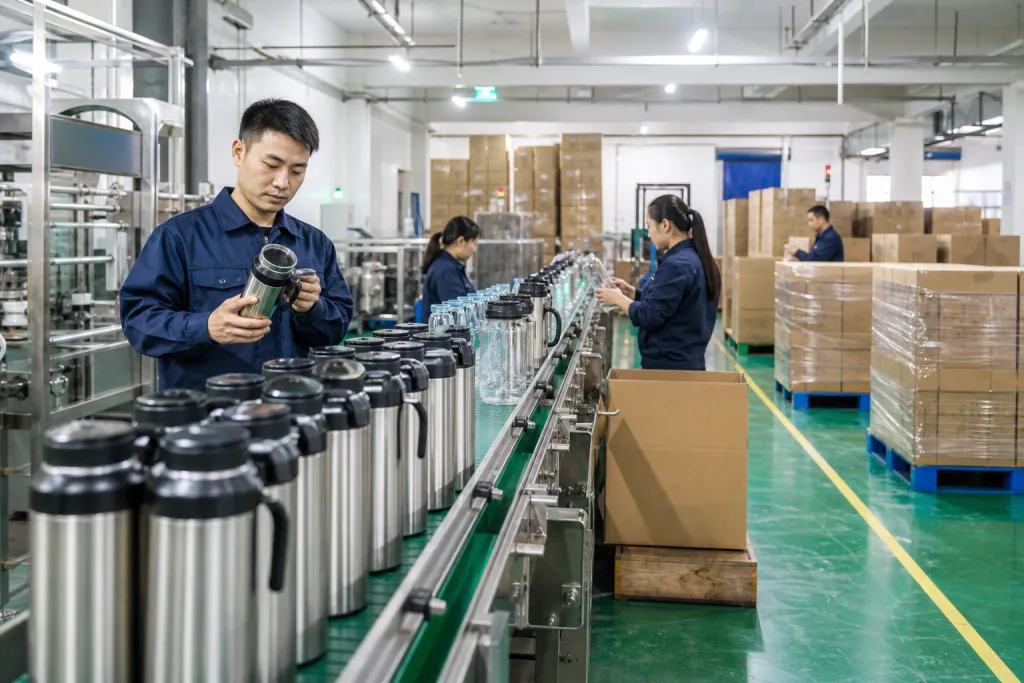
Key Takeaways
- For custom drink bottle bulk, MOQ is usually 1,000 to 3,000 pcs per SKU, while stock colors can start at 300 to 500 pcs
- A standard 500ml stainless bottle ex-works often lands at USD 2.80-5.80 before decoration, depending on 18/8 steel, coating, and lid type
- Normal lead time from Zhejiang, China is 25-45 days after sample approval and deposit, with new molds adding 15-25 days
- Use AQL 2.5 for major defects and verify REACH, LFGB, FDA, or ASTM requirements before mass production, not after shipment
You are not buying a sample for a photoshoot. You are buying 3,000 to 30,000 bottles that need to ship on schedule, pass compliance, survive a 1.2 m carton drop test, and still leave margin after duty, freight, and rejects. This is where drink bottle bulk programs break down. Buyers lock onto the unit price, then the line hits decoration limits, QC pulled the sample for carton crush, the lid vendor slips 12 days to 18 days, or the test report does not match the final resin on the PO.
From Zhejiang, China, we see this every season: a buyer asks for wholesale drinkware pricing before locking volume, print method, packaging, and target market. Last month one PO even had the logo size typed as 22 cm instead of 22 mm, and the buyer flagged the quote gap after three factories priced three different specs. You do not get a usable comparison that way. If you want a clean RFQ and a workable landed cost, start with a sourcing checklist that answers the practical questions first. Frankly, "what's your best price?" is the wrong question to ask at this stage.
What should you define first
The first buyer question is usually price. The right first question is specification. If you ask five factories in China for drink bottle bulk pricing before the spec is locked, you will get five prices built on five different assumptions. One shop quotes 201 stainless on the outer wall, another quotes full 304 18/8, one includes individual polybags, another leaves out straws, spare seals, or even export carton marks. We see this every week, and this is the wrong question to ask first.
Your RFQ needs to pin down commercial terms and engineering details in the same sheet. On our line, one missing note like a 0.3 mm thicker lid insert or mixed colors per carton can change both unit cost and packing count. For most procurement teams, the minimum workable checklist looks like this:
- Volume and shape: 350ml, 500ml, 750ml, 1L; slim bottle, wide-mouth bottle, growler, flask, or tumbler. QC pulled a sample last month where the PO said “wide month” instead of “wide mouth,” and the buyer flagged it after sampling.
- Material: single-wall stainless, double-wall vacuum 18/8, Tritan, soda-lime glass, borosilicate, PP lid, silicone seal. If the steel grade is not written clearly, the math doesn’t work.
- Use case: corporate promo, retail shelf, gym, kids, beer growler bulk, alcohol flask bulk, or canteen wholesale. A kids bottle and a beer growler do not run on the same cap and leak test standard.
- Decoration: silkscreen, heat transfer, laser engraving, powder coating, embossing, private label packaging. Different artwork methods change reject rate on the line, especially on curved bodies.
- Target market: EU, US, Canada, UK. This affects REACH, LFGB, FDA, CPSIA, and labeling. We ship the same body with different warning text depending on market, and buyers miss this point all the time.
- Order split: units per color, per size, per artwork, and whether mixed colors are allowed in one carton. A 10,000-piece order split into 8 colors is not the same quote as 10,000 pieces in 2 colors.
If you skip these points, the first quote is only a placeholder. At BottleForge Industrial in Zhejiang, our monthly output can reach 300,000 units across bottles, tumblers, flasks, and growlers, but capacity does not fix a vague brief. We’ve seen this go sideways: the buyer pushed for another USD 0.08 off, then had to redo packaging after carton assortment was clarified. A clean RFQ saves more money than chasing a lower price on a bottle that is still under-specified.
You do not control cost until you control variation.
How do MOQ and price really move
MOQ in wholesale drinkware is almost never one fixed number. It moves with the body style, surface finish, logo method, and packout. On our line, a stock 500ml sports bottle often starts at 500 pcs in one color carton pack. A custom powder-coated vacuum bottle with a printed box and two lid options is usually 2,000 to 3,000 pcs, because the coating line, logo setup, and packaging all add changeover cost. For a bulk growler or wholesale growler with a new cap tool, we’ve seen MOQ land at 1,000 pcs per size plus mold cost, and that is before the first cap sample comes off the tool.
Buyers miss this all the time: the price break is not linear. Going from 500 pcs to 1,000 pcs can cut unit cost by 8% to 15%. Going from 1,000 pcs to 3,000 pcs may save only another 5% to 9%, because stainless, insulation structure, and lid components still drive the cost. We’ve had buyers push for 5,000 pcs expecting a huge drop, then QC pulled the sample and the math didn’t work.
Typical export price ranges
- Single-wall stainless bottle: USD 1.60-2.90
- Double-wall vacuum bottle: USD 2.80-5.80
- Beer tumbler bulk, 20oz vacuum: USD 3.20-5.50
- Alcohol flask wholesale, 6oz-8oz: USD 1.10-2.40
- Beer growler in bulk, 32oz-64oz stainless: USD 5.50-11.50
- Tritan canteen bulk: USD 1.50-3.20
These are ex-works or FOB-style working ranges, not guaranteed offers. We usually add USD 0.12-0.45 for basic one-color silkscreen, USD 0.25-0.80 for laser engraving, and USD 0.35-1.20 for custom gift boxes, depending on bottle size and print coverage. On a 20oz bottle, a full-wrap box print and insert card can push the pack cost faster than the logo itself.
If you are sourcing the best wholesale drink bottle for retail, do not compare it with promo-grade stock. A bottle built with 0.4mm outer wall and 0.3mm inner wall, copper plating, and a tested leakproof lid will not price like a giveaway item. This is the wrong question to ask. Ask whether your target margin still holds after decoration, packaging, freight, and a reject allowance of 1% to 3%. We’ve seen this go sideways over one PO typo on lid color, then the buyer flagged the whole batch cost after production was already booked.
Which materials fit which channel
Material choice should match the sales channel. Not the sketch on page 1. We often get a brief that says only “stainless bottle,” then the buyer later admits the item is for school retail, brewery merch, or a 20,000-piece promo drop. That is the wrong question to ask first.
For retail shelves and outdoor programs, 18/8 stainless vacuum bottles are still the safe base hit. They hold temperature, look better in catalog photos, and take fewer dents through distribution tests. On our line, a standard 500ml double-wall bottle with a 0.4mm inner and 0.5mm outer usually gives fewer complaints than cheaper builds. For price-driven promotions, single-wall stainless or Tritan usually lands better because the math on vacuum bottles often does not work. For tea and infusion lines, glass still sells well, but we have seen this go sideways when the buyer underestimates breakage and carton setup.
- Vacuum stainless: best fit for premium wholesale drinkware, beer tumbler wholesale bulk, and winter gifting. Typical insulation is 6-12 hours hot and 12-24 hours cold depending on fill conditions. Buyers ask for 24 hours hot on a low-cost body, but QC pulled the sample and the wall thickness was off by 0.1mm.
- Single-wall stainless: lower cost and lower freight weight, so it works for sports programs and promo orders. No insulation. It will sweat with cold drinks, and that buyer pushback comes up on almost every first PO.
- Tritan or food-grade plastic: a solid pick for canteen bulk, school, or gym programs where weight matters more than heat retention. Verify BPA-free declarations and migration testing. We also check lid hinge life on the bench because a 3,000-cycle failure is not rare on cheap molds.
- Glass: cleaner taste perception, so it fits wellness lines and tea programs. It is more fragile. Ask for silicone sleeve options and stronger dividers; for one 1,200-carton order, the buyer flagged transit damage until we changed the inner divider spec.
- Hip flask formats: alcohol flask in bulk needs extra attention on cap thread consistency and edge finishing. We run thread gauges at the line because a sharp lip or loose cap gets rejected fast.
- Growlers: wholesale growler and beer growler wholesale programs need cap retention, pressure expectations, and filling process confirmed early. If the customer plans carbonated filling, say it up front; a standard cap setup and a pressure-fill setup are not the same thing.
For Europe, REACH and LFGB questions come up in the first round. For North America, buyers usually ask for FDA-contact compliance and, for children’s items, ASTM or CPSIA-related checks depending on age grading and packaging claims. If a supplier says “material is safe” but cannot show recent reports tied to the same stainless grade, lid resin, and seal, keep pushing. We have seen test reports that covered the bottle body but not the PP lid or silicone ring. In China, that paperwork gap is often the difference between a trading quote and a factory-ready quote.
What lead times are actually normal
Lead time on drinkware bulk usually comes down to body stock, decoration load on the line, and how fast packaging gets signed off. Buyers blame production first, but we’ve seen the hold-up come from a barcode revision, a logo file in the wrong outline, or one PO typo in the carton mark.
For standard bottle bodies already running in Zhejiang, China, normal timing usually looks like this on our side:
- Stock sample: 2-5 days
- Pre-production sample with logo: 5-10 days
- Mass production for 1,000-5,000 pcs: 25-35 days after deposit and sample approval
- Custom color box or display carton: add 5-10 days
- New mold or major structure change: add 15-25 days
Peak season changes the schedule fast. From August to November, vacuum bottle lines in China get tight, especially once gift programs and outdoor programs hit together. If you need canteen wholesale, growler bulk, or beer tumbler in bulk before Black Friday or winter promotions, book production 60-75 days before ETD. That is the safer window. We run into this every year when QC pulled the sample on time, but the buyer flagged the box insert and lost 6 days.
Questions worth asking before PO
- Are lids made in-house or bought from a partner factory?
- Is powder coating done on-site, or does the factory truck semi-finished bottles out for coating?
- Can barcodes, FNSKU, and carton marks be printed in one pass on the same packaging line?
- What is the daily output for this exact SKU, not just for a similar 500ml body?
- What happens if the PP sample is approved, but the master carton changes later by 3 mm or the drop test fails?
If a factory offers a 15-day lead time on a fully custom 3,000-piece vacuum bottle order with printed boxes, be careful. This is the wrong question to ask anyway; ask what capacity they checked before quoting. We’ve seen this go sideways when the line was already full with two-screen print jobs and outsourced cartons were still waiting on approval. Short promises are cheap. Missed vessel cutoffs are expensive.
How do you control quality before shipment
Quality control in drink bottle bulk needs to be locked before deposit, not patched during final inspection. We’ve seen this go sideways. A factory may run its own checkpoints, but your pass/fail rules still need to sit in the PO or quality agreement, down to details like visible scratch limit at 3 mm and barcode placement on the master carton.
For most wholesale drinkware programs, use a practical inspection structure that the line and QC both follow:
- Incoming checks: confirm stainless thickness with a micrometer, verify resin grade against the supplier COA, match color chips under the light box, check gasket hardness with a Shore A durometer, and test carton burst strength before packing starts.
- In-process checks: run vacuum retention tests by batch, do a 90-degree or full inversion leak test, check coating adhesion with cross-hatch tape, confirm print registration against the approved artwork, gauge thread fit with the mating cap, and place bottles on a flat glass plate for base stability.
- Final random inspection: AQL 2.5 for major defects, 4.0 for minor is a common starting point.
Major defects usually mean the bottle fails in use or fails at retail: leakage, wrong artwork, sharp edges, failed vacuum performance, contamination, incorrect barcode, or carton count errors. Minor defects are the ones buyers argue about at 6 p.m.—light print misalignment, a small dust point in coating, or a cosmetic mark outside the visible panel limits already defined on the sample.
Ask for test methods in plain language. This is the right question to ask. A leak test should be 90-degree inversion for 30 minutes, not a 3-second tilt at the bench. Coating adhesion may use cross-hatch tape testing, and QC pulled the sample with a 1 mm blade grid on one recent order. Vacuum retention should be checked by weighted temperature drop over a defined period, such as 12 hours. If you are buying alcohol flask wholesale bulk, verify weld and seam finishing carefully; hip flasks often look clean on the table and still leak at the cap or shoulder after carton vibration in transit.
If you use a third-party inspector, send the approved sample, packaging artwork, and defect photos before inspection day. We ship cleaner when everyone works from the same file. One common failure is simple: the inspector has V3 artwork, while the factory is packing V2 with a typo on the PO. BSCI, ISO-style systems, and audit reports are useful, but they do not replace SKU-level checks on your actual order.
What packaging and logistics change margin
Packaging looks cheap on the quote. On the line, it hits breakage, pick-and-pack labor, Amazon compliance, and how much we can load into a 40HQ. That is margin, not decoration. We have seen a $0.18 saving on the unit disappear after QC pulled the sample and found corner crush on the outer carton at 6mm deflection.
For bulk drinkware shipping by sea, master carton design decides whether your low unit price survives the trip. Ask for carton dimensions, gross weight, drop test history, and whether dividers are corrugated or EPE. Standard export cartons usually target a gross weight under 18kg to 20kg for easier handling, though this varies by buyer request and destination rules. We run carton compression checks before booking, and this is the wrong question to ask: “What is your cheapest carton?” Ask what carton passed after stacking 5 layers in the warehouse.
- Basic pack: polybag plus egg-crate divider, lowest cost, common for MOQ 3,000 pcs where retail display does not matter.
- Retail pack: printed white box or kraft box, better shelf impact, but the buyer often flags box dent risk if the fit has more than 8mm headspace.
- E-commerce pack: higher board grade and tighter fit, often needed for parcel networks; on our side, the line usually checks inner box shake before seal-off.
- FBA prep: FNSKU labels, suffocation warning where needed, carton marks, pallet limits by appointment terms; one wrong PO typo on a carton mark can hold inbound.
If you sell on marketplace channels, your supplier needs to know barcode placement and carton count accuracy. A missing FNSKU on even 5% of units can trigger relabeling fees that wipe out your negotiation gains. We have had buyers push back on labels placed across the bottle curve because the scanner missed them at inbound. For beer growler wholesale bulk or growler wholesale to specialty retail, ask whether the handle shape increases carton dead space; awkward geometry can push CBM up faster than expected. The math doesn't work if a 64oz growler saves $0.12 on packaging but loses 0.8 CBM across the booking.
Incoterms change the margin as much as packaging does. FOB Ningbo or FOB Shanghai is common from Zhejiang. EXW may look cheaper, but if you are new to China consolidation and customs handover, it can create hidden local charges. We ship this every month, and we have seen EXW end up 12 days vs 18 days only on paper because the handover was messy and the truck waited at the warehouse gate. Ask for a freight estimate based on real carton dimensions before confirming the pack-out. The cheapest unit cost is often not the cheapest landed cost.
Get a workable quote for your next bulk order
Send your target volume, bottle type, decoration, and market. We will reply with realistic MOQ, lead time, and compliance checkpoints from Zhejiang, China.
Frequently asked questions
What is a realistic MOQ for custom drink bottle bulk?
For a stock body with custom logo, 500 to 1,000 pcs is realistic. For a custom color vacuum bottle with printed box, expect 1,000 to 3,000 pcs per SKU. For a new mold, many factories in China will ask for 3,000 to 5,000 pcs plus tooling. If you need mixed colors, confirm the split rule. A common setup is 300 pcs per color within a 1,000-piece order. For alcohol flask wholesale or wholesale growler projects, MOQ may be higher if the cap or handle is not a standard part. Always ask whether MOQ is by model, by color, or by artwork, because those are not the same thing.
How much should I budget for samples and tooling?
Stock samples are often free or charged at USD 10-30 plus courier. Logo samples usually cost USD 30-80 depending on decoration and can be refunded against bulk orders. New molds are a different discussion. A simple lid insert or silicone part may cost USD 300-800. A full bottle body mold can run from USD 2,000 to over USD 8,000 depending on structure and size. Ask whether the tool is exclusive, where it will be stored, and whether you get a signed drawing approval before cutting steel. If the factory cannot explain mold ownership clearly, treat that as a sourcing risk.
Which compliance documents should I request for Europe and North America?
For Europe, buyers commonly ask for REACH screening and, depending on the product and channel, LFGB-related food contact testing. For North America, FDA food-contact declarations are common for drink-contact parts. Kids items may need additional checks tied to age grading, packaging, and state-level requirements. Ask for reports that match the actual bill of materials: stainless grade, lid resin, paint or powder, straw, and seal. A two-year-old generic report is not enough if the supplier changed the gasket or coating vendor. If your PO value is high, it is worth budgeting USD 300-900 for pre-shipment lab confirmation on the final materials.
How do I compare quotes for bulk canteen or bulk growler fairly?
Build a quote sheet with identical fields. Include capacity, net weight, wall thickness, stainless grade, coating, lid type, print method, unit pack, master carton quantity, carton size, gross weight, MOQ, sample time, production lead time, and Incoterm. Without carton data, you cannot estimate freight, so the quote is incomplete. Without wall thickness or material grade, you cannot compare durability. For beer growler in bulk, also ask about cap sealing, neck finish, and whether the product is meant for short-term transport or repeated refill use. A lower price is only useful if the product spec and packaging are truly matched.
What defect rate is normal on wholesale drinkware orders?
For mass-produced drinkware wholesale, a practical working target is under 1% major defects and 2% to 3% minor defects, but this depends on the SKU and finish. Powder-coated dark colors often show fewer cosmetic marks than glossy light colors. Complex prints, metallic coatings, and bundled accessories usually increase defect risk. That is why many buyers use AQL 2.5 for major and 4.0 for minor at final inspection. If your channel is premium retail or marketplace direct-to-consumer, tighten cosmetic standards on the visible panel and request an approved golden sample. A bottle that is functionally fine can still be unfit for a gift or shelf program.