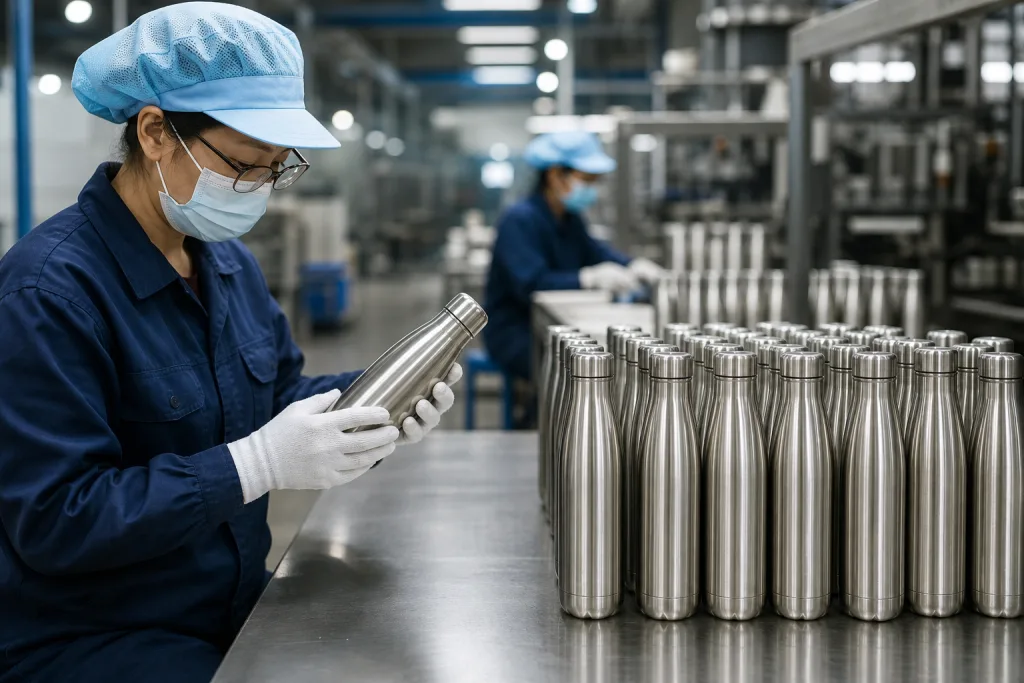
Key Takeaways
- For most 500-750 ml vacuum bottles, 304 stainless with 0.4/0.5 mm wall thickness is the practical baseline; going thinner saves about USD 0.08-0.18 but raises dent risk.
- A realistic MOQ for customized drinkware is 1,000 pcs per color, while new mold lids usually add USD 2,500-8,000 and 25-40 days.
- Ask for heat retention data with a stated test method: 95°C fill, 20°C room, 6-hour target above 60°C is more useful than vague “12 hours hot” claims.
- Use AQL 2.5 for major defects and pre-shipment drop, leak, coating adhesion, and torque tests before FOB China shipment.
You usually do not lose margin on the obvious parts of a bottle quote. You lose it in the small spec lines buyers skip on first pass: 18/8 instead of 18/10, a 0.35 mm inner wall, a lid gasket that fails after 2,000 cycles, or a coating that picks up scratches before the cartons reach Rotterdam. We have seen QC pull a top-seal sample that looked fine at packing and failed after a simple 1 meter drop test. Read the quote like the engineer on the line. Catalog language is not enough.
That matters more if you are buying custom drinkware from Zhejiang, China for retail, promotion, or distribution. A canteen distributor and a brand owner should not buy the same bottle, and this is the wrong question to ask if the only target is the cheapest FOB price. BottleForge Industrial in Hangzhou, Zhejiang ships around 600,000 units per month, with MOQ from 1,000 pieces per color and standard lead times of 30 to 45 days, so we keep seeing the same issues from Europe and North America: a PO typo on lid color, a buyer flagged Pantone drift, or insulation claims with no test method behind them.
Start with body material grade
The first line on any spec sheet should state the bottle body metal grade. On double wall vacuum bottles, the standard commercial choice is food-grade stainless steel 304, also called 18/8. Some canteen factories in China quote 201 on the outer wall to cut USD 0.08-0.18 per unit on a 500ml body. That works on some low-budget promo orders, but the tradeoff is clear: 201 gives weaker corrosion resistance, reacts faster in salty or humid conditions, and is harder to sell as premium customized drinkware in Europe. We’ve seen this go sideways after a 48-hour salt spray check.
For mainstream retail and gift programs, ask for inner wall 304 stainless as the minimum. If your buyer sells into coastal markets, gym channels, or outdoor use, a full 304 inner and outer body is the safer call. For acidic drinks, long hold times, or a premium custom canteen range, 316 on the inner wall can make sense, but the cost increase is usually around USD 0.25-0.60 per unit depending on size and market nickel pricing. On the line, QC pulled the sample and checked the shell thickness at 0.4mm before sign-off.
Read the actual line wording. “Stainless steel” alone means nothing. This is the wrong question to ask if you only compare shape and price. A proper quote should specify:
- Inner wall grade: SS304 or SS316
- Outer wall grade: SS304 or SS201
- Contact parts in lid: PP, Tritan, silicone, stainless
- Compliance requested: REACH, LFGB, FDA, Prop 65 if needed
If you are buying from double walled bottle vendors for a canteen distributor network, ask for mill certificates or at least a supplier declaration on steel grade. Not every canteen supplier keeps full traceability by coil, but serious factories in Zhejiang, China can tie a material declaration to the PO and production date. We run into buyer pushback here: “sample was 304, bulk should be the same, right?” Not always. If a canteen vendor avoids the question or changes grades between sample and bulk, stop there. You are not comparing the same bottle anymore.
Wall thickness is not a detail
First-time buyers usually stare at capacity and color chips. That is the wrong question to ask. On a vacuum bottle, wall thickness tells you more about real build quality than any studio photo. You will see specs like inner 0.4 mm / outer 0.5 mm or 0.35 mm / 0.45 mm. The thinner set trims cost, but it dents faster, shifts shape during vacuuming, and gives the powder coat line more rejects. We have seen QC pulled the sample after vacuum and found shoulder ovality over 0.8 mm on thinner bodies.
For a 500 ml to 750 ml bottle, practical ranges are:
- Budget promotion: 0.35/0.45 mm
- Mainstream retail: 0.4/0.5 mm
- Outdoor or premium gifting: 0.45/0.5 mm or above
On paper, the cost gap looks small. Thicker steel may add USD 0.08-0.18 per piece. In returns math, it is cheap insurance. If you are a canteen distributor or distributor drinkware buyer handling claims, those cents beat a dent complaint every time. We ship plenty of pallet loads, and dents near the shoulder and base show up again and again after ocean stacking and Amazon FBA transfers. Last year one buyer flagged base deformation on 67 pcs from a 3,000 pc lot; the math did not work in favor of the cheaper wall.
Weight should match thickness
Ask the canteen factory for net weight tolerance in writing. A 500 ml vacuum bottle often lands around 260-320 g depending on shape and lid. If the approved sample weighs 295 g and bulk averages 272 g, the factory likely cut steel or swapped a component. We have seen this go sideways after aggressive price rounds, then the line runs a lighter body and hopes nobody checks. Put a tolerance on the PO, such as 295 g ± 5 g, and have QC verify it on a digital scale every 30 minutes.
Good vendors do not just state thickness. They tie it to weight tolerance, dent resistance, and packaging assumptions.
If you need canteen customized for retail shelves, ask for a simple drop protocol before shipment: 1 corner, 3 edges, and 6 faces on the master carton, then inspect for bottle deformation and lid leakage. This is basic transit risk control, not overkill. We run this kind of check with a 76 cm drop height on the packed carton, then inspect the bottle mouth and thread fit with a go/no-go gauge. If a canteen supplier thinks that is excessive, they probably have not handled enough claims data.
Vacuum performance needs test conditions
“Keeps hot 12 hours, cold 24 hours” is ad copy, not a lab spec. A double walled bottle vendor should tell you how the test was run. Ask for fill temperature, ambient temperature, fill volume, and the exact reading point. If the sales rep only repeats “12 hours hot,” this is the wrong question to leave there. We’ve seen buyers compare two quotes on that line alone, then QC pulled the sample and the test setups were completely different.
A usable factory spec reads like this: fill with water at 95°C ±1°C, close lid, store at 20°C room temperature, then measure liquid temperature after 6 hours. For cold retention, start with 4°C water in the same room and check after 6 or 12 hours. On a standard 500 ml bottle, a solid line can usually reach above 60°C after 6 hours and above 45°C after 12 hours. But bottle geometry changes the result fast. A 38 mm narrow mouth behaves differently from a wide-mouth sports lid, even with the same vacuum station settings.
Ask for the vacuum reject rate too. Serious canteen suppliers check vacuum by temperature sampling, with a vacuum gauge on the line, or by post-production spot checks from packed cartons. We run impact checks on some outdoor items because a weak vacuum often looks normal on day 1 and fails after a drop test. One buyer flagged this after seeing fine appearance but poor 12-hour heat data. That pushback was fair. This matters more for customizable canteen and customizable growler programs sold into camping and outdoor retail, where end users notice performance fast.
- Narrow mouth usually improves retention by 5-15% versus wide mouth, especially around the 32-38 mm opening range
- Stainless inner screw cap often holds heat better than a flip straw lid; the seal stack is simpler and leak risk is lower
- Copper coating on the outer side of inner wall can improve insulation modestly, but the math doesn't work if the vacuum process itself is unstable
If you are sourcing custom growler or customized growler formats, press harder on test data. Larger 1.2 L to 1.9 L bodies have more weld area and more process swing at the bottom seam. A canteen manufacturer that runs stable at 500 ml can still have trouble on large vacuum vessels. We’ve seen this go sideways on pilot orders of 1,000 pcs when the first article passed but mass production drifted. For distributor growler programs, put a signed retention standard on the PI, not just a catalog sentence—one PO we received even had “vaccum” typed on it, which told us nobody had checked the actual test requirement.
Lid system decides complaint rate
The bottle body sells the sample. The lid drives the complaints. When you screen double walled bottle vendors, “PP lid” tells you almost nothing. Ask for the lid structure, resin grade, gasket material, thread spec, and test method on the drawing. We have seen a bottle pass insulation, then fail in retail because the straw seeped after a 2-hour side-lay test or the handle snapped at 5°C during a drop check. That is where returns start.
Common lid materials are PP, Tritan, ABS, stainless accents, and food-grade silicone, but the right pick depends on the price point and use case. For a basic canteen custom order, PP is still the workhorse and we run it on 16-cavity tools with stable output. For a premium custom canteen or customizable drinkware line, Tritan gives better clarity and shelf appeal, but the resin cost is usually 20%-35% higher on the same lid weight. If the bottle is for Europe, ask for BPA-free declarations and migration testing where applicable. Buyers push back on this paperwork, then customs asks for it later.
Request these tests on pre-production and final inspection samples:
- Leak test: inverted for 30 minutes and side lay for 2 hours
- Torque test: cap open/close consistency, for example 1.2-1.8 N·m target
- Handle pull test: 10-15 kg static load for 1 minute if carry loop is included
- Life cycle: 2,000-5,000 open/close cycles depending on design
For canteen customizable programs with multiple lid options, standardize the thread finish across the whole bottle family. This sounds basic. It gets missed all the time. If one neck finish is off by even 0.3 mm, your canteen distributor ends up holding body SKUs and lid SKUs that do not interchange cleanly, and the warehouse team starts hand-checking cartons. We have seen this go sideways after one PO typo changed a lid code and 3,000 sets would not match.
At BottleForge, the biggest preventable issue we see from China projects is not steel quality. It is buyers approving a good-looking sample without asking what happens after 500 openings. If the lid includes a straw, spring, or lock button, your quality team should ask for spare-part control and a child-safety review for kids’ lines under ASTM or relevant market rules. QC pulled the sample too late on one project and found the spring force had drifted after cycling. A canteen vendor who only talks about logo printing is missing the main failure point, and this is the wrong question to ask in a lid review.
Decoration limits affect your branding
Brand owners ask about logo method after the bottle shape and coating are locked. That is the wrong order. On our line, the finish decides decoration yield, scratch resistance, and how the custom drinkware still looks after 6 months of carton rub and shelf handling. The common options are powder coating, spray paint, raw stainless, electroplating, silkscreen, heat transfer, digital print, and laser engraving.
For most B2B programs, powder coating is the safe middle ground. We run it on a lot of 500 ml and 750 ml bottles because it hides small clamp marks better than spray paint and holds up better in abrasion checks. Typical powder coat thickness is around 60-90 microns. Go too thick and thread fit starts drifting at the neck; go too thin and QC pulled samples with weak edge coverage around the shoulder radius.
Here is the practical buyer view:
- Silkscreen: low setup cost, usually 1-2 spot colors, good for 1,000-5,000 pcs; the buyer flagged this fast when artwork had fine lines under 0.2 mm
- Laser engraving: durable, premium look, no ink migration concern; works well on raw stainless and some painted surfaces
- Heat transfer: wraps complex artwork, but test adhesion carefully; we have seen curved artwork shift by 1-2 mm if the bottle taper is not checked first
- Digital print: flexible for short runs, but unit cost is higher; the math doesn't work on most 300 pcs orders unless the retail margin is strong
For canteen promotional orders, buyers pick the cheapest print method, then the logo starts scratching from carton rub. We have seen this go sideways. Ask for a cross-hatch adhesion test and a simple rub test before mass production. If your distributor canteen program ships in mixed cartons, use individual polybags or tissue sleeves to cut scuffing. For matte black or navy surfaces, specify partitioned inner packaging; marks show fast, and we have had buyers come back over scuffs found before store delivery.
If you sell canteen customized or customized canteen products online, color matching needs to be written clearly on the PO. Ask for Pantone approximation tolerance and batch control. Metallic, neon, and soft-touch finishes usually come with wider variation and 12 days vs 18 days lead-time differences depending on the coating queue. This is not a factory failure. It is the nature of the finish. Good canteen manufacturers in Zhejiang will say that up front instead of promising a perfect match they cannot repeat.
MOQ, tooling and lead time math
The quote that wins fastest is often the order that breaks the line. Buyers send 10 double walled bottle vendors the same RFQ: low MOQ, custom lid, gift box, 2 colors, 6 logo versions. Then the buyer flagged the delay. The spec sheet needs to match commercial terms with factory reality, not just target price.
For a standard vacuum bottle on an existing mold, a realistic MOQ in China is often 1,000 pcs per color. We sometimes run 500 pcs for plain stock combinations. We also quote 3,000 pcs if the finish is hard to control, like fine metallic powder coat on a 0.4 mm body wall. New lid tooling can cost USD 2,500-8,000. A new body mold may run USD 4,000-12,000 depending on size and complexity. Sample timing is usually 7-10 days for decoration samples and 20-30 days for new tooling samples. This is the wrong question to ask: “Can you do any MOQ?” Better ask what MOQ keeps yield and cost steady.
Bulk lead time on a normal custom drinkware order is usually 30-45 days after deposit and sample approval. During peak season, 45-60 days is the honest answer. We have seen this go sideways when a canteen factory promises 20 days on a heavily customized order and then skips carton drop testing, pre-production sample sign-off, or lid fit checks with the torque gauge. If someone offers 20 days, ask what they are cutting.
What buyers should lock before deposit
- Incoterm: FOB Ningbo or Shanghai is common from Zhejiang, China
- Final packaging spec and carton drop requirements
- Barcode, FNSKU, carton marks, and pallet rules if for Amazon or retail DC
- AQL plan: often AQL 2.5 major, 4.0 minor
- Golden sample ownership and sign-off date
A canteen supplier or canteen vendor that treats MOQ like a random sales number is a risk. MOQ should reflect coating line efficiency, print setup, lid sourcing, and carton economics. QC pulled the sample on one order because the PO had a mark typo and 2 barcode versions were mixed into one shipment. If you are a canteen distributor with repeat business, negotiate annual volume instead of just one PO price. That is how we ship a stable customized drinkware program, not one cheap order followed by 3 painful reorders.
Compliance, audit and inspection checklist
If you buy for Europe or North America, the last page of the spec review should cover compliance and verification. This is where buyers sort a trader quote from a factory-run project. We have seen POs move ahead with one missing line on the declaration, then lose 9 days waiting for a lab stamp. Whether you buy from a canteen manufacturer direct or through a canteen distributor, put the paper trail into the purchase order from day one.
For stainless custom drinkware, common requirements include REACH, LFGB or FDA food-contact compliance, and sometimes California Prop 65 depending on your market. Social and system audits such as BSCI and ISO 9001 do not guarantee product quality, and this is the wrong question to ask, but they do show the canteen factory runs with more control than a small workshop pushing the line too fast. Ask where testing is done: in-house, third-party lab, or both. On our side, QC pulled the sample and checks coating thickness with a dry film gauge before we send anything out.
Your pre-shipment checklist should include:
- Appearance and color match against approved sample
- Leak test and vacuum retention spot check
- Coating adhesion and scratch resistance
- Barcode scan and packaging verification
- Carton gross weight, dimensions, and drop test
- Quantity count and assortment check
For bulk orders, use a third-party inspection company or your own QC team until the canteen suppliers prove they can repeat the same result across 3 orders. Set the acceptance standard in writing. AQL 2.5 for major defects is common. If your program includes custom growler, customized growler, or large-format distributor growler items, ask for extra checks on handle welds, lid threads, and pressure sensitivity if carbonated use is even remotely implied. We have seen this go sideways: a buyer flagged thread drag on a 64 oz growler cap after only 20 open-close cycles. Most vacuum growlers are not meant for pressure retention, and your packaging should say that clearly.
The right canteen manufacturers in China will not be offended by this level of detail. They prefer clean specs because the math works better on the line. Clear specifications cut disputes, trim approval time from 18 days to 12 days, and protect both sides. If a supplier in Zhejiang can explain why one spec line changes cost, yield, or complaint risk, you are probably talking to a factory partner instead of a quote collector.
Send your bottle spec sheet for a real factory review
We will mark the risk points, suggest practical cost-down options, and quote MOQ, tooling, and lead time based on actual production in Zhejiang, China.
Frequently asked questions
What is a realistic MOQ when buying from double walled bottle vendors?
For an existing bottle mold with one powder coat color and one logo, 1,000 pieces per color is a normal starting MOQ in China. Some canteen suppliers can do 500 pieces if stock components are available, but decoration choices become limited. If you need a new lid, custom body shape, or retail gift box, expect 2,000 to 3,000 pieces to make the project efficient. New tooling usually adds USD 2,500 to 8,000 for lids and 4,000 to 12,000 for body molds. If a canteen vendor promises a very low MOQ, check whether they are mixing old stock components, using a less stable coating line, or charging the setup cost back into unit price.
How do I compare insulation claims across suppliers?
Ask every supplier to state the same test conditions. A useful baseline is 95°C water fill, room temperature at 20°C, full fill volume, and measurement after 6 and 12 hours. On a standard 500 ml vacuum bottle, a solid result is above 60°C after 6 hours and above 45°C after 12 hours. For cold retention, start with 4°C water and test at the same room condition. Wide-mouth bottles, flip lids, and straw lids usually perform worse than narrow-mouth screw-cap designs. If double walled bottle vendors only say “12 hours hot” without test details, you are not comparing like for like. Put the retention standard on your PO and pre-shipment checklist.
Which steel grade should I specify for custom drinkware?
For most B2B programs, specify SS304 on the inner wall at minimum. If you want better corrosion resistance and a stronger premium position, use SS304 on both inner and outer walls. Some canteen manufacturers quote SS201 on the outer wall to reduce price by roughly USD 0.10 to 0.25 per unit, depending on bottle size and metal market conditions. That can be acceptable for lower-end canteen promotional orders, but it is less durable in humid or coastal environments. If your product is for acidic beverages or long hold times, ask about SS316 inner wall options, which usually add around USD 0.25 to 0.60 per bottle.
What quality tests should I require before shipment?
At minimum, ask for leak testing, vacuum retention spot checks, coating adhesion testing, packaging drop tests, and barcode verification. For lids, include torque consistency and gasket fit checks. A practical standard is AQL 2.5 for major defects and 4.0 for minor defects on final random inspection. For bottles with carry loops, ask for a 10 to 15 kg handle pull test for 1 minute. If the design includes straw lids or button lids, request 2,000 to 5,000 open-close cycle testing. On retail-ready customized drinkware, also inspect logo placement, color variation, and carton markings before FOB shipment from Zhejiang or other China ports.
How long should production take for a customized canteen order?
If you are using an existing mold and standard packaging, expect 7 to 10 days for pre-production samples after artwork approval, then 30 to 45 days for bulk production after deposit. If there is new tooling, add 20 to 30 days for mold sampling and confirmation. Complex finishes, gift boxes, or multiple logo versions can push the total timeline to 45 to 60 days, especially before peak shipping season. For buyers in Europe and North America, do not forget transit time after FOB China: around 30 to 40 days by sea to many ports, plus customs and inland delivery. Build at least a 2-week buffer if the program is event-driven.