Key Takeaways
- A reliable double walled bottle vendor should quote clear MOQs, often 1,000-3,000 pcs per SKU and 35-55 day bulk lead time
- For 18/8 stainless vacuum bottles, a practical FOB China price range is about USD 2.80-6.50 depending on size, coating, lid, and decoration
- Ask for AQL 2.5 inspection, REACH or LFGB material compliance, and at least 6-12 hour heat retention data before placing a PO
- Factories in Zhejiang, China with 300,000+ units/month output and in-house coating or laser marking usually control quality better than sample-only vendors
You can get a stainless steel bottle quote from almost any trading company in China before lunch. That part is easy. The real test starts when the order leaves the sample bench and hits the line: can your double walled bottle vendor hold vacuum performance, keep logo color within the approved delta, pass a 76 cm carton drop, and still ship on the promised date? We have seen nice pre-production samples fall apart at 5,000 pcs because weld consistency was not controlled.
If you buy for a brand, retail chain, or distributor drinkware program in Europe or North America, a catalog is not enough. You need a canteen manufacturer or canteen supplier that answers with numbers, not sales talk: MOQ, wall thickness in mm, leak rate, AQL level, lead time, and how claims are handled after arrival. This is the right question to ask. In Zhejiang, China, the better factories give those figures early—sometimes on the first call, sometimes after QC pulled the sample and checked thread fit with a go/no-go gauge. Weak suppliers usually give you adjectives, and the math does not work.
What should you ask first?
Start with questions that tell you who is actually making the bottle. We’ve seen buyers spend 20 minutes on logo placement, then find out the supplier is only forwarding WeChat messages to another factory. Wrong order. You do not need a perfect supplier on day one, but you do need straight answers with specifics like city, capacity, and 0.5 mm wall setup.
Ask these in the first email or call:
- Are you a factory or trading company? If factory, ask for city, province, and main product line. A real answer sounds like Hangzhou, Zhejiang, vacuum bottles 350 ml to 1,200 ml. Zhejiang and nearby manufacturing clusters in China should be easy to verify, and the buyer flagged it fast on one project when the PO listed Yongkang but the business license showed another province.
- What is your monthly capacity? Ask for a number tied to the actual line. A useful answer sounds like 400,000 units per month for vacuum bottles, not “large capacity.” If they run 3 auto welding lines and 2 vacuum furnaces, they should say so.
- What is the MOQ per size and color? Get the MOQ by SKU, size, and finish, not one blanket number. Typical MOQ is 1,000 pcs for standard molds, but special powder coat colors may require 2,000 pcs, and custom Pantone matching sometimes gets pushback below that because the math doesn’t work for one powder batch.
- What is your normal lead time? Ask for sample time and bulk time separately. For custom drinkware, 7-12 days for pre-production samples and 35-55 days for bulk is normal. If a supplier says 25 days for everything, ask what happens after sample approval, carton print, and final AQL booking.
- What material grade do you use? For the bottle body, 18/8 stainless steel is standard. Some low-end offers quietly shift to 201 grade on outer walls. QC pulled the sample on one order and the magnet response told the story before lab paperwork even came over.
- What tests do you run? Ask for the test list and the standard they follow. Leak test, vacuum retention, salt spray for coated parts, and carton drop test are the basics. On our side, the line also checks lid fit torque and does a 1.2 m carton drop during packing review.
If a canteen vendor dodges details, you will see it in the first 2 emails. Buyers get distracted by shape and logo finish before checking supply basics. That is backwards. Whether you need a custom canteen, customizable growler, or canteen promotional line for a distributor canteen program, the supplier’s process matters more than the render, and we’ve seen this go sideways when the sample looked clean but bulk packing spec was still blank.
A good first quote should include material, size, net weight, MOQ, sample cost, tooling if any, FOB port, and bulk lead time. If half of that is missing, expect surprises later. We ship quotes with those fields up front because missing net weight or FOB Ningbo usually turns into a freight argument later.
How do you judge bottle construction?
Most buyers ask for “double wall stainless.” Too few ask how the bottle is built on the line. That is where quality starts, and this is the right question to ask first.
For a standard vacuum bottle, the food-contact parts should be 304 stainless steel, often called 18/8. A common body setup is 0.4 mm inner wall and 0.5 mm outer wall, and we check this with a micrometer when raw tubes come in. Some lightweight models run thinner. That is not automatically wrong. It does change dent resistance, squeeze feel, and how the bottle lands in the hand. Retail buyers notice it fast. We have had buyers flag a sample for feeling “cheap” even though the insulation result passed.
Construction points worth checking
- Vacuum process: Ask whether every unit gets vacuum tested or the factory only checks sampled pieces. We run full-line vacuum checks on key programs because the math does not work if you save 2 seconds here and then eat complaint cost later.
- Mouth finish: Thread quality drives leakage more than most buyers expect. QC pulled the sample on one PO because the thread start was slightly off, and the lid failed only every 8 to 10 turns. Those are the worst defects because they slip through casual checks.
- Base design: A silicone or PP anti-slip pad cuts table noise and scratch claims, but it adds cost, usually USD 0.08-0.18 per unit. It also adds one more bonding step on the line, so ask what glue spec or press-fit method the factory uses.
- Lid seal: Food-grade silicone gasket should fit tightly and stay replaceable during development if needed. We have seen gasket grooves off by 0.3 mm create slow leaks after shipping, even when the first sample looked fine.
- Coating: Powder coating is standard for durable matte finishes. Ask for coating adhesion results and a salt spray reference if metal trim stays exposed. Cross-hatch tape test is basic, but ask for the actual result, not just “passed.”
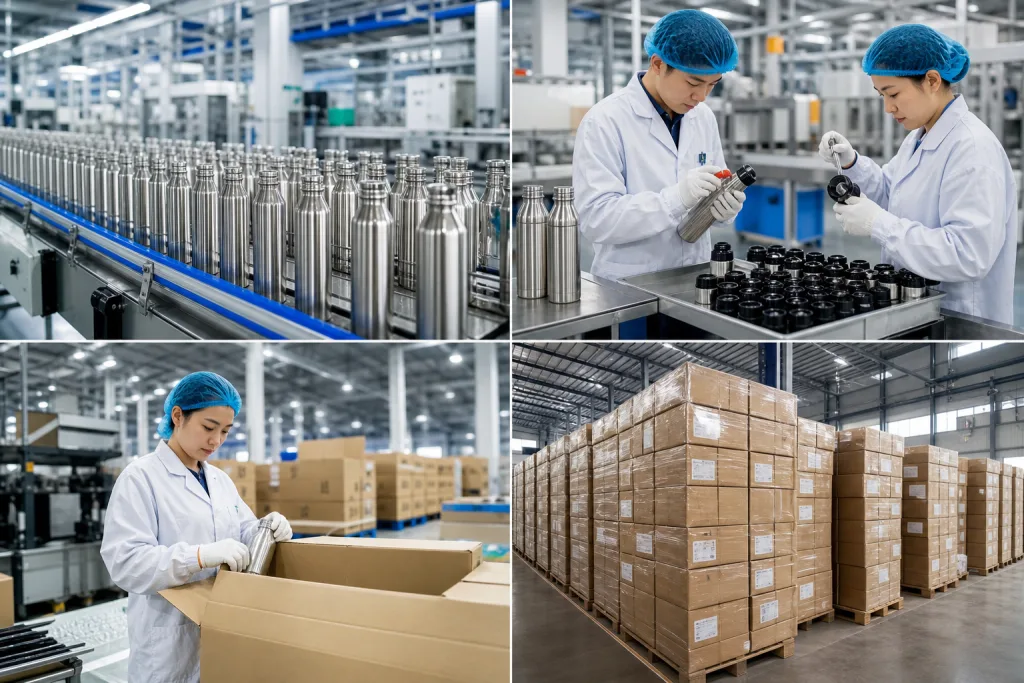
If you are sourcing a customized canteen or customized growler, ask for cross-section photos or actual production photos, not just lifestyle shots. A capable canteen manufacturer in China should be able to show neck forming, welding, polishing, vacuuming, and coating. If they cannot show that, we have seen the project go sideways after deposit. This matters when you plan to build a long-running customizable drinkware line with repeat POs of 3,000 to 10,000 pcs, not a one-off promotion.
For growlers, the stakes are higher because the lid system and volume tolerance matter more. A custom growler at 64 oz with a carry handle needs tighter neck control than a simple 500 ml office bottle, and the handle pull test should be part of the review. We have had a buyer send a PO with “64OZ” typed as “46OZ,” so check the drawing and the carton mark twice. If your canteen distributors or distributor growler customers will resell under their own brand, construction stability is not optional.
Pricing signals you should not ignore
Price shopping is normal. Reading the quote wrong gets expensive fast. If one canteen supplier offers USD 2.95 FOB Ningbo and another comes in at USD 4.10 for a 500 ml bottle that looks the same on a screen, there is a reason. We’ve seen a 0.12 mm wall difference hide inside that gap.
Cost usually moves on five levers:
- Steel usage: A heavier body and thicker wall push stainless cost up right away. On the line, even a small weight jump per piece shows up fast at 3,000 pcs.
- Lid complexity: A basic screw lid is cheaper than a handle lid or a straw lid because the mold set has more parts, more assembly time, and more leak-risk points.
- Surface finish: Standard powder coat is the low-drag option. Gradient spray, rubber paint, and full-wrap print add labor, reject risk, and curing control.
- Decoration method: One-color silkscreen is usually the low-cost choice. Laser engraving and 360-degree digital print cost more, and QC pulled the sample more than once for logo position drift.
- Packaging: Egg-crate inserts, color boxes, and mailer-safe cartons add cost fast. Carton size, drop-test target, and loading qty all change the math.
As a rough FOB China range, a standard 500 ml vacuum bottle from a canteen factory is often USD 2.80-3.80 at 3,000 pcs. A more premium 750 ml bottle with powder coating, handle lid, and custom box can land at USD 4.50-6.50. A customized growler with larger capacity and more robust lid hardware can move above USD 7.00. If a buyer asks for the “best price” before locking spec, this is the wrong question to ask.
Watch low quotes from canteen vendors. You may be looking at thinner steel, outsourced coating, lower-grade gaskets, or aggressive carton loading that drives transit damage. We’ve seen this go sideways with 24 pcs packed into a master carton that should have stayed at 20. Ask the vendor to break out what is included:
- sample charges and refund policy
- logo setup cost
- inner box or color box details
- spare gasket inclusion
- inspection standard, such as AQL 2.5/4.0
- Incoterm: EXW, FOB, or DDP
For canteen customizable projects, the cheapest first order often turns into the most expensive one after claim credits, delayed launch dates, and rework. The buyer flagged it, then the line had to rerun lids because the PO showed “pantone” as “pantong” and nobody stopped to confirm. Smart procurement managers compare landed risk and unit price. The math doesn’t work any other way.
Compliance, testing, and claim prevention
If you import into Europe or North America, the paperwork is part of the bottle cost. Treat it that way. A solid double walled bottle vendor should already know the base documents and should be able to send them before you chase three emails. On our side, QC usually pulls the first material file before the sample goes to the vacuum oven, because missing paperwork this late has already burned enough lead times.
For Europe, ask for REACH, LFGB where relevant, and packaging compliance. For the US and Canada, ask how the factory matches food-contact testing requirements. For children’s products, ask for ASTM or CPSIA-related controls only if they fit the design and target use. This is where buyers get loose with terms, and we’ve seen this go sideways. A general canteen manufacturer is not automatically the right kids bottle source. One buyer sent us a PO marked “school bottle” with no age grade, no drop requirement, and no small-parts review; that is the wrong question to ask at PO stage.
Your pre-PO checklist
- Material declaration: 304 stainless on inner wall and food-contact components
- Seal and plastic resin data: PP, Tritan, silicone, or other specified materials
- Vacuum retention report: For example, hot above 55°C after 6 hours, cold below 10°C after 6 hours, depending on model
- Leak test standard: Inverted test and pressure or shake test where relevant
- Drop test: Especially for e-commerce packaging or Amazon FBA shipments
- Inspection plan: AQL 2.5 for major defects is a common baseline
Most custom drinkware claims come from the same short list: leaking lids, coating scratches, color variance, denting, logo misplacement, and seal odor. We catch a lot of this before bulk if the line runs a real pre-production sample, not a quick digital mockup. Approve the exact logo size in mm, Pantone reference, packaging layout, and barcode position. Last month the buyer flagged a 3 mm logo shift on a powder-coated flask, and they were right to flag it before mass print.
If your buyer role includes canteen distributor or canteen distributors across multiple markets, insist on a master specification sheet. Lock the dimensions, unit weight tolerance, finish code, print position, carton marks, and test requirements on one file. We ship repeat orders faster when that sheet is fixed at the start; 12 days vs 18 days is common on refill orders during August to November. Without it, the math doesn't work, because every repeat PO turns into a fresh argument over a lid thread, a 0.5 kg carton limit, or a missing barcode side mark.
Customization without production headaches
A lot of sourcing trouble starts with the phrase “full customization.” This is the wrong question to ask. In most bottle programs, semi-custom is the cleaner route: keep an existing mold, then change the finish, lid, logo, and packaging.
The reason is simple. We run stock molds every week, so sample timing and risk stay under control. A standard mold from a canteen factory in Zhejiang can often move to sample in 7-10 days. A new mold for a custom canteen body may take 20-35 days just for tooling and first sample, with tooling costs from roughly USD 1,500 to USD 6,000 depending on complexity. On the line, even a 0.3 mm change at the base can force fixture adjustments and slow first-off approval.
Here is the practical order of customization choices:
- Level 1: Stock body, stock lid, one-color logo
- Level 2: Stock body, custom color, laser mark or wrap print, custom box
- Level 3: Stock body, mixed lid options, gift set inserts, retail-ready barcode labels
- Level 4: New lid or new body mold, unique bottom shape, exclusive accessories
If you need canteen custom, canteen customized, or customizable canteen options for a seasonal campaign, stay at Levels 1 to 3 unless your volume justifies tooling. We’ve seen this go sideways when a buyer wants a new body for a 3,000 pcs trial order; the math doesn’t work. Exclusive molds make sense when you can forecast at least 10,000-30,000 pcs over 12 months, and MOQ planning needs to match that from day one.
Also decide who owns artwork proofing before sampling starts. QC pulled the sample more than once because the vector file was outlined wrong, the logo width came in 18 mm instead of 25 mm, or the buyer flagged a Pantone mismatch after print. For customized drinkware and customized growler projects, require signed artwork approval and a golden sample retained by both sides. That is basic discipline, yet plenty of canteen suppliers still skip it when the PO is rushed or a carton mark typo slips through.
How do you qualify the factory?
You do not need to fly to China to qualify every supplier. You do need proof beyond a PDF brochure. A real canteen manufacturer or canteen supplier should be able to run remote qualification in a way that shows the line, the paperwork, and the weak points. If a factory only sends a polished catalog and one workshop photo, that is the wrong question to stop at.
Ask for:
- Factory audit documents: BSCI, ISO 9001, or other current certifications where applicable
- Production video: Welding, vacuuming, polishing, coating, assembly, and packing lines
- Inspection records: Sample QC sheets or defect photos from previous runs
- Shipping experience: EU and US shipment references, FNSKU labeling or retail routing guide familiarity if needed
- Claim handling process: Time frame for root cause analysis and credit or remake decisions
One useful sign is how the factory talks about defects. QC pulled the sample, found two pinholes at the weld seam, and the team can explain what changed on the vacuum test bench. That matters. For example, they may state a leak defect target below 0.3% after final inspection, or decoration rework below 1.0% for standard silkscreen. Those are not magic numbers. They show someone owns the process and is watching the data instead of hiding behind “pass.”
At BottleForge Industrial in Hangzhou, Zhejiang, buyers often ask whether smaller MOQs damage quality consistency. The truthful answer is yes, they can. We have seen 500 pcs split into 5 colors go sideways faster than 3,000 pcs in two colors, because each color change means another setup on the coating line and another chance for gloss mismatch. That is why many canteen manufacturers in China set color-specific MOQs. It is not arbitrary. It protects coating stability and packing efficiency, and the math does not work the same way on short mixed runs.
If you work with canteen distributors, canteen vendors, or a multi-country distributor drinkware network, qualify the supplier for communication speed too. Good vendors reply to technical questions within 24 hours, send corrected artwork the same day if the buyer flagged a PO typo, and call out timeline risk before the booking window gets tight. We ship a lot of private-label orders, and silence is rarely neutral. It is usually the first warning sign.
The short checklist before you place PO
Before you place the PO, keep the checklist short and specific. We’ve seen orders go sideways because one line stayed fuzzy—like a 500 ml bottle on the quote and a 530 ml bottle on the approved sample, or a PO typo on the lid code that the buyer flagged after packing started.
- SKU confirmation: lock capacity, dimensions, unit weight, lid type, and finish; on our line we check height and diameter with a digital caliper in mm before sign-off
- Commercial terms: confirm MOQ, unit price, tooling charge, payment terms, and FOB port; if the math doesn’t work at 500 pcs, ask for the real break at 1,000 pcs
- Sample status: approve the pre-production sample against final artwork and packaging; QC pulled the sample should match the Pantone callout and barcode position exactly
- Compliance file: collect test reports or declarations before mass production ends; do not wait until cargo is on the truck and then chase FDA or LFGB paperwork
- QC method: define inline checks, final inspection standard, and AQL level; this is the wrong question to skip, because AQL 2.5 means nothing if defect photos were never agreed
- Carton plan: approve carton size, gross weight, palletization if required, and shipping marks; we ship faster when outer carton weight stays under 18 kg and the mark layout is confirmed early
- Delivery plan: confirm ex-factory date, booking window, and peak-season buffer from China; 12 days vs 18 days matters once the vessel cut-off gets tight
If you source custom canteen, customizable drinkware, or a distributor growler assortment, build one master purchase checklist and run it every order. Experienced buyers do not trust memory. They trust repeatable control points, the same way the line trusts a go/no-go gauge more than a verbal note.
The best double walled bottle vendor is rarely the one with the lowest quote or the biggest catalog. It is the supplier that holds stable quality, offers realistic MOQs, ships on consistent lead times, and sends a clean corrective action report when a weld mark or coating scratch shows up in inspection. In Zhejiang and across China, that cuts the list fast once you ask for details instead of promises.
Get a factory-level quote you can actually compare
Send your target size, logo method, MOQ, and market requirements. We will reply with practical pricing, lead time, and production notes from Hangzhou, Zhejiang.
Frequently asked questions
What MOQ should I expect from a double walled bottle vendor?
For standard vacuum bottle molds, a normal MOQ is 1,000 to 3,000 pcs per SKU, with color-specific requirements in many factories. A common structure is 1,000 pcs for one stock color, or 2,000 to 3,000 pcs when you want a custom Pantone powder coat and printed box. For a custom growler or a new lid, MOQ often rises to 3,000 to 5,000 pcs because setup loss is higher. If a canteen factory in China accepts 300 pcs on a fully customized item, check what they are compromising: mixed leftover materials, outsourced production, or weak price protection. Small trial runs can work, but they usually carry a 8% to 20% unit cost premium.
How long does custom drinkware production usually take?
If you use an existing mold, expect 7 to 12 days for samples and about 35 to 55 days for bulk production after sample approval and deposit. During peak season in China, especially from August to November, lead times can extend by 7 to 15 days. A new mold adds more time: roughly 20 to 35 days for tooling and first article approval before normal production even starts. Decoration also matters. Simple laser logo work is usually faster than multi-position print, custom inserts, or gift packaging. If you need shipment for a retail launch, build in at least a 10-day buffer for inspection, booking, and possible rework.
What compliance documents should I request before shipment?
At minimum, ask for material declarations for stainless steel, plastics, and silicone seals, plus relevant food-contact testing. For Europe, REACH and, where needed, LFGB-related documentation are common requests. For North America, ask for food-contact compliance support and packaging material data. If the product is intended for children, the document set becomes stricter and should be reviewed separately. Also request a final inspection report using an agreed AQL standard, often AQL 2.5 for major defects, and a vacuum or leak test summary. A capable canteen supplier in Zhejiang, China should be used to preparing these files before the goods leave port, not after your customs broker asks.
How do I compare quotes from different canteen suppliers fairly?
Compare like for like on 10 points: steel grade, wall thickness, bottle weight, lid construction, coating type, logo method, packaging, MOQ, Incoterm, and inspection standard. A quote of USD 3.10 FOB and another at USD 3.85 may be completely different products once you check those details. One may include 304 inside and outside, powder coat, individual polybag, and AQL inspection; the other may use thinner outer steel, plain paint, and basic bulk packing. Ask each canteen vendor to confirm the same specification sheet and carton plan. Without that, price comparison is mostly guesswork, and guesswork is how claim costs end up sitting in your landed margin.
Is it better to work with a factory directly or through a trading company?
Direct factory sourcing usually gives you better visibility on MOQ, lead time, process control, and engineering changes, especially for customized drinkware. It can also reduce cost by 3% to 10% depending on the project. That said, a good trading company can add value if you need mixed product categories, lower combined MOQs, or stronger English coordination across several workshops in China. The key is transparency. If you ask whether they are a canteen manufacturer, canteen distributor, or trading company, the answer should be clear. For repeat vacuum bottle programs above 5,000 pcs per order, most B2B buyers prefer a direct canteen factory relationship with documented QC and compliance responsibility.