Key Takeaways
- A 500ml double wall bottle typically lands at USD 2.85-5.40 FOB China, with MOQ from 1,000 to 3,000 pcs depending on lid and finish.
- 304 stainless steel works for most projects, but 316 interior upgrades add about USD 0.25-0.60 per unit for sports, marine, or premium channels.
- Standard lead time is 25-35 days after sample approval, while custom color, mold changes, or FSC gift boxes can push delivery to 40-50 days.
- For stable mass orders, use AQL 2.5 major and 4.0 minor, plus leak, insulation, coating adhesion, and drop tests before shipment.
You can buy a double wall bottle from twenty suppliers in one afternoon. Easy. The hard part is reading why one quote is USD 2.85 and another is USD 5.40, why one sample holds heat for 8 hours and another for 12, and why a clean-looking bottle turns into a warranty claim after 60 days with end users. On our line, QC pulled a sample last month with a 0.3 mm lid-thread mismatch; it looked fine in photos and leaked in drop testing. If you are sourcing double walled bottle custom programs, the gap usually sits in steel grade, vacuum quality, coating process, lid structure, and how the canteen manufacturer controls production. This is the wrong question to ask: “Who is cheapest?” Ask what you are getting for the money.
For buyers in Europe and North America, the safer move is not chasing the lowest FOB price from China. Compare bottle types against the channel you actually sell into: retail with shelf-drop tests, gifting with tighter color matching, ecommerce with stronger mailer cartons, or promotional with hard target pricing. We ship for all four, and the math doesn’t work if the factory is built for one model and you need another. A Zhejiang canteen factory that runs 600,000 units per month can still be the wrong fit if your logo process, carton spec, or compliance file is weak; we have seen buyers flag a PO over one missing LFGB page and a carton mark typo. You need a spec-first buying method.
Start with the spec table
If you are comparing a double walled bottle custom project across 4 or 5 China factories, build the spec table first, then talk price. We see quote gaps start there. One supplier prices a bottle with powder coat, copper coating in the vacuum layer, and a BPA-free screw lid; another prices spray paint and a basic PP cap. Both write “stainless bottle” on the sheet. They are different SKUs, and the math doesn’t work if you compare them side by side.
Typical comparison points
- Body material: 18/8 stainless steel, usually SUS304 inside and outside; SUS316 inside for premium or harsh-use applications
- Capacity: 350ml, 500ml, 750ml, and 1000ml are the easiest sizes for production planning
- Wall structure: double wall vacuum, with or without copper coating for better heat retention
- Outer finish: spray paint, powder coat, rubber finish, electroplating, or bare steel
- Logo method: silkscreen, laser engraving, heat transfer, water transfer, or digital print
- Lid type: basic screw cap, loop lid, straw lid, flip lid, bamboo cap, or dual-use cap
- Packing: egg-crate bulk pack, white box, color box, PDQ, or gift set
Our rule on the sales side: if one canteen supplier sends a one-line quote and another sends 12 line items, take the 12-line version first. At mass production, it is easier to control, easier to approve, and easier for QC to check against the PO.
At BottleForge Industrial in Zhejiang, China, buyers save the most time when they freeze six points early: capacity, steel grade, finish, logo process, packaging, and target retail price. We run better once those are fixed. QC pulled a sample last month where the PO said “matte black powder coat,” but the approved artwork sheet showed spray paint; that kind of mismatch burns 3 to 5 days fast. This matters whether you are buying a custom canteen for promotion, a customized drinkware line for retail, or a customizable growler for outdoor channels. Without a spec table, every canteen vendor looks acceptable. With one, the weak offers drop out fast.
Head-to-head bottle types
Not every insulated bottle fits the same sales channel. “Which bottle is best?” is the wrong question. Ask which bottle is least likely to come back with claims in your channel. That is how most B2B buyers compare it on the line, after leak test, drop test, and carton math.
| Type | Best Use | MOQ | FOB China | Main Risk |
|---|---|---|---|---|
| 500ml basic screw lid | Promotional, corporate gifting | 1,000 pcs | USD 2.85-3.40 | Logo wear on cheap coating |
| 600ml powder coat sport lid | Retail, gym, campus | 2,000 pcs | USD 3.40-4.20 | Straw lid leakage |
| 750ml wide-mouth bottle | Outdoor, worksite, DTC | 1,000 pcs | USD 3.90-4.80 | Higher dent rate in transit |
| 1000ml carry-loop bottle | Hydration-focused retail | 1,000 pcs | USD 4.40-5.40 | Heavy parcel cost |
| 64oz insulated growler | Outdoor, beverage refill | 500-1,000 pcs | USD 6.80-9.50 | Lid seal consistency |
If you are buying canteen promotional stock, the 500ml screw-lid bottle is usually the safest place to start. Fewer moving parts. Fewer leak claims. Better carton density too; we can load 24 pcs per master carton on this style without fighting wasted space, and QC pulled the sample less often for cap-fit issues than on flip lids. If you are building a retail range, a 600ml or 750ml body usually sells better on shelf because the bottle looks fuller in hand and the buyer sees the value faster.
For a customized canteen or customizable canteen line sold online, watch dimensions and shipping weight as hard as appearance. We have seen a bottle pass showroom review, then get hit by parcel surcharge because the packed height was 310mm instead of 295mm. The math does not work if the bottle looks premium but freight eats margin. For a customized growler or custom growler, ask your canteen factory to confirm pressure expectation, gasket material, and handle pull strength. Growler buyers and distributor growler programs usually get more complaints from lid systems than from the steel body, and the buyer flagged this on one PO after a silicone seal batch came in too soft.
The same logic applies if you are a canteen distributor, one of several canteen distributors, or a distributor drinkware importer running mixed channels. Standardize on 2 or 3 bottle families, not 7. We have seen this go sideways when one customer kept separate lids, straws, loop caps, and cartons for too many SKUs; one PO even had a cap code typo that held sampling for 3 days. Fewer families cut spare-part mix-ups, shorten sample approval, and make carton planning cleaner when we ship.
Where price really moves
Buyers new to custom drinkware often look at capacity first. That is the wrong question to ask. On our line, a 500ml double-wall bottle and a 750ml bottle may share the same forming setup, while price jumps faster on four items: coating, lid style, printing method, and the box spec.
For a standard 500ml bottle from a Zhejiang canteen manufacturer, the stainless body may account for roughly 45% to 55% of cost. The lid can be 10% to 20%. Decoration and packaging swing the rest. We ship plenty of plain programs at about USD 3.00 FOB China with a white box and one-color silkscreen. Change that to powder coat, laser logo, bottom pad, barcode sticker, and a rigid color box, and the same bottle moves above USD 4.00. QC pulled one sample last month where the outer box board came in at 350gsm instead of the approved 400gsm, and the buyer flagged it right away.
- Powder coating: usually adds USD 0.18-0.35 per unit versus bare steel or simple spray paint; on the line we also watch film build, usually around 60-80μm, because thin coat chips fast
- Laser engraving: adds around USD 0.05-0.12, but works best on powder-coated or painted surfaces; on bare steel, the mark often looks weak and uneven
- Straw or flip lids: often add USD 0.20-0.60 versus a basic screw cap; most buyer pushback here is leak risk, so we run a simple upside-down check before mass production
- Individual gift boxes: can add USD 0.25-0.90 depending on insert design and board grade; if the insert fit is off by even 2 mm, the bottle rattles in transit
- SUS316 interior: often adds USD 0.25-0.60 on common bottle sizes; the math does not work for every promo order, so this upgrade needs a clear use case
If a canteen supplier offers a low quote, check what they removed. We have seen this go sideways. Common omissions are no copper layer, lighter steel thickness, thinner gasket, cheaper coating, no drop test requirement, or plain export carton only. One PO we received even had a typo on the gasket hardness note, 50 shore instead of 60 shore, and that small miss changes sealing performance. Reliable canteen suppliers and serious canteen vendors usually list these points clearly because claim cost later is worse than a neat quotation now.
For a canteen customized project, ask the same factory for two quotes: one target-cost version and one recommended version. We do this a lot, often at MOQ 3000 pcs, and it shows where the money actually goes. You get a cleaner comparison of feature cost instead of asking three factories to guess your ceiling. It also helps when you compare offers from a canteen manufacturer, a trading company, and a larger canteen factory in Zhejiang or elsewhere in China.
Use-case fit beats trend
A bottle that moves in one channel can sit dead in another. We’ve seen buyers copy a hot item from retail and miss the math on the next program. A matte powder-coated 750ml bottle looks premium on a sample table, but it is the wrong pick for a school fundraiser, an Amazon FBA launch, or a 12-day customizable drinkware rush order. Last season one buyer flagged carton weight at 18.6 kg, and that single detail killed the fundraising margin.
For custom drinkware in promo programs, simple sells. A 500ml or 600ml bottle with a standard mouth, screw lid, and 1-color logo usually gives the best FOB cost, leak performance, and lead time. MOQ is often 1,000 pcs per color, and repeats are smoother because we run standard components on the line. QC pulled the sample at 0.20 MPa vacuum and the screw lid held clean, which is what most promo buyers care about.
Retail is different. Buyers want separation on shelf, not just a safe spec sheet. That usually means a custom lid, a 28 mm wider handle, a two-tone powder coat, or upgraded pack-out with cleaner insert fit. Here, a stronger canteen manufacturer matters because decorative consistency sells the second order, not the first sample. Ask for color tolerance, gloss control, and whether the coating passes cross-hatch adhesion testing; we’ve seen this go sideways when the gold lid and body color come from two paint batches.
For ecommerce, especially if you ship single units, dent rate beats showroom looks. Pick a body shape that locks into the insert instead of floating inside the box. A narrow shoulder can look better in photos, but broad-shoulder bottles usually survive parcel drops better from 80 cm test height. For customized drinkware on marketplaces, outer carton burst strength and barcode accuracy are close to as important as the bottle. One PO even came through with the ASIN typoed, and the buyer spent three days fixing relabeling.
If you are a distributor canteen buyer or you manage a catalog for 6 or 12 customers, standard neck finishes and shared lid platforms save a lot of trouble. This is the right question to ask. The fewer unique caps you buy, the easier it is to hold backup stock and swap parts during a claim. That is why experienced canteen manufacturers in China build body families around the same thread standard. It is less flashy than a new shape, but we ship repeat orders faster and service claims drop when the spare lids already match.
Compliance, testing, and failure points
A bottle can pass pre-production and still come back with claims after launch. We see the same misses on the line: pinhole leaks, weak powder coat at the base ring, and lids that look fine but bind after 2 turns. For Europe and North America, check three things first: food-contact compliance, mechanical function, and cosmetic durability.
Ask your canteen supplier for current declarations and test support for the selling market, not last year's file. We usually send the buyer a document pack tied to the SKU and PO number because one typo in a lid material callout can create a mess. Depending on product type and destination, that may include REACH, LFGB, FDA-related food-contact statements, California Proposition 65 screening, and ASTM or CPSIA considerations for kids' items. If the program is social-compliance sensitive, confirm whether the factory has BSCI or equivalent audit status. This is the wrong question to ask late.
- Leak test: 100% testing on production line is standard for screw-lid insulated bottles; we run an air-pressure or upside-down water check on every unit before packing
- Vacuum test: spot-check or line test to confirm insulation integrity; QC pulled the sample if the body wall temperature drifted outside spec
- Heat retention: common target is 12 hours hot / 24 hours cold, but method must be defined; 95°C fill temperature and room temperature test conditions need to be written on the sheet
- Coating adhesion: cross-hatch test plus tape pull on decorated surface; if the coating film builds too thick, it chips first at the bottom edge
- Drop test: often 3 to 5 drops depending on pack style and buyer standard; carton structure matters as much as bottle weight
- Salt spray: relevant for some coated or plated components, especially if the cap has painted metal trim or a plated handle part
For inspection, AQL 2.5 major and 4.0 minor is a reasonable starting point for stainless drinkware. For high-visibility retail, tighten the visible logo area, lid alignment, and color tolerance; we have had buyers flag a 2mm logo shift that passed a general carton-level check. If it is a canteen promotional run, slight carton variation may pass, but leaks, sharp edges over 0.3mm burr feel, and wrong artwork should stop shipment.
The expensive problems are rarely dramatic. They are the slow leaks after 48 hours, coating chips around the base, mixed lids in master cartons, or logos printed 3mm off center.
A solid canteen vendor in China should bring up these failure points before you ask. If not, plan for heavier QC control and more hold points at assembly. We've seen this go sideways on customized growler programs and larger insulated formats, where gasket compression, thread engagement, and handle-load checks need closer attention on the line.
How to choose the right factory
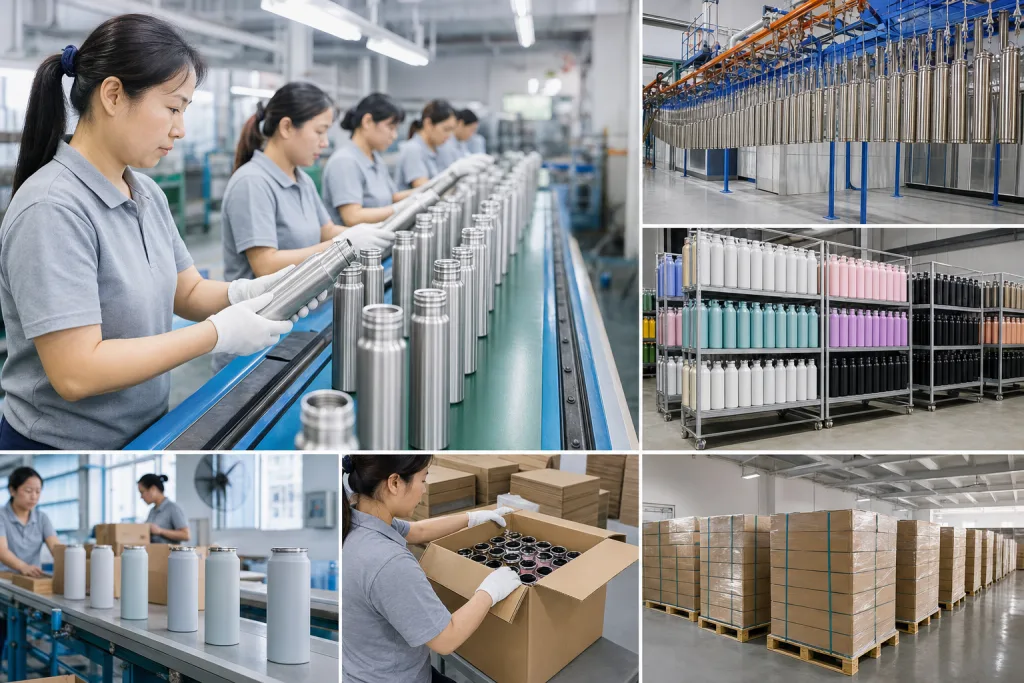
You do not need the biggest supplier in China. You need the factory that fits your order profile. A Zhejiang plant rated at 600,000 units per month sounds safe on paper, but if your order is 1,200 mixed-color bottles with retail gift boxes, that size can work against you. We have seen big plants push small custom runs to the side of the line. A mid-sized factory with tighter finishing control and a packing team that checks box fit with a 3 mm tolerance gauge is often the better call.
When you screen a canteen factory, ask practical questions:
- What is your real MOQ by model, color, and logo method?
- What is your sample lead time, normally 5 to 10 days or 12 days vs 18 days?
- What is your mass production lead time after approval, 25 to 35 days or 40 plus?
- Which processes are in-house: drawing, polishing, powder coating, laser, packing?
- Do you support FOB, EXW, and basic DDP coordination?
- How do you control spare lids and replacement parts?
If you are speaking with several canteen manufacturers or canteen vendors, compare the answers for clarity, not sales talk. This is the wrong question to ask: "Can you do it?" Most factories will say yes. Ask where the order can fail. A solid canteen supplier will tell you straight: dark matte coating scratches more easily after cross-line handling, bamboo lids show grain variation lot to lot, large bottles raise carton drop risk, and narrow necks cut polishing yield. QC pulled a sample last month with a coating edge chip at the shoulder radius. That kind of honesty saves days.
For brand owners, ask whether the factory can handle packaging development, barcode application, and pre-shipment inspection coordination. We ship projects where the buyer flagged a barcode position shift of 2 mm, and that matters at retail. For a distributor drinkware or distributor growler account, ask about continuity: how long will the mold stay active, and can matching repeat colors be maintained within a stated tolerance? If the supplier cannot give a number, the math does not work.
The best supplier relationship is rarely the cheapest first order. It is the one that still works on order six, when you need repeat color, stable sealing, and shipment on time. We have seen this go sideways over one small detail—a PO typo on lid color, or a seal ring hardness change from 50 to 60 Shore A. That is where a disciplined Zhejiang team stands out, not a flashy sample room.
Get your bottle spec checked before you place it
Send your target price, capacity, artwork, and packaging needs. We will review feasibility, MOQ, and lead time from our Zhejiang, China production team.
Frequently asked questions
What MOQ should I expect for a double walled bottle custom order?
For common insulated bottles, MOQ is usually 1,000 pcs per model and color for a basic screw-lid design. If you add a custom lid, special finish, or complex gift box, MOQ often moves to 2,000 or 3,000 pcs. Some canteen factory programs in China accept 500 pcs for existing colors and laser logo, but unit cost goes up fast. For insulated growlers, MOQ can be 500 to 1,000 pcs depending on size and stock components. Always ask whether MOQ applies per SKU, per color, or per shipment, because those are not the same. A buyer who sees “1,000 pcs MOQ” without that detail can end up approving 3,000 pcs across three colors by mistake.
How long does production usually take after sample approval?
For standard models, production is commonly 25 to 35 days after final sample approval and deposit receipt. New color matching, custom packaging, or peak-season scheduling can push that to 40 to 50 days. Pre-production samples often take 5 to 10 days if the bottle uses existing molds, and 15 to 25 days if there is a new tool or major lid change. In Zhejiang and other drinkware clusters in China, timing also depends on how much work is done in-house. A canteen manufacturer with in-house powder coating and laser marking usually controls timing better than one that outsources every decoration step. If you need an event date, build in at least 7 extra days for inspection and rework buffer.
Is SUS304 enough, or should I upgrade to SUS316 inside?
SUS304 is enough for most B2B drinkware projects. It is the standard choice for promotional bottles, retail hydration, and general custom drinkware because it balances corrosion resistance, cost, and supply stability. SUS316 interior makes sense when your product position is more premium, when users may keep electrolyte or acidic drinks longer, or when the bottle is aimed at marine, medical, or performance channels. The typical cost increase is about USD 0.25 to 0.60 per unit on common sizes. If your retail price is under USD 15, 304 is usually the practical choice. If your brand story depends on premium materials, then 316 can be a useful upgrade, but ask for written material confirmation, not just a verbal promise.
What tests matter most before I approve mass production?
The basic four are leak test, vacuum or insulation check, coating adhesion, and drop test with actual packaging. Those catch most field failures. For a 500ml or 750ml bottle, I would also confirm logo placement, thread smoothness, gasket fit, and base stability on a flat table. If the bottle is for Europe, ask for REACH-related support and food-contact documentation; for North America, confirm the relevant food-contact and chemical compliance paperwork for your market. On inspection, many buyers use AQL 2.5 major and 4.0 minor as a starting point. If the order is ecommerce-focused, add carton and barcode checks. A bottle that passes lab paperwork but ships with wrong FNSKU or weak packaging still becomes your problem.
How do I compare canteen suppliers without wasting weeks on sampling?
Start by sending one tight RFQ sheet to every canteen supplier: capacity, dimensions, steel grade, finish, logo method, packaging, target market, compliance needs, MOQ, and target ship date. Then ask each factory for the same five items: FOB price, sample cost, lead time, production capacity, and the exact test list they run. Remove any canteen vendor that answers with vague ranges only. Next, sample only two or three suppliers, not ten. One should be a price-focused option, one a balanced option, and one a stronger retail-grade canteen manufacturer. In China, the best partner is usually the one that identifies risk early and documents details clearly. Fast replies matter, but clear technical replies matter more.