Key Takeaways
- A 500 ml double wall bottle with 0.5 mm/0.6 mm steel usually lands at USD 2.20-4.80 FOB China.
- Most serious canteen manufacturers quote 1,000-3,000 MOQ and 30-45 days for standard custom drinkware.
- Vacuum retention should be tested at 24 hours hot and 12-18 hours cold, not just printed as a claim.
- Ask for AQL 2.5/4.0, REACH, food-contact declarations, and a monthly output figure like 200,000 units/month.
If you buy custom drinkware for a brand, Amazon program, or distributor line, the wrong double wall bottle suppliers will cost more than a bad unit price. They bring claims, slow approvals, and margin leaks from rework. We saw a 500 ml bottle pass PDF signoff, then fail at the seam and lose vacuum after 3,000 cycles. Read the spec sheet like an engineer. The buyer flagged the print after the third wash test, and that was the real warning.
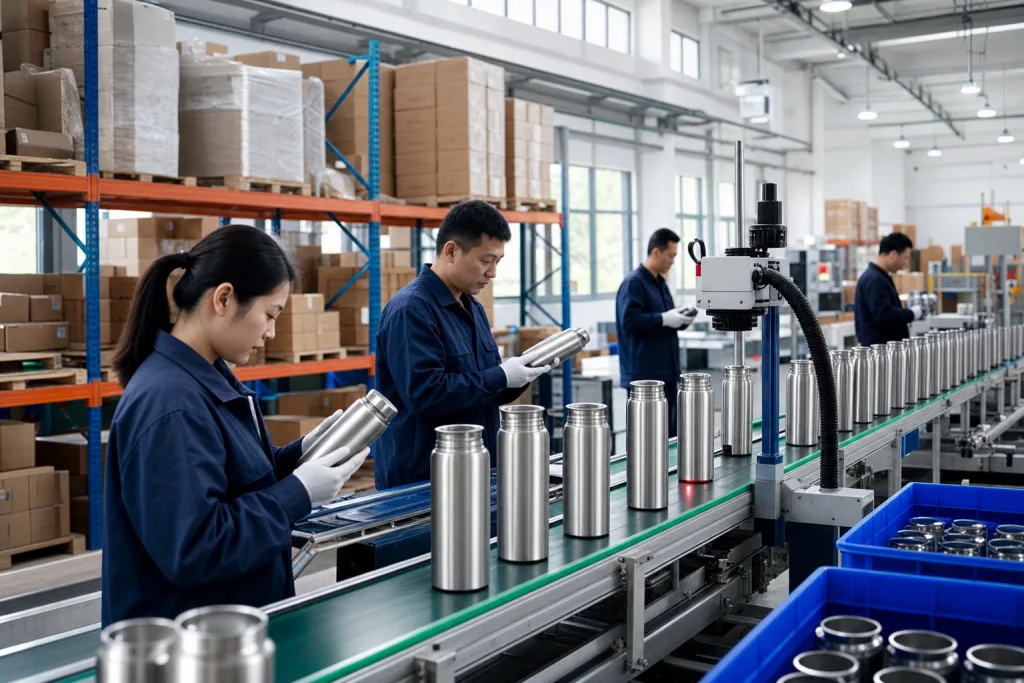
At a Zhejiang canteen factory, the numbers tell the story: 18/8 steel, 0.5 mm inner wall, 0.6 mm outer wall, 30-45 day lead time, and MOQ from 1,000 to 3,000 units depending on tooling and decoration. We run a vacuum gauge on the line, and QC pulled the sample when the lid torque drifted by 0.3 N·m. China has plenty of canteen suppliers; the question is whether they hold tolerances, pass REACH and food-contact checks, and ship the same customized drinkware spec month after month.
Read the spec sheet first
Compare double wall bottle suppliers by reading the spec sheet first, not the sales pitch. The four lines that change landed cost and claim rate are material, wall structure, capacity, and finish. We ask straight away whether the inner and outer shells are 304 stainless steel, whether the lid has PP, Tritan, or 201 steel parts, and whether the bottle is true vacuum insulation or only double-wall air insulation. If a supplier answers in soft language, the line will drift later. This is the wrong question to skip.
For a normal 500 ml bottle, expect body weight around 220-320 g depending on gauge and shape. On our line, QC pulled a 238 g sample once and the buyer liked the freight number, but the sidewall dented after a 60 cm drop test. In Zhejiang, experienced canteen suppliers usually quote wall thickness at 0.4-0.6 mm. For retail-facing custom drinkware, 0.5 mm inner wall is a practical floor. Below that, ask why the price is low, because we have seen this go sideways with weld distortion and weak heat retention.
- 304 inner wall: standard for food-contact credibility
- 0.5 mm inner / 0.6 mm outer: common cost-durability balance we ship every week
- 500 ml / 750 ml / 1,000 ml: core sizes most distributors reorder, though 750 ml usually moves slower in gift channels
- Vacuum test: ask for heat-loss data in hours and degrees, not slogans
For canteen promotional projects, the spec sheet should also show the decoration area. A 70 x 90 mm silk-screen panel is not the same job as a 220-degree wrap run on the screen-print jig. That changes setup fee, yield, and decoration life. One buyer flagged logo scratching after dishwasher cycles, and the issue came back to finish choice, not bottle quality. If the customized canteen is meant for daily use, shelf-display decoration is the wrong target.
Steel grade and wall thickness
This is where buyers get caught by a clean sample. Two bottles can both say “18/8 stainless,” yet one is built from 0.4 mm sheet with sloppy seam control, so the bottle fails faster in use. We see quotes from double wall bottle suppliers in China marked 304, 316, or the loose term “food-grade stainless.” For most canteen distributor programs, 304 is enough. Ask 316 only if you already have a corrosion case on the table, or your brand can carry the extra FOB cost, usually +10% to +18%. We’ve seen buyers ask for 316 first; this is the wrong question to ask if the wall spec is still vague.
Wall thickness decides how the bottle feels and how it holds vacuum after rough handling. A 0.5 mm inner wall plus 0.6 mm outer shell is standard on mainstream custom canteen lines, and we run that combo every week on the hydroforming line. If a factory offers 0.35 mm material, ask for the reject rate, dent test result, and sidewall crush feedback. Thin sheet cuts weight. It also makes the bottle feel cheap in hand. Buyers selling customized drinkware in Europe often miss this point; the end customer notices cap sound, hand weight, and whether the body picks up a dent after one bad drop in carton transit. QC pulled samples before with no leak, then found shoulder deformation after carton compression at 18 kg.
What to ask the canteen factory
- Is the inner liner 304 or 316?
- What is the exact gauge in mm, not just “thick”?
- Are weld seams polished or just buffed?
- Can you provide material certs and a lot traceability sheet?
Paying USD 0.25 more for better steel is cheaper than replacing 2% of a container after customers complain about dents or odor.
If you are sourcing canteen customizable models for private label, ask the canteen vendor to show the same body in multiple finishes. Powder coat, sprayed lacquer, and raw matte steel behave differently under laser engraving and screen printing, and we usually test logo adhesion with 3M tape on the line before mass production. The wrong coating can peel at the logo edge after 50 dishwasher cycles. We’ve also had a buyer flag a PO that said “mat steel” when they meant raw matte steel, and that small wording mistake turned into a finish approval delay.
Vacuum performance and insulation
Insulation is the whole point of a double wall bottle. Do not buy on a headline like “12 hours hot, 24 hours cold” unless the supplier shows the test setup. We ask for four basics every time: starting water temperature, ambient temperature, fill ratio, and cap type. If the factory cannot tell you whether the test used 95°C fill water, a 23°C room, and full-fill or 90% fill, the claim came from sales copy, not the line.
For most sourcing programs, this is the spec that matters: water starting at 60-65°C should still sit above 45°C after 6 hours, and cold water should stay below 10°C after 6-8 hours at room temperature. That covers most distributor drinkware lines. Chasing all-day lab numbers is often the wrong question to ask. On growler projects, buyers usually push on beer carry temperature and sweat control instead. We have seen a 64 oz growler pass cold hold but get flagged because condensation formed around the base after 40 minutes on a retail counter.
Check the weld ring and the base closure first. That is where vacuum failures show up. The body can look clean and still leak from the bottom seam. Ask the canteen supplier for a vacuum leak test—helium or hot-water dwell is standard—plus aging data after 60°C heat exposure. QC pulled one sample last season with a good top-cap seal and a weak bottom pull point, and the loss showed up after the dwell test, not in visual inspection. If a factory ships 200,000+ units/month, they should already have that record. If they do not, the process is not mature.
- Hot retention: ask for 6-hour and 12-hour data, with starting water temperature listed
- Cold retention: ask for 6-hour and 12-hour data under stated room conditions
- Seal integrity: check bottom weld performance, not only the top cap
- Batch consistency: compare sample A, sample B, and the pilot run; we have seen pilot runs drift by 2-3°C
Lids, seals, and leak control
Most field failures start at the lid, not the steel body. We’ve seen a custom drinkware bottle hold temperature perfectly and still leak in a backpack because the cap gasket was undersized by 1 mm. For double wall bottle suppliers, the lid spec needs four plain items: material, gasket type, thread standard, and torque target. Skip that, and the line guesses. This is the wrong place to save time if you want distributor returns under 1%.
Common lid materials are PP, Tritan, and stainless steel, but they do different jobs on the shelf and on the line. PP is the low-cost pick and works for basic canteen promotional projects; we run it a lot on MOQ 3,000 orders. Tritan gives clearer appearance and better drop resistance, which matters when the buyer flagged scuffing after a 1.2 m desk fall. Stainless lids lift perceived value, though they add weight and cost, and freight math changes fast on large programs. For gaskets, silicone is the normal choice, often 50-70 Shore A. If the supplier cannot tell you the hardness, they are guessing.
Test the bottle with 180-degree inversion for 2 minutes, then a 30-minute carry test in a sealed bag. That tells you more than a lab-only claim for canteen distributors selling into schools, gyms, or outdoor channels. QC pulled the sample last month on a lid that passed bench testing but failed after bag pressure built up around the spout. Also check if the lid comes apart for cleaning. A lid that traps odor brings repeat complaints, and we’ve seen this go sideways in custom canteen and distributor canteen programs after the first shipment.
Practical lid questions
- Does the cap use a one-piece or two-piece gasket?
- What is the torque spec for leak-free closure?
- Can the lid survive 3,000 open-close cycles?
- Is the straw or spout part replaceable?
For canteen customizable SKUs, a supplier offering 3-5 standard lid platforms is usually the safer choice than one promising endless options. Standard tooling means sampling in 12 days vs 18 days, less mold risk, and tighter QC discipline. We ship more stable repeat orders this way. On the factory floor, shared platforms also make go/no-go gauge checks simpler, and that cuts avoidable mistakes like the wrong lid code typed on a PO.
Decoration that survives real use
Custom logo work looks easy until the first bulk run hits the line. A canteen factory can make 2 sample pieces look perfect in the showroom, then QC pulled the sample from mass production and found edge wear after a 30-cycle rub test with a 3M pad. The real question is not whether the artwork prints. It is whether it stays on after abrasion, ice buckets, dishwashers, carton friction, and distributor handling. Decoration changes bottle cost fast, and this is where buyers often ask the wrong question.
Silk screen is the low-cost option for flat panels or light curves, usually where the artwork area stays within about 60 x 120 mm. Expect setup charges around USD 30-80 per color, and the math starts to work at 1,000 units and above. Laser engraving is durable and gives a cleaner premium look on bare steel, but it depends on coating type and surface color; on some painted bottles, the contrast is weaker than the buyer expects. Heat transfer and water transfer handle full graphics, though the line needs tighter temperature and curing control. We have seen this go sideways on fast promo orders. If you are buying canteen promotional stock for a campaign with quick turnover, keep the art simple. Every added color means another registration point, and the buyer flagged this more than once after seeing 0.8 mm misalignment on multicolor logos.
A good canteen supplier should give you Pantone matching tolerance, print adhesion testing, and dishwasher resistance data, not just a nice pre-production photo. For a customized canteen meant for retail resale, ask for a rub test after 50 cycles and ask what tape they use for adhesion cross-hatch testing. We run this with a cutter grid before shipment. If the logo fades early, the bottle turns into generic stock sitting in a warehouse. That hurts margin fast for canteen distributor and distributor drinkware businesses that depend on repeat orders.
- 1-color print: cheapest and safest at scale, especially from 1,000 pcs up
- Laser engraving: durable, premium, slower on the line than basic print
- Powder coat + laser: strong retail look, higher unit cost and one more process step
- Wrap graphics: good for seasonal custom canteen runs, but QC needs to watch seam alignment
For canteen customized projects in Europe and North America, also ask whether the inks and coatings meet REACH and food-contact expectations. We ship plenty of compliant bottles, but clean decoration control matters as much as the base bottle. One inspection finding can kill the whole PO, even if the 304 stainless body passed everything else.
MOQ, pricing, and lead time
Buyers ask for “the best price” on day one. That is the wrong question to ask. What matters is where the price moves by volume break and finish. On a standard 500 ml double wall bottle, FOB China pricing commonly sits around USD 2.20-4.80 depending on steel grade, lid, finish, and decoration. On our line, a matte powder coat with one-color screen print usually runs lower than a soft-touch body with laser engraving and a custom lid insert, and the laser position tolerance alone can add rework if the logo window is tight.
Typical MOQ from a serious canteen manufacturer is 1,000 units for an existing mold and 3,000 units if you want a new cap or body shape. Sample lead time is often 5-10 days. Mass production is usually 30-45 days after approval and deposit. If a canteen vendor promises 7-day mass production on a non-stock customized drinkware item, ask what they are skipping on the line. We have seen this go sideways. QC pulled the sample, color was fine, but the vacuum hold test was still waiting and the inner carton mark had the PO typo carried into bulk.
For distributors, a two-step buy works better in real orders: run 300-500 samples for sales validation, then lock a 3,000-5,000 unit purchase order once artwork and packaging are final. That cuts dead stock. It also shows where the item fits. We ship plenty of programs where the first 500 pieces go out with a plain white mailer, then the full run moves only after the buyer signs off the barcode size and 3 mm logo spacing on the gift box.
In Zhejiang, factories that ship 200,000 to 400,000 units per month tend to have better repeatability than small traders posing as canteen suppliers.
If your target is a canteen custom program with mixed SKUs, ask for split MOQ by color and print. That one line changes your cash flow. One factory may allow 500 units per color if the body is shared; another may hold the line at 1,000 per color because setup loss on the silk-screen station does not justify smaller lots. Buyers flag this late, then the math doesn’t work.
QC, certifications, and export paperwork
For Europe and North America, compliance is not optional. A qualified double wall bottle supplier should send food-contact declarations, REACH-related material statements, and third-party lab reports on request, not after 3 rounds of chasing. Retail buyers usually ask for BPA-free statements for lids, lead and cadmium limits for coatings, and carton compression data before the PO is released. We ship these files with the pre-production pack, because this is where orders get stuck. Last month a buyer flagged a missing lid resin declaration 48 hours before booking.
Ask about AQL before you place the order. A common standard is AQL 2.5 for major defects and 4.0 for minor defects, with visual inspection, leak tests, and random insulation checks. On our line, QC pulled the sample with a 0.2 MPa air-pressure leak test and checked vacuum retention from the same lot. A mature canteen factory separates incoming material inspection, in-process checks, and final inspection. If they only inspect at the end, they are already late, and we have seen this go sideways on coating color, lid fit, and logo position by 1.5 mm.
Packaging matters because bottles fail in transit. A 5-layer export carton, proper divider inserts, and drop-test confirmation are not fancy extras. They decide whether you receive goods clean or open a claim at destination. For distributor canteen programs, request carton marks, FNSKU or barcode placement, and pallet specs if you are shipping into Amazon or a warehouse network. We run carton drop checks at 76 cm, and the weak point is usually the divider, not the bottle. The wrong question is "Can you use a nicer gift box?" Ask what protects the unit after 18 days at sea.
- Material docs: 304/316 proof, silicone declarations, coating statement
- QC standard: AQL 2.5/4.0 is a reasonable baseline
- Packaging: drop-test ready carton, not just retail looks
- Traceability: batch code on cartons and production lot records
China has 1,000-plus canteen manufacturers. The practical filter is simple: can they pass your compliance checklist as written, or do they send back a marked-up version because the factory has never handled that document set before?
Send your bottle spec, get a real quote
We’ll review your canteen custom requirements, suggest workable materials, and quote the MOQ, lead time, and decoration path that fits your market.
Frequently asked questions
What is a normal MOQ for double wall bottle suppliers?
For existing molds, a normal MOQ is 1,000 units. If you want a new lid, new body shape, or special coating, 3,000 units is more realistic. Some Zhejiang canteen suppliers can split colors at 500 units each if the tooling stays the same. For custom drinkware buyers, that difference affects cash flow more than the FOB price. Ask for sample MOQ separately; many factories will send 2-3 pre-production samples and charge freight only. If a canteen vendor says zero MOQ on a complex insulated bottle, expect limited decoration options or stock-only inventory.
How much does a customized double wall bottle cost FOB China?
A standard 500 ml bottle usually lands around USD 2.20-4.80 FOB China. Lower pricing usually means thinner steel, basic PP lids, and one-color print. Higher pricing comes from 316 steel, powder coating, laser engraving, or upgraded leakproof lids. A custom canteen for retail often needs the middle tier, not the cheapest one. Ask for a price ladder at 1,000, 3,000, and 5,000 units so you can see the real step-down. A serious canteen manufacturer should quote clearly, not hide decoration and packaging fees.
What certifications should I ask for from canteen manufacturers?
At minimum, ask for food-contact material declarations, REACH-related statements for Europe, and BPA-free confirmation for plastic lid parts. For branded retail or chain accounts, request third-party lab reports for lead, cadmium, and overall migration if needed. Many canteen suppliers in China can also provide ISO 9001 or BSCI audit summaries, but those are factory-level documents, not product compliance. For North America, buyer-specific testing may still be required. If the supplier cannot separate factory audit from product test, they are not export-ready.
How do I check insulation performance before ordering?
Ask for a test report that shows starting temperature, ambient temperature, fill level, cap type, and test duration. A credible result for a 500 ml bottle might show 60-65°C water staying above 45°C after 6 hours, and cold water staying below 10°C after 6-8 hours. You should also request a vacuum leak check and a bottom-seam inspection. For custom growler or distributor drinkware programs, test the exact lid you will ship, not a generic cap. A lid change can alter performance by 10-15%.
What lead time should I plan for custom drinkware orders?
For standard artwork on an existing mold, plan 5-10 days for samples and 30-45 days for mass production after approval. New lids or body tooling can push that to 45-60 days. If you need canteen promotional stock for a fixed launch date, build in another 7-10 days for ocean freight buffer and customs clearance. In Zhejiang, larger canteen factory lines with 200,000+ units per month usually keep better schedule discipline, but peak season can still add a week. Always confirm production start after artwork sign-off and deposit.