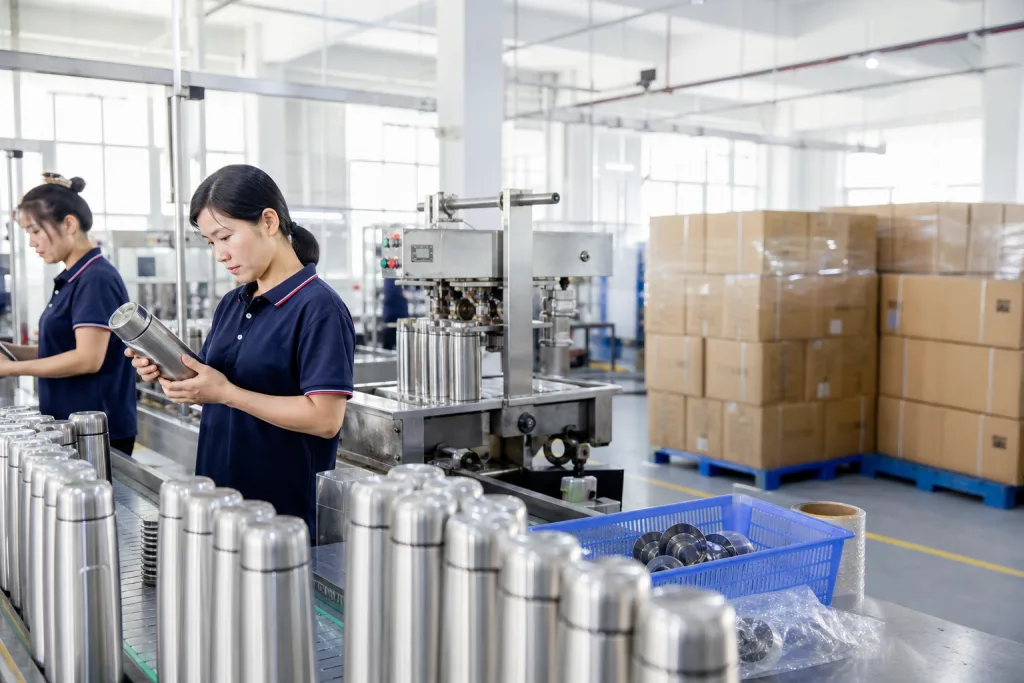
Key Takeaways
- 304 inner and outer steel at 0.4/0.4 mm is common; 316 inner usually adds about USD 0.18-0.45 per unit
- A workable MOQ for custom double wall bottles is often 1,000 pcs per color, with 35-45 day lead time after sample approval
- Vacuum insulation performance should be stated as a temperature retention result, such as 12 hours hot above 55°C or 24 hours cold below 10°C
- Use AQL 2.5 for major defects and carton drop testing from 76 cm to reduce claims in export shipments
You can pull pricing from ten suppliers in one afternoon. That does not mean you can compare them. A serious double wall bottle manufacturer should walk you through each spec line and tell you what changes cost, what adds 12 days, and what raises return rate. If they cannot, you are not buying a bottle. You are buying risk.
Most procurement problems start with vague drawings, copied test reports, and decoration choices made too late. We have seen a PO call for “matte black” and the buyer later flag a Pantone mismatch after the sample was already packed. Buyers in Europe and North America usually need custom drinkware that passes REACH, lands on time, and survives retail handling. In Zhejiang, the better canteen factory teams talk wall thickness, vacuum rate, lid leak path, AQL, and packaging before they quote. QC pulled a sample at 2.0 mm once and the line caught the weak spot fast. That saves money later.
Start with the steel line
Read the material line first, not the color chip. On a double wall bottle project, the first thing we check is steel grade for the inner wall, outer wall, lid contact parts, and any tea filter or straw. Most mainstream insulated bottles use 18/8 stainless steel, listed as SUS304 in China. That works for most customized drinkware programs. If the bottle will hold acidic drinks, electrolytes, or sit in a premium price band, ask for 316 on the inner wall only. That is the practical spec. The cost stays under control, and you get better corrosion resistance where the liquid actually sits. On our side, QC usually confirms the BOM against the coil tag before the line starts.
Do not stop at grade. Ask for wall thickness in writing. Typical mass-market structure is 0.35 mm inner and 0.35 mm outer. A steadier retail bottle is 0.4/0.4 mm. For larger customized growler formats like 64 oz, 0.5 mm outer is a safer call because denting during transport is where claims start. Thicker steel adds weight and cost. It also changes hand feel fast. We have seen buyers push back on price, then change direction after holding a 0.35/0.35 mm sample next to a 0.4/0.4 mm sample. If you sell through a distributor drinkware channel, that tactile difference matters. The math does not work if the bottle feels light and the shelf price is premium.
- SUS304 inner/outer: standard for most custom canteen programs
- SUS316 inner: useful for premium SKUs and salt or acid exposure
- 0.4/0.4 mm: a good balance of durability and cost
- Food contact: request LFGB or FDA declaration plus REACH review for coatings and seals
In Zhejiang, China, some canteen manufacturers quote low prices by quietly cutting steel thickness. We see this on competitor samples more than buyers expect. The saving is often USD 0.10-0.25 per unit, and it shows up later as dents, loose thread fit, or a bottle that feels cheap in hand. One common inspection finding is an outer wall measuring under spec with an ultrasonic thickness gauge after painting. If you are sourcing for a canteen distributor or a distributor growler program, ask for cross-section photos or production drawings before you approve price. If a supplier avoids that request, the buyer flagged the right problem.
Vacuum, insulation, and bottle geometry
Vacuum insulation is where quotes get slippery fast. Ask for numbers. A solid double wall bottle manufacturer should state the vacuum method, the insulation target, and the exact test method on the spec sheet. We’ve seen 12 hours hot and 24 hours cold written on a quote in 14-point bold, then the buyer asks for the test condition and nobody on the line can answer. Those claims mean nothing without fill temperature, ambient temperature, and the pass/fail point. A workable internal standard is hot water at 95°C, held above 55°C after 12 hours, and cold water with ice, held below 10°C after 24 hours at room temperature. If the supplier skips those details, this is the wrong question to ask: “How long does it keep hot?” Ask how they tested it.
Geometry changes thermal performance and decoration yield. A narrow-mouth bottle usually holds heat better than a wide-mouth custom growler because the opening loses less heat. Small change, big effect. On one 500ml body, a mouth change from 45mm to 55mm was enough for QC to flag weaker hot-retention results in the same vacuum batch. A taller shoulder can feel better in hand, but it often cuts into logo space and forces artwork to sit higher than the buyer wanted. A bottle with a large flat print area works better for canteen custom graphics, but once body diameter gets too small, wrap printing registration or laser positioning starts drifting on the jig. We’ve seen this go sideways at sample stage, then the PO still says “full wrap logo, centered.”
Ask how the vacuum is checked. Better factories in China run a vacuum inspection after sealing and before powder coating, because rework after decoration burns money and time. On our side, QC pulled the sample before coating more than once because the vacuum reading was off and the bottle wall temperature changed too fast during spot check. Ask about condensation testing too. A failed vacuum bottle can sweat on the outside within 20 to 30 minutes in a room test, and that is one of the fastest ways to trigger complaints in retail and promotional channels. The buyer flagged it, the end customer returns it, and the math doesn’t work.
A bottle that looks good on a CAD drawing can still perform badly if the shoulder radius, mouth size, and vacuum sealing process are not matched correctly.
If you need a customizable canteen for outdoor or corporate gifting, set the priority early: insulation first, or shape first. We ship better projects when that decision is made before sampling. You can usually improve one without damaging the other, but not if the supplier gets only a logo file and a target price. A 1mm shoulder change, a wider mouth, or a larger flat panel sounds minor on paper, yet those are the details that decide whether the bottle passes the test bench or just looks good in the rendering.
Lids, seals, and leak path details
Lids cause more claims than bottle bodies. Buyers often stare at the paint and ignore the closure, but the lid is what makes the user trust the bottle after 3 days on the road. A solid spec sheet should state lid material, gasket material, thread standard, handle load in kg, and the leak test method. We usually see PP, Tritan, stainless cap shells, and food-grade silicone seals on the line, and QC pulled one sample last month with a 0.6 mm flash on the gasket groove that would have leaked in transit. For EU programs, ask for REACH review on all non-metal parts. That is not optional.
Leak proof is not a slogan. Write the test into the PO. For most custom drinkware, we run an upside-down test for 30 minutes, a light squeeze test if the body has flex, and a transport vibration check. If the product uses a straw lid, call the use case straight. A lot of straw lids are spill resistant, not leak proof, and we have seen buyers flag this only after the carton hits the warehouse. That is the wrong question to ask late. For a canteen promotional order, end users do not read the small print.
Questions worth asking your canteen supplier
- Is the lid shared with existing molds, or is it new tooling?
- What is the torque range for cap closing?
- How many opening cycles has the handle passed?
- Can replacement seals be supplied for after-sales service?
A canteen vendor with a low opening mold charge can still box you into a weak seal design. We have seen decorative bamboo tops look solid in photos, then warp after moisture got into the insert area because the glue gap was off by 0.3 mm. For a customizable growler or customized canteen built for repeated outdoor use, ask for cycle testing and a simple exploded view. One buyer even sent a PO with "leak proff" typed on it, and that kind of loose spec is where trouble starts. If your canteen distributors will reorder the style for multiple markets, lid interchangeability across colors and sizes cuts spare-part headaches later. The math doesn't work if every color needs its own seal set.
Decoration affects yield and MOQ
B2B buyers often leave logo printing to the end. That is a costing mistake. We need decoration in the first quote round because it changes yield, MOQ, and even carton layout. On our line, a 0.3 mm logo shift that looks small on screen can turn into a rework call once QC pulled the sample. The main options are silk screen, heat transfer, laser engraving, digital printing, water transfer, and powder coat color matching. A straight-wall bottle runs easier than a heavy tapered body. A matte powder coat hides minor handling marks better than a mirror-polished surface. If your canteen customized artwork includes 4 pt text, test readability on an actual bottle before you lock packaging.
Here is the factory side. Silk screen usually carries the lowest setup cost and fits 1 or 2 spot colors; we run it fast on existing jigs. Laser engraving sells well because buyers like the durable, premium look, but the mark can vary on painted surfaces if coating thickness drifts from 60 to 80 microns. Full-wrap digital or transfer graphics look strong at retail, but this is where we've seen orders go sideways. If registration tolerance is tight, defect rates climb fast, and the math doesn't work once your MOQ is 1,000 pcs per color and you still need shipment balance by SKU. One EU buyer flagged a seam mismatch of 1.5 mm on a wrap file, and that became the whole discussion.
A typical custom order from a canteen manufacturer in Zhejiang may look like this:
- MOQ: 1,000 pcs per size/color for existing molds
- Sample time: 7-10 days for logo sample
- Mass lead time: 35-45 days after deposit and artwork approval
- Decoration add-on: roughly USD 0.08-0.60 depending on process
If you are building a canteen customizable range for several distributors, standardize body colors and change logos. Do not change both at once unless the margin covers it. We ship cleaner and faster that way, and overrun drops because the line is not stopping to swap body color, lid color, barcode label, and print position every few cartons. At BottleForge Industrial in Hangzhou, Zhejiang, monthly output can reach 300,000 units across insulated programs, yet planning still slows down if Carton 12 needs a black lid, Carton 13 needs navy, and the PO even has one barcode typo in the last column.
Packaging, compliance, and shipment reality
The bottle can be right and the project still fails if packaging gets decided at the end. Put the packing spec on the same sheet as the bottle drawing: unit box style, insert material, master carton count, carton gross weight, barcode position, and drop-test standard. If you sell into Amazon FBA or chain retail, ask for carton dimensions before you lock bottle height. We’ve seen a 5 mm height change cut one row from the master carton, and the freight math stopped working.
For export from China, we usually run one polybag, one white box, then a 5-layer export carton. For premium customized growler or custom canteen projects, the line often switches to molded pulp or EPE inserts after QC pulled a dented sample from a 1.2 m drop test. If the shipment goes by sea to Europe or North America, keep carton gross weight below 15 kg where possible. Buyers push back on damage claims, but this is the wrong question to ask; the first check is whether the packout was built for handling at origin and destination.
Compliance belongs on the same page as packaging because the labels, declarations, and carton marks move together. On one PO last year, the buyer flagged a barcode placement note that said “left side” while the artwork file showed “right side,” and that small typo held shipment two days. Depending on your market, ask for:
- FDA or LFGB food contact declarations
- REACH screening for coatings, inks, and silicone parts
- BSCI or equivalent social compliance if your customers require it
- ISO 9001 quality system evidence
- FNSKU / outer carton labels for marketplace fulfillment
A canteen factory with export experience will confirm INCOTERMS in plain words. FOB Ningbo or FOB Shanghai is common for Zhejiang suppliers, and we ship both every month depending on vessel space and buyer forwarder routing. If a canteen supplier quotes EXW only, the price can look clean on day one and turn messy after local charges, pallet handling, and export docs get added. Serious canteen vendors know clear carton specs and complete compliance files shorten approvals faster than a $0.08 unit-price cut.
Quality plan before deposit
Do not wire the deposit before the quality plan is on paper and signed. At minimum, lock three things first: the approved sample, the specification sheet with revision date, and the defect standard tied to inspection. On our side, we run this in four control points: pre-production sample approval, in-line checks during forming and coating, 100% leak test at assembly, and final random inspection by AQL. For most double wall bottle programs, AQL 2.5 for major defects and 4.0 for minor defects is a solid starting point. This is not paperwork for show. QC pulled a sample last month because the logo position drifted 1.8 mm from the signed print file, and the buyer flagged it right away.
Write defects in plain language, not buyer shorthand. Major defects usually mean vacuum failure, leakage, wrong logo, unstable base, sharp burrs on the rim, wrong barcode, or coating peel in visible areas. Minor defects may mean slight print shift within tolerance, small bottom scuffs, or tiny color deviation not visible at 30 cm. If this section stays vague, the line and the third-party inspector will judge the same bottle two different ways. We have seen this go sideways over one PO typo on barcode artwork.
Ask one direct question: do you do 100% leak testing? For insulated stainless bottles, the answer should be yes. Then ask if vacuum retention is sampled every batch and whether incoming steel and plastic are traceable by lot code. If the answer is no, the math does not work, because one complaint can turn into 12 days of sorting records instead of 2 hours pulling the lot card. On the floor, that trace usually starts from the steel coil tag and injection batch number, not from someone's memory.
Experienced canteen suppliers in China do not get uncomfortable with these checks. They answer fast because serious buyers ask them every week. If you work with canteen distributors or a distributor canteen network, build one master checklist and keep it on every reorder, even at 500 pcs MOQ trial level. This is the right question to ask, not whether a new factory is 3% cheaper on the first order. We ship plenty of repeat programs, and reorder number three is where stable quality starts paying back.
How to compare suppliers fairly
When you compare a canteen manufacturer, canteen supplier, or double wall bottle manufacturer, force every quote into one template. If not, you are pricing different bottles with the same photo. We run this check on the factory side too. Your comparison table should list steel grade, wall thickness, capacity tolerance, bottle weight, lid material, seal material, decoration process, MOQ, tooling charge, sample cost, lead time, packaging, test reports, AQL level, and trade term. Add one more line that buyers often miss: neck diameter in mm, because a 44 mm mouth and a 55 mm mouth do not use the same lid set.
You should also ask direct questions that show whether the supplier actually runs the line or just sells the sample:
- Can the supplier provide a mass production schedule by day, not just a shipment week?
- What is the standard overrun or underrun policy, such as plus or minus 5%?
- How are color standards approved: Pantone panel, powder chip, or photo only?
- What is the claim process if leakage exceeds 0.5% after receipt?
A capable canteen factory in Zhejiang or broader China will answer with documents, not sales talk. QC pulled the sample, checked net weight on a digital scale, and matched the lid BOM to the quote. That is what you want to see. They should tell you if your target price is wrong for 316 inner steel, a leak-proof flip lid, individual color gift boxes, and a 25-day lead time. We have seen buyers push for all four on a 3,000 piece MOQ, and the math does not work. You do not need a supplier who says yes to everything. You need one who can show where the cost sits and what can be changed first.
If you are sourcing custom drinkware for a private label, a canteen promotional campaign, or a distributor growler assortment, pick the supplier that flags risk early. This is the right question to ask. We have seen this go sideways over a simple shoulder radius change or a 60 shore gasket that should have been 70 shore. It is easier to fix the drawing before tooling than after 5,000 pieces are packed, carton drop test is done, and the booking is already out of Ningbo.
Send your bottle spec for a real factory review
Share your drawing, target price, quantity, and market. We will mark risk points, suggest cost options, and reply with workable MOQ and lead time.
Frequently asked questions
What MOQ should I expect from a double wall bottle manufacturer?
For existing bottle molds, a realistic MOQ is usually 1,000 pieces per size per color, with some factories accepting 500 pieces for plain stock colors and one simple logo. If you need a new lid mold or a new body shape, total MOQ often moves to 3,000-5,000 pieces. For mixed orders, many Zhejiang, China suppliers will let you combine 2-3 colors under one 3,000-piece total if the decoration is the same. Always ask whether the MOQ is based on body color, logo color count, or packaging style. Those details change the real minimum.
How long does custom double wall bottle production take?
For an existing model, plan 7-10 days for a pre-production sample and 35-45 days for mass production after sample approval and deposit. If you need new tooling, add about 20-30 days for mold making and first article adjustments. During peak season from August to November, some canteen manufacturers in China extend to 50-60 days, especially when powder coating and gift boxes are involved. If your order includes multiple SKUs, ask for a line-by-line production calendar. A supplier saying 'about 30 days' without splitting sample, coating, assembly, and packing is not giving you a reliable timeline.
Which tests matter most for insulated stainless steel bottles?
Focus on the tests that affect returns. First is 100% leak testing during assembly. Second is vacuum or temperature retention verification by batch, such as 12 hours hot above 55°C and 24 hours cold below 10°C under a stated method. Third is coating adhesion and cross-hatch testing for painted surfaces. Fourth is food-contact compliance, usually FDA or LFGB, plus REACH review for inks, coatings, and silicone. For packaging, add a carton drop test from 76 cm and a transit vibration check. If you sell to children or outdoor channels, request handle cycle testing and impact testing as well.
Is 316 stainless steel worth the extra cost for a custom canteen?
Sometimes yes, often not. For standard water, coffee, or tea bottles, SUS304 inner and outer is usually enough. SUS316 is worth considering when the bottle will hold acidic beverages, electrolyte mixes, or when you want a premium positioning with a stronger material story. In many projects, using 316 only on the inner wall adds about USD 0.18-0.45 per unit depending on size and market conditions. Full 316 construction costs more and is rarely necessary for mainstream custom drinkware. If budget is tight, spend first on reliable lid sealing and stable coating quality before upgrading every metal part.
How do I reduce risk when buying from a canteen factory in China?
Lock the specification before deposit. That means approved drawing, exact steel grade, wall thickness, lid materials, decoration method, packaging, AQL level, and test requirements in one signed document. Then request a production sample that matches mass-production materials, not just a photo sample. Use staged checks: pre-production review, in-line inspection, and final random inspection. For first orders, keep the assortment narrow, such as 2 colors and 1 decoration method, rather than 6 combinations. A reliable canteen supplier in Zhejiang, China should accept clear QC terms, provide compliance files, and quote FOB terms transparently.