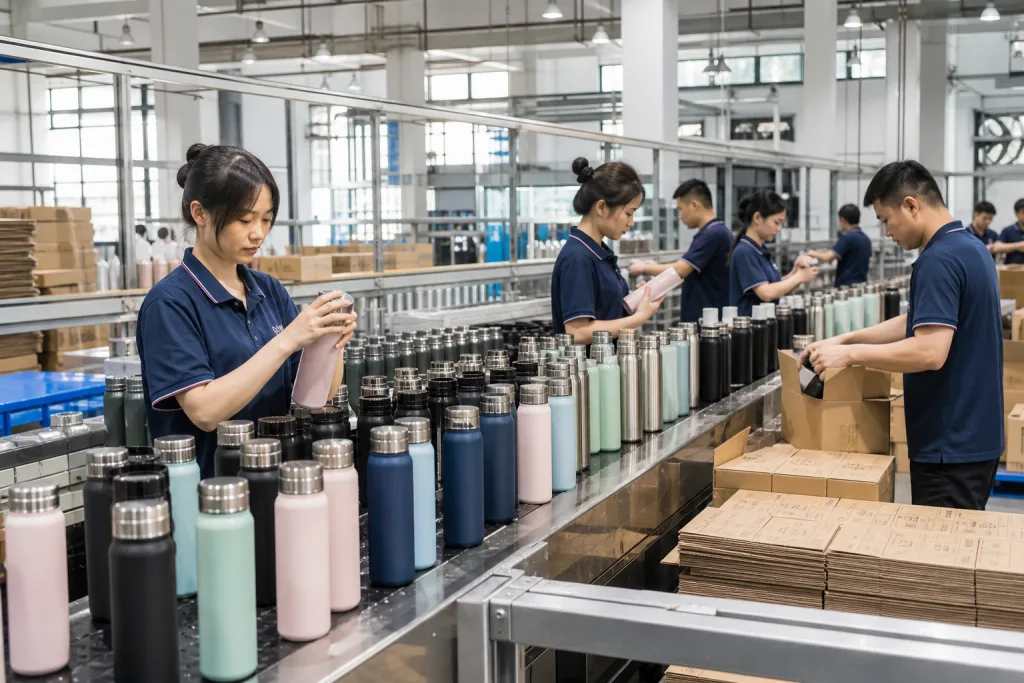
Key Takeaways
- For a standard 500 ml 18/8 stainless steel double wall bottle, practical MOQ is usually 3,000 pcs per color, with 35-45 day production after sample approval
- A FOB Zhejiang target of USD 2.85-4.60 per unit is realistic for powder-coated vacuum bottles, depending on capacity, lid structure, and print method
- Use AQL 2.5 for major defects and AQL 4.0 for minor defects, with leak, vacuum, coating adhesion, and carton drop tests written into the PO
- The fastest way to avoid claims is to freeze 12-15 spec points before deposit, including wall thickness, mouth diameter, logo position, carton mark, and barcode format
You rarely lose money on a double wall bottle bulk order because 304 stainless is hard to source. You lose money on the small misses. A lid leaks after 28 days at sea. A silk-print logo scratches after a 200-cycle rub test. The outer carton fails a 76 cm drop. The bottle base comes out 2 mm wider than the gift box insert. We’ve seen this go sideways, and it usually shows up late, right when the vessel booking is tight and the sales team has already opened the launch.
A good buyer in Europe or North America treats China sourcing like an engineering job, not a catalog pick. This is the right approach. If you buy from Zhejiang, lock the bottle structure, decoration process, test plan, AQL level, and shipping terms before mass production starts. On our line, QC pulled a pre-production sample once because the PO said matte black body but missed the lid finish, and that one typo cost 12 days vs 18 days on the original booking plan. That is how you protect margin on a double wall bottle bulk order instead of paying for rework.
Start with one buyer scenario
Start with a real buyer case. You run an outdoor hydration brand selling into Germany and Canada, and the opening PO matters even if it is only 8,000 units: a 500 ml insulated bottle in two matte colors, one-color logo, each piece in its own kraft box. You also want the supplier to price the next wave off the same tooling logic: a bulk canteen, a beer tumbler bulk program, and a growler bulk option for hospitality customers.
A Zhejiang factory tells you it runs 600,000 units per month on stainless drinkware, with a standard MOQ of 3,000 pcs per model per color for custom decoration. Fine. That is not the first question to ask. We have seen buyers approve a quote, then QC pulled the sample and found the mouth size was 3 mm tighter than expected, which changed the lid fit and cleaning feel. For a double wall bottle bulk order, your RFQ should state:
- Body material: food-contact SUS304 interior and SUS304 or SUS201 exterior depending on market and price target
- Vacuum structure: double wall, copper-coated inner liner optional for higher heat retention
- Capacity tolerance: 500 ml nominal, +/- 3%
- Wall thickness: inner 0.4 mm, outer 0.5 mm is a common commercial build
- Mouth diameter: for example 44 mm if you want easier filling and cleaning
- Base diameter and total height: needed for cupholder fit and carton engineering
- Finish: powder coating, Pantone reference, gloss level if critical
- Lid: PP inner, silicone seal, carry loop yes or no
Skip these details and you are not comparing quotes. You are comparing assumptions. We ship projects like this every month, and this is where the line starts drifting: one factory prices 0.4/0.45 mm, another prices 0.4/0.5 mm, and lead time moves to 12 days versus 18 days because carton size changed after sampling. The same problem shows up later on wholesale canteen models, alcohol flask bulk, or beer growler in bulk. Write the structure down first. Then the price means something.
Build the spec before price
Most buyers ask for price on the first email. That is the wrong question to ask. Build the spec first: target market, compliance, usage, packaging, then cost. If you sell into the EU, spell out REACH-related material control where applicable, LFGB or food-contact migration testing if your channel asks for it, and packaging compliance that matches your importer’s file. We see buyers miss this point, then QC pulled the sample and found the gift box warning text did not match the PO. For North America, ASTM or CPSIA matters more on kids items; standard adult bottles usually come down to food-contact materials, labeling, and retailer test protocols.
For this order, the target is a practical bottle that lands at retail around USD 19.99. On our line, your FOB target from China should sit between USD 3.10 and USD 3.80 for a 500 ml powder-coated bottle with silkscreen logo and standard color box, assuming 8,000 pcs. If you move to laser engraving, add a more complex lid, or open a custom mold base, you can go above USD 4.20 fast. If you stay with stock colors and bulk pack, you may get under USD 3.00. We’ve seen this go sideways over small details—a buyer flagged a 2 mm taller lid skirt because it changed the insert fit and carton drop result.
What changes cost fastest
- Steel grade: full 304 inside and outside costs more than 304 inside with 201 outside; some buyers ask only about inside contact, but the math doesn't work the same once rust-risk claims hit the market
- Coating: powder coat is usually USD 0.18-0.35 above plain spray finish, and the line also runs slower if the texture spec is tight
- Decoration: laser marking may add USD 0.08-0.20; multi-color print adds setup time, screen cost, and hand placement checks
- Lid complexity: straw lids, metal cap tops, and molded handles push up failure risk and cost; leak test rejects often start here at 0.03 MPa air pressure
- Packaging: gift box inserts can add USD 0.20-0.60 per unit, especially when the insert die-cut has to hold the bottle neck and lid in one position
If your program may expand into canteen wholesale, wholesale growler, or alcohol flask wholesale bulk, ask the same supplier to quote the whole family in one round. Shared decoration, shared carton specs, and combined buying of lids or seals can save 3-7%. We run this way in Zhejiang because platform sourcing is cleaner than quoting one SKU at a time. One PO last season even had the carton mark typo “stianless,” and fixing it across three related items was still easier than fixing three separate supplier files. That is how you find the best wholesale drink bottle supplier for the next six months, not just this PO.
Sample approval is where orders survive
Then you request samples. For a serious double wall bottle bulk order, we run 3 stages, not 1, and this is where weak projects usually slip.
- Reference sample: checks shape, hand feel, and overall build; we often compare wall feel by hand and confirm body profile against the original sketch
- Pre-production sample: checks exact color, logo size, and packaging; QC usually pulls this sample off the line before full packing starts
- Sealed golden sample: signed and dated by both sides for QC reference; we bag it, label the PO number, and keep it at the inspection table
Do not check appearance only. We usually ask buyers to verify 12 points with a caliper, a scale, and a few basic shop-floor tests, because one 0.8 mm size drift or 6 g weight gap can turn into a freight claim later.
- Net weight, within +/- 5 g if important for freight planning
- Total height and base diameter, within +/- 1.0 mm
- Mouth thread fit and torque feel
- Leakproof performance after inverted 30 minutes
- Vacuum retention, for example hot water loss after 6 hours
- Powder coat adhesion by cross-hatch or tape check
- Logo registration and scratch resistance
- Silicone odor and fit
- Carton dimensions and barcode scan rate
A common mistake is approving a photo instead of a physical sample. We have seen buyers approve body color, then flag the lid after it hits daylight at store level. Powder coating shifts batch to batch, especially matte textures; on the line, even a small spray-gun setting change can move the tone. If your brand book is strict, set a visual tolerance and require a retained swatch. This is the right question to ask, not "can you match the Pantone exactly" on every textured finish.
You do not control mass production with email words alone. You control it with a sealed sample, a signed spec sheet, and a PO that references both.
This matters across drinkware bulk categories such as beer tumbler wholesale bulk, wholesale growler, or alcohol flask in bulk. Once the approval routine is disciplined on 1 SKU, repeat orders usually move faster—12 days vs 18 days in some reorder cases—and cleaner. We have even seen simple PO errors, like a wrong lid code typed on line 3, get caught early because the golden sample was tied back to the spec sheet.
Plan production like a factory does
After sample approval and deposit, we run the order the same way the line does: material buying, tube cutting, hydroforming, welding, vacuuming, polishing, coating, decoration, assembly, then packing. For 8,000 custom vacuum bottles in Zhejiang, 35-45 days is normal in regular season; before Christmas, 45-60 days is more honest. On our floor, the vacuum station log is checked lot by lot after welding, and this is the wrong question to ask if you only ask for “fast delivery.” Ask for a backward schedule with milestone dates tied to your ship date.
For example:
- Day 1-5: confirm artwork, packaging files, and carton mark; we usually catch at least 1 PO typo here, often on the carton mark or barcode note
- Day 6-12: raw material and accessory purchasing; lid and box suppliers often work on a 3,000-5,000 pcs MOQ
- Day 13-22: body forming, welding, vacuum processing; QC pulled the sample after seam welding before the vacuum hold check
- Day 23-30: coating and decoration; powder coat thickness is usually checked in microns, not guessed by eye
- Day 31-36: assembly and inline inspection; the buyer flagged lid fit on one run because the silicone seal sat 1 mm proud
- Day 37-40: final packing and pre-shipment inspection; AQL setup and drop-test carton review should happen before booking out
You should also ask what is outsourced. In Zhejiang, a lot of factories make bottle bodies in-house and buy lids, straws, boxes, or silicone seals from nearby suppliers. That is normal. It still changes your risk map. If the lid vendor slips 4 days, finished bodies sit in bins. If the box vendor prints the wrong FNSKU, your Amazon prep plan stops. We have seen this go sideways over one small carton mark error.
For a broader wholesale drinkware strategy, production planning matters even more. A canteen bulk order might run one cap family across 2 or 3 SKUs, while a beer growler wholesale bulk project may need a different neck finish and seal test because the buyer asked about pressure performance. A beer tumbler bulk run is often faster because it skips threaded lid assembly on the line. Each product family needs its own lead time. Not one sales promise. If a factory says every item takes 20 days no matter the decoration, lid structure, and packaging spec, the math doesn't work.
Write QC into the purchase order
Do not write QC in the PO as “quality must be good.” That line is useless. Put QC into a PO attachment and list the checkpoints by stage: incoming material, inline inspection on the line, and final random inspection before loading. On our floor, QC pulled the sample every 2 hours at logo printing and neck-thread assembly because those two spots fail first. If your order is 10,000 pcs or more, pay for a third-party inspector. If the volume is smaller, require dated production photos, internal inspection reports, and clear carton marks tied to the PO number. We have seen this go sideways when the PO attachment was missing and the buyer flagged logo drift after shipment.
A practical final random inspection standard for bulk drinkware is:
- Inspection level: General Level II
- AQL major: 2.5
- AQL minor: 4.0
- Critical defects: 0 tolerance
Typical defect definitions
- Critical: sharp edge, mold contamination, failed leak test, wrong barcode, food-contact risk
- Major: dent, severe coating peel, wrong logo position, poor vacuum retention, carton mismatch
- Minor: small speck, light color variance within agreed tolerance, minor print imperfection
Your test list should call out a 100% leak test where possible. For screw-lid bottles, we usually run an air-pressure or inverted-water test on every piece, then random checks for vacuum performance, coating adhesion, shipper carton drop resistance, and the dishwasher warning mark if the item is not dishwasher safe. Define the vacuum method in writing. A workable standard is 95°C water, hold for 6 hours, room condition 20-25°C, same fill volume across samples. The exact retention target depends on bottle size and build, but wide spread between samples is a process problem, not bad luck. Last month one lot showed a 7°C gap between 2 samples from the same line, and the cause was a vacuum solder issue at the base.
If you are also sourcing wholesale canteen, beer tumbler wholesale, or alcohol flask wholesale, build one master defect library with photos and approved limits in mm. Use the same names every time. “Small scratch” means nothing unless the photo shows, for example, under 3 mm on the body and not on the logo area. This is the wrong question to ask: “Can you just control quality better?” Ask for the defect library, signed against the PO. Buyers often underestimate how much time this saves; we have seen approval time drop from 5 days to 2 days once the sample photos, carton standard, and barcode placement were all in one file. China factories respond faster to a visual standard than to angry emails after goods land.
Packing, shipping, and landed cost reality
First-time buyers often stare at FOB and miss the other 20% of the bill. For this 500 ml bottle, each packed unit usually comes in at 0.42-0.48 kg, depending on the lid set and box spec. A 24-piece export carton might be 52 x 35 x 27 cm, but we always check final pack-out on the line with a tape measure before shipment. A 3 mm change in gift box thickness sounds small. It can cut container loading and push freight up.
Ask for these numbers before you book:
- Unit net weight and gross weight
- Gift box dimensions
- Master carton dimensions and gross weight
- Pieces per carton
- Cartons per pallet if palletized
- 20GP and 40HQ loading estimate
For Amazon or retailer delivery, lock barcode type and label position early. We have seen POs with the FNSKU file missing and the buyer flagging it only after 8,000 units were packed. If you need FNSKU labels, carton labels, suffocation warning, or country-of-origin marking, send artwork before production starts. Re-labeling after packing is slow and expensive; QC pulled one job last year where the COO mark was 12 mm off the approved position and the cartons had to be opened again. If you ship FOB Ningbo or Shanghai from Zhejiang, add 5-7 extra days for vessel booking and port handover in peak season. In August, 12 days can turn into 18 days fast.
Now the commercial side. Suppose FOB is USD 3.45, sea freight and local charges add USD 0.55, duty and customs add USD 0.20, and inland handling adds USD 0.18. Your landed cost is now around USD 4.38 before warehousing and marketing. That is the real number purchasing needs to work with. A USD 0.12 gap at factory level matters, but the math doesn't work if a 3% defect rate triggers retailer chargebacks or a repack. We have seen buyers fight over cents, then lose dollars because lid torque was out of spec at 1.8 N·m.
The same math applies to beer growler bulk, canteen bulk, or alcohol flask bulk. Heavy stainless products punish inefficient packaging, and this is the wrong question to ask if the only question is unit price. We ship plenty of 304 stainless programs where carton fill decides the margin more than the opening quote does. The best wholesale drink bottle source is usually the supplier that holds carton efficiency and stable QC together, not the one that throws out the lowest first price.
When to reorder and when to switch
After the first shipment, don’t jump straight to a bigger PO. Run a post-order review. Put the approved sample next to shipped goods, check defect photos, track complaint rate for 30 days after receipt, and confirm whether the factory hit the promised lead time. We usually check finish, logo position, and lid fit with a caliper and torque gauge on the bench. If the order arrived with less than 1% meaningful defect rate, documents were clean, and replies came within 24 hours on working days, you have a supplier worth running again.
For repeat orders, ask the factory to lock down color formula references, print screens, and key tooling dimensions. If decoration and packaging stay the same, repeat lead time often drops by 5-10 days; we’ve seen 12 days vs 18 days on the same bottle after the line kept the same screen and carton layout. A stable stainless steel supplier in China should also keep your logo positioning file, carton mark, and pallet standard on record, so your team is not explaining the same basics every PO. If the buyer flagged a 2 mm logo shift on the first run, that note should already be in the file.
When should you switch? This is the right question. Usually it comes down to four problems: repeated leakage or coating claims, chronic lead time misses above 10 days, weak corrective action after inspection failure, or pricing that rises faster than steel and labor trends justify. We’ve seen this go sideways when QC pulled the sample, found the same leak point at the weld seam twice, and the factory still sent a generic CAPA. If the factory cannot explain cost changes with data, be careful. The math doesn’t work without backup.
A long-term procurement plan often starts with one double wall bottle bulk SKU, then expands into drinkware wholesale categories with purchase logic behind each item: wholesale growler for breweries, wholesale canteen for outdoor chains, beer tumbler bulk for events, and alcohol flask wholesale for gift programs. That only works if your first supplier treats the initial PO as a controlled manufacturing project instead of a one-off trade order. We’ve even seen a simple carton mark typo on a PO turn into 800 wrong master cartons, so process matters. In Zhejiang and wider China, that difference separates factories that can scale with you from factories that only sample well.
Send your bottle spec and get a practical quote
Share capacity, lid type, finish, packaging, and target market. We will review feasibility, MOQ, lead time, and FOB Zhejiang pricing before you commit.
Frequently asked questions
What is a normal MOQ for double wall bottle bulk with custom logo?
For a standard 350-750 ml stainless steel vacuum bottle, MOQ is usually 3,000 pcs per color per model if you want custom coating and logo. Some Zhejiang factories will accept 1,000-2,000 pcs using stock body colors, but your print options may be limited and unit cost can rise by USD 0.20-0.45. If you need a custom lid mold, practical MOQ often starts at 5,000-10,000 pcs because tooling and setup must be absorbed. Ask whether the MOQ applies by body color, by lid color, or by total SKU. That detail affects planning more than buyers expect.
How much should I expect to pay for a 500 ml insulated bottle from China?
A realistic FOB China range for a 500 ml double wall bottle bulk order is about USD 2.85-4.60 per unit. The lower end usually means a stock shape, simple spray or powder coat, one-color print, and plain packaging. The mid range, around USD 3.20-3.90, is common for 18/8 interior, powder coating, branded box, and standard screw lid at 3,000-10,000 pcs. Above USD 4.00, you are often paying for custom lid structures, premium textures, gift packaging, or more decoration steps. Always ask whether the quote includes leak testing, export cartons, and spare seals.
Which quality tests matter most before shipment?
For adult stainless drinkware, the core tests are leakproof performance, vacuum retention, coating adhesion, logo abrasion resistance, and carton drop resistance. We recommend 100% leak testing during production, plus random vacuum checks using 95°C hot water over 6 hours. Coating adhesion can be checked with a cross-hatch or tape method, and logo durability with a simple rub test based on your decoration type. For final inspection, use AQL 2.5 major and 4.0 minor at General Level II. If you sell to a chain retailer, ask whether they also require food-contact reports, barcode verification, or pallet stability testing.
How long does production usually take for a first order?
For a first custom order, 35-45 days after sample approval is typical in Zhejiang, China. That assumes standard materials, no new mold, and clean artwork files. If you are ordering in peak season, especially August to November, plan 45-60 days. Add 7-10 days if packaging is complicated or your box vendor needs multiple approvals. Samples usually take 7-12 days for a pre-production version, then 3-5 more days if you need revisions. If the supplier promises 20 days for a fully custom order, ask for a stage-by-stage production plan before you rely on it.
Can one factory handle bottles, growlers, tumblers, and flasks together?
Often yes, if the supplier is a real stainless drinkware manufacturer rather than only a trading company. A capable factory in China may run vacuum bottles, beer tumbler wholesale bulk, wholesale growler programs, and alcohol flask bulk using related forming, welding, polishing, and coating lines. The advantage is shared QC standards, consolidated shipments, and easier logo color control across your collection. But do not assume every category is equally strong. Ask for monthly capacity by item, for example 300,000 vacuum bottles, 120,000 tumblers, and 80,000 growlers, plus sample photos and test records for each product family.